Introduction
Every UCaaS vendor's homepage says the same three things: AI-powered, all-in-one, enterprise-grade. That makes feature lists nearly useless for comparing platforms, since almost everyone claims the same checklist.
What actually separates a strong UCaaS platform from a rebadged phone system is which of these features ship by default at the base tier, and which get sold back to you later as an upsell. This guide ranks the ten features that carry the most weight in that decision, in the order they actually matter — not alphabetically, and not by whatever order a vendor's pricing page lists them.
How We Ranked These UCaaS Features
Further reading: UCaaS providers
This list is ranked by how consistently each feature shows up as a baseline expectation across the market's leading UCaaS platforms — RingCentral, Nextiva, 8x8, Dialpad, and GoTo Connect — cross-checked against independent buyer's guides, not any single vendor's own marketing page. A feature ranks higher when most serious platforms treat it as core, and lower when it's still commonly sold as a paid add-on or a higher-tier upgrade.
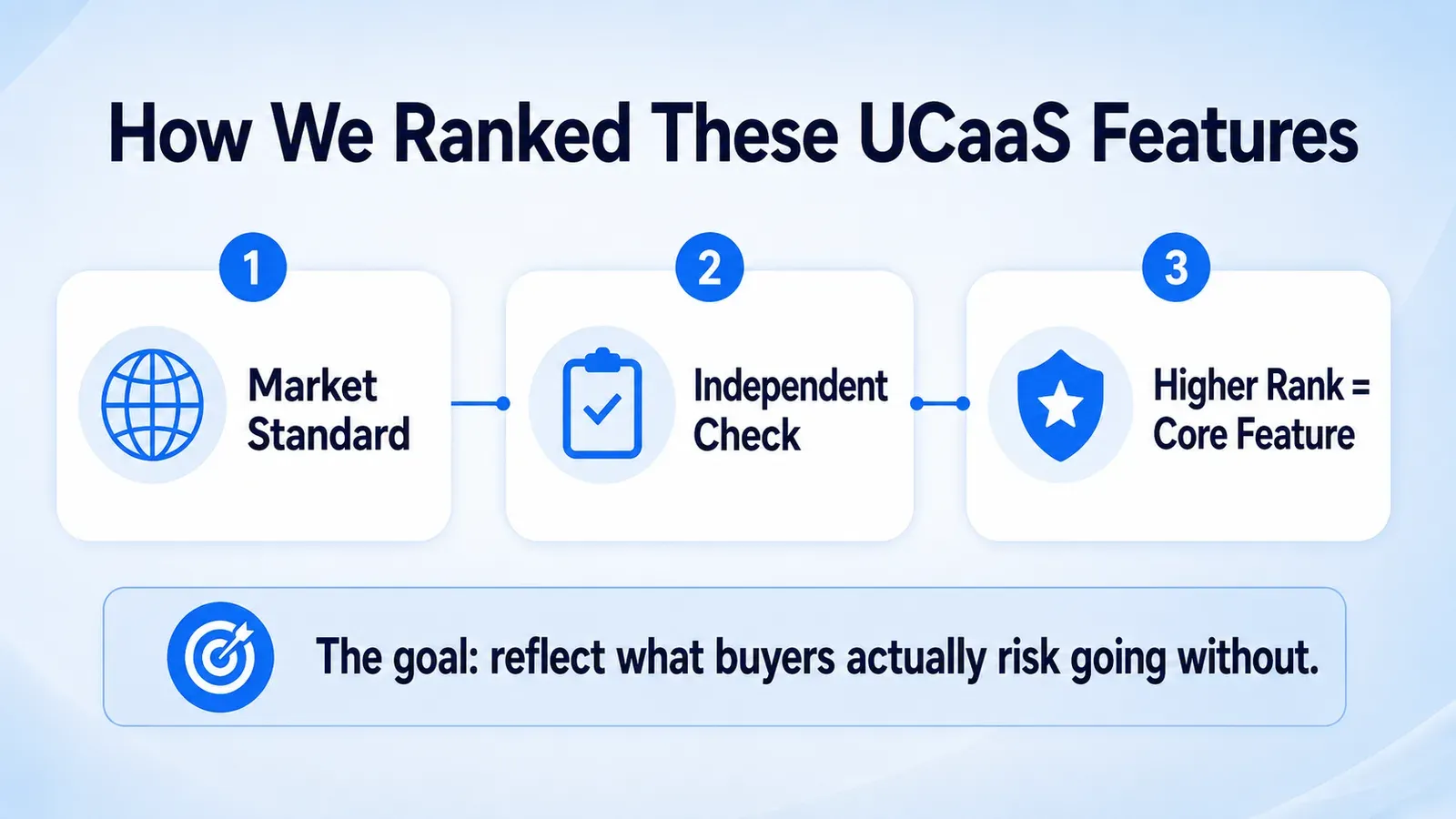
That filters out marketing language on purpose: a feature only one or two vendors push hard ranks lower than one that's become an unspoken baseline across the whole category.
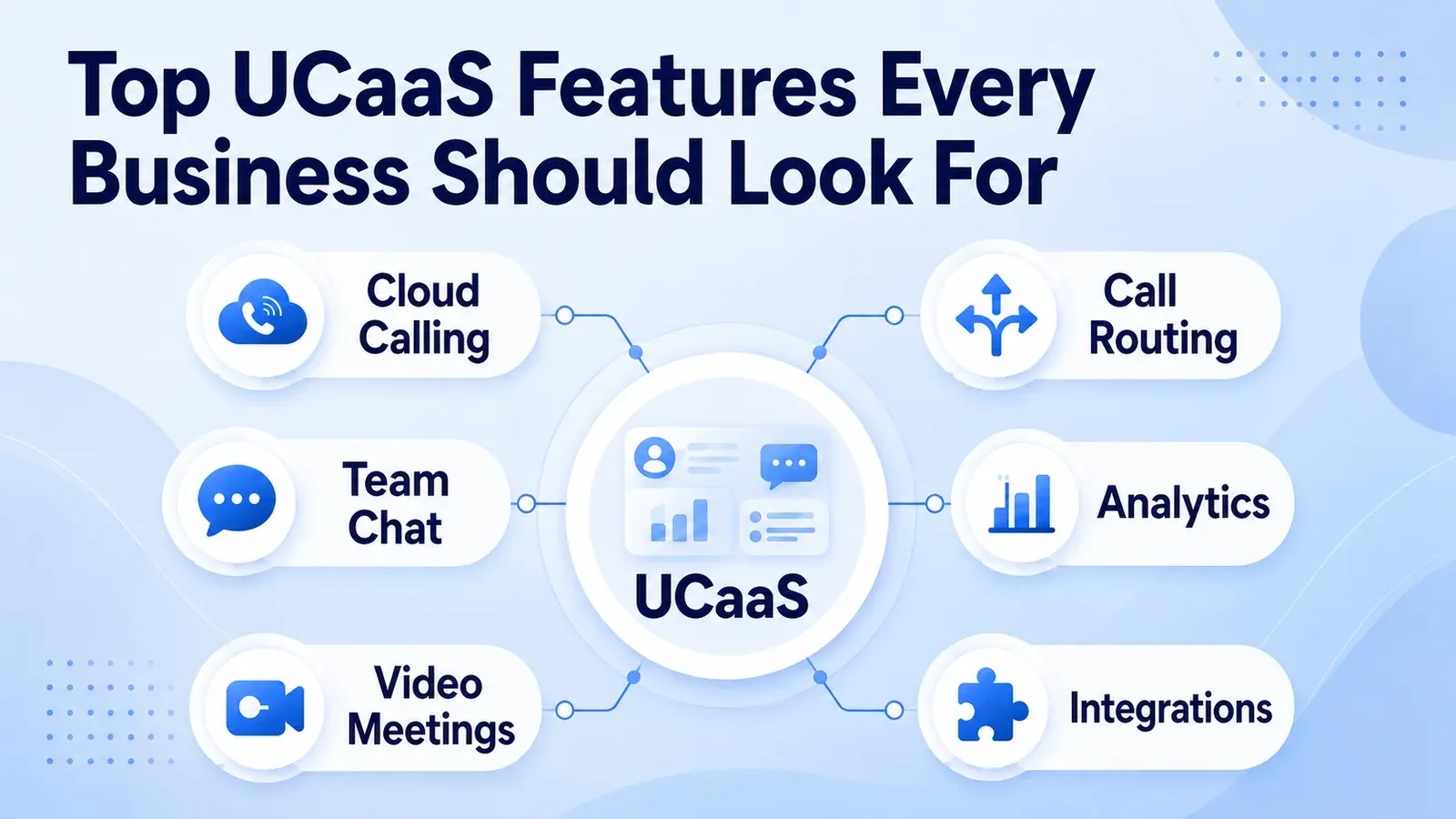
Top 10 UCaaS Features, Ranked
Feature lists read the same on every vendor site, so here's what actually separates a serious UCaaS platform from a phone line with a new coat of paint, ranked by how load-bearing each one is.
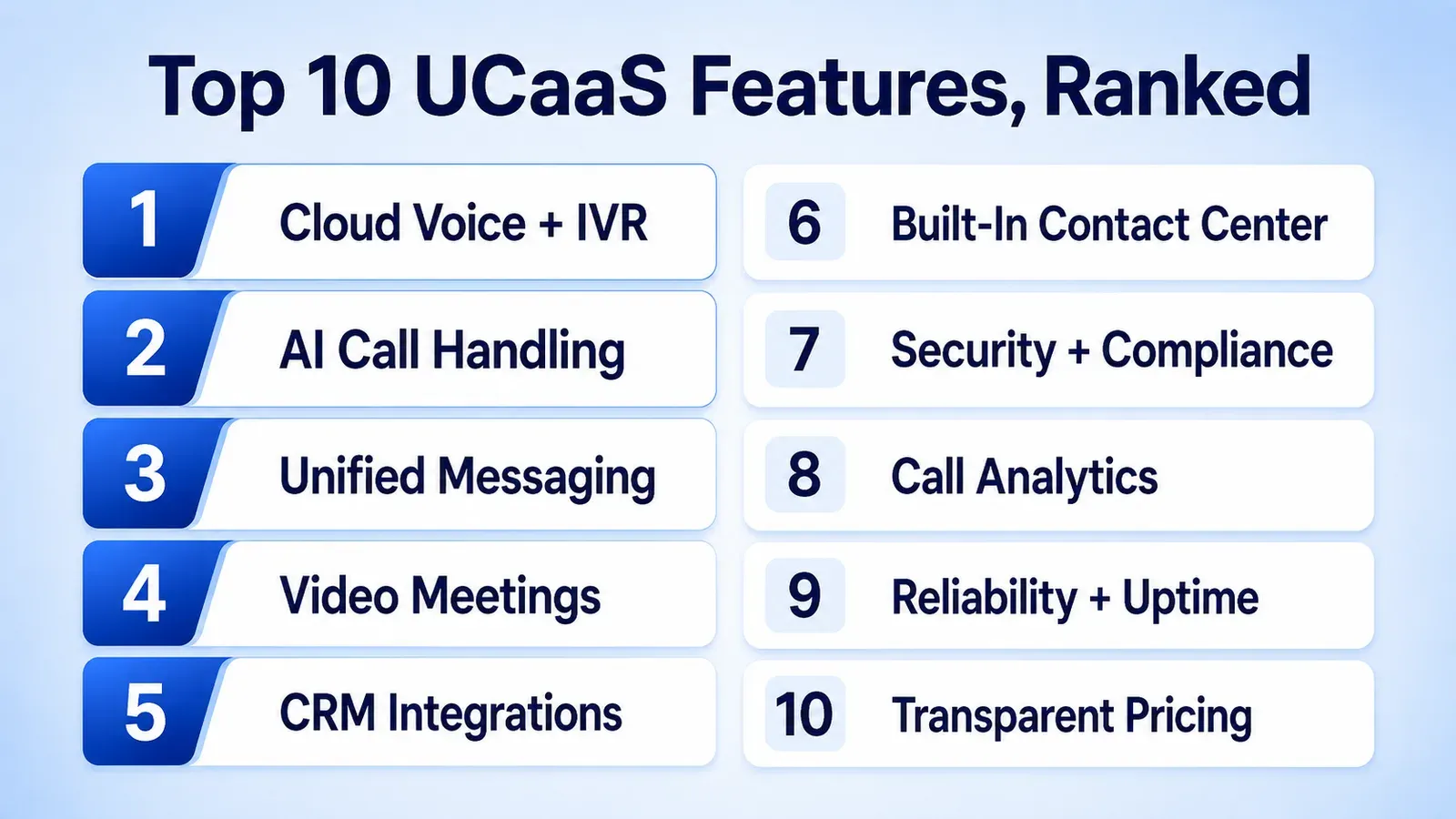
The further down the list, the more a feature tends to be a genuine differentiator rather than a shared baseline — worth reading past the familiar entries at the top.
1. Cloud Voice with Auto-Attendant and IVR
This is the floor, not the differentiator: business phone numbers, extensions, hunt groups, and a multi-level auto-attendant that routes callers by menu choice, business hours, or time zone. Every platform worth shortlisting includes this at every tier, with a visual call-flow builder instead of a config file.
Where platforms actually differ is how fast a non-technical admin can build a working call flow without a support ticket — a drag-and-drop designer that takes minutes beats a technically complete one that needs a telecom background.
2. AI Call Handling
AI has moved from a premium add-on to a base-tier expectation in 2026. That means an AI receptionist that answers calls and books meetings when no one's free, live call transcription, and automatic post-call summaries — not as a separate SKU, but included in the plan a business actually buys.
The gap between vendors here isn't whether AI exists, it's whether it's included standard or gated behind an enterprise tier. A platform that charges extra for AI call handling in 2026 is charging for what's rapidly becoming table stakes.
3. Unified Messaging
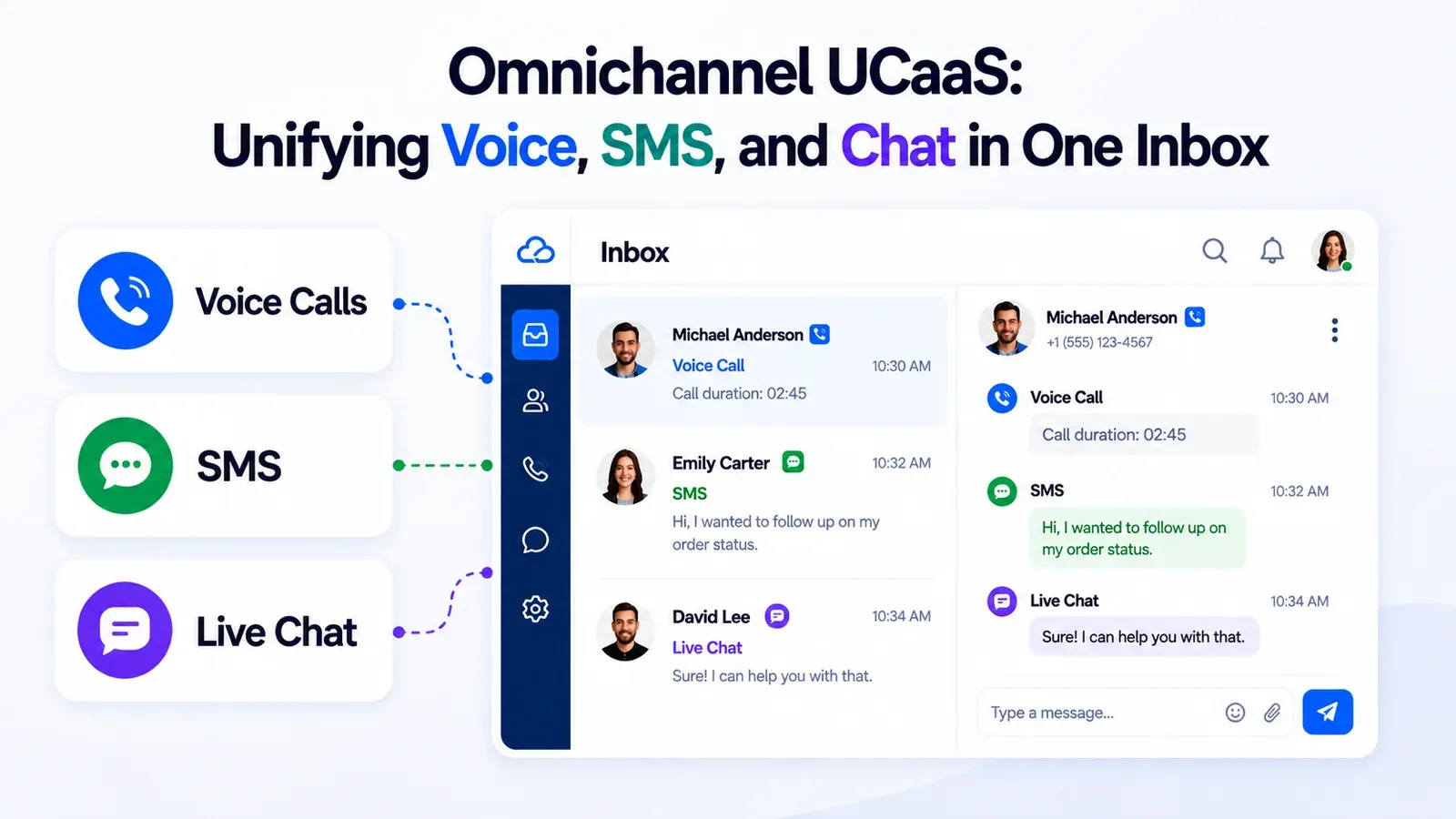
Business SMS and MMS from the same number a business calls from, plus internal team chat, in one inbox instead of two separate apps. Two-way texting needs 10DLC or A2P registration handled by the vendor, not left for the business to sort out with a carrier directly.
The practical test: can a front-desk employee text a customer back from the same number that just called them, without switching tools? If not, that's two products sharing one login, not unified communications.
4. Video Meetings with Easy Join
Browser-based video that a customer or prospect can join with one click, no app download required, matters more than resolution specs most businesses will never max out. HD quality is standard now; frictionless joining for external guests is where platforms actually differ.
Screen sharing, recording, and a reasonable participant cap round this out, but the download-free join experience is the detail that decides whether a client shows up on time or gives up and calls in instead.
5. Native CRM and Business App Integrations
Two-way sync with the CRM a sales or support team already runs — HubSpot, Zoho, Salesforce, Pipedrive — with click-to-call, screen-pop, and automatic call logging. Native integration means no Zapier workaround and no middleware subscription just to log a call.
A platform that only offers integrations through a third-party connector marketplace is pushing that work, and its upkeep, onto the business instead of owning it.
6. Contact Center Capabilities Built In
Skills-based routing, queue management, and omnichannel ticketing for the team that actually handles customer volume — available on the same login as general business calling, not sold as a separate CCaaS product with its own contract and its own admin panel.
This is the feature most likely to get sold as an expensive bolt-on. Platforms that build it into the core product, rather than bolting on an acquired one, tend to keep it cheaper and better integrated.
7. Security and Compliance
STIR/SHAKEN call attestation, encryption on calls and messages, and compliance frameworks like HIPAA-aware configurations for regulated industries need to be part of the platform, not a checklist item the business has to build itself.
10DLC and A2P registration for SMS falls in the same bucket: a vendor that handles this registration on the business's behalf saves weeks of carrier paperwork compared to one that leaves it as a self-service task.
8. Call Analytics and Conversation Intelligence
Every call transcribed, scored, and searchable, with sentiment analysis and topic detection surfacing patterns a manager would otherwise never see across hundreds of calls a week. This is what turns a phone system from a utility into a source of business intelligence.
The useful version of this is queryable, not just archived. Being able to search every call for a specific phrase or objection matters more than a dashboard of averages nobody checks.
9. Reliability and Uptime SLA
Further reading: Wireless solutions for business phone systems
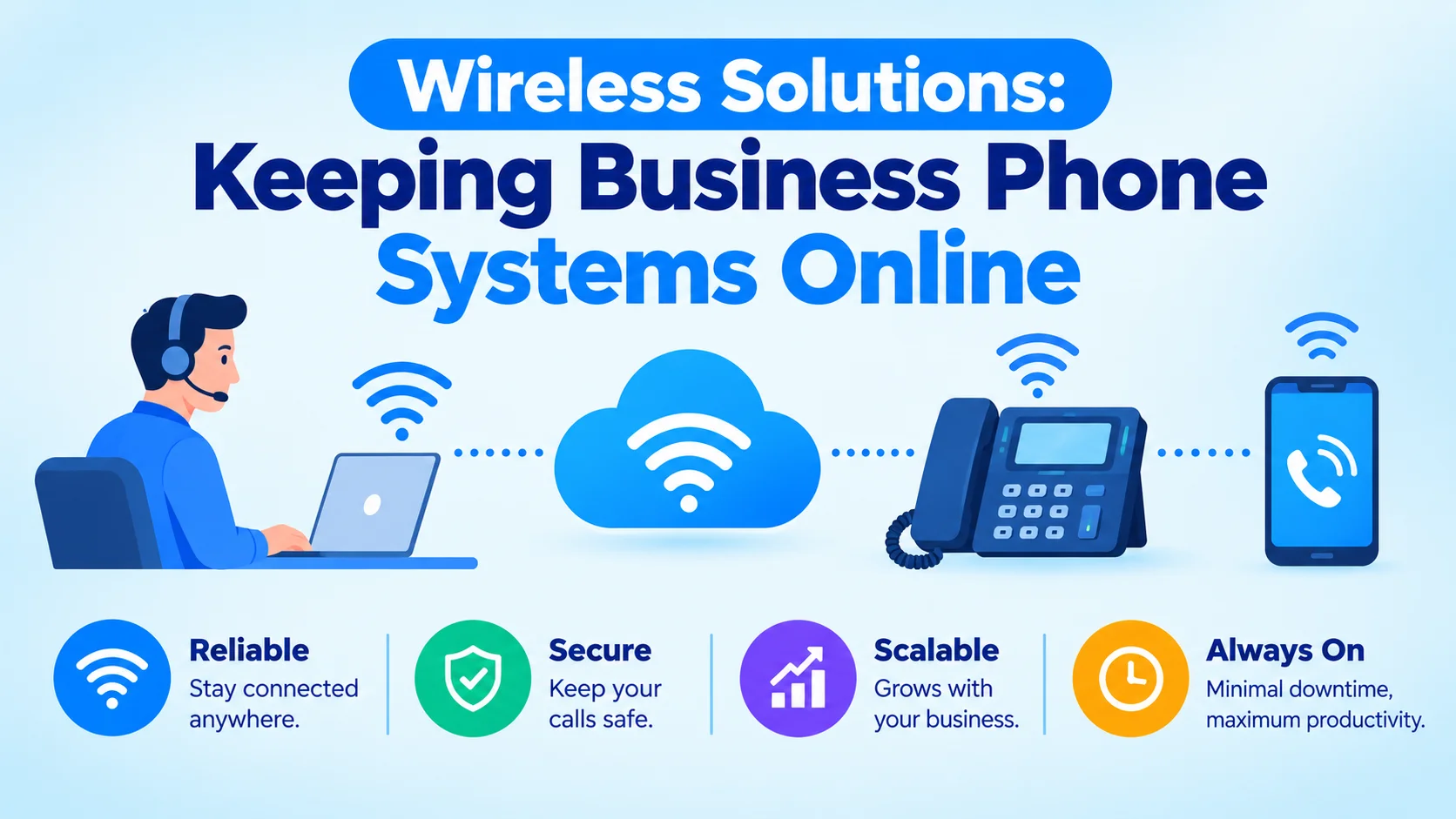
A published uptime SLA of 99.99% or better, backed by real geographic redundancy and automatic failover, not just a number on a pricing page with no infrastructure behind it. Downtime on a phone system means missed revenue, not just an inconvenience.
Ask what happens during a regional outage specifically. A platform with real redundancy can answer in seconds; one without it talks about "best effort."
10. Transparent Per-User Pricing
The advertised per-seat price should be close to the real one. The most common gap between quote and invoice comes from AI features, contact center capability, or advanced analytics getting priced as separate add-ons after the sales call.
This ranks last only because it's not a feature in the technical sense — but it's the one that determines whether every feature above it actually ships in the plan a business signs up for, or gets upsold one at a time after the contract is signed.
UCaaS Features at a Glance
For a quick gut-check against a shortlist, here's the same ranking condensed to what to verify before signing anything.
Each line is phrased as something to confirm rather than a feature name, since "do you have AI" gets a yes from every vendor while "is it included standard" gets the answer that actually matters.
- Cloud voice and IVR — confirm a visual call-flow builder, not just menu depth.
- AI call handling — confirm it's included standard, not an Enterprise-only add-on.
- Unified messaging — confirm SMS and calling share the same number and inbox.
- Video meetings — confirm external guests can join with no app download.
- CRM integrations — confirm native two-way sync, not a third-party connector marketplace.
- Contact center — confirm it's the same login as general calling, not a separate product.
- Security and compliance — confirm STIR/SHAKEN and 10DLC/A2P are handled by the vendor.
- Analytics — confirm calls are searchable by phrase, not just summarized in a dashboard.
- Uptime SLA — confirm the redundancy behind the number, not just the number itself.
- Pricing — confirm the quoted price already includes AI and contact center features.
Treat this as a live-demo checklist, not just a reading exercise — asking a sales rep to confirm each line directly surfaces gaps faster than the fine print does.
Table Stakes vs. Real Differentiators in 2026
Further reading: UCaaS and a contact center
Cloud voice, video, and basic messaging stopped being differentiators years ago — virtually every platform on the market offers all three at every tier. The features that actually separate vendors in 2026 are the ones further down this list.
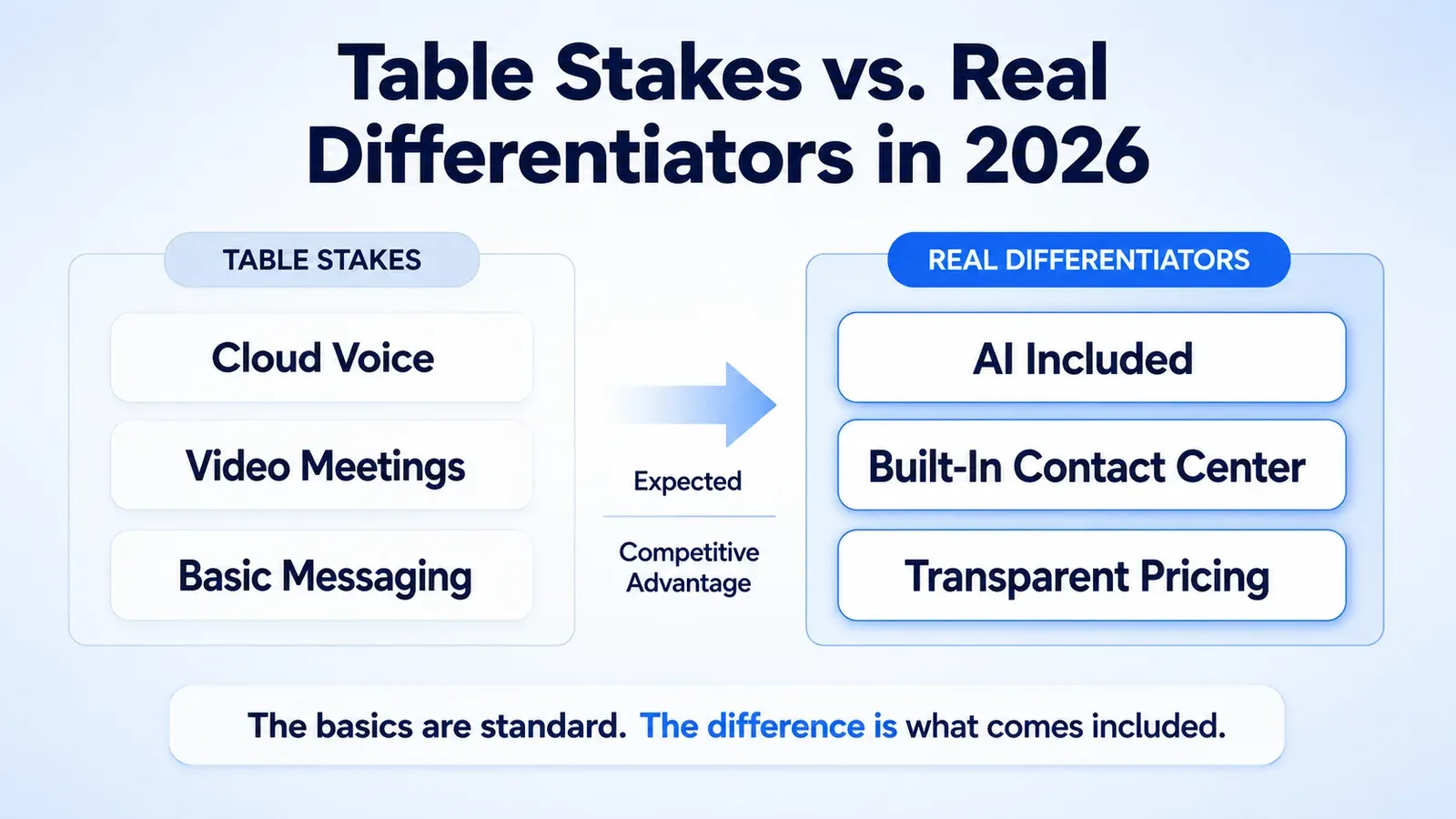
AI included at the base tier, native contact center capability instead of a bolted-on second product, and pricing that doesn't quietly grow between quote and invoice — those three are where the real gap shows up now. Everything else has become close to standard.
How Twiching Covers This Checklist
Further reading: FCC STIR/SHAKEN overview
Twiching runs all ten of these as standard, not staged behind upsells: cloud voice with a visual IVR builder, an AI receptionist and call transcription included on every plan, SMS and team chat from the same login as calling, browser-based video with no-download join, native HubSpot, Zoho, and Pipedrive sync, and contact center routing and queues on the same account as general business calling.
That's backed by STIR/SHAKEN verified calling, a 99.99% uptime SLA, searchable call analytics with sentiment scoring, and per-user pricing that already includes the AI and contact center features other vendors charge extra for. The checklist above isn't hypothetical — it's the list this platform was built against.
Conclusion
Every UCaaS platform's marketing page reads the same, which is exactly why this ranking is built around what ships by default, not what's technically offered somewhere in the pricing table. Cloud voice, video, and messaging are the floor every serious platform clears now, so they're not what should decide a shortlist.
The real gap in 2026 opens up further down this list: AI included standard, contact center capability built into the core product, and pricing that doesn't quietly grow between the quote and the invoice. Run any vendor through all ten before signing, and the difference between a strong platform and an average one gets obvious fast.