Introduction
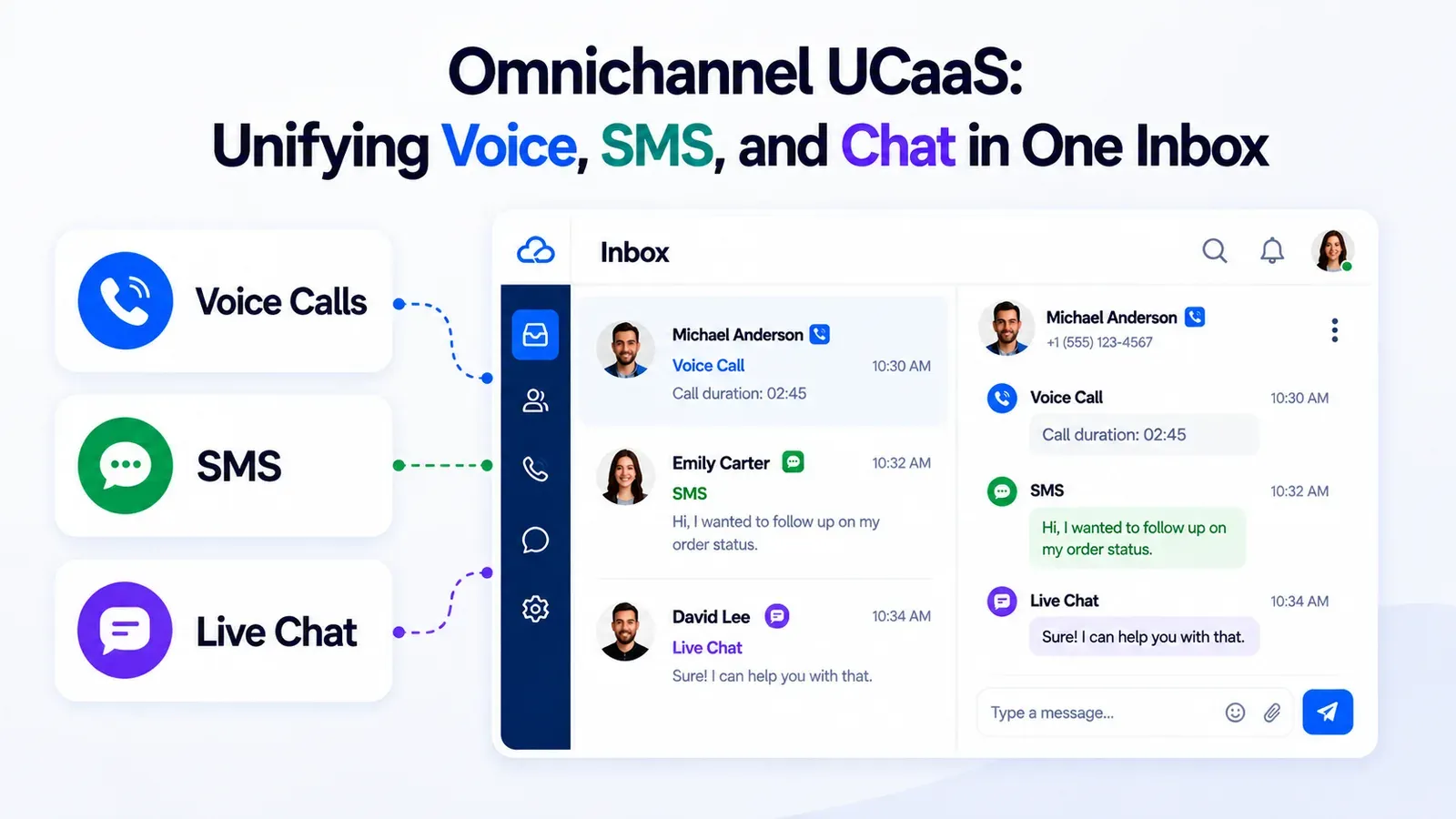
Most platforms that call themselves "omnichannel" just mean they support several channels — not that those channels actually share one inbox. Voice, SMS, and chat each get their own tab, their own notification badge, and often their own separate conversation history for the same customer.
That's multichannel, not omnichannel, and the difference matters the first time a customer calls about a text they already sent and the agent has no idea it exists. This guide ranks the ten capabilities that actually determine whether an inbox is unified or just several channels sharing a login, scored on whether each one holds up under a real cross-channel conversation.
How We Ranked These Capabilities
Further reading: UCaaS platform
This ranking is built by cross-checking what RingCentral, Nextiva, 8x8, Dialpad, and GoTo Connect actually ship for cross-channel unification — not just which channels appear on a features page, but whether those channels genuinely share one thread, one number, and one context. A capability ranks higher the more it determines whether an inbox is truly unified versus several channels bundled under one login.
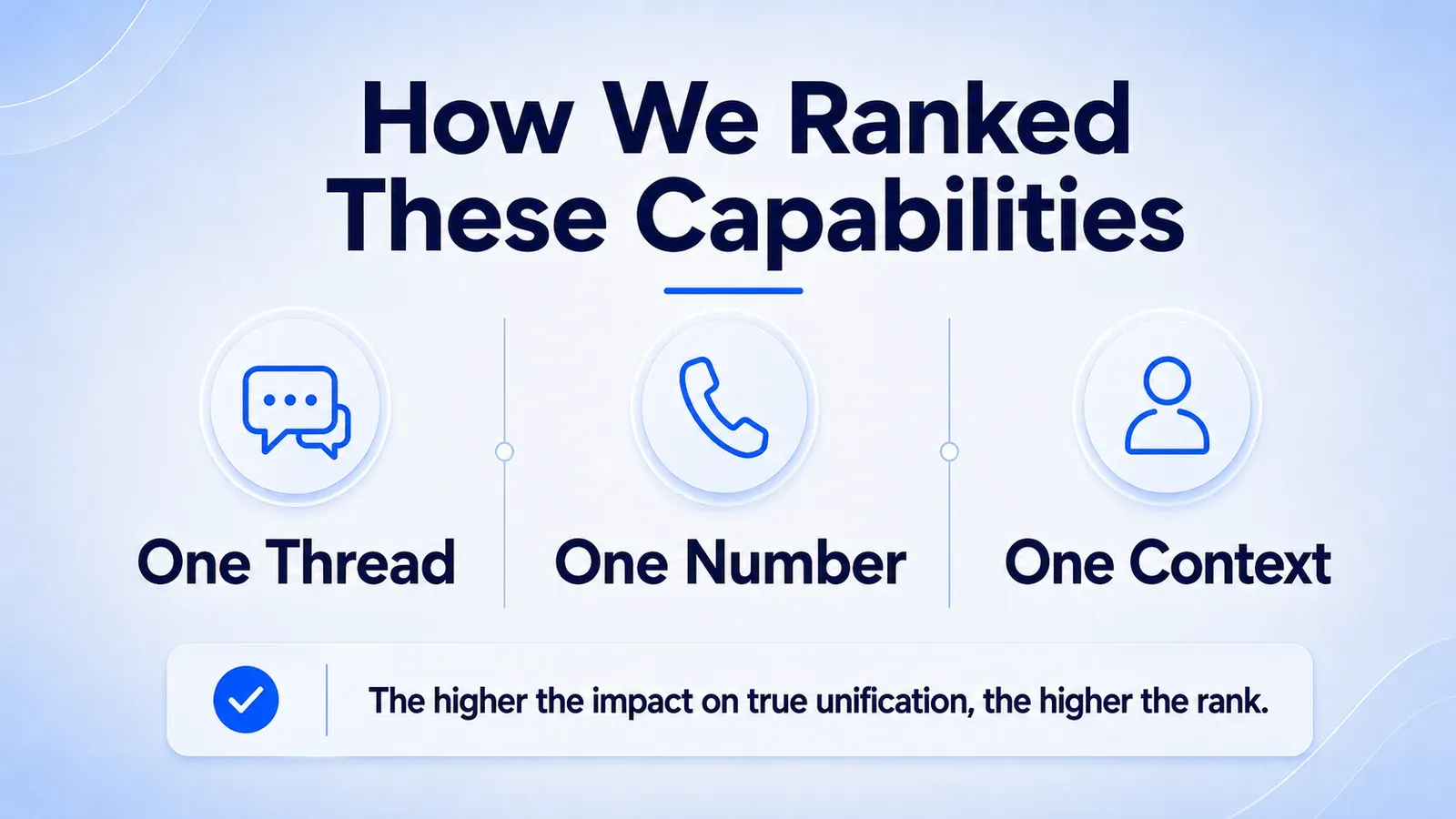
That distinction is the whole point of this list — plenty of vendors list voice, SMS, and chat on one pricing page without those channels ever actually talking to each other behind the scenes.
Top 10 Omnichannel UCaaS Capabilities, Ranked
Here's what actually separates a unified inbox from a pile of channels with a shared bill, ranked by how much each one determines whether "omnichannel" is real or marketing.
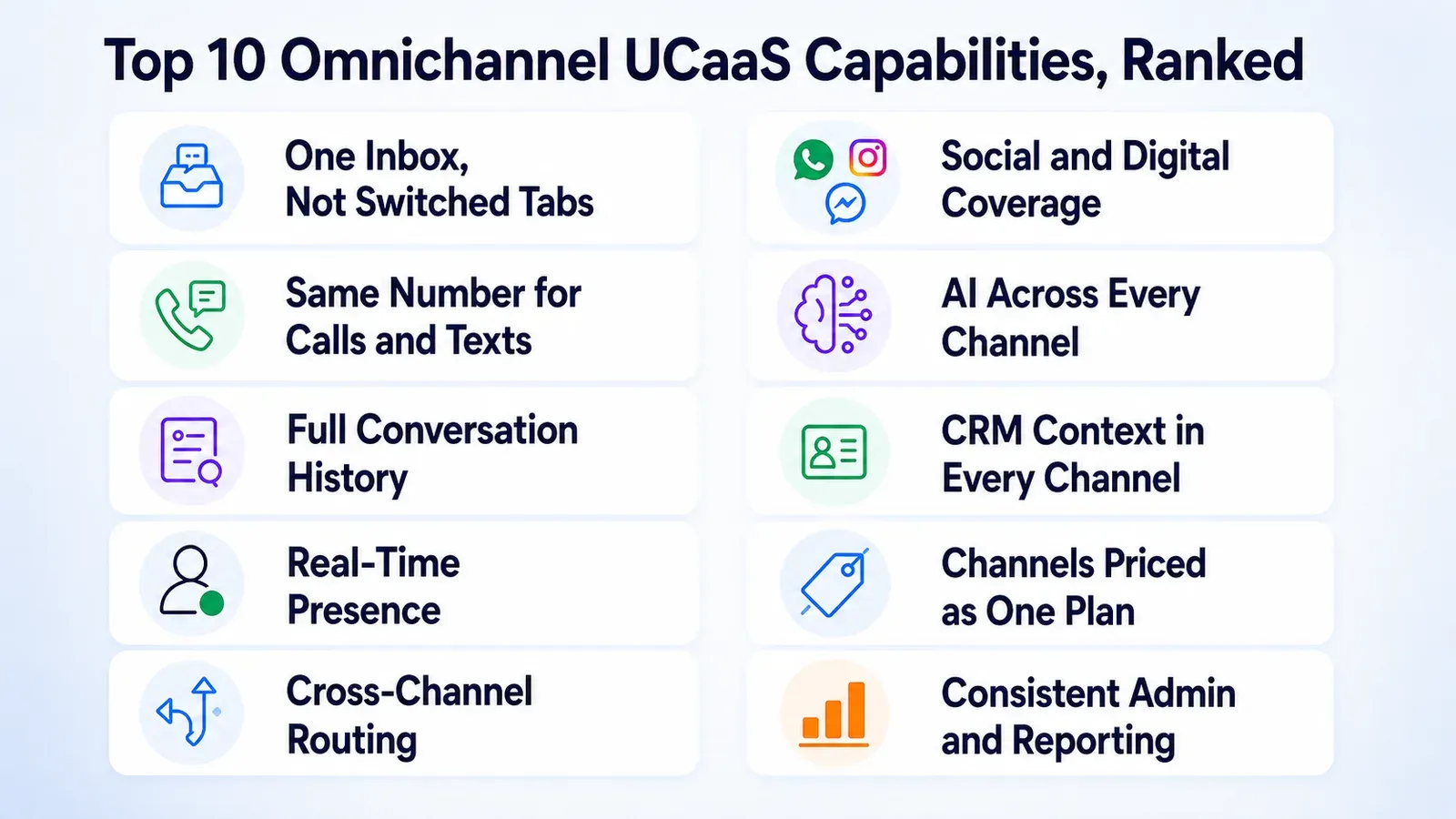
The first few entries are close to non-negotiable; further down, each one functions more as a real differentiator between an average platform and a well-built one.
1. One Inbox, Not Switched Tabs
The test that matters most: does a call, a text, and a chat message from the same customer land in one thread, or three separate ones an agent has to click between? A real unified inbox shows the whole conversation — voice, SMS, chat — as one continuous history, not three parallel logs that happen to share a login screen.
Plenty of platforms market "omnichannel" while running each channel as its own module with its own interface bolted on. The giveaway is usually a separate app or tab per channel.
2. Same Number for Calls and Texts
Voice and SMS sharing one business number is the foundation everything else depends on. If a customer calls a number and texts a different one, there's no way to unify that history in the first place — the identity itself is already split before any inbox software gets involved.
This sounds basic, but it's still a real differentiator — some platforms provision SMS on a separate short code rather than the line customers already call, breaking unification at the source.
3. Full Conversation History Across Channels
Further reading: Zendesk CX Trends Report
An agent picking up a call should see the SMS thread, the chat transcript, and every prior voice call with that customer, not just the channel currently ringing. Context carryover across channels is what actually saves the "please repeat everything you already told us" moment that damages customer experience.
The practical test: switch channels mid-conversation with a test contact and see whether the history follows. If a chat escalates to a phone call and the agent taking it can't see the chat that just happened, the channels aren't really unified.
4. Real-Time Presence Across Channels
Availability status should be one signal, not per-channel. An agent who's on a call should show busy for chat too, not accidentally get pinged on three channels at once because presence isn't shared across the platform.
This matters more as team size grows. A five-person team can manage presence manually; a fifty-person team needs the system enforcing it, or two agents end up answering the same customer at once.
5. Cross-Channel Routing and Escalation
A chat that needs a phone call, or a call that needs a follow-up text, should route to the same agent or queue without the customer repeating themselves to someone new. Escalation paths that cross channels but stay within the same conversation are what separates omnichannel routing from channel-specific routing that happens to live under one brand.
Routing that only works within one channel — voice routing that ignores which agent already has the chat open — reintroduces the exact silo problem omnichannel is meant to solve.
6. Social and Digital Channel Coverage
WhatsApp, Instagram DMs, Facebook Messenger, and website chat widgets increasingly count as first-class channels alongside voice and SMS, not afterthoughts bolted onto a contact center tier. Customers expect to reach a business wherever they already are, and a platform that treats social channels as a separate add-on undercuts the whole premise of "one inbox."
Coverage matters less than consistency — five channels reporting into one thread beat ten each living in a separate silo.
7. AI Applied Across Every Channel, Not Just Voice
Transcription, sentiment scoring, and summarization are common on voice calls now, but the same intelligence layer should apply to chat and SMS conversations too. A platform that only analyzes calls is treating text-based channels as second-class, even while marketing itself as fully omnichannel.
This shows up in reporting: if sentiment trends only cover phone calls, a growing share of customer interactions — the ones over chat and SMS — stay invisible to the business.
8. CRM Context Injected Into Every Channel
Customer history, open tickets, and recent purchases should appear automatically regardless of which channel a conversation starts on. A chat from a known customer should surface the same context a call would.
Platforms that only pull CRM data into the voice interface are half-solving this — the agent working a chat queue is working blind compared to the one answering phones.
9. Channels Priced as One Plan, Not Separate Modules
A recurring pattern in the market: voice, SMS, and chat get sold as add-on modules stacked on top of a base plan, each with its own per-seat cost, rather than bundled as one omnichannel license. That pricing structure is a strong tell that the channels aren't architecturally unified either — separate billing usually mirrors separate backend systems.
Ask directly whether SMS and chat are included in the quoted price or billed as additions — the answer usually predicts how unified the inbox actually is.
10. Consistent Admin and Reporting Across Channels
One dashboard for queue performance, response times, and volume across voice, SMS, and chat — not three separate reporting views an admin has to reconcile manually. Channel-siloed reporting makes it hard to see the real picture of how a team is actually spending its time across a day.
This is the capability most likely to get deprioritized, since it doesn't show up on a sales demo the way a shared inbox does. It's also what determines whether a manager can run the team, or just monitor three systems that share a login.
Omnichannel Capabilities at a Glance
A quick checklist to run any platform through before assuming "omnichannel" means what it should.
Each item is phrased as something to confirm rather than a feature name a vendor can simply claim to have — the confirmation is what actually separates a unified inbox from three channels sharing a login.
- One inbox — confirm voice, SMS, and chat show as one thread, not three tabs.
- Shared number — confirm calls and texts use the same business number.
- Cross-channel history — confirm an agent sees prior channels, not just the current one.
- Shared presence — confirm availability status is one signal across every channel.
- Cross-channel escalation — confirm a chat can become a call without losing context.
- Social coverage — confirm WhatsApp, social DMs, and web chat report into the same thread.
- Channel-wide AI — confirm transcription and sentiment apply to chat and SMS, not just calls.
- CRM context everywhere — confirm customer history appears on every channel, not just voice.
- Bundled pricing — confirm SMS and chat are included, not billed as separate add-ons.
- Unified reporting — confirm one dashboard covers every channel, not three separate views.
Run this against a live demo, not a spec sheet — asking a rep to prove each line with a real cross-channel conversation surfaces the gap faster than any comparison chart.
The Real Test: Modules vs. a Genuinely Unified Inbox
The clearest signal in the market right now: many established platforms still treat channels as modules a business assembles and pays for individually, rather than one inbox that happens to carry voice, SMS, and chat. That shows up on the pricing page before it shows up in the product.
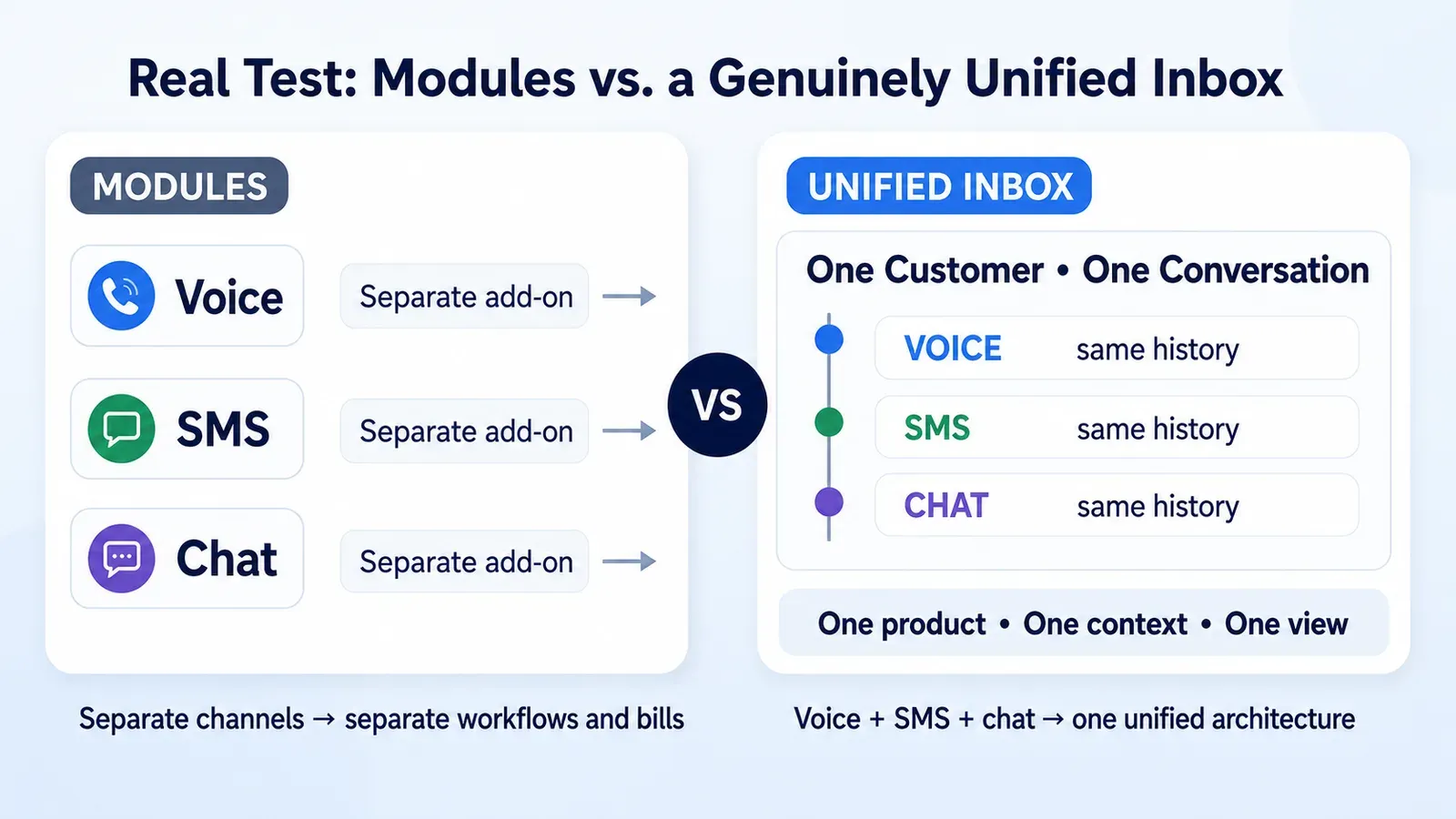
A newer generation folds voice, SMS, and AI into a single view by default, where extra channels stop feeling like extra bills and start feeling like one product — the practical difference between omnichannel as an architecture and as a marketing label.
How Twiching Approaches Omnichannel
Further reading: omnichannel queues
Twiching runs voice, SMS, and team chat from the same number and the same login by default — not as separate modules with separate per-seat pricing. A conversation that starts as a text and escalates to a call stays in one thread, with the same customer context available to whichever agent picks it up.
AI transcription, sentiment scoring, and summarization apply across calls and messages alike, and omnichannel queues route voice, SMS, and chat through the same skills-based logic instead of three separate routing systems. Reporting reflects that too — one dashboard for queue performance and volume across every channel, not three.
Conclusion
"Omnichannel" gets used loosely enough that it's stopped meaning much on its own. The real question is whether voice, SMS, and chat share one inbox, one number, and one context — or just one invoice while running as separate systems underneath.
Run any platform through the ten capabilities above before trusting the label. Start with the simplest test: does the conversation history actually follow the customer across channels, or does someone have to ask what happened somewhere else.