Introduction
The wholesale VoIP switch is the routing engine at the centre of every carrier voice platform — it applies LCR routing, generates CDRs, and fails over in milliseconds when an interconnect degrades. This guide explains how a modern Class 4 softswitch works and what a credible switch must do in 2026, and how Twiching's cloud-native softswitch delivers carrier-grade capacity without legacy TDM hardware.
What a Wholesale VoIP Switch Actually Is
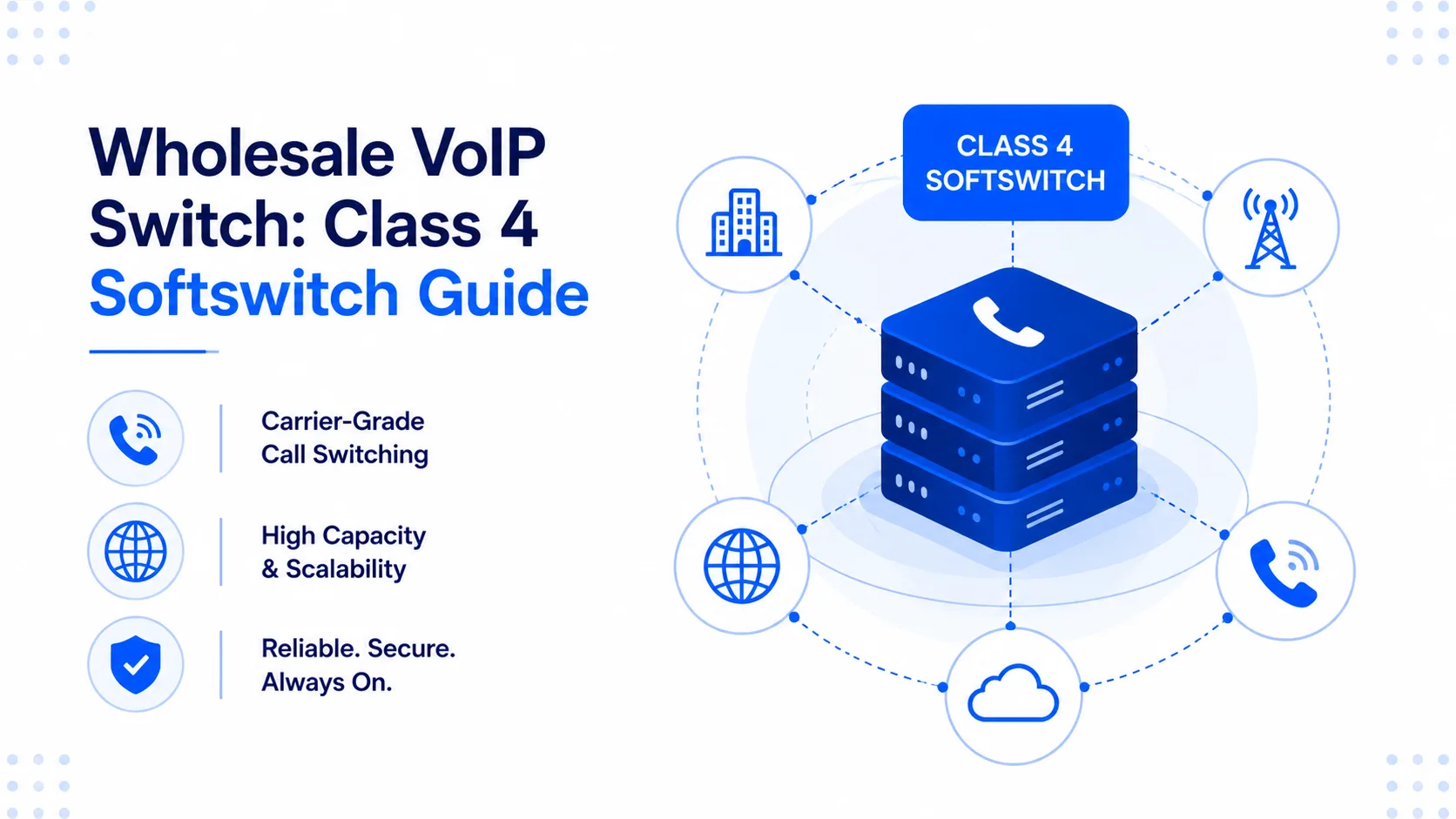
A wholesale VoIP switch — almost always a Class 4 softswitch — is the SIP routing engine at the core of a carrier voice platform. On every call, it performs a consistent sequence of steps.
- Receives inbound SIP calls from customers.
- Applies LCR routing logic against a live rate deck.
- Selects the best upstream path.
- Forwards the call.
- Generates CDRs for billing.
- Manages failover across alternative carriers in real time.
Everything else in a wholesale VoIP platform — provisioning, rating, fraud detection, dashboards — exists to feed or consume the softswitch.
Unlike a Class 5 softswitch (which handles retail subscriber features like voicemail and hunt groups), a wholesale VoIP softswitch is built for carrier-to-carrier traffic. Concurrent call capacity, route quality, and CDR accuracy matter more than end-user features. The wholesale VoIP switch is the engine; SIP termination is the output.
Class 4 vs. Class 5 Softswitch — Why It Matters
Further reading: Wholesale pricing & rate deck
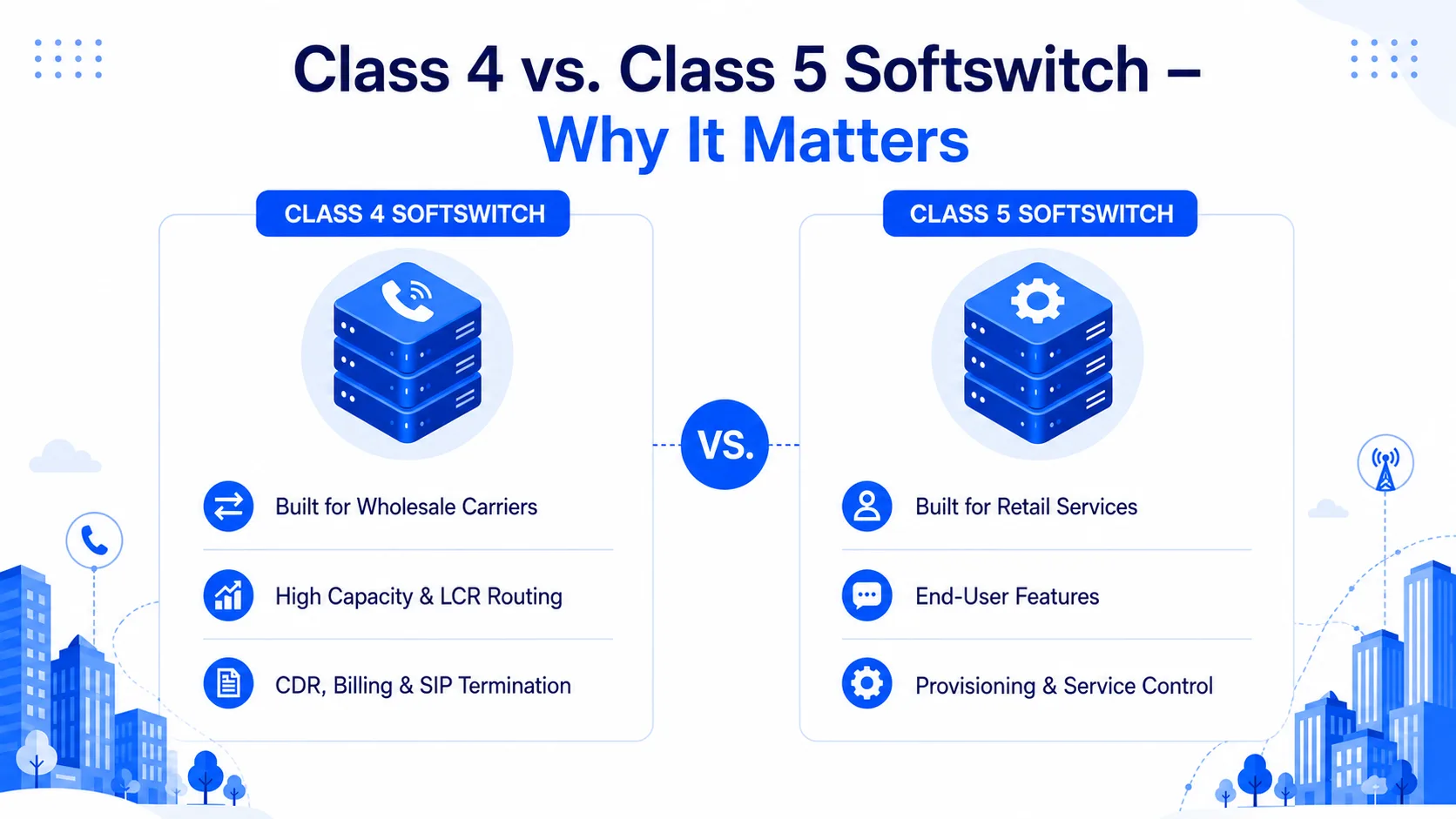
A Class 4 softswitch routes high-volume wholesale traffic between networks: ITSPs, contact-centre platforms, and other carriers. A Class 5 softswitch serves retail subscribers and handles UC features.
Wholesale operators use Class 4; retail providers use Class 5. Some platforms layer both, but the wholesale VoIP switch sitting at the core is always Class 4.
The distinction matters because the engineering trade-offs are different. A Class 4 wholesale VoIP softswitch optimises for raw concurrent call capacity, sub-millisecond LCR routing decisions, and rock-solid CDR generation.
A Class 5 prioritises feature richness and per-subscriber state. Buying a wholesale VoIP switch built on the wrong class is a slow, expensive mistake.
LCR Routing and the SIP Routing Engine
Least-cost routing (LCR) is the brain of any wholesale VoIP switch. For every inbound call, the SIP routing engine follows a consistent sequence.
- Looks up the destination prefix.
- Consults the live rate deck across all upstream carriers.
- Applies quality filters (minimum ASR, maximum PDD).
- Picks the best available path.
Modern wholesale VoIP platforms layer in real-time quality scoring so degraded routes get demoted automatically instead of waiting for the next manual review.
AI-driven LCR routing is the natural evolution. Instead of pure cost ordering, the wholesale VoIP switch learns which carriers degrade at which times of day and pre-emptively rebalances. The result is consistently higher ASR on the same set of upstream contracts, which translates directly into healthier margins for the wholesale VoIP solution underneath.
CDR Generation and Softswitch Billing
Further reading: Wholesale VoIP platform
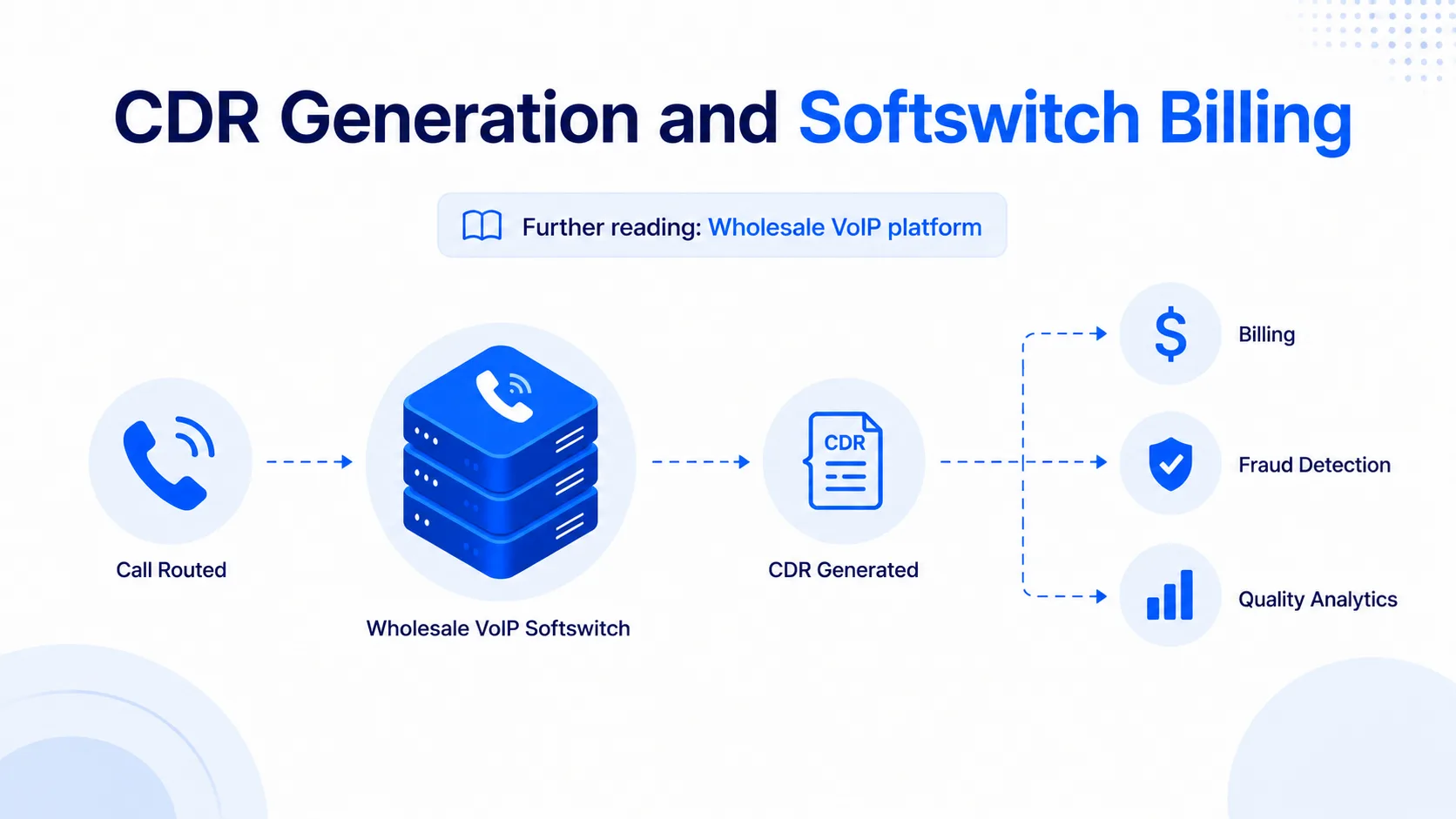
Every call routed through a wholesale VoIP switch produces a CDR (call detail record) — a structured row capturing source, destination, duration, codec, route, and rate. CDRs feed billing, fraud detection, and quality analytics.
A wholesale VoIP softswitch that batches CDRs hourly is already a generation behind. Modern platforms stream them in real time so spend caps and IRSF detection can react inside the call window, not after.
Softswitch billing accuracy is where a lot of wholesale VoIP switch implementations quietly leak money. Wrong billing increments, missed connection charges, or rounding errors compound across millions of calls. A carrier-grade softswitch reconciles CDRs against the rate deck on every call and exposes the math to customers through real-time dashboards and APIs.
Concurrent Call Capacity and Scalability
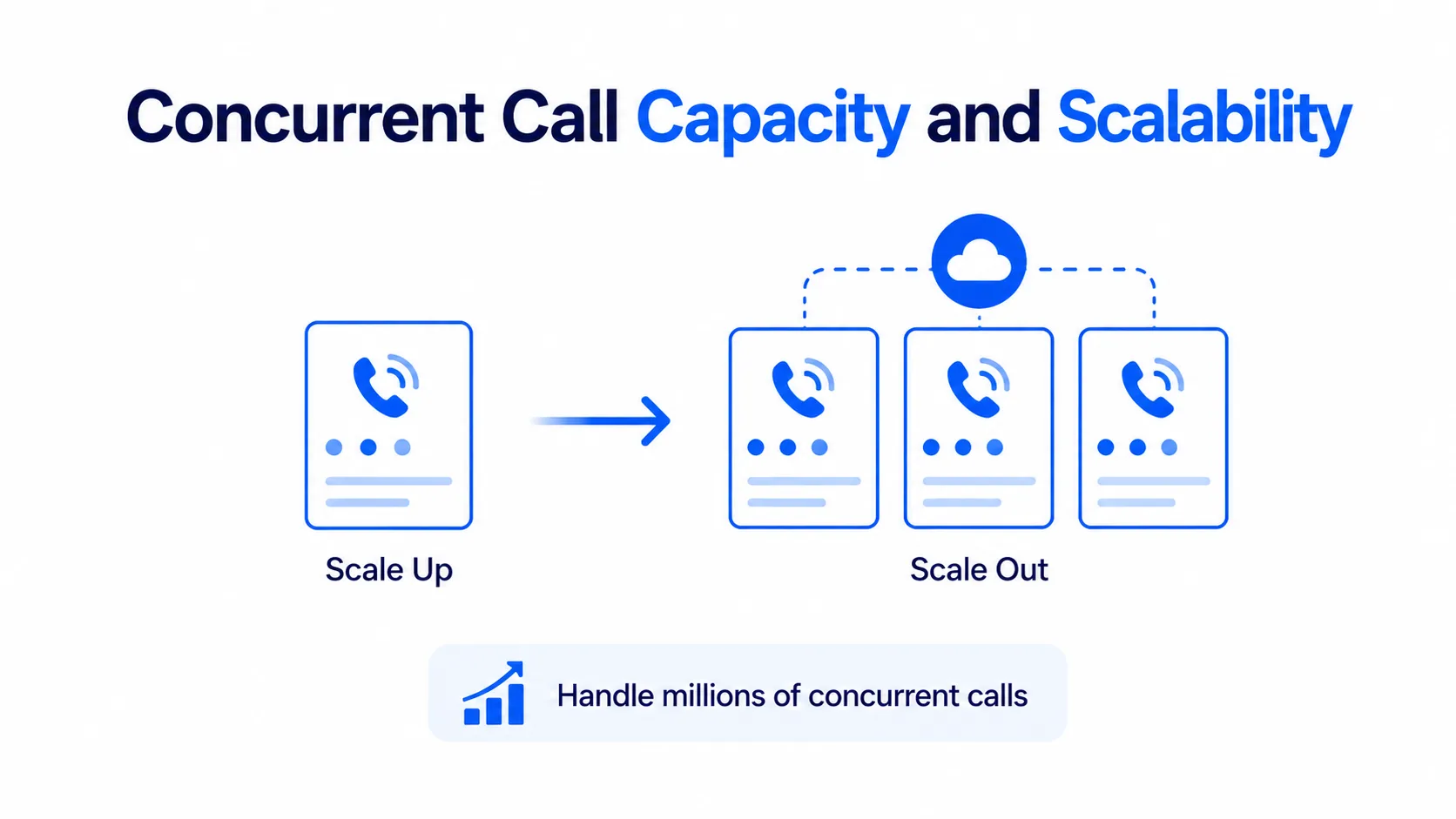
Legacy TDM switches were sized in concurrent channels and capped in hardware. A cloud-native wholesale VoIP switch scales horizontally — adding capacity is a matter of spinning up another softswitch instance, not racking a new chassis. Modern wholesale VoIP softswitch platforms handle millions of concurrent calls across distributed infrastructure, with capacity expansion measured in minutes.
This elasticity matters precisely when the business cares most — Black Friday calling campaigns, political-event surges, contact-centre seasonality. A wholesale VoIP platform stuck on hardware sizing has to pre-provision for the peak or accept blocked calls. A cloud-native carrier-grade softswitch absorbs the spike, then scales back down.
STIR/SHAKEN Attestation Inside the Switch
For any wholesale VoIP switch handling US-bound traffic, STIR/SHAKEN attestation is now embedded in the call flow. The softswitch signs outbound calls with the appropriate attestation level (A, B, or C) based on the customer's KYC posture.
Downstream carriers then verify the signature before completing the call. A-attested traffic gets higher ASR, fewer spam labels, and better acceptance.
A wholesale VoIP switch without integrated STIR/SHAKEN handling forces customers to bolt on signing externally — operationally messy, often broken, and quietly costing connection rates. Twiching's softswitch handles attestation natively, with reporting visible in the same dashboard as ASR and CDR data.
Should You Build a Wholesale VoIP Switch or Partner?
Further reading: Wikipedia: VoIP overview
Building a wholesale VoIP switch from scratch is a multi-year engineering programme.
- Softswitch software
- Hardware sizing
- NOC staffing
- Carrier interconnect negotiations
- Billing reconciliation
- Regulatory compliance per market
Most operators who try it underestimate the operational load by an order of magnitude.
For ITSPs, resellers, and platform companies, the better answer is almost always partnering with a wholesale VoIP switch provider. That provider already owns the carrier-grade softswitch, interconnects, and NOC.
SIP trunks plug in, CDRs stream out, and the customer focuses on the application layer where their margin actually lives. Only operators with serious carrier ambitions should consider building their own wholesale VoIP softswitch.
Twiching's Wholesale VoIP Switch Platform
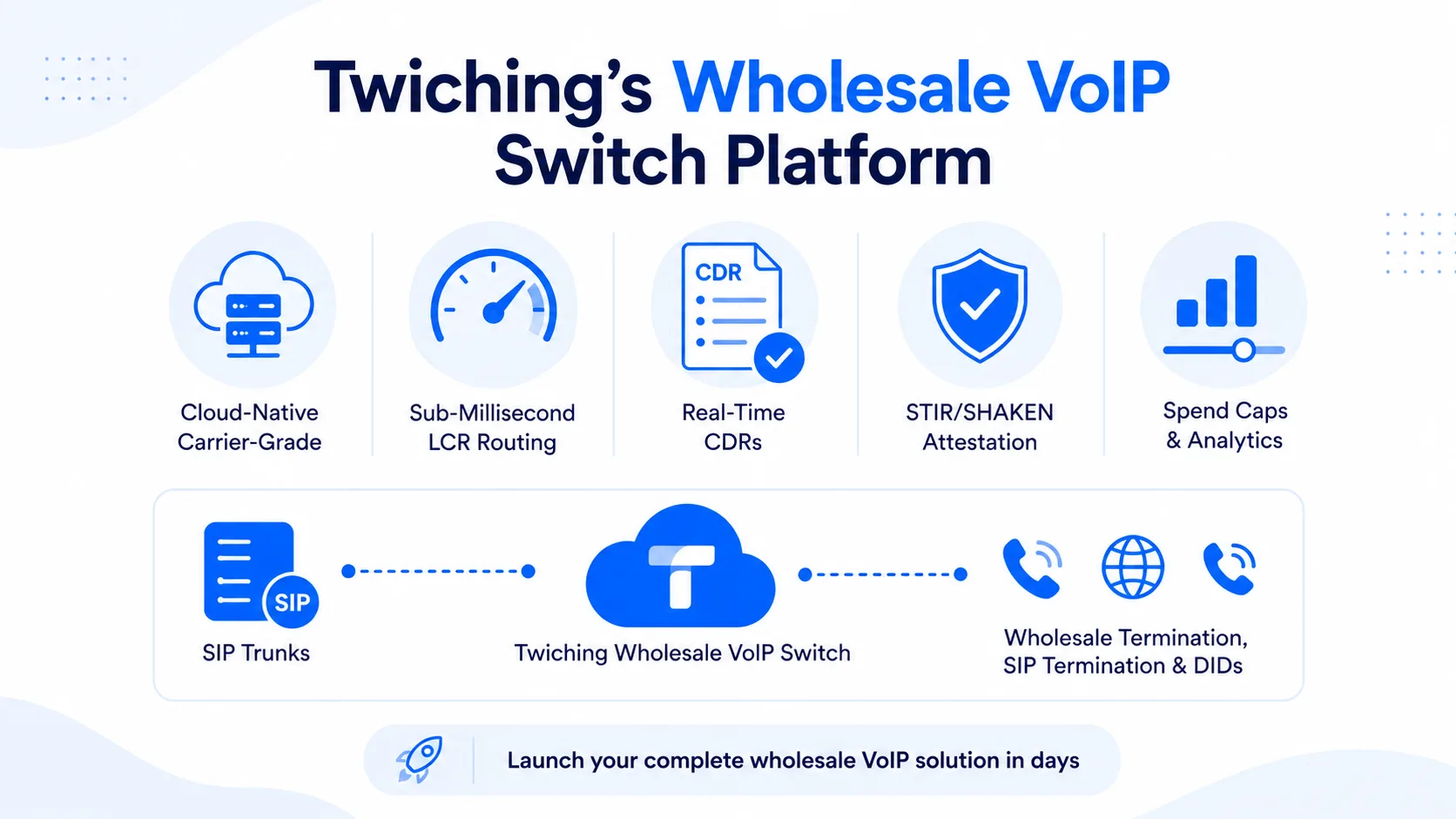
Twiching operates a cloud-native carrier-grade softswitch across multiple regions, sized for millions of concurrent calls and engineered for sub-millisecond LCR routing decisions. The wholesale VoIP platform exposes real-time CDRs, per-route ASR/ACD scoring, STIR/SHAKEN attestation, and configurable spend caps through both a dashboard and a REST API.
Customers connect with standard SIP trunks — no softswitch deployment, no carrier interconnect negotiations, no 24/7 NOC staffing required. The same wholesale VoIP switch handles wholesale termination, SIP termination services, and inbound DIDs on a single billing account.
That lets partners launch a complete wholesale VoIP solution in days. The platform combines VoIP switch software, a wholesale switch for VoIP traffic, and a tuned softswitch for telecom carriers — without forcing customers to integrate three vendors.
Evaluation Checklist for a Wholesale VoIP Switch
- 01Architecture — Class 4 softswitch built for carrier-to-carrier traffic, not retail features.
- 02Routing — LCR with live ASR/PDD quality filters, ideally with AI-driven LCR routing.
- 03Capacity — cloud-native horizontal scaling, not hardware-sized concurrent call channels.
- 04CDRs — real-time streaming with API access, not hourly or daily batches.
- 05Attestation — STIR/SHAKEN signing integrated in the softswitch billing path.
- 06Operations — 24/7 NOC with 15-minute critical response, named escalation contacts.
- 07Interconnects — direct Tier 1 routes, transparent on which carriers serve which destinations.
Conclusion
A wholesale VoIP switch is the carrier-grade softswitch sitting underneath every serious wholesale VoIP platform — Class 4 routing, real-time CDR billing, integrated STIR/SHAKEN attestation, and cloud-native horizontal scaling are the non-negotiables. Building one in-house is a multi-year programme most operators should avoid; partnering with a wholesale VoIP switch provider that already runs the softswitch and the interconnects is faster, safer, and almost always cheaper. Twiching delivers that wholesale VoIP softswitch on a single platform, so customers can focus on the wholesale VoIP solution they sell instead of operating the carrier underneath it.