Introduction
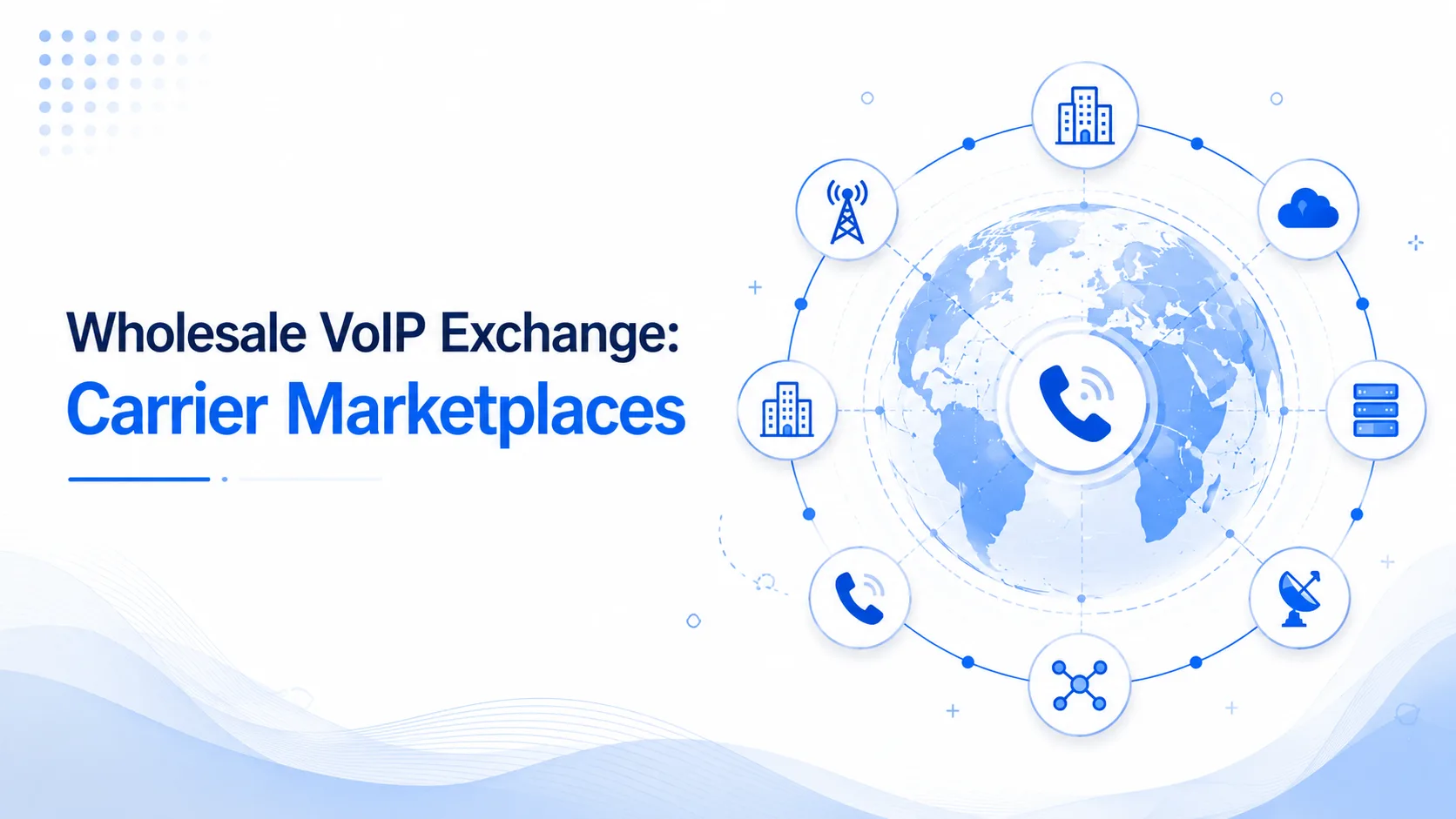
A wholesale VoIP exchange is the carrier-neutral marketplace where VoIP operators buy and sell termination capacity and discover competitive rates without negotiating each interconnect individually. For ITSPs, resellers, and contact-centre platforms, a credible exchange compresses months of bilateral carrier talks into a single connection point. This guide explains how a VoIP exchange works and how Twiching delivers carrier-grade exchange services on a global footprint.
What a Wholesale VoIP Exchange Actually Is
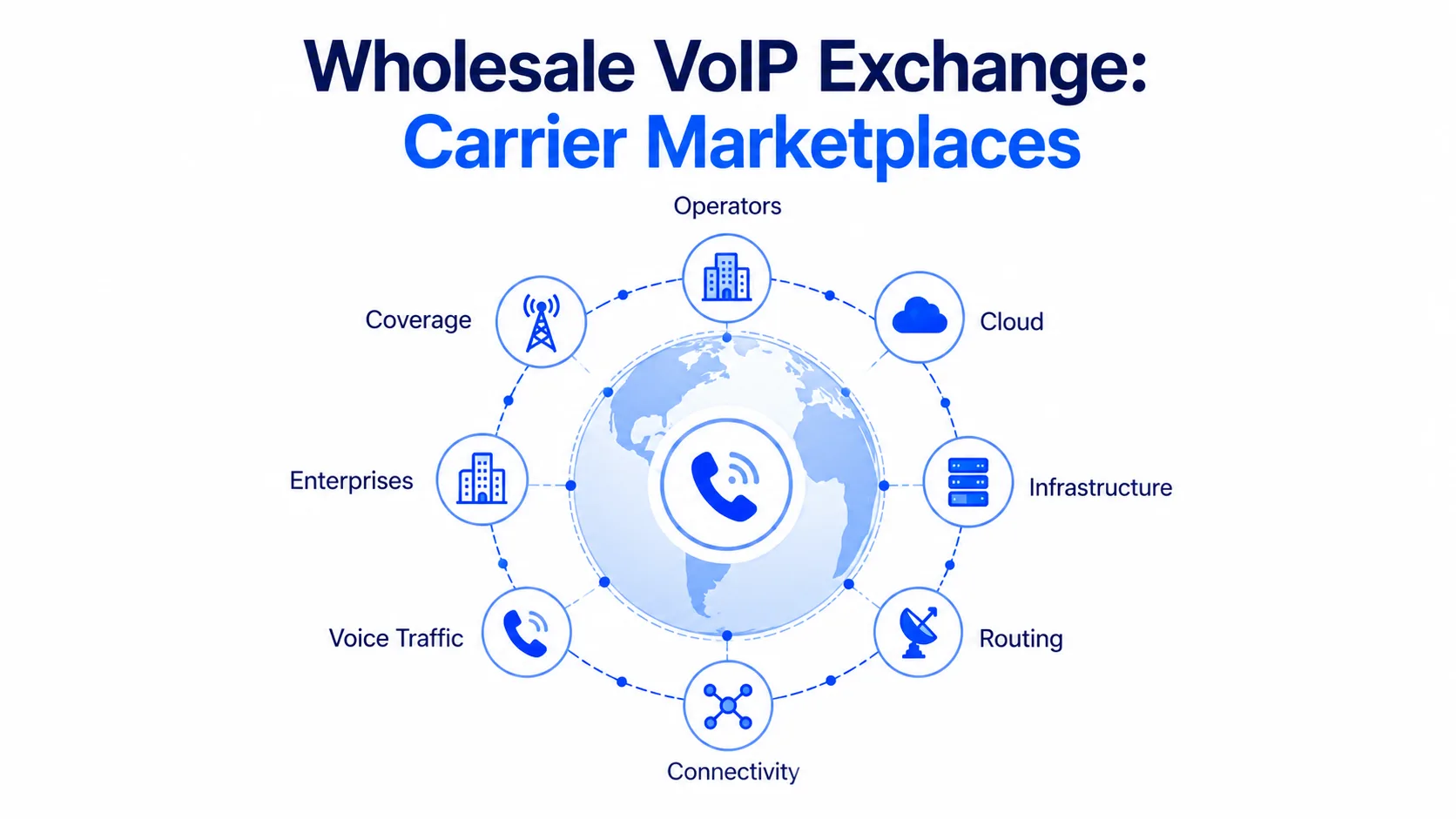
A wholesale VoIP exchange is a multilateral carrier interconnect platform. It is a marketplace where many VoIP operators connect to a single hub and route traffic to any other member through that single connection.
Instead of negotiating one bilateral interconnect at a time, members of the wholesale VoIP exchange get access to dozens or hundreds of upstream routes. All of it comes through one technical and commercial agreement.
The architecture matters because it changes the economics of entering new markets. A traditional carrier strategy requires bilateral contracts with every destination network.
A wholesale VoIP exchange platform replaces that with a single SIP endpoint that reaches every member of the exchange. Wholesale VoIP rates are discovered dynamically rather than baked into a long-term contract.
Wholesale VoIP Exchange vs. Direct Interconnect
Further reading: Wholesale pricing & rate deck
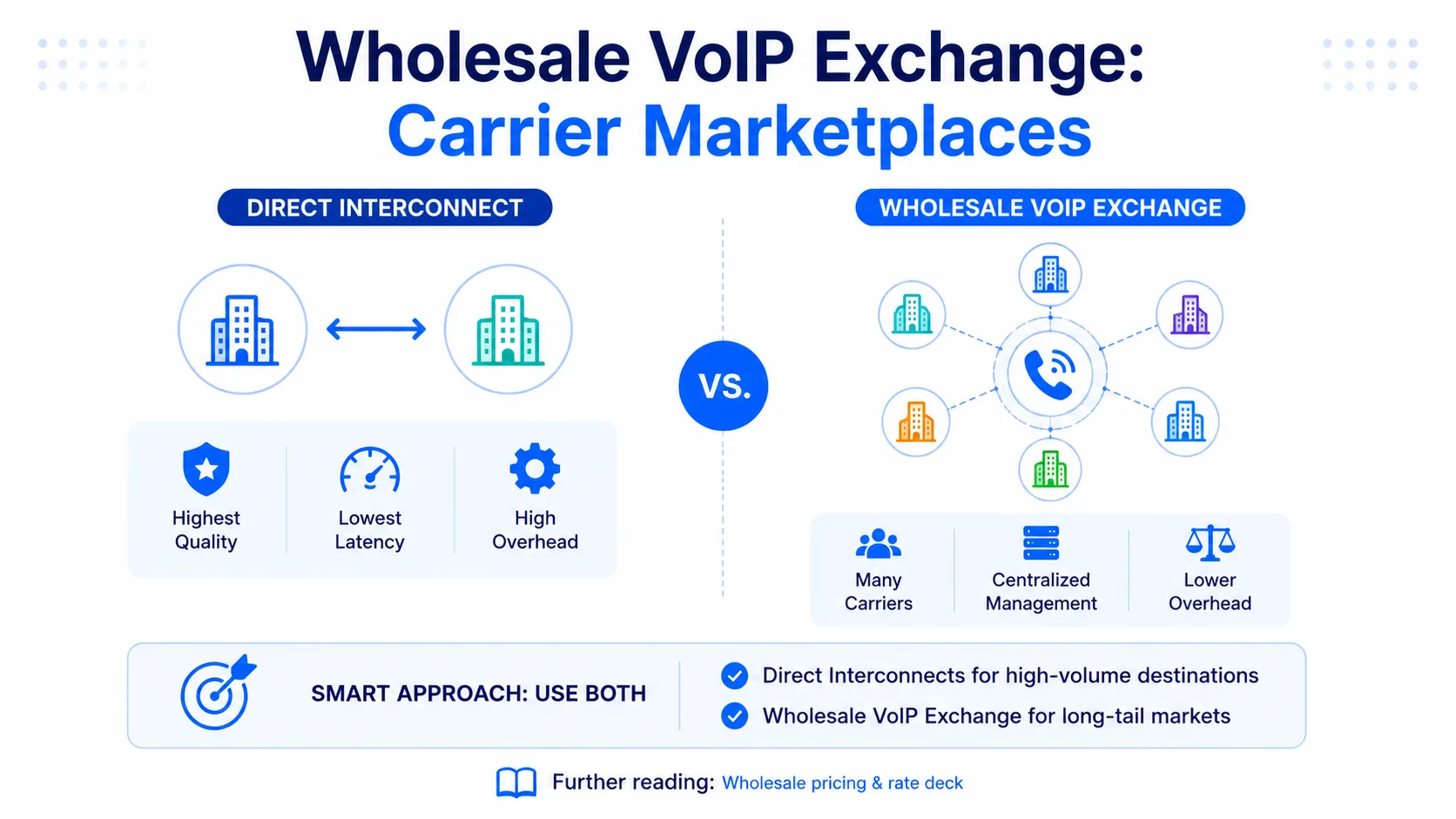
A direct bilateral interconnect is a private agreement between two carriers — the highest-quality, lowest-latency option but operationally expensive to maintain. A wholesale VoIP exchange is a multilateral hub where many carriers connect simultaneously, with the exchange platform handling routing, billing, and dispute resolution centrally.
Most serious operators use both. They sign direct interconnects for the highest-volume destinations and lean on a wholesale VoIP exchange for the long tail of low-volume markets. The exchange handles the destinations where bilateral negotiation simply is not worth the operational overhead.
How VoIP Exchange Routing Works
Inside a wholesale VoIP exchange, every member publishes their available routes and indicative wholesale VoIP rates. When a buyer sends a call to the exchange, the VoIP exchange platform runs LCR routing across all available members for that destination.
It applies quality filters (minimum ASR, maximum PDD) and picks the best match. Calls fail over to alternative members automatically if the primary path degrades.
This is fundamentally different from a single wholesale VoIP provider. Instead of one carrier's rate deck and one carrier's quality assumptions, a wholesale VoIP exchange routes against many — and the buyer benefits from the competition. Real-time CDRs feed back into the exchange's quality scoring, so underperforming members lose traffic until they remediate.
Wholesale VoIP Rates on an Exchange
Further reading: Wholesale VoIP platform
Pricing on a wholesale VoIP exchange is typically dynamic. Rates update daily or hourly based on supply and demand across exchange members.
Buyers see competing wholesale VoIP rates per destination and can route to the cheapest member that meets their quality floor. Or they can pin specific carriers when reliability matters more than cost.
For high-volume operators, this transparency is a margin tool. The wholesale VoIP exchange surfaces price changes the moment they happen, so traffic moves to the cheapest qualifying route automatically. Compare that to a single-carrier wholesale VoIP provider, where rate changes often take 30 days to land and rarely move in the buyer's favour.
Traffic Types That Trade on a Wholesale VoIP Exchange
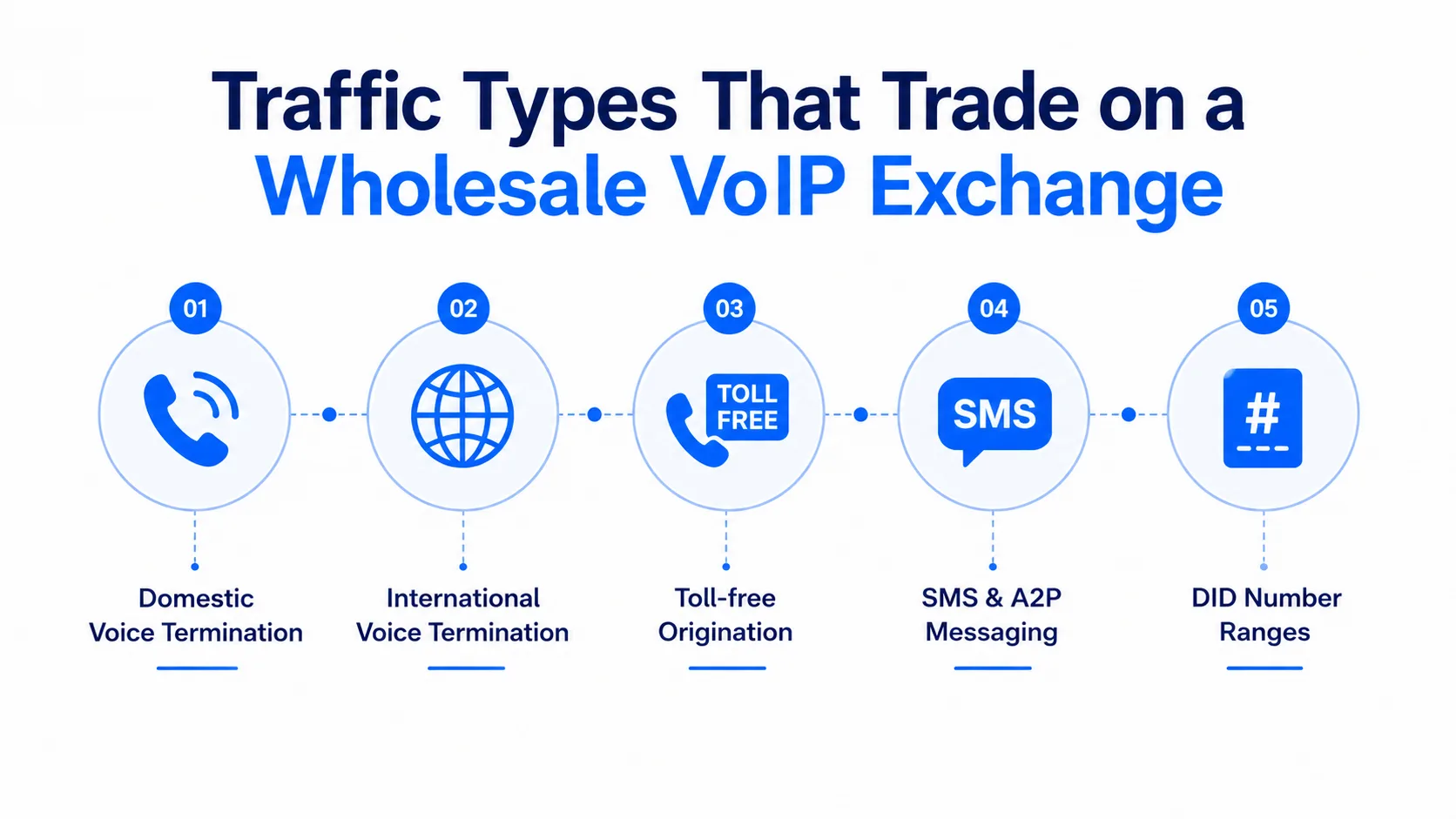
- Domestic voice termination — typically the most liquid market on a wholesale VoIP exchange.
- International voice termination — A-Z international termination across major and emerging corridors.
- Toll-free origination — inbound traffic for businesses with national or regional toll-free numbers.
- SMS and A2P messaging — increasingly traded alongside voice on the same wholesale VoIP marketplace.
- DID number ranges — some VoIP termination exchange platforms broker inbound numbers across markets.
VoIP Peering Exchange Mechanics
A VoIP peering exchange — sometimes called an IPX — is a specific flavour of wholesale VoIP exchange focused on carrier-to-carrier peering with strong SLA guarantees. Members agree to common signalling standards, codec negotiation, and security postures, then exchange traffic at or near cost. Peering reduces transit costs and improves quality on inter-carrier routes.
For most ITSPs and resellers, a fully managed wholesale VoIP exchange is more practical than running a peering exchange directly. The managed model abstracts away the peering protocols and gives buyers the same outcome — broad reach, competitive wholesale VoIP rates, and quality-tiered routing. It does this without requiring them to operate the carrier-grade VoIP exchange platform underneath.
STIR/SHAKEN and Compliance on Exchanges
On a wholesale VoIP exchange handling US-bound traffic, STIR/SHAKEN attestation is a member-level requirement. Each member signs outbound calls according to its KYC posture, and the wholesale VoIP exchange enforces those attestations as calls move between members.
A-attested traffic gets prioritised routing and better downstream acceptance — exactly as on a single-carrier wholesale VoIP solution.
Beyond the US, the wholesale VoIP exchange has to handle several per-market regulatory rules.
- GDPR for European call data.
- Country-specific licensing.
- EU mobile termination caps.
- KYC requirements that vary by destination.
A credible exchange operates compliance centrally so members do not each have to rebuild it.
How to Evaluate a Wholesale VoIP Exchange Provider
- 01Member depth — how many carriers connect to the wholesale VoIP exchange, and which destinations they cover?
- 02Route quality — live ASR, ACD, and PDD per member exposed through the platform.
- 03Rate transparency — dynamic wholesale VoIP rates published with billing increments and currency.
- 04STIR/SHAKEN enforcement — attestation handled across all members for US-bound traffic.
- 05Operational SLAs — 24/7 NOC with named escalation contacts and incident response inside 15 minutes.
- 06Dispute resolution — clear remedies when CDRs disagree across members.
- 07Programmability — REST APIs for CDR access, route controls, and rate-deck queries.
Twiching as a Wholesale VoIP Exchange
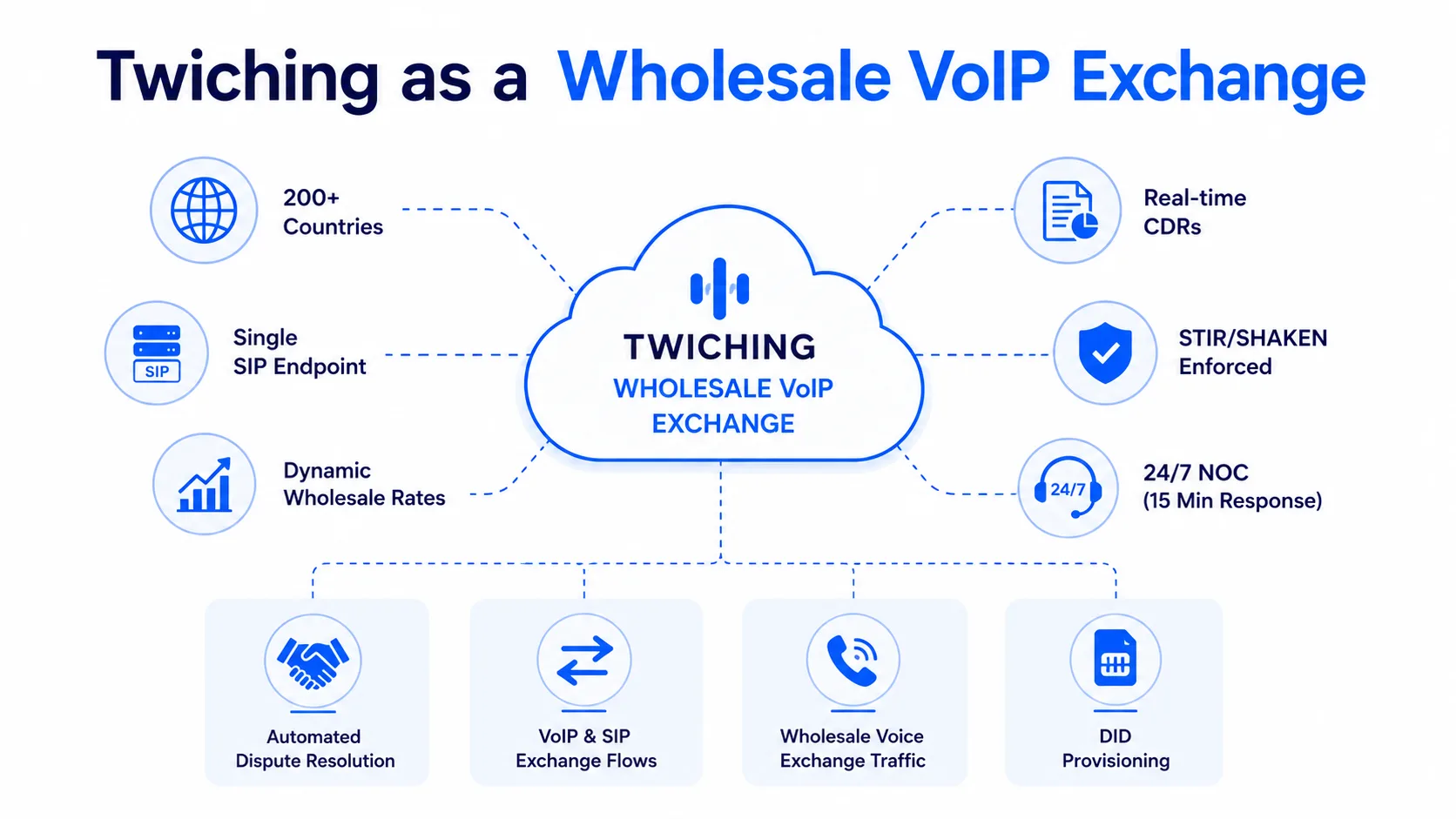
Twiching operates a carrier-grade VoIP exchange combining direct Tier 1 interconnects with a managed multilateral hub. Members get access to global VoIP termination across 200+ countries through a single SIP endpoint. Dynamic wholesale VoIP rates, real-time CDRs, and quality scoring per route are published in the dashboard.
STIR/SHAKEN attestation is enforced across the exchange for US-bound traffic. Dispute resolution is automated against real-time CDRs, and a 24/7 NOC responds to critical incidents within 15 minutes.
The same platform handles VoIP termination exchange, wholesale SIP exchange flows, wholesale voice exchange traffic, and DID provisioning on a single billing account. That lets partners launch a wholesale VoIP marketplace business with full wholesale VoIP solutions stacked behind it, without operating the underlying carrier interconnect platform themselves.
Conclusion
A wholesale VoIP exchange compresses what used to be carrier negotiation overhead into a single technical and commercial endpoint. The right wholesale VoIP exchange provider gives operators dynamic wholesale VoIP rates, transparent route quality, STIR/SHAKEN enforcement across members, and a 24/7 NOC underneath the carrier interconnect platform. Twiching combines those primitives with direct Tier 1 routes and managed dispute resolution, so ITSPs, resellers, and contact-centre platforms can run a global VoIP exchange business at carrier-grade quality without operating the exchange themselves.