Introduction
Wholesale VoIP routes are the carrier paths that actually carry every minute you sell. Two operators on the same softswitch can still perform very differently, because ASR, MOS, and margin all depend on how routes are managed — direct or transit, A-Z lists, and testing new routes.
What Wholesale VoIP Routes Actually Are
A wholesale VoIP route is the specific carrier path used to complete a call from its origin to its destination. Each route passes through one or more carrier networks.
Its quality depends on how many hops the call makes, the carrier interconnect agreements at each hop, and the real-time health of every carrier in the chain. Two routes to the same destination can have wildly different ASR and PDD profiles.
For wholesale VoIP routes buyers — ITSPs, contact centres, platform companies — this matters because the path your minutes travel determines what your retail customers hear. A cheap wholesale VoIP route with three hops and a stressed transit carrier in the middle will deliver visibly worse call quality. That's true even against a direct route on the same per-minute price.
Direct vs. Transit Wholesale VoIP Routes
Further reading: Wholesale pricing & rate deck
Direct wholesale VoIP routes connect two carriers via a bilateral peering agreement. The call passes through exactly one carrier handoff: origin carrier to destination carrier. PDD is low, latency is predictable, and the responsibility for route quality is concentrated in the two parties on the agreement.
Transit wholesale VoIP routes introduce an intermediate carrier that accepts the call from the origin and forwards it onward to the destination. The extra hop adds latency, increases the number of failure points, and usually adds margin to the per-minute price. Transit routes are unavoidable for long-tail destinations where direct interconnects do not exist — but for major markets, direct wholesale VoIP routes deliver materially better outcomes.
A-Z Route Lists and Global VoIP Routes
An A-Z route list is a comprehensive database mapping every country and number prefix to one or more carrier paths with per-minute pricing. It is the master rate sheet that drives LCR routing across global VoIP routes. The list is huge: thousands of destination prefixes, refreshed as carriers publish updates, with quality scores attached to each path.
A credible wholesale VoIP routes provider exposes the A-Z route list through both a dashboard and an API. Customers can pin specific carriers for specific destinations, blacklist underperforming routes, and inspect why their LCR engine selected the path it did.
The list is what drives A-Z termination decisions in real time, and route scoring per destination is what keeps quality honest. Anything less is opaque routing — and opaque routing is where margin quietly leaks.
How Route Quality Is Scored
Further reading: Wholesale VoIP platform
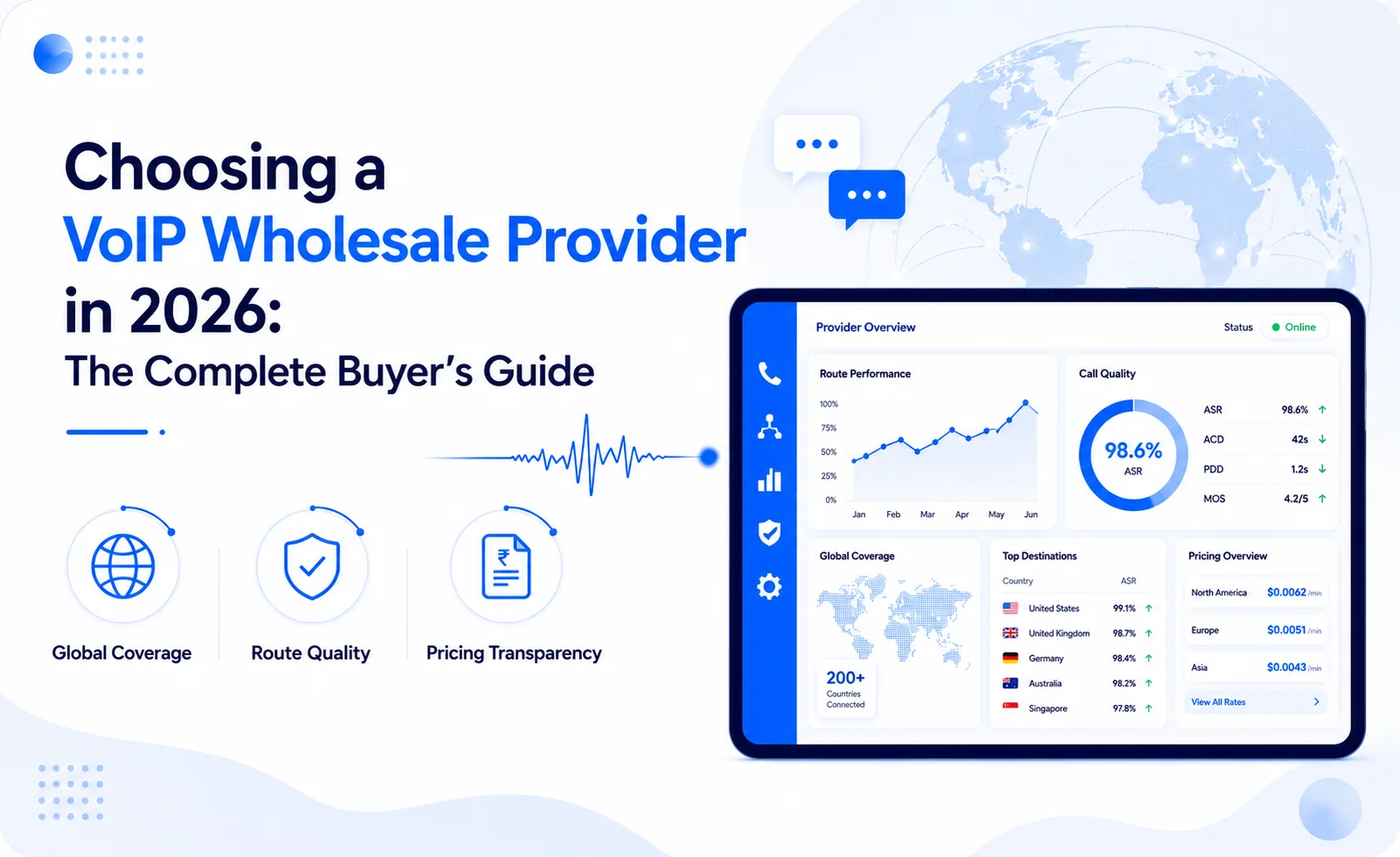
Wholesale VoIP routes are scored on a small set of objective metrics that aggregate from CDR data. The core metrics are ASR (answer-seizure ratio), ACD (average call duration), PDD (post-dial delay), MOS (mean opinion score), and short-duration call ratio. A serious wholesale VoIP routes provider streams CDRs into a scoring engine and updates per-route quality numbers in near real time.
No single metric tells the full story on its own — a route can post a strong ASR while still delivering choppy audio, or a healthy MOS while quietly dropping calls before a real conversation happens. Scoring all five together is what catches the failure modes any one number would miss.
- ASR above 50% on major destinations is the floor; premium business routes target 70%+
- ACD below 30 seconds usually signals routing issues or abusive traffic on the path
- PDD below 5 seconds is the expectation; anything above suggests transit hops or congestion
- MOS at or above 4.0 is the bar for business-quality voice
- Short-duration ratio above 30% indicates problems that warrant pulling the route from rotation
Testing New Wholesale VoIP Routes Before Production
Adding a new wholesale VoIP route without testing first is how operators ship quality regressions to retail customers. The discipline is straightforward.
Run a dedicated test campaign of 500 to 1,000 minutes to the new route's target destinations. Measure ASR, ACD, PDD, and subjective audio quality before promoting it into the production LCR engine.
Run the test across different times of day. Many wholesale VoIP routes look healthy at 11am UTC and degrade hard at 2am when peak load hits the destination carrier. A single window of testing tells you nothing about how the route behaves under stress, which is precisely when retail customers will be calling.
Buying vs. Building Wholesale VoIP Routes
Most operators get access to wholesale VoIP routes by signing with a provider like Twiching that already owns hundreds of preconfigured paths via a single SIP trunk. The provider handles upstream interconnect negotiation, rate-deck management, LCR routing, and the 24/7 NOC. The customer brings the traffic.
Building your own wholesale VoIP routes means negotiating bilateral interconnects with individual carriers, paying for cross-connects in carrier hotels, and staffing the operations team to manage them. It is the right move for genuine Tier 1 carriers and very large operators.
For everyone else, partnering with a wholesale VoIP routes provider is the better path. A provider that already owns the global VoIP routes footprint is faster, cheaper, and almost always higher quality from day one.
Wholesale VoIP Routes and STIR/SHAKEN
Further reading: Wikipedia: VoIP overview
For US-bound traffic, STIR/SHAKEN attestation has become a route-level attribute. Wholesale VoIP routes that carry A-level attestation get higher downstream ASR and fewer spam labels, while routes without attestation get aggressively filtered by terminating carriers. Any modern wholesale VoIP routes provider treats STIR/SHAKEN as a routing dimension alongside cost and quality.
Outside the US, similar trust frameworks are spreading across the EU and UK. A wholesale VoIP routes provider that handles attestation centrally saves customers from re-implementing the same compliance logic across every market. It also exposes per-route attestation status in the dashboard.
Choosing a Wholesale VoIP Routes Provider
The checklist below moves from ownership of the underlying network toward day-to-day operability, since a provider can look strong on the first point and still fall short once you need a route swapped at 2am.
- 01Direct route footprint — published list of bilateral interconnects in your top destinations.
- 02A-Z route list breadth — coverage across 200+ countries with named carrier paths.
- 03Real-time quality scoring — ASR, ACD, PDD, MOS exposed via API per route.
- 04Failover behaviour — documented logic on setup vs mid-call route failures.
- 05STIR/SHAKEN — per-route attestation status visible in the dashboard.
- 06Programmability — route controls, blacklists, and pinning configurable via REST API.
- 07Operations — 24/7 NOC with 15-minute critical-incident SLA and a route-quality engineer on call.
Failover behaviour is the item most shortlists skip, and it's usually the one that matters most during an actual incident — a route that fails gracefully mid-call looks very different from one that just drops it.
How Twiching Manages Wholesale VoIP Routes
Twiching operates a curated A-Z route list across 200+ countries with direct interconnects in every major financial and contact-centre hub. Every route is scored continuously against streaming CDR data, and underperforming paths are demoted automatically until upstream carriers remediate. Customers see live ASR and PDD per destination in the dashboard and can pin or blacklist specific routes via API.
STIR/SHAKEN attestation is integrated into every US-bound route. The white-label reseller programme exposes the same wholesale VoIP routes infrastructure to partner brands, and a 24/7 NOC responds to route-quality incidents within 15 minutes. Partners launch on carrier-grade global VoIP routes without negotiating a single bilateral interconnect themselves.
Conclusion
Wholesale VoIP routes are not interchangeable, and treating them as commodities is how operators silently ship poor call quality to retail customers. Direct routes beat transit routes on the major destinations; A-Z route lists matter for global VoIP routes coverage; route-quality scoring catches degradation before customers complain.
A credible wholesale VoIP routes provider exposes all of that in the dashboard and pairs it with STIR/SHAKEN attestation and 24/7 NOC support. Twiching is built around that discipline, so partners inherit carrier-grade wholesale VoIP routes from day one without negotiating a single upstream interconnect themselves.