Introduction
Wholesale VoIP service providers sit at the carrier layer that every retail voice product is assembled from. They bundle SIP trunking, termination, DID origination, hosted PBX, and CPaaS-style APIs into one contract, letting ITSPs, telecoms, ISPs, and SMBs buy carrier-grade voice without operating the carrier themselves. This guide covers what they deliver, the evaluation criteria that matter in 2026, and how Twiching compares.
What Wholesale VoIP Service Providers Actually Do
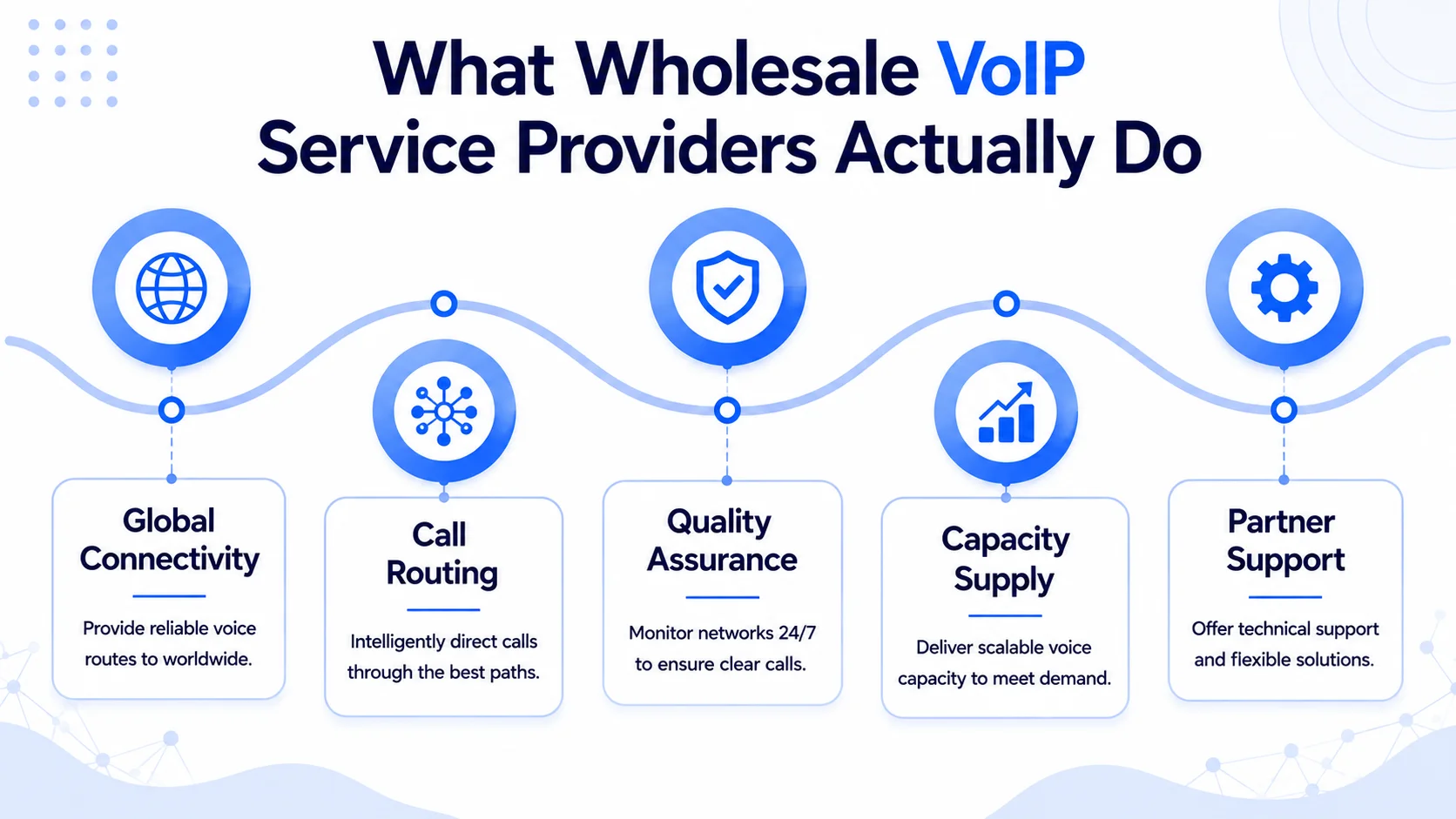
Wholesale VoIP service providers operate the carrier layer that delivers voice connectivity in bulk to other businesses. Their customers are telecom companies, ISPs, ITSPs, contact-centre platforms, and SMBs running their own PBX.
They hold the licences, run the softswitches, sign the carrier interconnects, and expose the result as SIP trunks and DID numbers their customers consume. The customer brings the application; wholesale VoIP service providers bring the carrier underneath.
This is fundamentally different from a retail VoIP provider, which sells packaged plans, handsets, and consumer support to end users. Wholesale VoIP service providers work at infrastructure-level pricing with per-minute billing, technical SIP integration, and contractual SLAs. The wholesale tier operates at higher volume and lower per-unit cost than retail.
Core Services Bundled by Wholesale VoIP Service Providers
Further reading: Wholesale pricing & rate deck
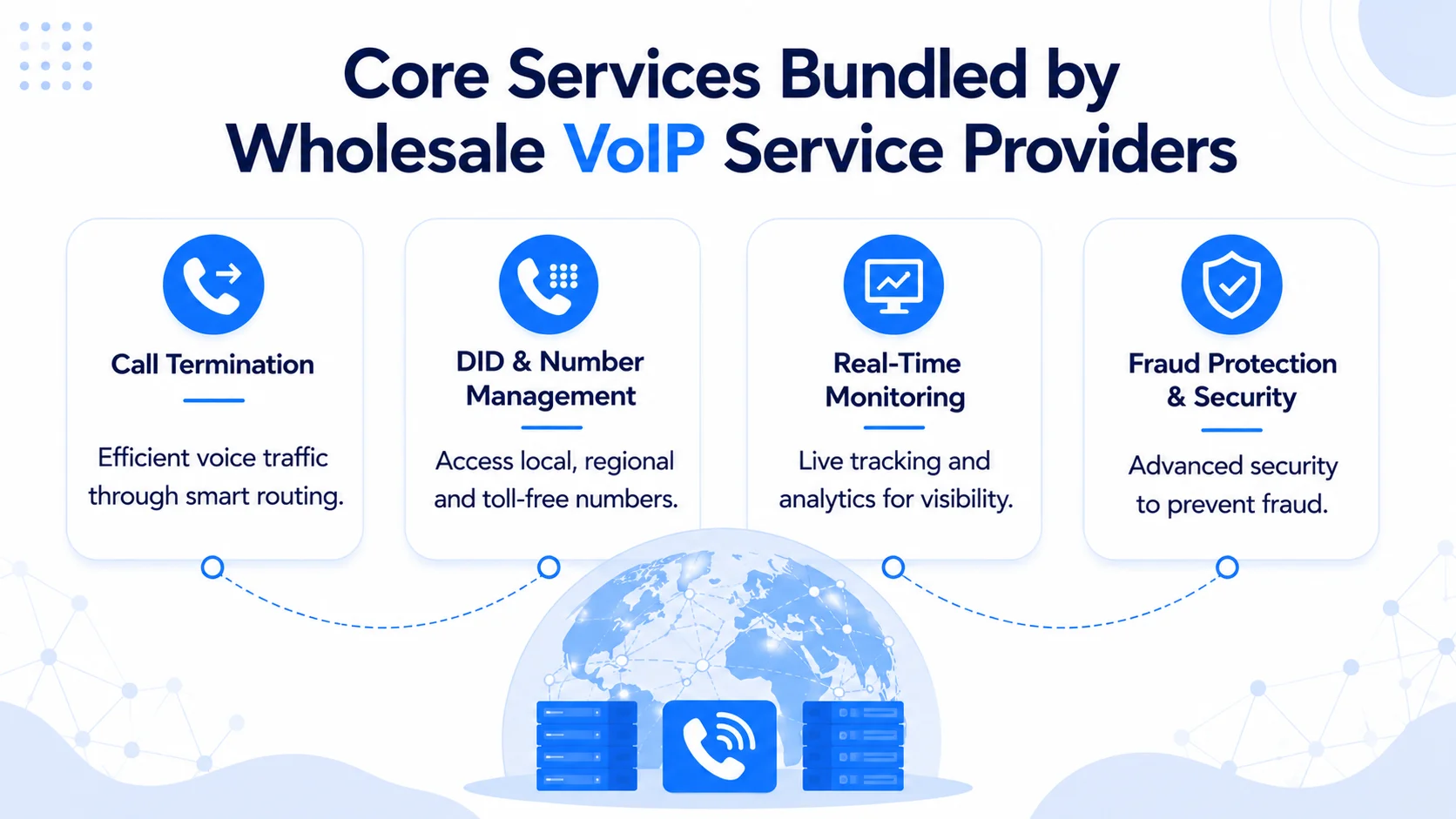
A serious wholesale VoIP service provider ships a tightly integrated stack of carrier-grade services on a single billing account. Buying these separately from different vendors is technically possible but operationally painful — reconciliation, fraud controls, and quality scoring all break down across mismatched stacks.
- SIP trunking — direct PBX-to-carrier connectivity that replaces legacy PRI
- Wholesale VoIP termination — outbound A-Z minutes delivered via LCR routing
- DID origination — local, mobile, and toll-free inbound numbers across 100+ countries
- Hosted PBX — cloud-based phone system with voicemail, IVR, and call routing
- Number porting — clean transfer of existing DIDs from other carriers
- STIR/SHAKEN attestation — embedded in the call path for US-bound traffic
- Real-time analytics and CDR APIs — usage, quality, and cost data via REST
Who Buys From Wholesale VoIP Service Providers
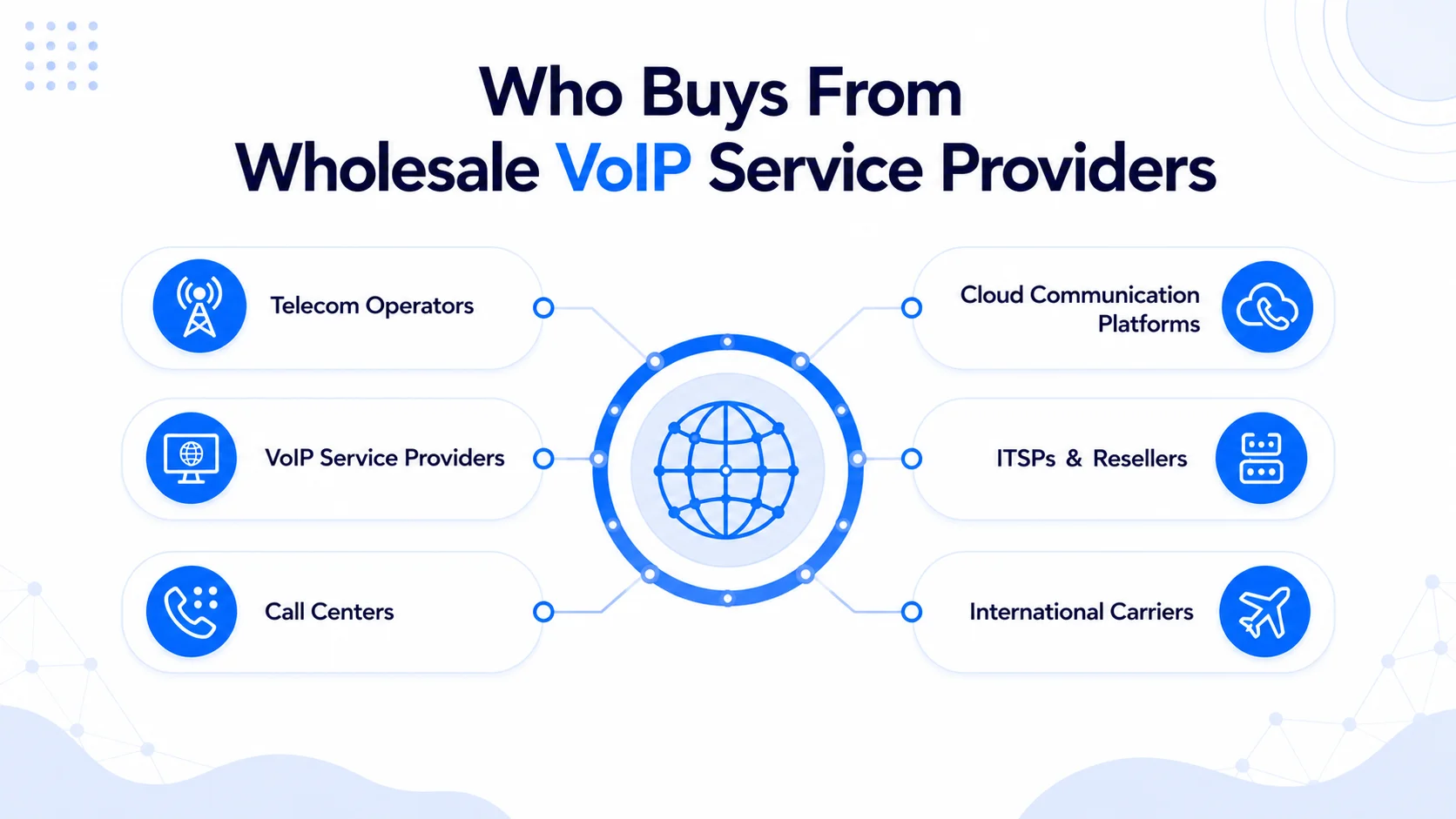
Three buyer profiles drive most of the wholesale VoIP service providers market. Telecom companies use them to extend their own footprint without building out new interconnects per market.
ISPs bundle wholesale VoIP services into broadband packages to lift ARPU and reduce churn. ITSPs and contact-centre platforms consume the carrier layer wholesale and resell it under their own brand to enterprise end users.
SMBs increasingly buy direct from wholesale VoIP service providers as well, because modern platforms have eliminated traditional volume minimums. A 20-seat business can now access the same carrier-tier wholesale VoIP rates as a multinational. They pay per-minute on a transparent rate deck rather than overpaying for retail bundles.
How Wholesale VoIP Service Providers Charge
Further reading: Wholesale VoIP platform
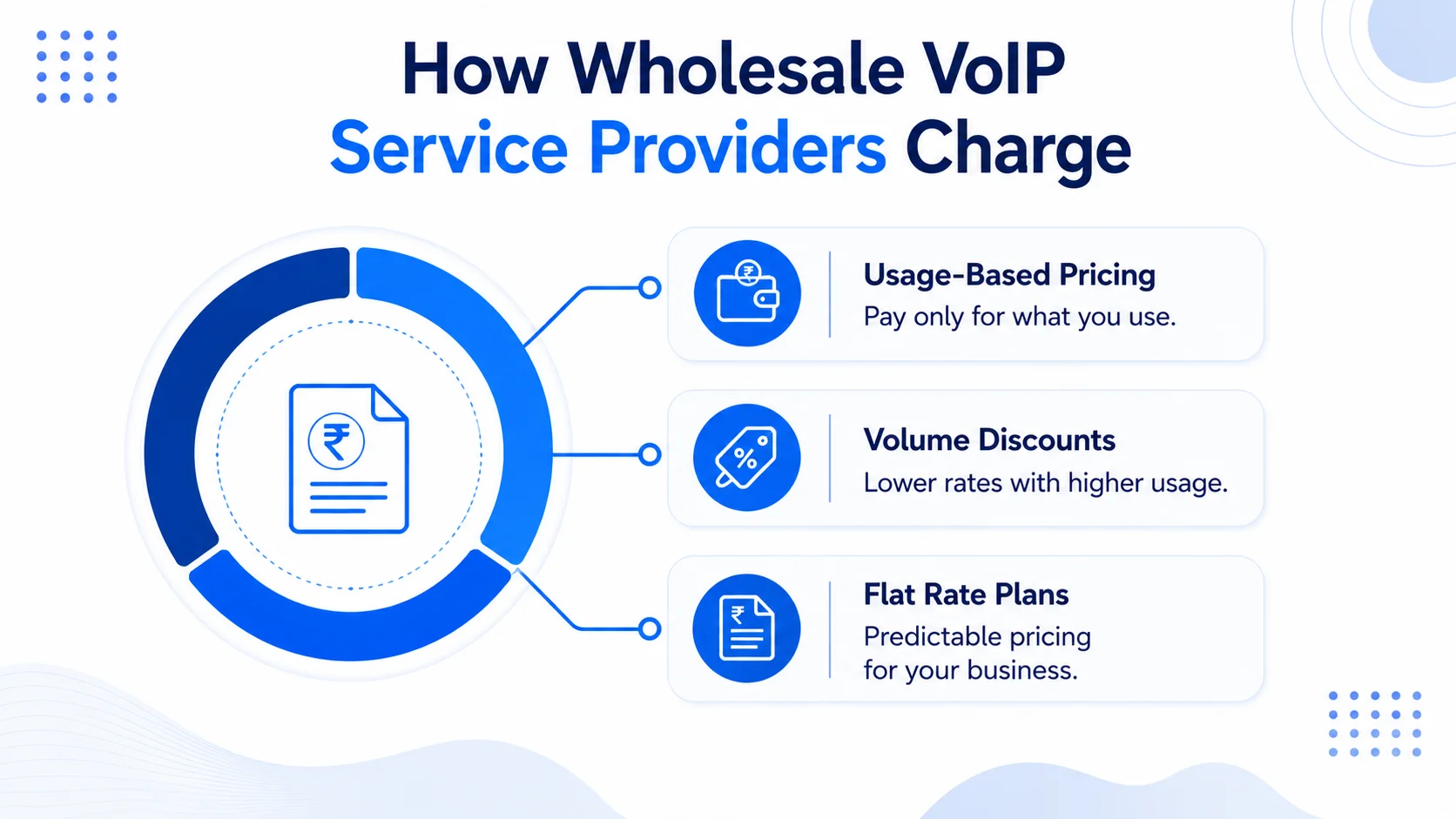
Pricing across wholesale VoIP service providers blends three recurring models. Per-minute usage for outbound termination, monthly DID rental for inbound numbers, and per-channel SIP trunk fees for the underlying capacity.
Hosted PBX adds a per-user monthly seat charge. CPaaS-style API features layer on per-API-call usage on top.
Volume commitments unlock tiered wholesale VoIP rates — typically 10 to 25 percent reductions across the curve. Billing increments (1/1 vs 6/6 vs 30/6) move the real cost on short-duration traffic by another 12 to 18 percent. Strong wholesale VoIP service providers publish all of these inputs transparently per destination so customers can model total cost before signing.
STIR/SHAKEN, Security, and Compliance
STIR/SHAKEN attestation has become table stakes for any wholesale VoIP service provider handling US-bound traffic. A-attested calls get higher downstream ASR, fewer spam labels, and better acceptance by terminating carriers. Providers without full attestation are quietly costing customers connection rates.
Security inside any wholesale VoIP service provider runs across several layers.
- TLS for SIP signalling.
- SRTP for media encryption.
- IP whitelisting for trunk authentication.
- DDoS scrubbing.
- IRSF anomaly detection on streaming CDRs.
Outside the US, GDPR for European call data, EU mobile termination caps, and country-specific licensing all factor into the regulatory floor. Credible wholesale VoIP service providers track these centrally so customers inherit compliance posture per market.
Analytics, APIs, and Self-Service
The customer portal is where wholesale VoIP service providers separate from their resellers in practice. Strong portals expose real-time CDR access, live traffic dashboards, per-route quality metrics, balance and usage monitoring, DID management, rate-deck downloads, and billing history. Self-service capabilities cut dependency on the support queue for routine work.
Programmable APIs sitting alongside the dashboard are now table stakes. CDR streaming, rate-deck queries, DID provisioning, and trunk configuration should all be accessible via REST. Wholesale VoIP service providers shipping only a web UI in 2026 are asking customers to do operational work that should be automated end-to-end through the API layer.
SLA Terms and Network Quality
Strong wholesale VoIP service providers commit to specific outcomes, not vague aspirations. Expect minimum 99.9% uptime SLAs with defined response and resolution times, ASR floors for major destinations, maximum PDD commitments, and financial credits for breaches.
The credit structure matters as much as the headline number. A 100% credit on one hour of downtime is meaningless if the real customer impact dwarfs the interconnect outage.
Network quality across wholesale VoIP service providers is measured continuously with streaming CDR data feeding per-destination ASR, ACD, PDD, and MOS. Degraded routes get demoted automatically by the LCR engine until upstream carriers remediate. Anything weaker means the operator is doing the monitoring manually, with all the delay that implies.
Comparing Wholesale VoIP Service Providers
- 01Service breadth — SIP trunking, termination, DID origination, hosted PBX, porting on one platform
- 02Rate transparency — wholesale VoIP rates published per destination with billing increments
- 03Route quality — live ASR, ACD, PDD, MOS per destination, accessible via API
- 04STIR/SHAKEN — full attestation on US-bound traffic, surfaced in CDRs
- 05SLA terms — 99.9% uptime, ASR floors, financial credits for breaches
- 06APIs — programmable provisioning, CDR streaming, and rate-deck queries via REST
- 07Onboarding — KYC under 48 hours, production traffic within a week
- 08Operations — 24/7 NOC with 15-minute critical-incident SLA
Twiching as a Wholesale VoIP Service Provider
Twiching is built specifically for ITSPs, telecom companies, ISPs, contact-centre platforms, and growing SMBs evaluating wholesale VoIP service providers. The platform bundles SIP trunking, wholesale VoIP termination, DID origination, hosted PBX, number porting, and CPaaS-style APIs on a single billing account. It backs that with direct Tier 1 interconnects across 200+ countries, full STIR/SHAKEN attestation, real-time CDRs, and a 24/7 NOC with a 15-minute critical-incident SLA.
Onboarding completes in under 48 hours and the rate deck publishes per-destination pricing with billing increments and effective dates visible on every row. New SIP channels and DID numbers activate within an hour of request.
Partners on the white-label reseller programme can launch their own branded wholesale VoIP service providers business as a wholesale provider in their own right. All of it runs on the same wholesale VoIP carrier infrastructure Twiching operates internally.
Conclusion
Wholesale VoIP service providers are infrastructure businesses with thin software wrappers — and the credible ones know it. SIP trunking, wholesale VoIP termination, DID origination, hosted PBX, porting, STIR/SHAKEN attestation, and a 24/7 NOC are the floor, not the upsell. Transparent rate decks, contractual SLAs, and programmable APIs are how serious wholesale VoIP service providers compete; opaque pricing and email-only support is how thin resellers hide their lack of carrier depth. Twiching is built around that bar, so partners and end customers launch on a carrier-grade wholesale VoIP service provider from day one — without operating the underlying carrier themselves.