Introduction
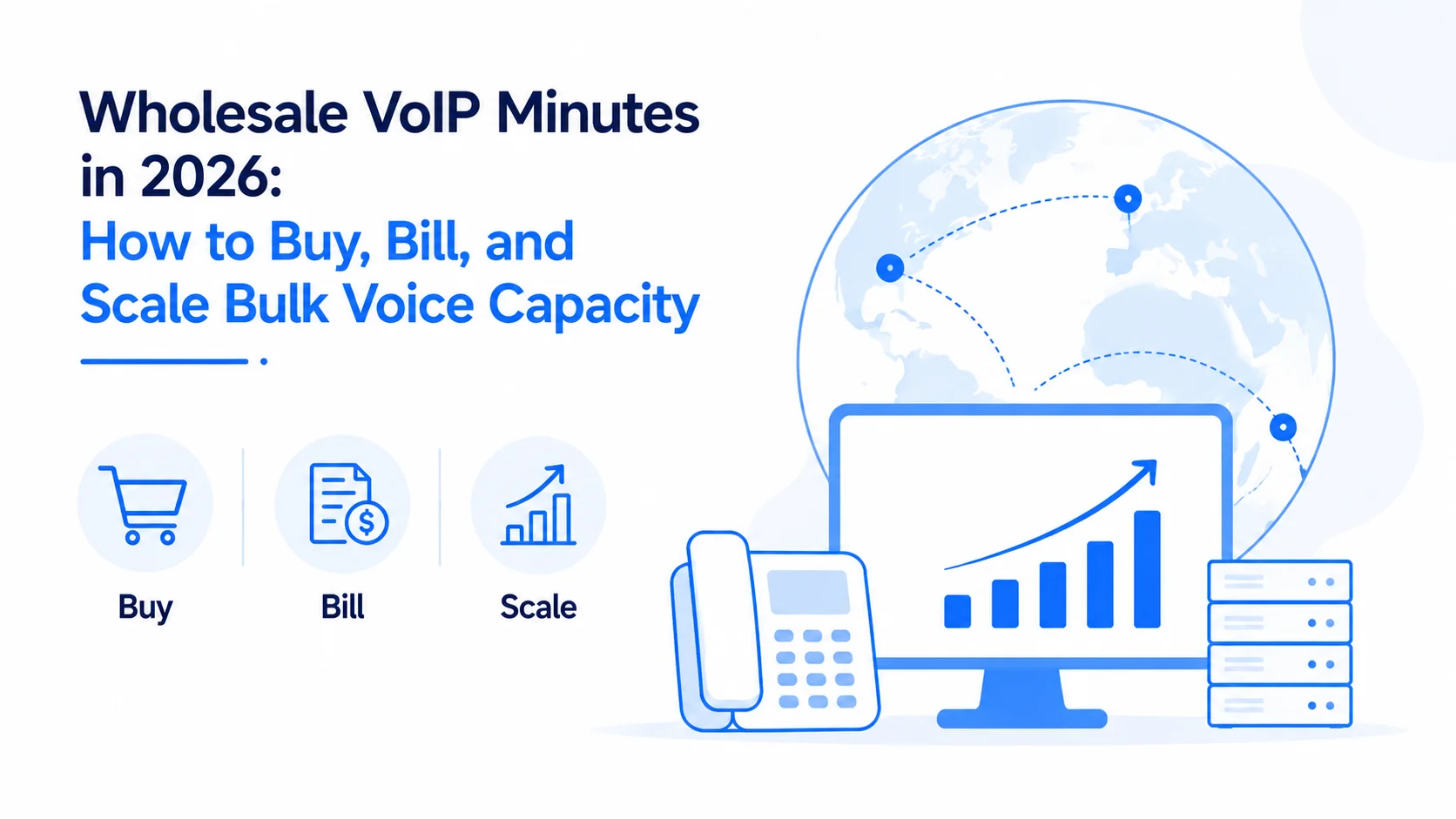
Wholesale VoIP minutes are bulk voice capacity sold at carrier-tier per-minute rates to other businesses — ITSPs, contact centres, resellers, and enterprises with high outbound volume. This guide covers how they're priced in 2026, why billing increments and volume commitments move real cost, and why STIR/SHAKEN attestation matters so much on US-bound traffic.
It also shows how to evaluate a provider against a structured checklist.
What Wholesale VoIP Minutes Actually Are
Wholesale VoIP minutes are bulk voice call capacity sold by a carrier-tier provider to other businesses at per-minute rates published on a destination-by-destination rate deck. Customers are operators rather than retail end users — ITSPs, contact centres, UCaaS platforms, programmable-voice companies, and enterprises with high outbound volume.
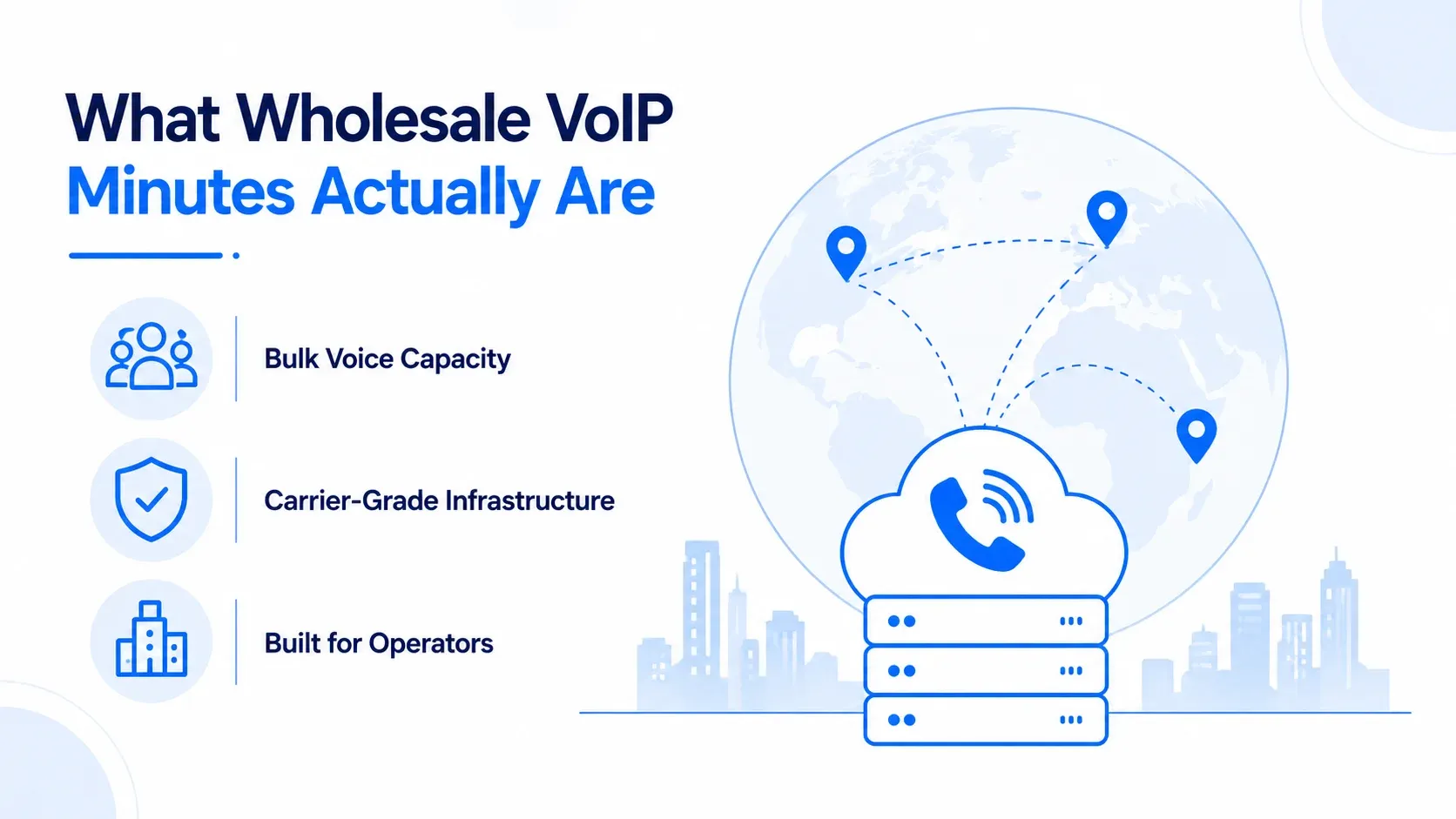
The wholesale VoIP minutes provider holds the carrier interconnects and runs the LCR routing engine. It also generates real-time CDRs, signs STIR/SHAKEN attestation for US-bound traffic, and runs the 24/7 NOC. The customer brings the SIP trunk and the traffic.
Retail VoIP wraps minutes inside a per-seat plan with handsets, voicemail, and consumer support. Wholesale VoIP minutes strip that wrapper away and sell raw transport at carrier-tier wholesale VoIP rates.
For any business shipping more than a few thousand minutes per month, the bundled retail model is structurally more expensive. Buying wholesale VoIP minutes directly and providing the application layer in-house costs less at that volume.
How Wholesale VoIP Minutes Are Priced
Further reading: Wholesale pricing & rate deck
Wholesale VoIP minutes are priced per minute by destination on a published rate deck. Each row carries the country, prefix range, mobile-or-landline indicator, per-minute price, billing increment, currency, and effective date. The rate deck is the load-bearing commercial document — a credible wholesale VoIP minutes provider publishes every column transparently so customers can model real cost before signing.
Pricing models layer on top of the rate deck. Pay-as-you-go suits volatile or unpredictable traffic with no commitment. Committed monthly minute pools — guaranteed minimums against a discounted blended rate — unlock 10 to 25 percent reductions across the curve.
Prepaid bundles deliver a fixed number of wholesale VoIP minutes at a fixed price with a typical 30-day expiry. Most operators land on a mix: pay-as-you-go on the long tail, committed pools on the high-volume destinations.
Billing Increments Move Real Cost as Much as the Rate Does
Billing increments determine the minimum billable unit for each call. The three common increments are 1/1 (1-second initial, 1-second steps), 6/6 (6-second initial, 6-second steps), and 30/6 or 60/60 (long initial increments).
For contact-centre or programmable-voice workloads with many short calls, billing increment matters a lot. 6-second billing on wholesale VoIP minutes versus 60-second billing on the same traffic can reduce effective per-minute cost by 30 to 50 percent. The headline rate looks identical; the real cost is materially different.
Any credible wholesale VoIP minutes provider publishes the billing increment alongside the per-minute rate on every destination row. Hiding the increment is one of the oldest tricks in opaque telecom pricing — and the math eventually catches up at audit. Always negotiate 6/6 or 1/1 increments for short-duration traffic, and read the rate deck for the increment column before agreeing the price.
Volume Commitments and Tiered Pricing
Further reading: Wholesale VoIP platform
Volume commitment is the single biggest lever on wholesale VoIP minutes pricing. A guaranteed monthly minimum gives the carrier predictable revenue, which they pass back as per-minute rate reductions.
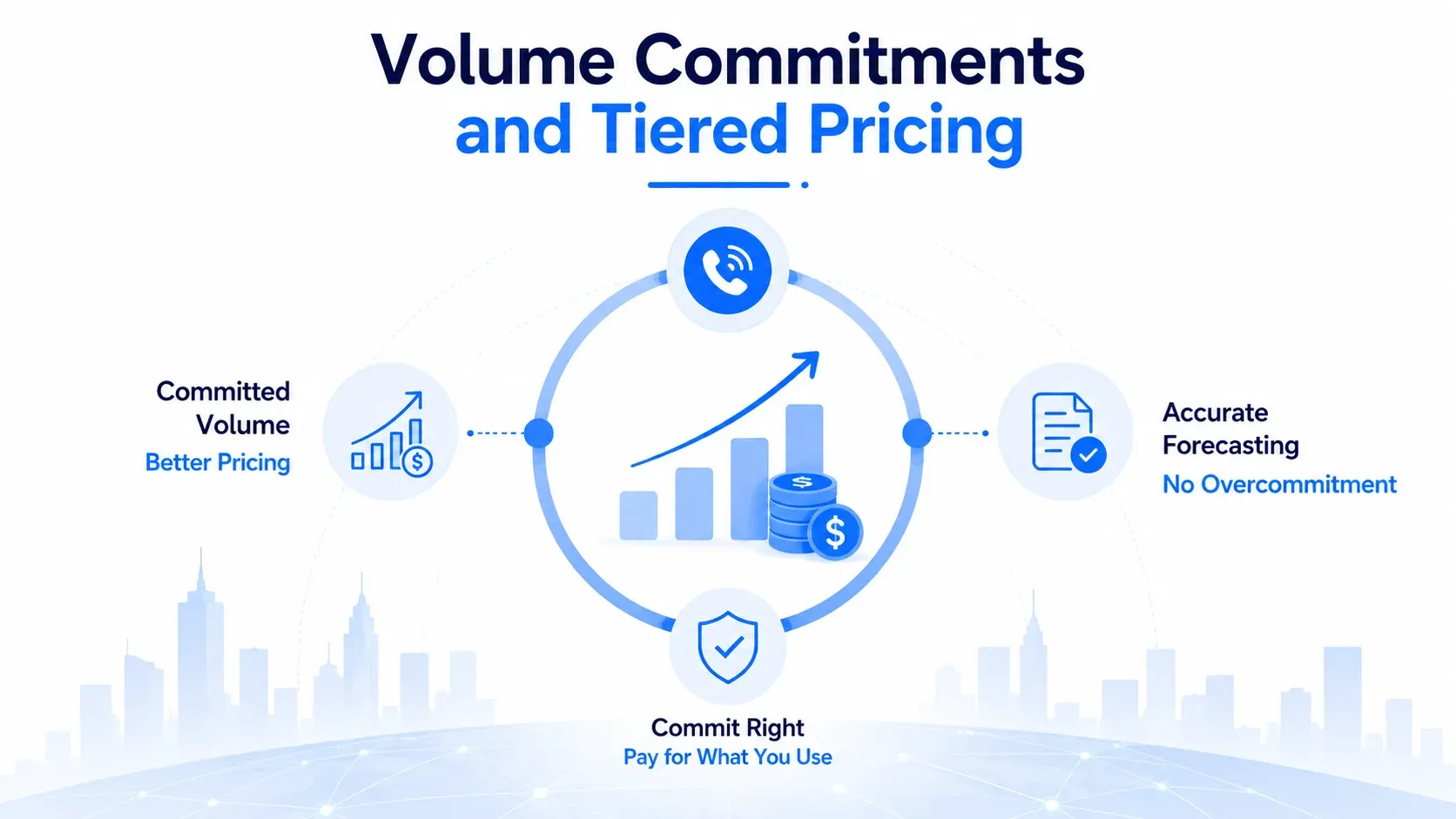
A clean CDR history with predictable ASR and ACD lets the wholesale VoIP minutes provider tighten their forecasting. That typically tightens the discount further — another 5 to 10 percent on top of the standard volume tier.
The trap with volume commitments is overshooting on the minimum. Committing to 500,000 minutes per month at a discounted rate and then shipping 300,000 means paying for 200,000 unused minutes.
Model traffic accurately against 3 to 6 months of CDR history before signing a committed-volume contract. Start lower than you think you need — the rate deck rewards real growth, not optimistic forecasts.
STIR/SHAKEN on Wholesale VoIP Minutes
For US-bound wholesale VoIP minutes, STIR/SHAKEN attestation has become a route-level attribute. A-attested calls get measurably higher downstream ASR, fewer spam labels, and better acceptance by terminating carriers.
Unattested minutes are aggressively filtered — connection rates on US destinations drop by double-digit percentages over time. A wholesale VoIP minutes provider that does not sign US-bound traffic inline is silently costing every customer who routes US traffic through them, before the per-minute rate even enters the conversation.
A modern wholesale VoIP minutes provider signs every US-bound call inline based on the customer's KYC posture. Twiching does this by default. There is no separate attestation product to buy, and the attestation level surfaces in every CDR row so customers can audit their own compliance posture themselves.
Quality Metrics That Matter on Wholesale VoIP Minutes
Four metrics determine the practical quality of wholesale VoIP minutes. ASR (Answer-Seizure Ratio) above 55 to 65 percent is healthy on most destinations; premium business routes target 70 percent or higher.
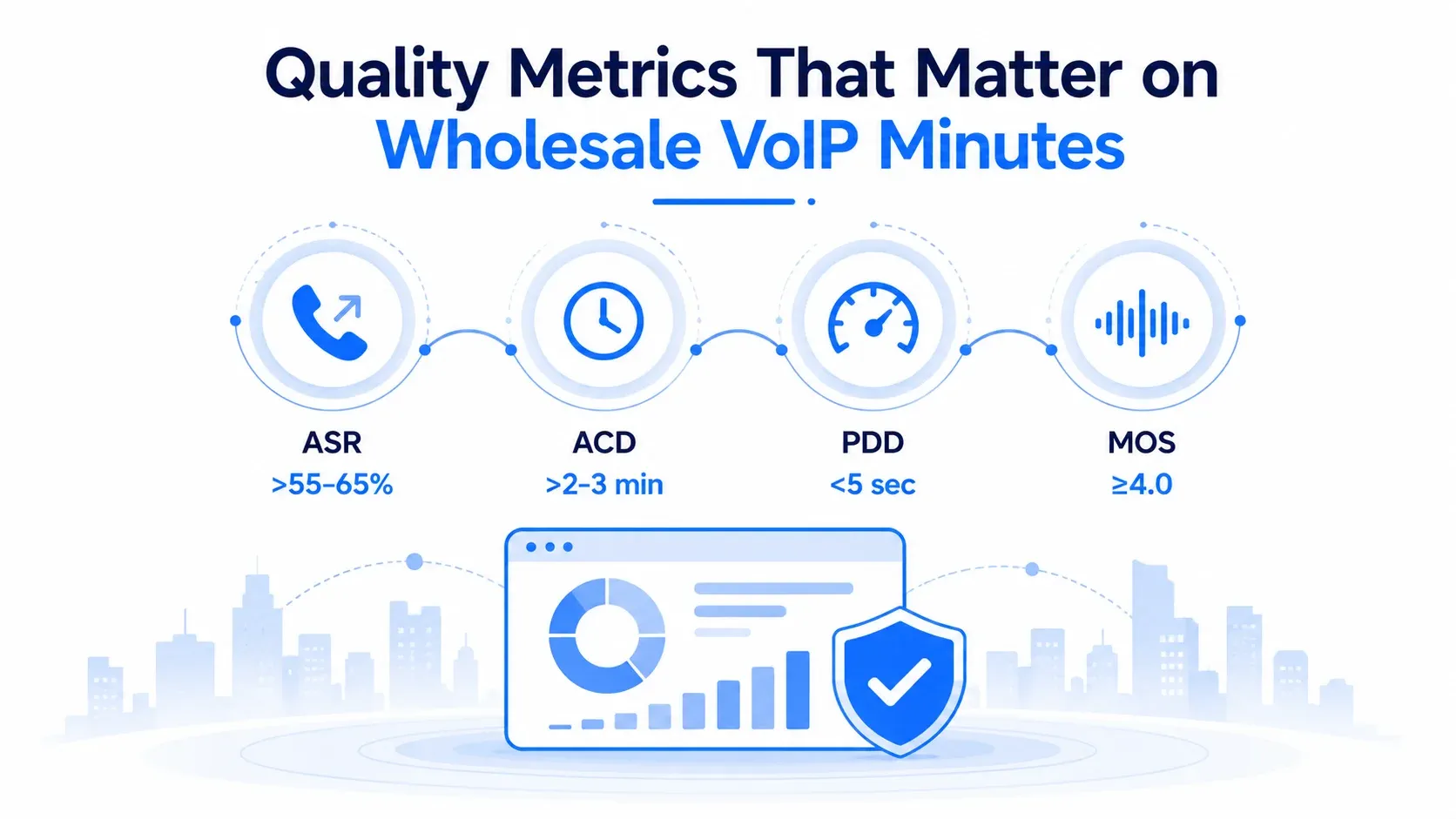
ACD (Average Call Duration) above 2 to 3 minutes indicates a clean route. PDD (Post-Dial Delay) below 5 seconds is the expectation. MOS (Mean Opinion Score) at or above 4.0 is the toll-quality bar.
A serious wholesale VoIP minutes provider exposes per-destination quality scoring continuously via dashboard and API. Underperforming routes drop out of LCR rotation automatically until upstream carriers remediate. A provider batching quality reports weekly is operating a generation behind any carrier-grade peer.
Fraud Protection on Bulk Wholesale VoIP Minutes
IRSF (International Revenue Share Fraud) is the existential operational risk when shipping bulk wholesale VoIP minutes. A compromised customer trunk can rack up six-figure exposure overnight if controls are not real-time. The carrier still bills you for the minutes regardless of whether your retail customer paid you for them.
Effective wholesale VoIP minutes providers run anomaly detection on streaming CDRs and apply hard per-account spend caps. They also maintain blocked-prefix lists and pause traffic instantly when patterns look off.
Customers should expect spend caps, destination whitelists, and real-time alerts as default features in any wholesale VoIP minutes provider dashboard. Anything weaker turns the customer's trunk into the carrier's fraud problem — and the contract worth declining rather than signing.
Voice and SMS Bundling on Wholesale VoIP Minutes
Modern wholesale VoIP minutes providers increasingly bundle A2P SMS on the same carrier relationships, the same billing engine, and the same dashboard. For platforms shipping authentication codes, transactional notifications, or marketing campaigns, buying wholesale VoIP minutes and wholesale SMS from a single provider pays off.
It collapses reconciliation overhead and unlocks better unified pricing. Twiching supports A2P SMS as a first-class product alongside wholesale VoIP minutes on one billing account.
Choosing a Wholesale VoIP Minutes Provider
Further reading: Wikipedia: VoIP overview
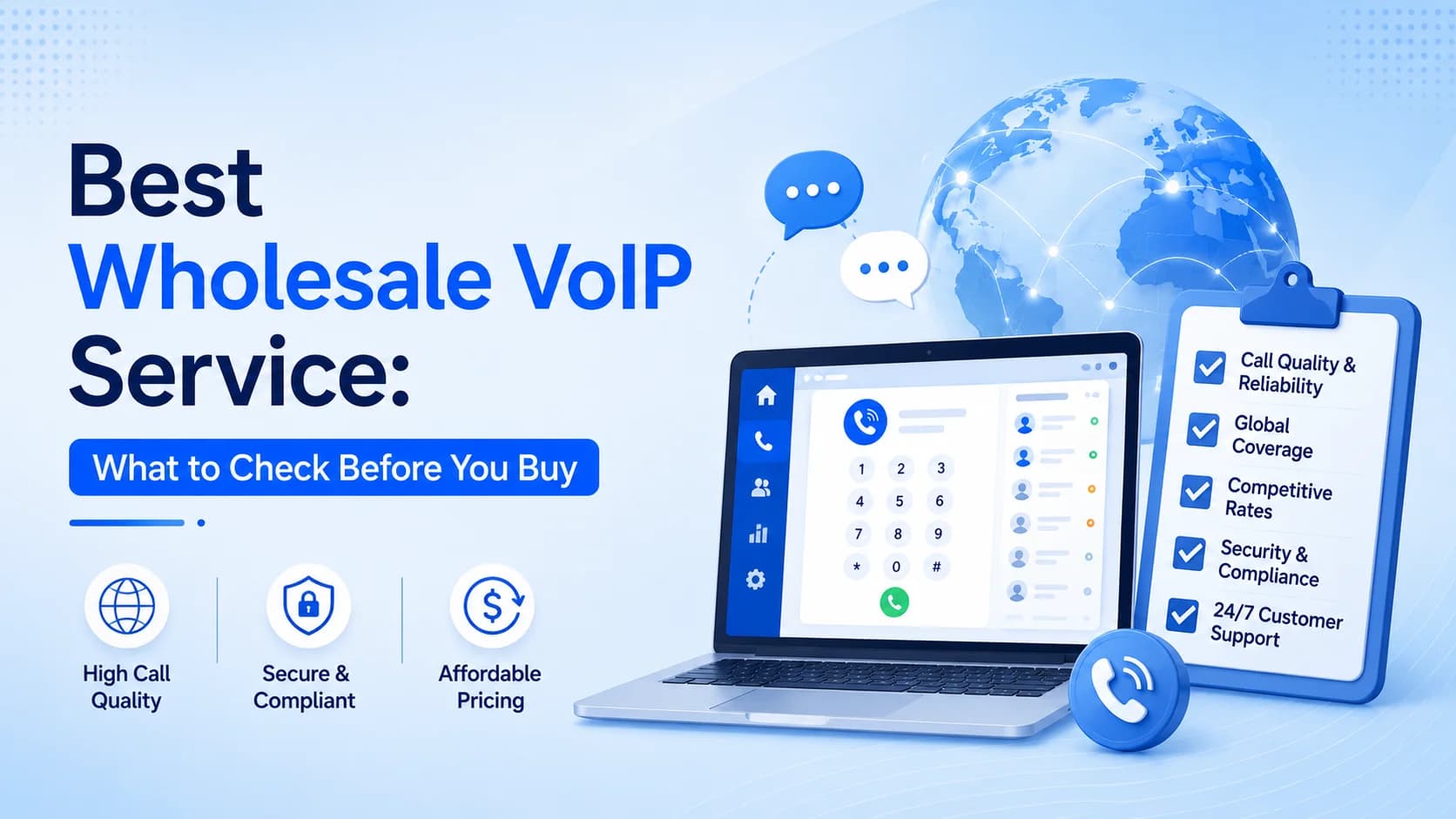
This list draws together the pricing, quality, compliance, and fraud-control points covered above into a single checklist to run against any provider before you commit volume.
- 01Owned carrier interconnects in your top destinations — not transit-only paths
- 02Per-destination wholesale VoIP rates published with billing increments and effective dates
- 03Live ASR, ACD, PDD, MOS per destination, accessible via API
- 04STIR/SHAKEN attestation on US-bound wholesale VoIP minutes, surfaced in CDRs
- 05Contractual SLAs with measurable financial credits for breaches
- 06Fraud controls — real-time spend caps, IRSF detection, blocked-prefix lists
- 07Both prepaid and postpaid options with seamless conversion
- 0824/7 NOC with 15-minute critical-incident SLA and named escalation contacts
Interconnects and rate transparency are the fastest to verify from public documentation; fraud controls and SLA terms are worth confirming directly, since they rarely appear in full on a pricing page.
Twiching's Wholesale VoIP Minutes
Twiching delivers wholesale VoIP minutes across 200+ countries on direct Tier 1 interconnects, with no hard minimum monthly commitment. Per-destination rates publish with billing increments and effective dates visible on every row. Small businesses access the same carrier-tier wholesale VoIP rates as large operators through traffic aggregation, and STIR/SHAKEN attestation runs inline on every US-bound call.
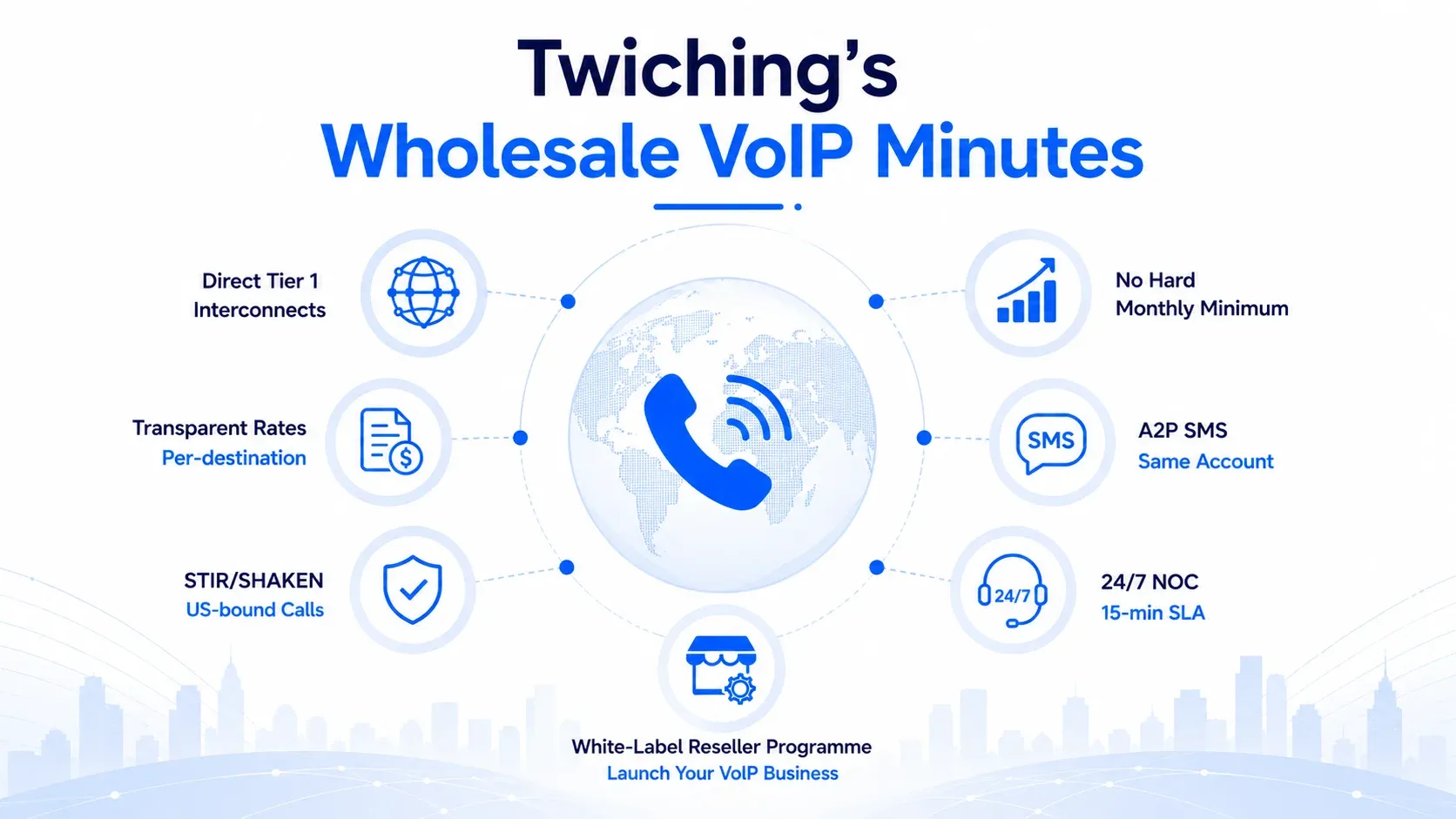
IRSF detection runs on streaming CDRs with hard spend caps, and A2P SMS bundles on the same billing account. A 24/7 NOC monitors the global wholesale VoIP minutes footprint with a 15-minute critical-incident SLA. Partners on the white-label reseller programme launch a branded wholesale VoIP minutes business on Twiching's carrier-grade infrastructure.
Wholesale VoIP minutes procurement becomes a strategic function at scale. Rather than reactive buying based on immediate traffic needs, sophisticated operators forecast traffic 90–120 days ahead and negotiate forward contracts that lock in favourable rates.
Carriers value predictability and price it accordingly — operators who provide reliable volume forecasts consistently receive better rates than spot buyers. Build your traffic forecasting capability early, as it becomes a competitive advantage in rate negotiations as you grow.
Conclusion
Wholesale VoIP minutes are commodity capacity wrapped in an infrastructure business. The per-minute rate is one input among many — billing increments, STIR/SHAKEN posture, IRSF controls, real-time CDR transparency, and contractual SLAs all bend real cost and real risk far more than the headline number.
Pick a wholesale VoIP minutes provider on owned carrier interconnects, transparent rate decks, and operational depth — not on the cheapest minute. Twiching is built around exactly that bar, so partners and enterprises buy wholesale VoIP minutes on carrier-grade infrastructure from day one without operating the underlying carrier themselves.