Introduction
ITSPs and channel resellers buy from a voip wholesale provider for one reason: carrier-grade voice infrastructure they can rebrand and resell without owning the licences or the softswitch. A partner-friendly provider ships sub-account billing, white-label SIP trunks, branded portals, and webhook-driven CDR streaming that plugs into the reseller's own billing engine.
This guide covers the partner-channel features ITSPs should demand, and how rate-deck markup determines resale margin.
What a VoIP Wholesale Provider Actually Is
A VoIP wholesale provider is a carrier-tier operator that delivers bulk voice services to other businesses — ITSPs, telecoms, ISPs, contact-centre platforms, resellers, and growing enterprises. The VoIP wholesale provider holds the licences, owns the softswitches, signs carrier interconnects, and runs the 24/7 NOC. Customers consume the result as SIP trunks, DID numbers, and per-minute termination on a published rate deck.
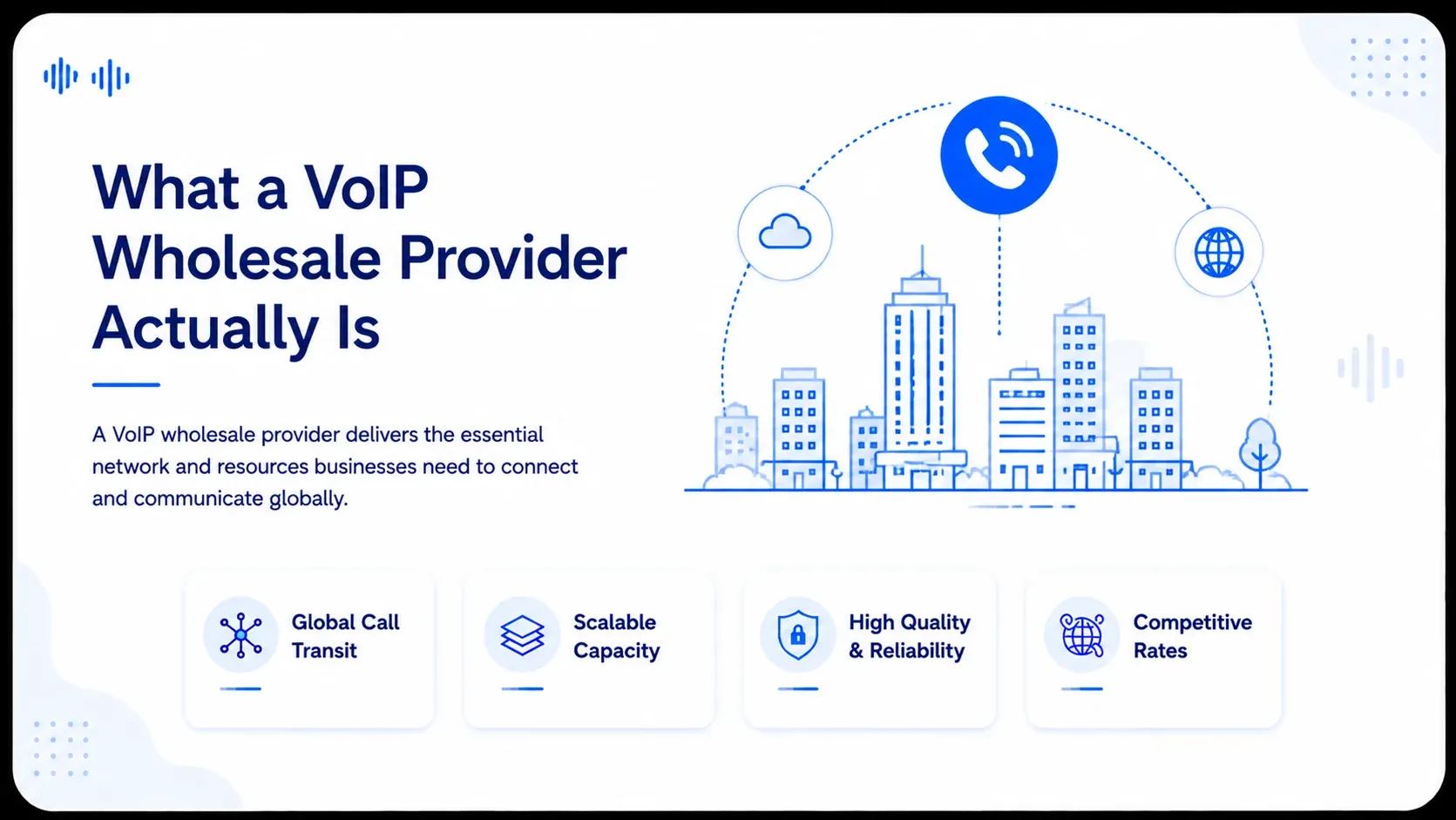
The category covers a wide quality spectrum. Tier 1 VoIP wholesale provider operators run direct interconnects with destination carriers in every major market. Thin resellers, by contrast, re-price minutes purchased from someone upstream and pretend to be a carrier.
The difference shows up immediately in ASR, billing accuracy, and how a real outage gets handled at 2am.
Core Services a Good VoIP Wholesale Provider Bundles
Further reading: Wholesale pricing & rate deck
A credible VoIP wholesale provider integrates a tightly bundled stack on one billing account. Splitting these across vendors is technically possible but operationally painful — reconciliation, fraud controls, and per-route quality scoring all break across mismatched stacks.
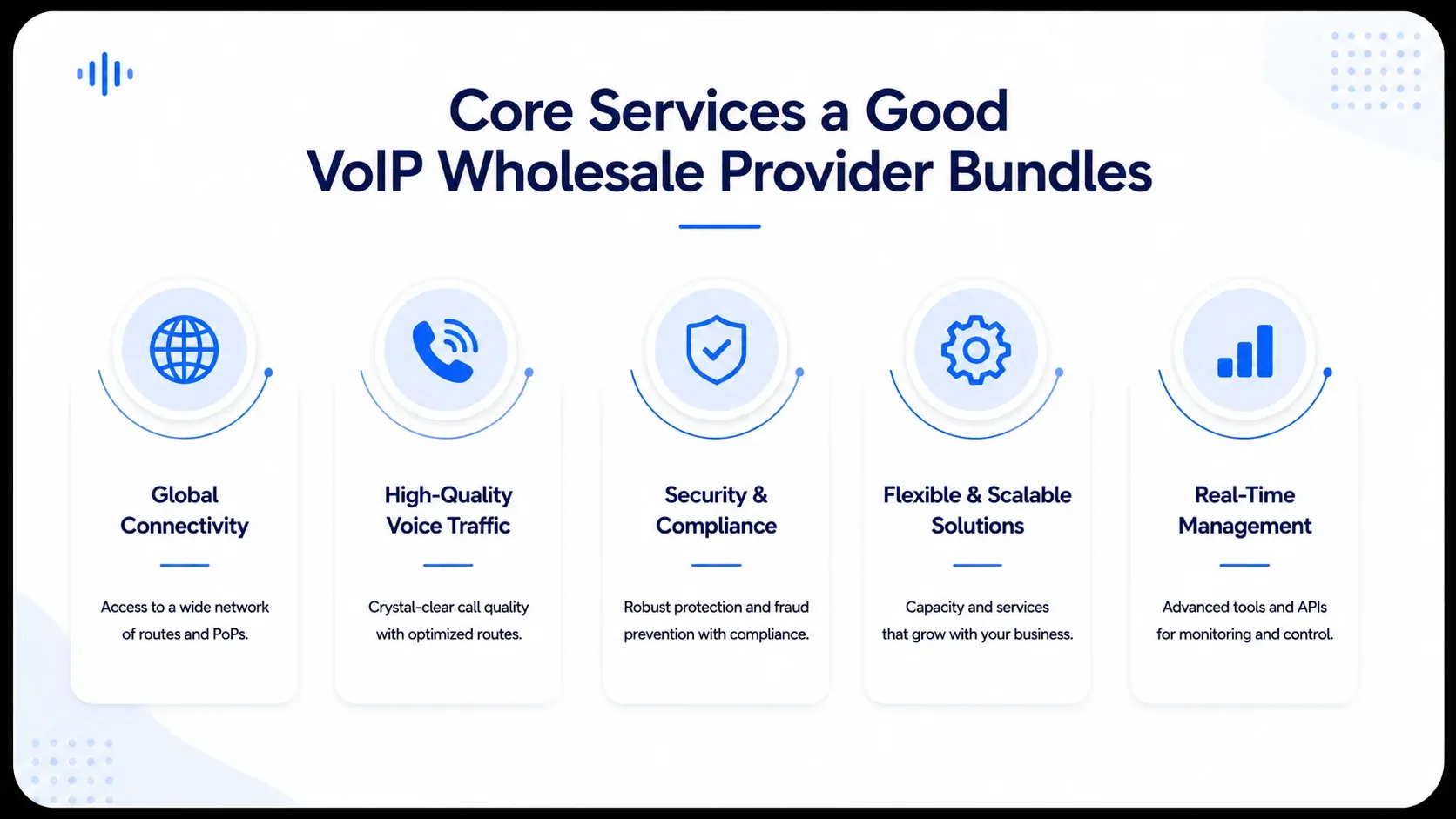
For an ITSP reselling under its own brand, the bundling matters even more than for a direct buyer — every one of these services needs to show up correctly on a sub-tenant's branded invoice, not just on Twiching's own.
- SIP trunking — direct PBX-to-carrier connectivity replacing legacy PRI
- Wholesale VoIP termination — outbound A-Z minutes via LCR routing across upstream carriers
- DID origination — local, mobile, and toll-free numbers across 100+ countries
- Number porting — clean transfer of existing DIDs from the incumbent VoIP wholesale provider
- A2P SMS — wholesale messaging on the same carrier relationships that carry voice
- STIR/SHAKEN attestation — embedded in the call path for US-bound traffic
- Real-time CDRs and programmable APIs — provisioning, rate-deck, and usage via REST
Evaluating Route Quality
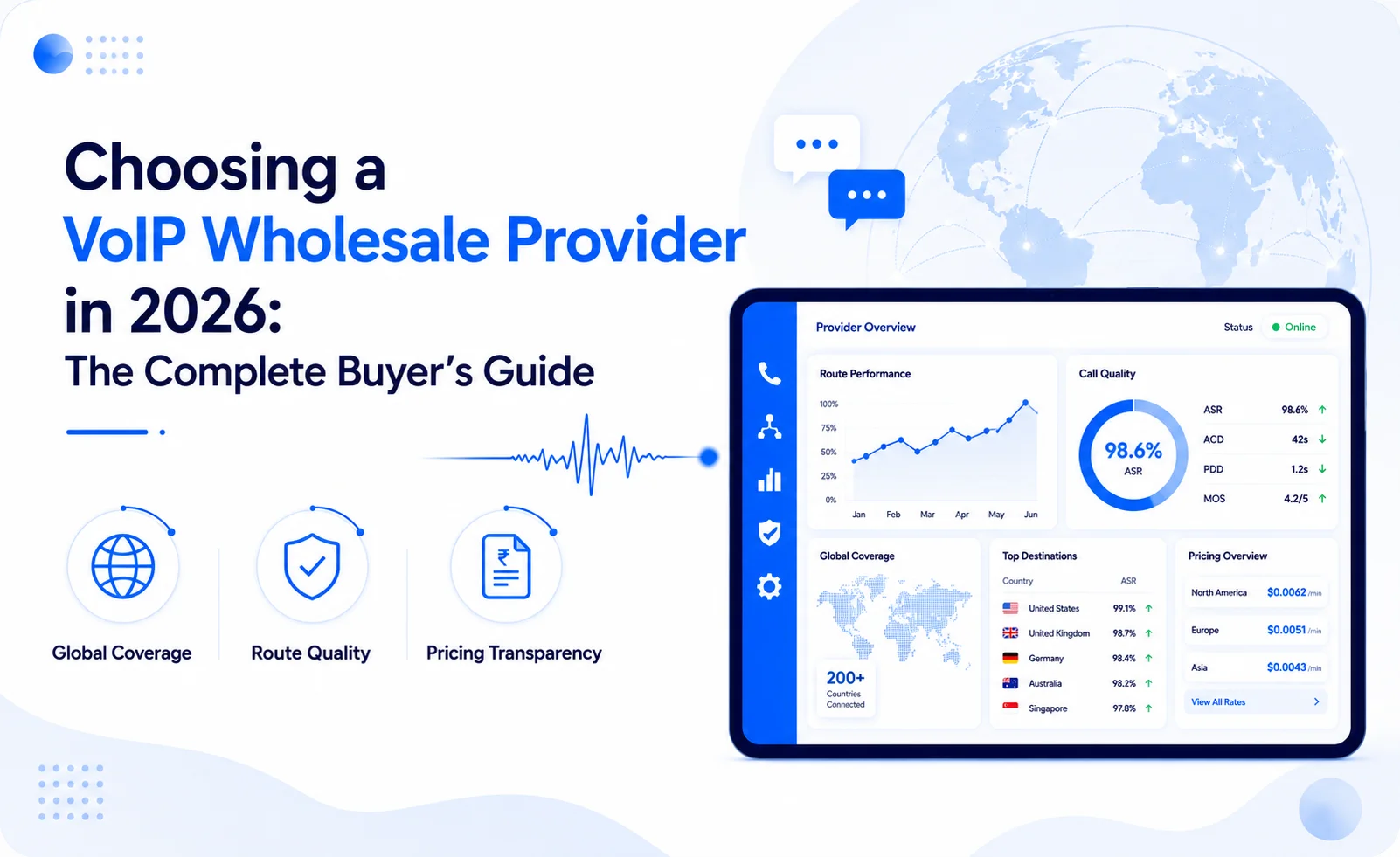
Route quality is what your retail customers actually hear. A serious VoIP wholesale provider streams CDRs into a quality engine that scores every route per destination on ASR, ACD, PDD, and MOS.
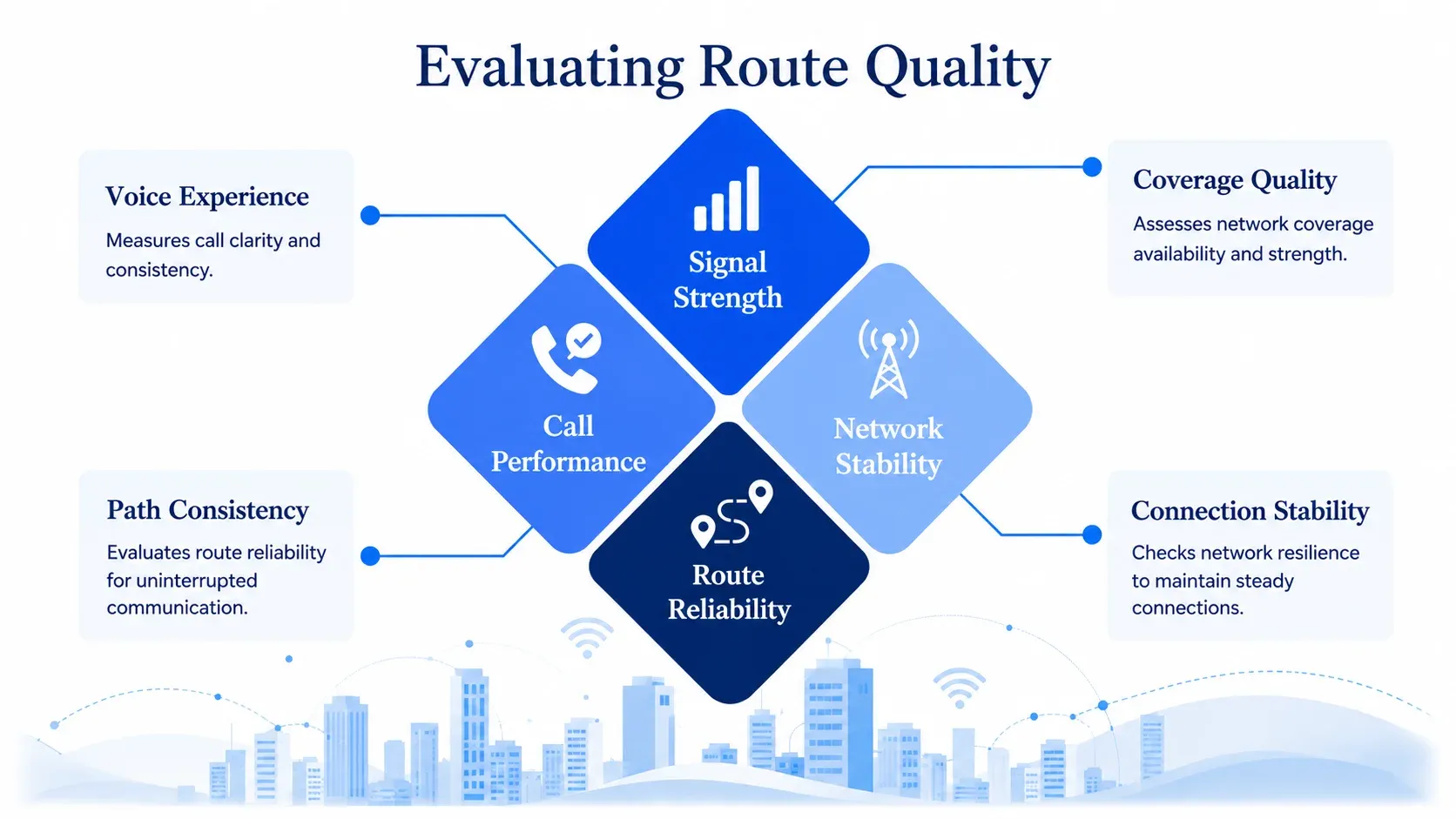
Degraded paths get demoted automatically from the LCR rotation until upstream carriers remediate. The customer dashboard exposes the same data the engineering team uses internally.
Before signing with any VoIP wholesale provider, run a test campaign. 500 to 1,000 minutes to your top destinations, measured for ASR, PDD, and subjective audio.
Run the test at peak times too — many providers look healthy at 11am UTC and degrade hard at 2am when destination carriers hit congestion. A VoIP wholesale provider unwilling to support live testing is hiding something.
Rate-Deck and Pricing Transparency
Further reading: Wholesale VoIP platform
Rate decks separate transparent VoIP wholesale provider operators from opaque ones. The deck should publish per-destination wholesale VoIP rates with the billing increment, currency, effective date, and quality class clearly listed. Hidden increments and surprise connection charges are the most common margin trap when comparing VoIP wholesale provider quotes.
Pricing models matter too. Per-minute pay-as-you-go suits volatile traffic; committed monthly minute pools unlock tiered discounts; hybrid contracts combine flat domestic termination with metered international.
A credible VoIP wholesale provider publishes all three structures. It lets you pick the one that fits your CDR profile — not the one that maximises their margin.
Fraud Protection and STIR/SHAKEN
IRSF (International Revenue Share Fraud) is the existential risk inside any VoIP wholesale provider relationship. A compromised customer trunk can generate six-figure exposure overnight if controls are not real-time. Effective VoIP wholesale provider platforms run several fraud controls in parallel.
The controls only work if they act inside the call window, not after a billing cycle closes. A spend cap that triggers a day later has already let the exposure happen — it just tells you how bad it got.
- Anomaly detection on streaming CDRs.
- Hard per-account spend caps.
- A blocked-prefix list refreshed continuously.
- Pausing traffic on the destination side the moment a pattern looks off.
STIR/SHAKEN attestation is now table stakes on US-bound traffic. A-attested calls get higher downstream ASR and fewer spam labels. A VoIP wholesale provider without integrated STIR/SHAKEN signing is quietly costing connection rates and brand reputation.
Outside the US, similar attestation and KYC frameworks are spreading across the EU, UK, and major emerging markets.
Modelling Total Cost — Not Just Per-Minute Rate
Picking a VoIP wholesale provider on the headline per-minute rate is one of the most common buyer mistakes. Total cost runs across several inputs beyond the headline rate.
Two providers quoting the same headline rate can land 15 to 20 percent apart once billing increments, DID rental, and FX handling are added in — and that gap is invisible until you model it against your own traffic.
- Per-minute usage.
- Monthly DID rental.
- SIP trunk fees.
- Optional features (recording, analytics, API).
- Billing increments.
- FX exposure on non-USD destinations.
- Fraud-loss exposure if controls are weak.
The right way to model VoIP wholesale provider cost is to take 3 to 6 months of historical CDRs. Apply each candidate provider's rate deck and increment to your real call mix, then add the fixed costs and any volume-tier discounts. A 10 percent gap on the per-minute rate often collapses entirely once realistic billing increments and DID rental are applied.
Voice + SMS Bundling at a Modern VoIP Wholesale Provider
Further reading: Wikipedia: VoIP overview
Modern VoIP wholesale provider platforms increasingly support A2P SMS alongside voice on the same carrier relationships, the same billing engine, and the same dashboard. For platforms shipping authentication codes, marketing campaigns, or transactional notifications, bundling voice and SMS at one VoIP wholesale provider collapses reconciliation overhead and unlocks better commercial tiers.
Twiching supports A2P SMS as a first-class product alongside wholesale VoIP termination, DID origination, and SIP trunking. Customers can manage both communication channels through a single provider relationship and one technical integration.
How to Onboard With a VoIP Wholesale Provider
A rushed cutover is the most common source of avoidable outages during a provider switch. The steps below keep an incumbent account live as a safety net until the new provider has proven itself on real traffic.
- 01Request a test account and confirm KYC takes under 48 hours
- 02Run a live test campaign on your top destinations at multiple times of day
- 03Review the rate deck against your historical CDR profile to model total cost
- 04Read the SLA carefully — uptime, ASR floors, financial credits for breaches
- 05Validate the dashboard and API support real-time CDR access and self-service DID management
- 06Plan a phased migration — parallel running with the incumbent for at least 30 days
- 07Keep the incumbent VoIP wholesale provider account active as a safety net during cutover
The last two steps are the ones teams most often skip under deadline pressure, and they're exactly the steps that turn a bad first week with a new provider into a contained problem instead of a customer-facing outage.
Twiching as a VoIP Wholesale Provider
Twiching operates as a carrier-grade VoIP wholesale provider purpose-built for ITSPs, contact-centre platforms, resellers, and growing enterprises that depend on reliable wholesale VoIP services. The platform combines direct Tier 1 interconnects across 200+ countries, full STIR/SHAKEN attestation on US-bound traffic, and real-time CDRs. It also includes IRSF anomaly detection with hard spend caps, A2P SMS alongside voice, and a 24/7 NOC with a 15-minute critical-incident SLA.
Onboarding completes in under 24 hours for standard business customers. The rate deck publishes per-destination wholesale VoIP rates with billing increments and effective dates visible on every row. Partners on the white-label reseller programme launch a complete branded VoIP wholesale provider service on the same carrier-grade infrastructure.
Conclusion
Choosing a VoIP wholesale provider is an infrastructure decision dressed up as a procurement decision. Route quality, rate-deck transparency, contractual SLAs, real-time fraud controls, STIR/SHAKEN attestation, and voice-plus-SMS bundling on one billing account separate a carrier-grade VoIP wholesale provider from a thin reseller.
Model total cost on your real CDR profile — not on the headline per-minute rate — and run a live test campaign before signing. Twiching is built around that bar, so partners and enterprises launch on a carrier-grade VoIP wholesale provider from day one and scale on competitive wholesale VoIP rates without operating the carrier themselves.