Introduction
Termination gets most of the attention in wholesale voice. It has per-minute rate decks, A-Z destinations and the metrics everyone tracks.
Origination, the inbound half, often gets treated as an afterthought: rent some DID numbers, point them somewhere, done. That is a mistake for any business where inbound calls matter.
Think of a support line, a sales number or a contact center's main queue. Origination has its own sourcing challenges, regulatory requirements, redundancy questions and pricing.
None of these map directly onto what buyers already know about termination. This guide covers origination as its own subject.
It explains how DID numbers get sourced and managed, and what happens to caller ID on the way in. It covers the E911 registration work for inbound numbers.
It shows how to design redundancy for a queue that depends on calls arriving. And it explains how origination is priced differently from termination.
What Wholesale VoIP Origination Actually Does
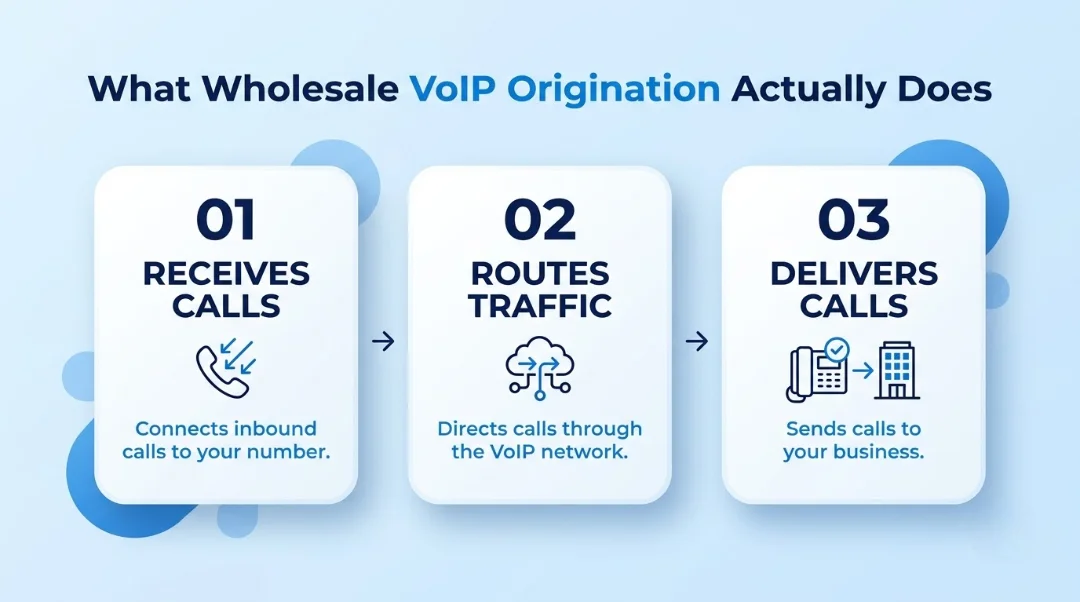
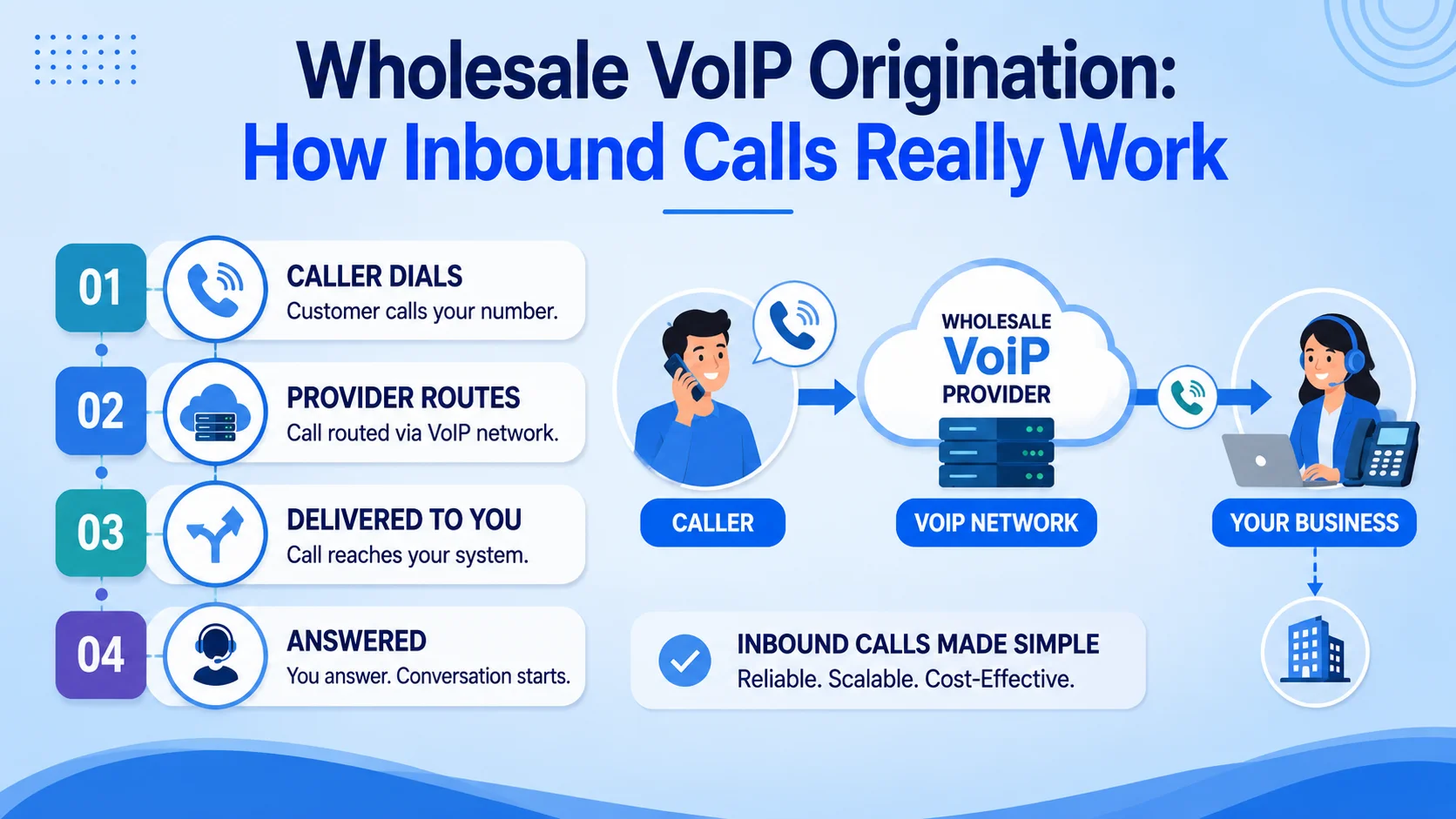
Origination routes a call from the public telephone network into your IP-based phone system. It is the inbound counterpart to termination's outbound delivery. Say someone dials a business's published number. The call enters the originating carrier's network. It is routed to whichever provider holds that DID. It lands on the business's PBX or UCaaS platform as a SIP call.
The distinction matters because origination and termination fail differently. They are also priced differently and need different due diligence. A termination problem means your outbound calls don't complete. An origination problem means customers can't reach you at all. For any business that depends on inbound contact, that is arguably the worse failure.
DID Sourcing and Number Inventory at Scale
For a handful of numbers, sourcing DIDs is simple. Pick a provider, request numbers in the area codes you need, and you're done. It gets harder at scale. That is especially true for platforms serving customers across many markets or countries.
- Geographic coverage — confirm the provider holds inventory in every market you need. Don't assume broad coverage. Some providers are strong in major metros and thin elsewhere
- Number pools and reservation — high-volume customers often need to reserve blocks of numbers through an API, not request each one by hand
- Vanity and toll-free availability — toll-free and desirable-number inventory varies widely. This matters if brand-relevant numbers are part of your requirement
- Number release and recycling — learn how long a released number stays out of circulation before reassignment. This matters for compliance and for avoiding inherited call history
A provider that can source numbers reliably in your actual markets matters more than total inventory size. A huge pool in the wrong geographies doesn't fix a real coverage gap.
Further reading: wholesale DID number sourcing
Porting Existing Numbers Into a New Origination Provider
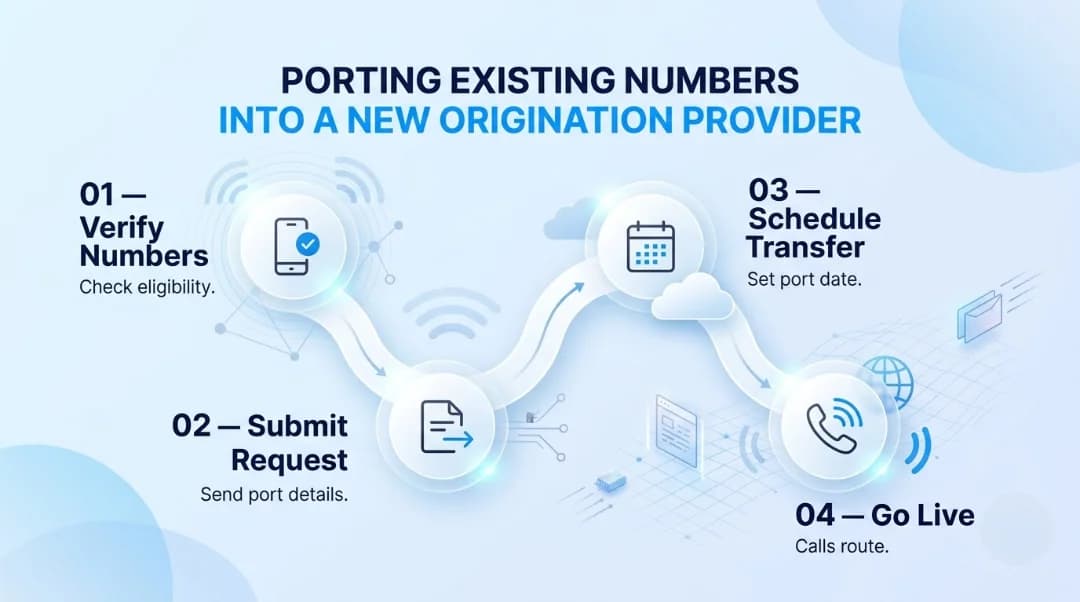
Sourcing new DIDs is only half the job for most established businesses. The other half is porting numbers that already exist. They are already printed on marketing materials and business cards, and in years of customer memory. Losing an established number during a provider switch is rarely acceptable. So understand porting before a migration, not during one.
A port starts with a Letter of Authorization (LOA). This is a signed document confirming the business has the right to move the number. The gaining provider submits it to the losing carrier. The losing carrier then has a regulated window to release the number. For standard US ports, this is commonly two to four weeks. Timelines vary with carrier responsiveness and number type. Toll-free numbers port differently. They use the Responsible Organization (RespOrg) system, not standard LNP. They can finish faster when both parties respond quickly.
- Snapback risk — a port that isn't fully completed can sometimes revert to the losing carrier. Verify the port actually finished. Don't assume it did because calls seem to work
- Service continuity during the port — calls to the number should keep working throughout. A poorly coordinated port can leave a gap where the number routes nowhere
- Documentation accuracy — LOA details must match the losing carrier's account records exactly. These are the business name, address and authorized signer. Mismatches are the most common cause of port rejections and delays
Plan the porting timeline with real slack. Don't assume the fastest-case estimate. Otherwise a business may commit to a cutover date the port can't support.
CNAM and Caller ID Delivery on Inbound Calls
Caller Name Delivery (CNAM) lets a receiving phone show a name, not just a raw number. It works differently than most buyers assume. CNAM data lives in a separate database from the number itself. The terminating carrier queries it at call time. So caller ID name isn't necessarily bundled with origination service. CNAM lookup accuracy also varies a lot between providers and databases.
The same goes for your own outbound caller ID, which is the name customers see when you call them. Registering it is a separate, deliberate step. You register the business name against your DIDs in the CNAM databases the major carriers query. Skip this step and outbound calls can show as "Unknown" or a generic listing. That happens even when the number is correctly provisioned.
E911 and Regulatory Registration Specific to Origination
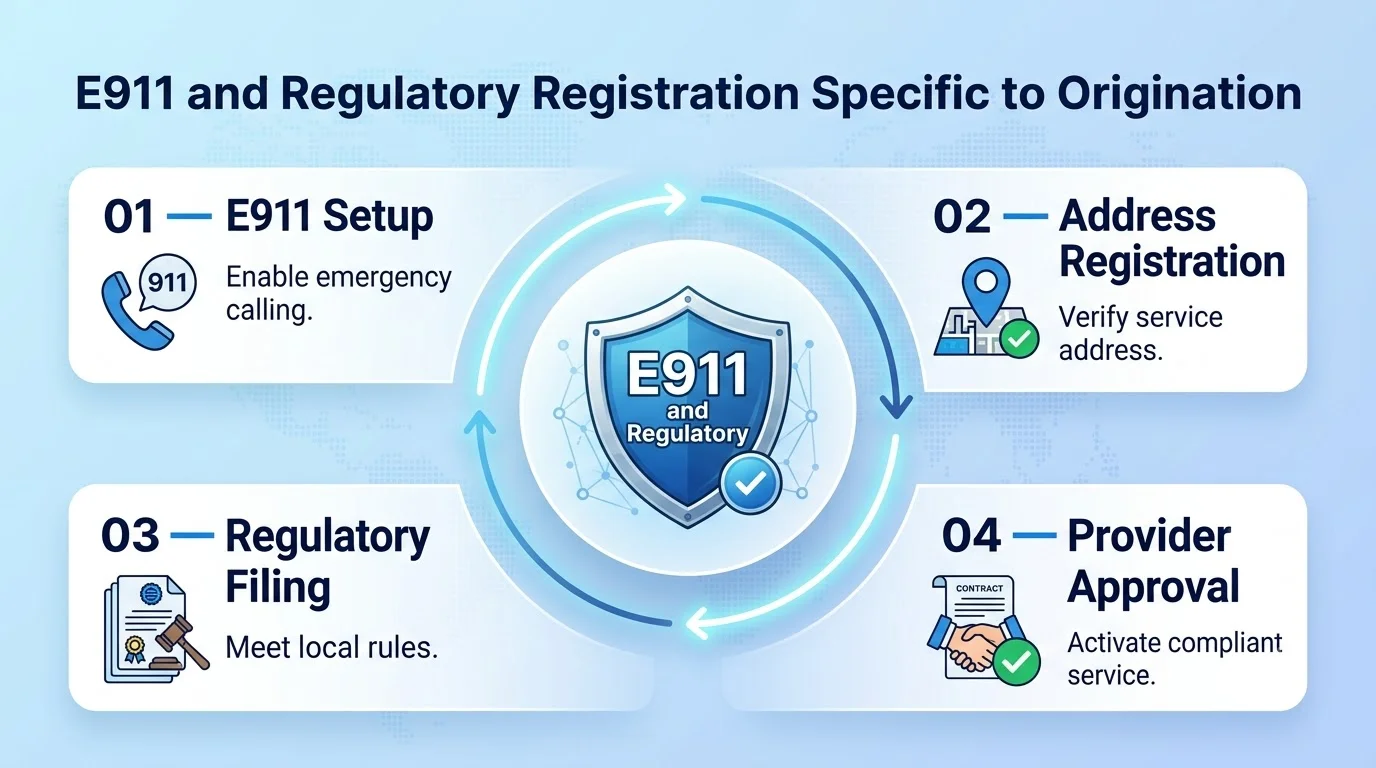
Every DID that can place or receive calls in the US needs an E911 address on file. This is an origination-side responsibility. It is separate from the STIR/SHAKEN attestation work, which sits mainly on the termination side. An emergency call from an extension must report a physically accurate location to dispatch. That accuracy depends on keeping the address registered against that DID current.
At scale, this becomes a real operational task. Say an extension moves, for example a new hire, an office relocation or a remote employee changing location. The E911 registration for that DID must be updated to match. It should not keep pointing at wherever the number was first provisioned. Businesses with distributed or remote teams carry more of this ongoing work than a single office does. It is easy to let slip, because nothing visibly breaks until a real emergency call exposes a stale address.
Further reading: FCC: MLTS 911 Requirements
Designing Redundancy for Inbound Call Delivery
Redundancy for origination is a different design problem than failover for outbound termination. The question isn't how many concurrent calls you can handle. It is whether an inbound call can reach you at all if your primary carrier, internet connection or PBX has a problem.
A properly redundant setup usually makes the DID reachable through more than one carrier path. Or it has a documented forwarding failover. For example, a call that fails to reach the primary SIP trunk can forward automatically to a backup. That might be a mobile number or a secondary system. It should not just ring to nothing. Test this failover on purpose before you need it. Don't assume it works because it is configured. The same principle applies to any continuity plan.
Further reading: wireless failover for business phone systems
How Origination Pricing Actually Works
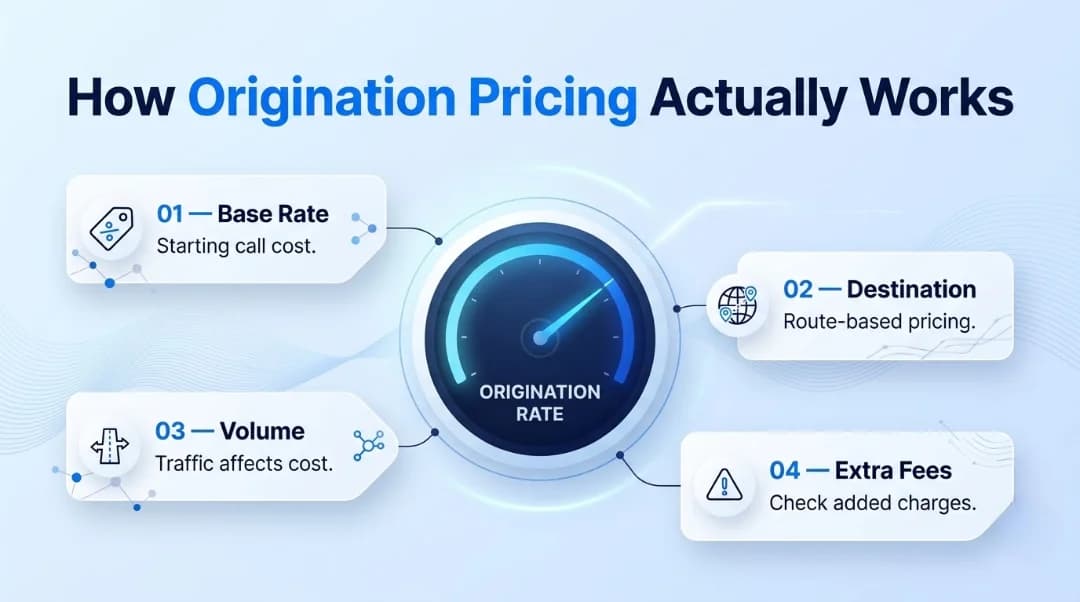
Origination pricing is structured differently from termination. It helps to understand this before comparing quotes. Most origination pricing combines two charges. One is a recurring monthly per-DID fee, which covers holding the number in inventory. The other is a per-minute inbound usage rate. That rate is typically lower than comparable termination rates. Origination doesn't carry the same interconnection costs on most routes.
Toll-free origination is priced differently again. The receiving business pays for inbound minutes that the caller doesn't. So toll-free per-minute origination rates run noticeably higher than local DID rates. Businesses with high toll-free inbound volume should model that per-minute cost carefully. Don't focus only on the per-DID monthly fee. At volume, usage charges typically outweigh the flat monthly cost by a wide margin.
Verifying an Origination Setup Before Go-Live
An origination setup can look correct on paper and still fail. DIDs may be provisioned, routing rules entered and CNAM submitted. Some problems only show up once real calls arrive. That is why verification before full cutover matters as much as the configuration work.
- Call from multiple carriers and geographies — a number that works from one mobile carrier can behave differently from a landline or another regional carrier. Routing paths aren't uniform across the network
- Confirm CNAM displays correctly — test from a phone that queries the database your registration targets. A registration that didn't propagate fails silently, with no error on your end
- Trigger the failover path on purpose — take the primary destination offline in a controlled test window. Confirm calls actually reach the backup path. Don't trust the configuration without seeing it work
- Verify E911 with the real registered address — some providers offer a test to confirm the address on file resolves correctly. Use it. Don't assume the entry was made without error
None of this verification is exotic. It is the same discipline you'd apply to any production system before it carries real traffic. Businesses that skip it find a CNAM gap through a customer complaint. Or they find a bad E911 address during a real emergency. Both are avoidable with an hour of deliberate testing before go-live.
Conclusion
Wholesale VoIP origination isn't a simpler, lesser cousin of termination. It is a distinct discipline.
It has its own sourcing issues, regulatory upkeep, failure modes and pricing logic. A business that treats origination as an afterthought, with numbers acquired once and never revisited, is the business that finds a stale E911 address during an emergency.
It finds a missing CNAM registration through a customer complaint. Or it finds a broken failover path during a real outage.
Origination deserves the same deliberate evaluation most buyers already give termination. The cost of getting it wrong shows up exactly when a customer is trying to reach you and can't.