Introduction
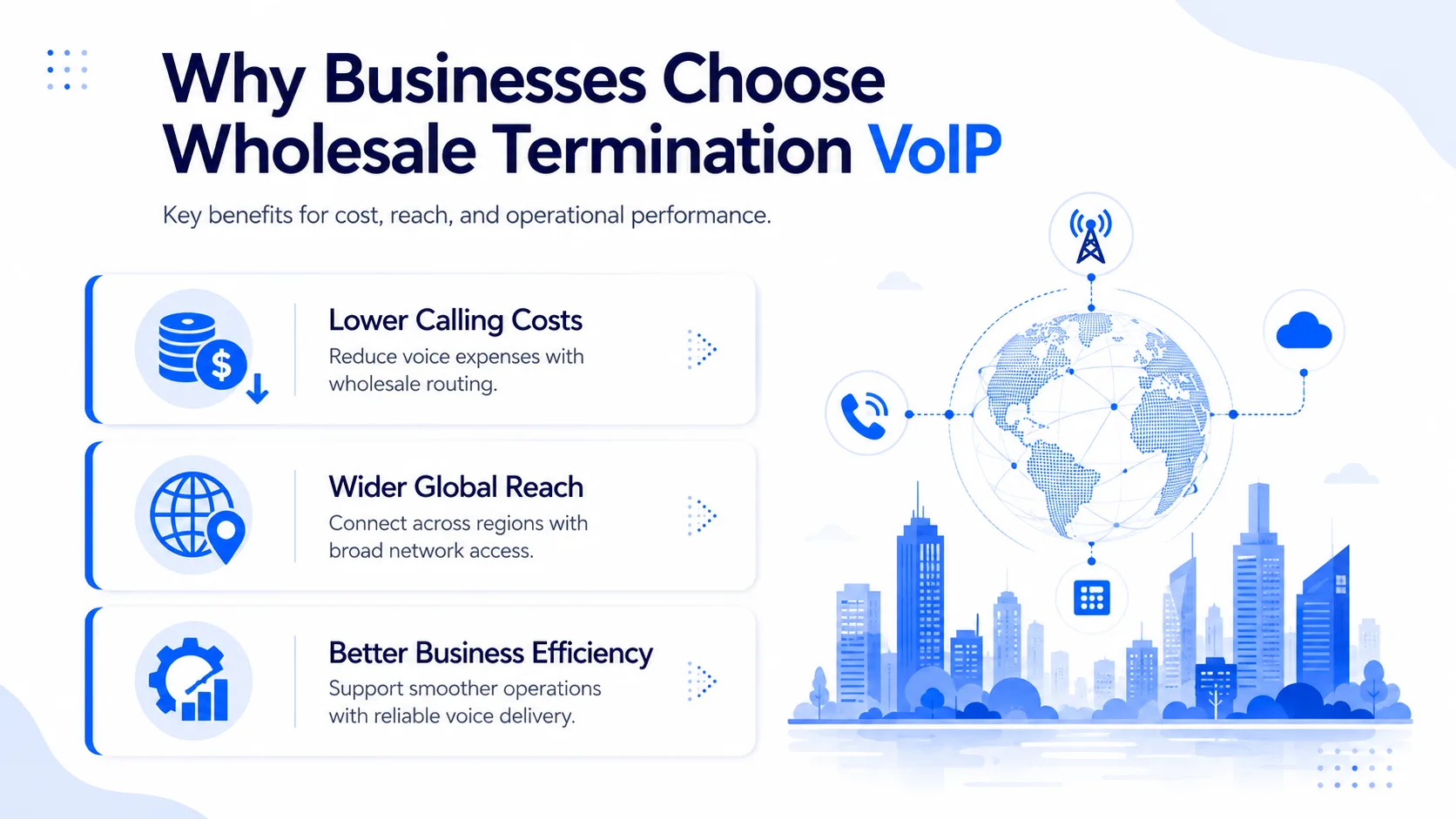
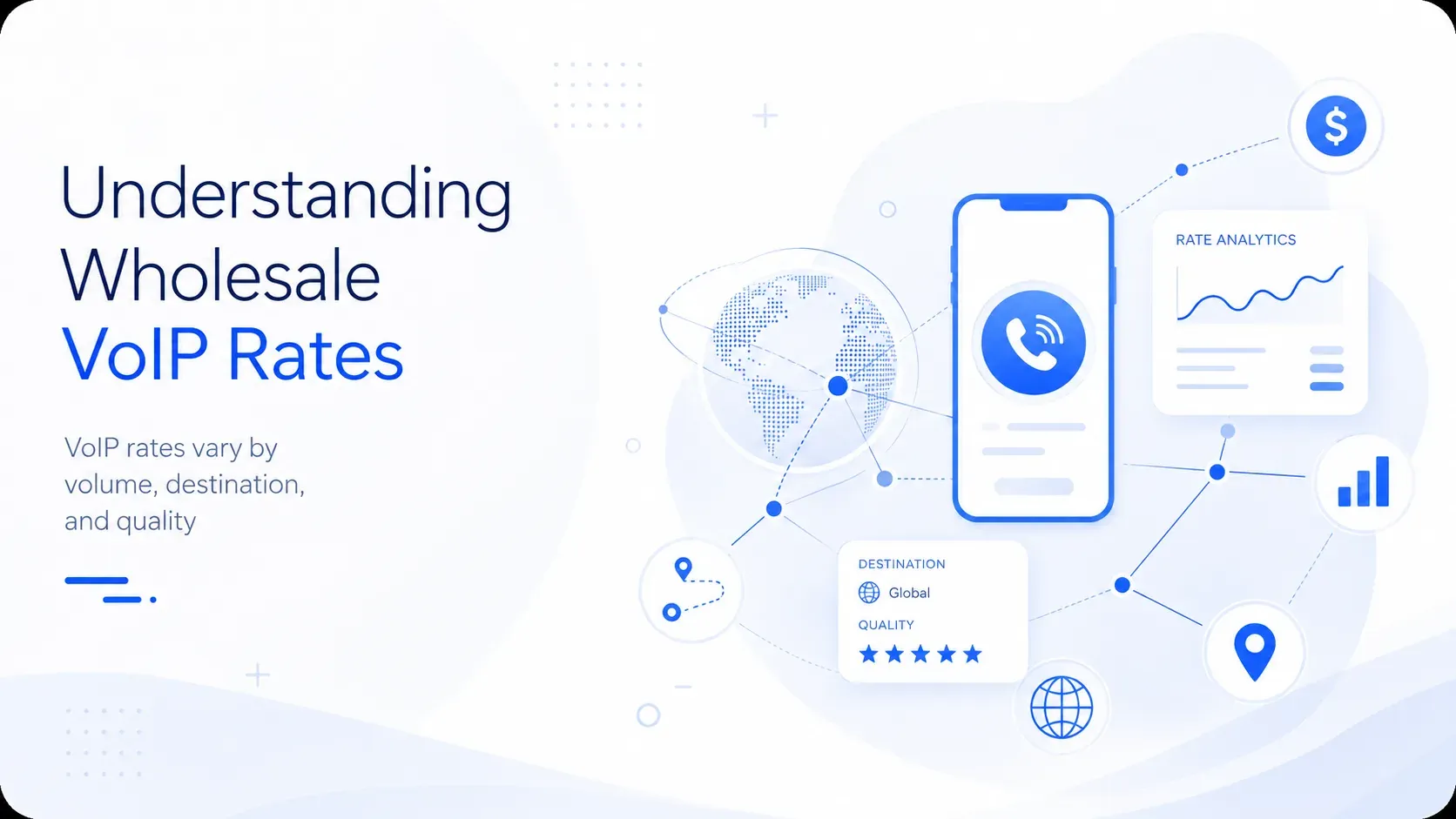
Understanding wholesale voip rates is key to running a profitable voice over IP business. Per-minute price gaps that look small on their own add up across millions of monthly minutes, deciding who wins on price and who keeps healthy margins.
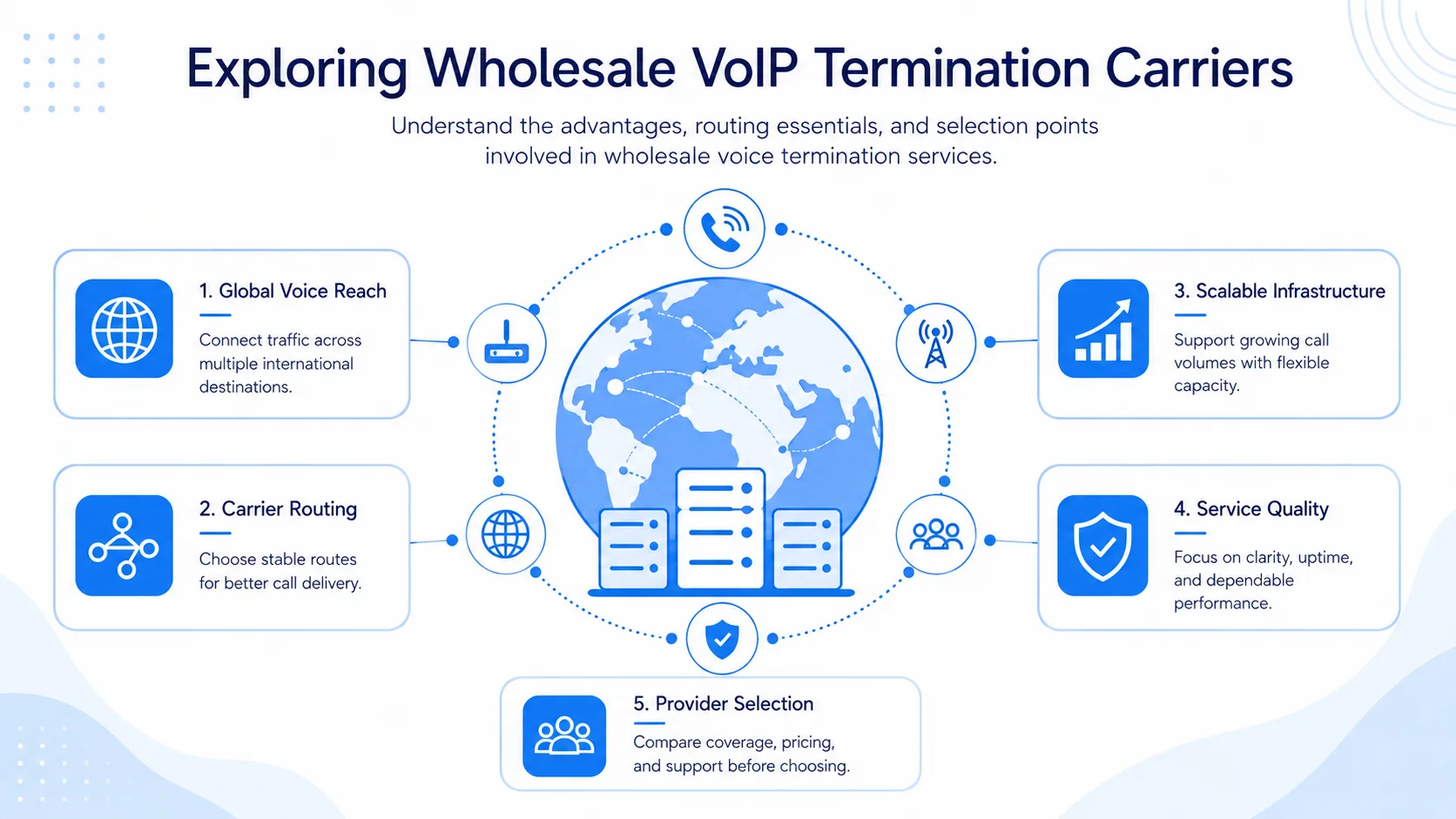
This guide covers how rates are structured, the market forces that drive pricing in different corridors, and the negotiation moves that unlock the best terms.
How Wholesale VoIP Rates Are Structured
Wholesale voip rates are set as per-minute charges in US dollars or local currency. They depend on destination, billing increment, and any surcharges for number types such as mobile, premium, or special service numbers.
Standard billing uses six-second increments after an initial minimum duration. This helps customers with longer average call times, compared to flat per-minute billing.
Some providers offer one-second billing at slightly higher per-minute rates. This can save money for traffic made up mostly of short calls, such as automated dialer campaigns.
Market Forces Driving Wholesale VoIP Pricing
Further reading: wholesale voice rates
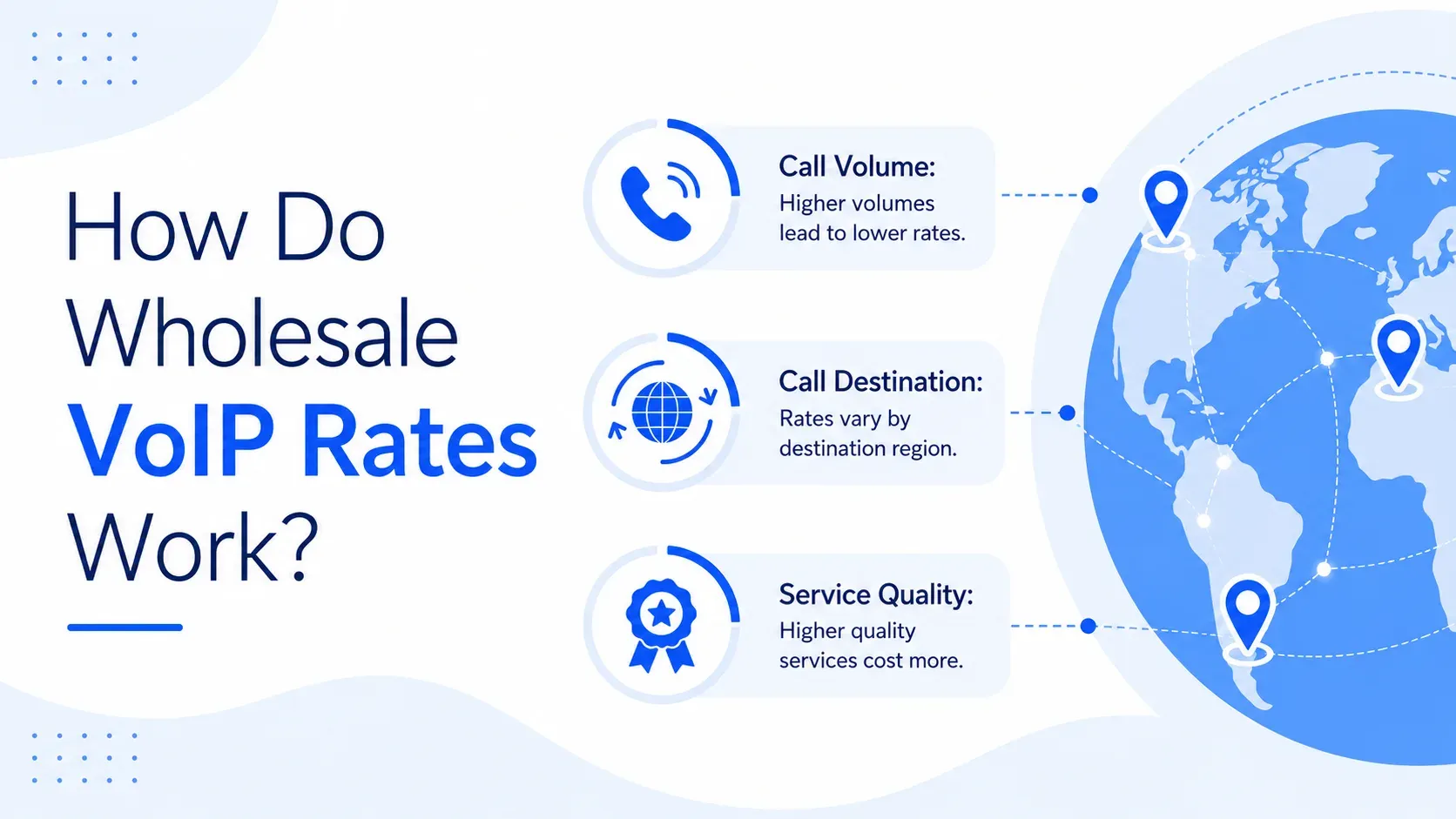
Several linked market factors set wholesale voip rates at any point in time. Traffic volume on specific corridors is the main driver: routes with high monthly minutes draw more competing carriers. This drives prices down.
Regulatory costs in destination countries also shape pricing. Interconnection fees and termination taxes set by local regulators get built into carrier rates.
Currency swings affect global routes priced in local currency. Political events can also disrupt specific markets, causing short-term rate swings on those routes.
Geographic Pricing Variation
Wholesale voip rates vary a lot by region, based on market competition and infrastructure costs in each country.
High-traffic, competitive markets like the US, UK, Germany, Australia, and Japan have among the lowest rates worldwide. Domestic termination on the most competitive routes costs a fraction of a cent per minute.
Remote destinations in equatorial Africa, island territories, and politically isolated markets carry much higher rates. These can run fifty to one hundred times higher than major markets. This reflects the low competition and high cost of serving these places.
Mobile vs. Fixed-Line Rate Differences
Wholesale voip rates differ a lot between fixed-line and mobile numbers in the same country. Many buyers underrate this gap when they forecast communication costs.
Mobile termination rates are higher because mobile carriers charge interconnection fees when calls reach their networks. These fees flow through the wholesale price.
Businesses whose customers mainly use mobile phones will pay much higher average per-minute costs than those with mostly fixed-line traffic. Check your traffic mix by number type before you compare carrier quotes.
Strategies for Negotiating Better Rates
Getting good wholesale voip rates takes prep work and market know-how. You also need to show providers that your traffic is worth their business.
The best base for rate talks is a detailed traffic breakdown. Show your volumes by destination, time of day, and number type.
Carriers always offer better wholesale voip rates to buyers with clean, high-quality traffic, steady monthly volumes, and a track record of paying on time. Uneven patterns or missing data make it harder for carriers to judge profit, so they price in that risk.
Volume Commitments and Tiered Pricing
Most wholesale VoIP carriers set their pricing tiers around volume commitments. Committing to a minimum monthly traffic volume unlocks better wholesale voip rates for top destination groups.
These commitments pay off when your traffic is steady. The per-minute savings across the committed volume usually beat the cost of any shortfall. This holds even in months when traffic falls a bit below target.
Always base commitment tiers on your real past traffic data, not hopeful growth forecasts. Overcommitting to volumes you can't reliably hit leads to shortfall penalties. Those penalties cancel out the rate gains you expected.
Competitive Benchmarking Process
Keeping an accurate picture of current wholesale voip rates across several providers is key to spotting when your existing deals fall behind the market.
Set up a quarterly check that asks for updated rate decks from three to five providers, then compares rates on your twenty highest-volume destinations.
The market shifts fast. Rates on competitive routes often drop a lot over six to twelve months as new carriers enter and better tech cuts infrastructure costs.
Regular checks capture these market gains. Otherwise, you keep paying rates set under older, worse terms.
Building an Optimized Rate Portfolio
Further reading: Wholesale VoIP platform
Treating your carrier list as a living asset, not a fixed setup, lets you keep improving wholesale voip rates across all destinations.
Different providers offer better rates on different destination groups, based on their carrier ties and own network infrastructure. Spreading traffic wisely gives a better overall cost than putting it all with one supplier.
Build a routing chart that assigns each destination to the provider with the best mix of quality and price. Update it often as provider pricing changes and new options appear.
Fraud Risk and Cost Control
Call fraud is a big cost risk that often gets overlooked. It can quickly wipe out the margin gains from well-negotiated wholesale voip rates.
IRSF schemes create fake call volumes to high-rate remote destinations. This builds large surprise charges fast, before detection systems can react.
Set up several fraud controls:
- Per-account spending limits with real-time velocity monitoring
- Geographic blocking for destinations your customers have no legitimate reason to call
- Automated suspension triggers for anomalous traffic patterns
These controls protect the cost structure that competitive rate agreements are built to create.
Billing Accuracy and Invoice Reconciliation
Accurate billing checks confirm the wholesale voip rates you're charged match your contract. They also confirm CDR counts match between your records and your provider's.
Even small per-minute gaps multiply across millions of monthly minutes into a big financial hit. That makes regular checks a worthwhile investment.
Compare your internal CDR exports against provider invoices every billing cycle. Flag any gaps for formal dispute within the contract's dispute window. Pick providers who make this easy with detailed CDR exports in standard formats, not ones who make checking hard.
Future Trends in Wholesale Voice Pricing
Further reading: ITU Telecom Statistics
Wholesale voip rates on competitive routes keep trending down over the long term. This comes from more carrier competition and better internet infrastructure. It's also driven by the global shift from TDM to all-IP telecom networks.
This trend should continue as new entrants cut margins on set routes. AI-powered routing also lets carriers manage traffic better with lower infrastructure costs.
Businesses that keep improving their carrier lists and keep pressure on their providers will capture these market gains. This keeps their costs low and running well.
Building Long-Term Carrier Partnerships
Beyond better rates, the most successful operators in the wholesale voice market build real partnerships with their carriers, built on mutual value and trust.
Carriers who trust your traffic quality and payment reliability offer real benefits:
- Preferential wholesale voip rates
- Priority for your traffic during congestion events
- Collaborative support when quality issues arise
Keep in regular touch with your account managers, pay invoices on time, and keep traffic clean with strong fraud controls. These habits earn you benefits that go well beyond the rates offered to one-off customers.
The clearest sign of a mature partnership is how a carrier acts when something goes wrong. One-off buyers usually learn about an outage from a customer complaint, then chase the carrier for an update. True partnerships work the other way around.
The account manager picks up the phone before the alert reaches your NOC. The network engineering team shares route-level telemetry without waiting for an RFI.
A written incident report arrives within forty-eight hours. It covers the root cause, the fix, and a credit that needs no dispute.
Carriers extend this level of service only to buyers who give back. That means:
- Paying on time
- Keeping fraud controls tight enough that the carrier never has to chase a chargeback
- Delivering volume forecasts that prove accurate month after month
Quarterly business reviews are the rhythm that turns a vendor relationship into a partnership.
The format doesn't need to be fancy. A ninety-minute session can cover volume trends, buy-rate changes, and ASR and ACD by region. It can also cover the top three quality issues of the period.
Round it out with the top three improvement ideas for the next period and a shared outlook for the coming quarter.
Just having this regular rhythm shows the carrier you run a disciplined operation. That unlocks better treatment that never shows up on a rate sheet.
That treatment includes:
- Early access to new routes
- Willingness to absorb a temporary loss on a strategic destination
- Proactive flagging of upstream changes weeks before they hit the published deck
Operators who skip QBRs always find out about the same changes through invoice surprises.
Finally, partnerships grow through give and take:
- Refer other buyers who fit the carrier's ideal traffic profile
- Give honest references in their sales process when asked
- Provide real feedback when a new product or routing feature is being tested
Carriers reward this kind of effort with real commercial perks. These include better commit-to-buy multipliers, longer credit terms, and the occasional off-cycle rate review when the market moves your way.
Over five years, the total value of these perks on a high-volume account easily beats the savings from one tough annual renegotiation. The relationship keeps compounding, instead of resetting every twelve months.
Treat each carrier as a long-term ally. The wholesale voip rates you get will keep improving long after the rest of the market levels off.
Conclusion
Mastering the business and operational sides of wholesale VoIP pricing takes steady focus and clear processes, not one-off effort. Building strong analysis skills, keeping active provider ties, and preparing well for rate talks will consistently bring better pricing outcomes.
Even small per-minute gains across high monthly traffic volumes add up into big financial gains. These translate directly into a stronger market position, better margins, and the ability to reinvest in service quality that builds customer loyalty and long-term growth.