Introduction
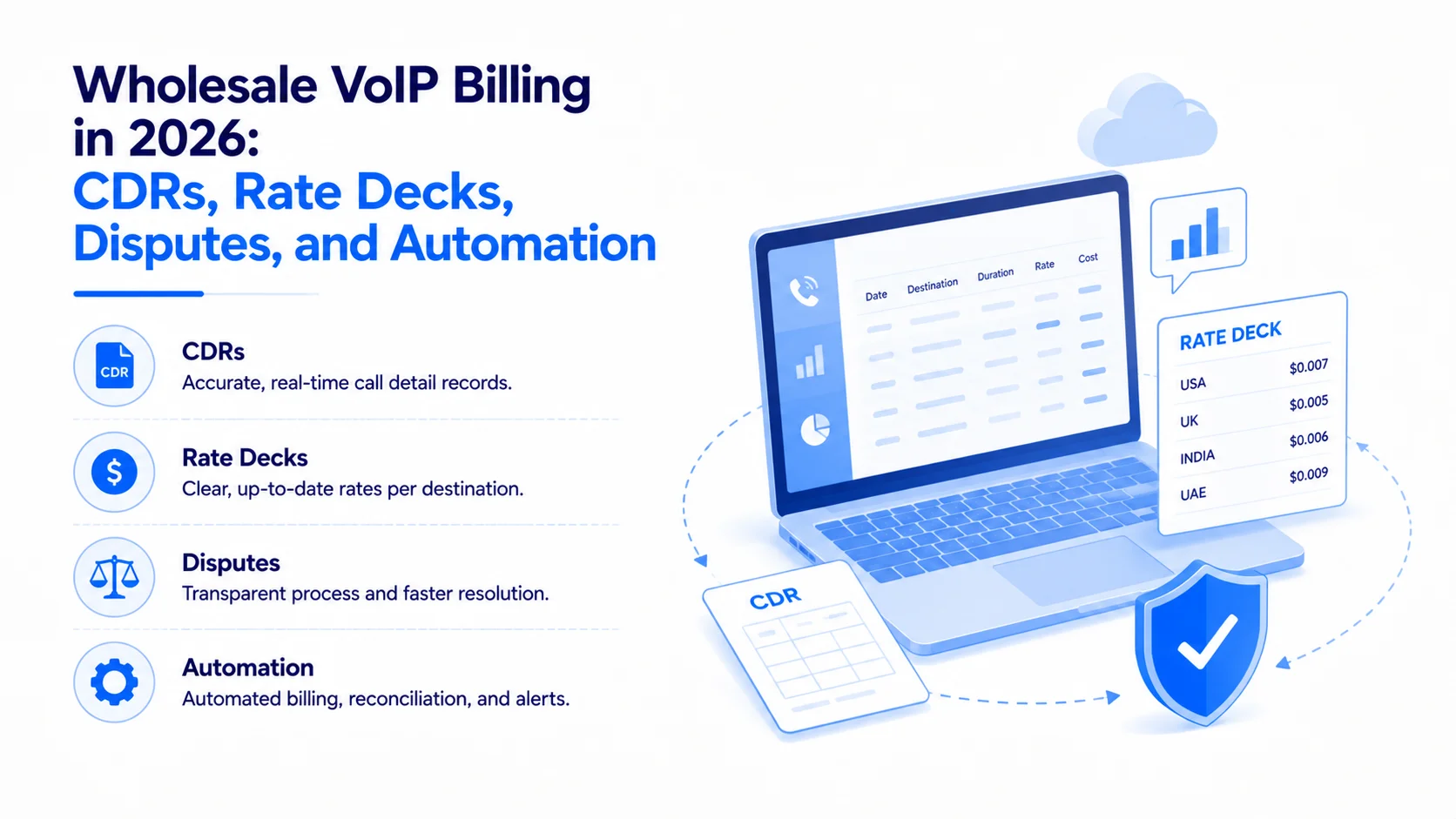
Wholesale VoIP billing is the engine that turns voice traffic into invoices. Every call generates a CDR that the engine rates against the per-destination rate deck, producing an invoice that should reconcile exactly with the customer's own data. Done badly, it's the most common source of customer disputes in wholesale voice.
What Wholesale VoIP Billing Actually Does
Wholesale VoIP billing is the rating, invoicing, and reconciliation engine. It sits between the voice traffic on a softswitch and the customer's invoice at the end of the period. Every call generates a CDR (Call Detail Record) capturing origin, destination, duration, route, and disposition.
The wholesale VoIP billing engine rates that CDR against the applicable per-destination rate deck and billing increment. It applies any volume tier discount and writes the result into the customer ledger.
For a wholesale VoIP carrier, the billing engine is as load-bearing as the softswitch itself. A platform that rates calls accurately, exposes CDRs in real time, and handles disputes with documented evidence trails stands apart. It separates a professionally run wholesale voice business from one that loses customers to billing surprises every quarter.
CDRs: The Source of Truth for Wholesale VoIP Billing
Further reading: Wholesale pricing & rate deck
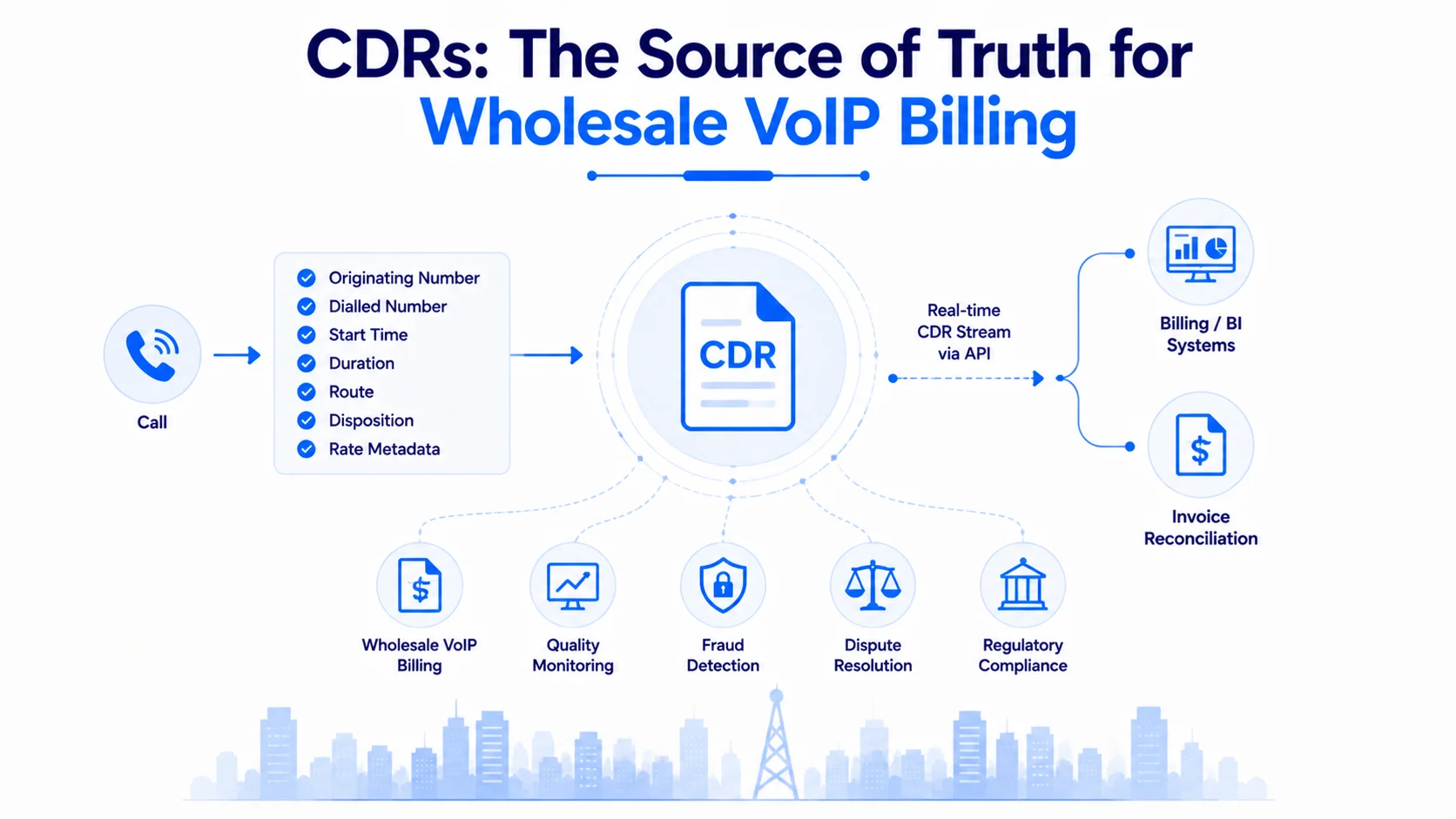
A CDR is the structured data record generated for each call. It captures the originating number, dialled number, start time, duration, route, disposition (answered, busy, failed), and any rate metadata applied. CDRs are the single source of truth for wholesale VoIP billing, quality monitoring, fraud detection, dispute resolution, and regulatory compliance reporting.
A serious wholesale VoIP billing platform streams CDRs in real time via API. Customers feed the stream into their own billing or BI systems and reconcile against the carrier's invoice on rolling basis rather than scrambling at end-of-month. Wholesale VoIP billing platforms that batch CDRs daily or weekly are operating a generation behind any carrier-grade peer.
Billing Increments: 6-Second vs 30-Second vs 60-Second
Billing increments determine the minimum billable unit for each call. Common wholesale VoIP billing increments are 1/1 (1-second initial, 1-second steps), 6/6, 30/6, and 60/60. For contact-centre and outbound-dialler traffic with many short calls, 6-second billing helps a lot.
It can reduce effective per-minute cost by 30 to 50 percent compared to 60-second billing on the same traffic. The headline per-minute rate looks identical, but the real cost is materially different.
Any credible wholesale VoIP billing platform publishes the billing increment alongside the per-minute rate on every destination row. Hiding the increment is one of the oldest tricks in opaque telecom pricing, and the math eventually catches up at audit. Always negotiate 6/6 or 1/1 increments for short-duration traffic, and read the rate deck for the increment column before agreeing the price.
Prepaid vs Postpaid Wholesale VoIP Billing Models
Further reading: Wholesale VoIP platform
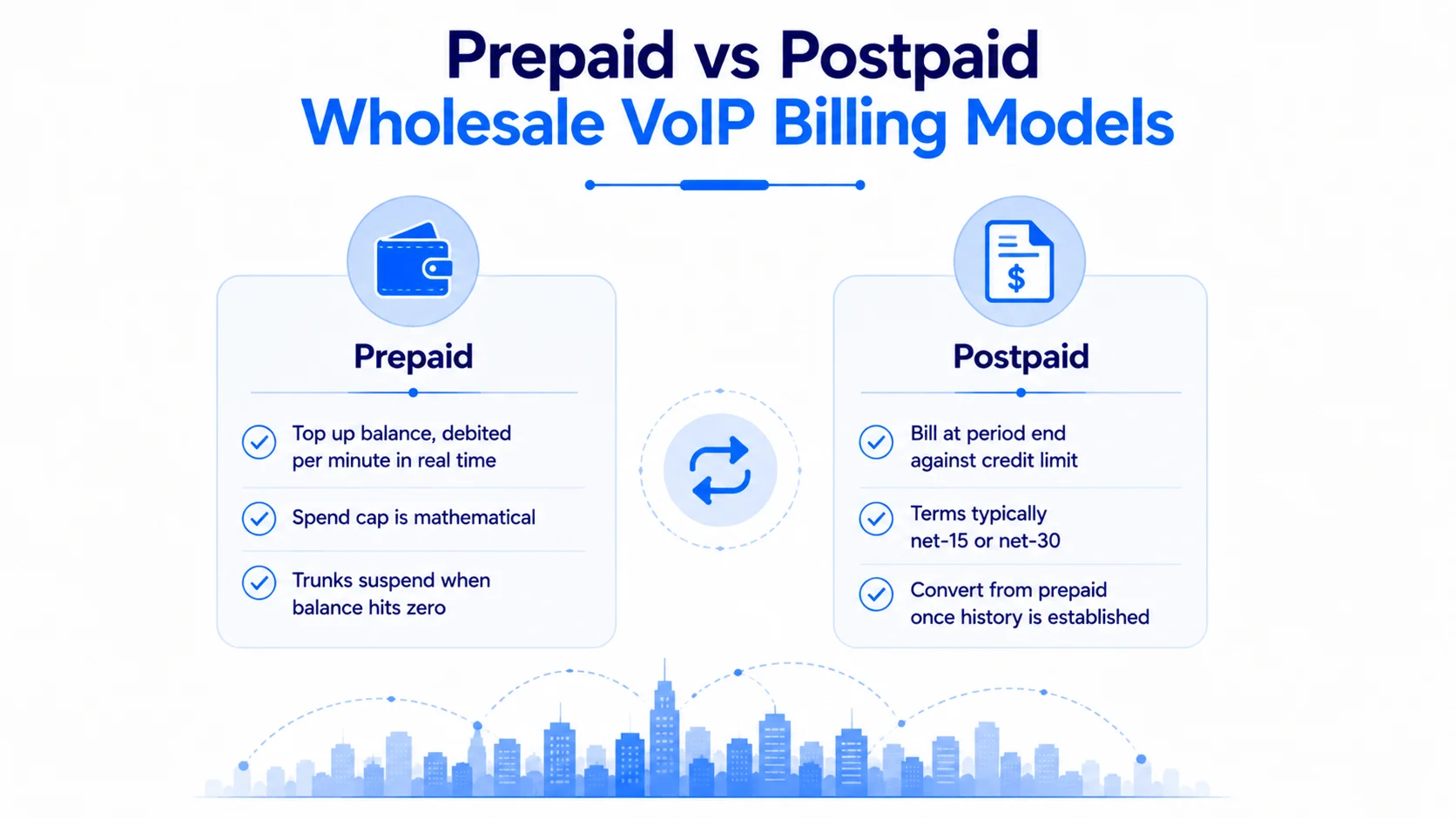
Wholesale VoIP billing supports both prepaid and postpaid arrangements, and credible providers offer both. Prepaid models require customers to top up a balance that gets debited per minute in real time. The spend cap is mathematical, the fraud exposure is bounded, and trunks suspend the moment the balance hits zero.
Postpaid arrangements bill at the end of the period against a credit limit, with terms that typically run net-15 or net-30.
New wholesale customer relationships often start prepaid and convert to postpaid once a payment history is established. This is good wholesale VoIP billing practice on both sides: the carrier limits IRSF exposure on unknown customers, and the customer avoids the surprise of an inflated first invoice.
Twiching supports both models and the conversion is a configuration change, not a contract amendment.
Rate Deck Mechanics in Wholesale VoIP Billing
A rate deck is the destination-by-destination per-minute price list that drives every wholesale VoIP billing decision. Each row carries the prefix range, mobile or landline indicator, per-minute price, billing increment, currency, and effective date. Wholesale VoIP billing platforms ingest rate decks from upstream carriers, apply markup tiers per customer, and rate every CDR against the resulting customer-facing deck in real time.
Rate-deck change notification is one of the most contentious areas in wholesale VoIP billing. Standard contracts give 30 days' notice on rate increases and require notification before the effective date — not after. A wholesale VoIP billing platform that quietly raises rates mid-period without notification is generating disputes that will eventually surface as churn.
Disputing a Wholesale VoIP Bill
Disputes are inevitable in wholesale VoIP billing. The process should be documented and fast: request a CDR export from the provider for the disputed period.
Then compare the export against your own platform's CDR data row by row, looking for discrepancies in call duration, destination classification (mobile vs landline misrouting is a common one), or rate application.
Step three is submitting the dispute in writing with specific CDR evidence inside the contract's dispute window — typically 30 to 60 days.
Credible wholesale VoIP billing platforms publish a defined dispute process with named contacts and timeline commitments. A wholesale VoIP billing provider that handles disputes informally over email without commitments is one that quietly absorbs disputes through customer attrition instead of fixing root cause.
Automated Wholesale VoIP Billing via API
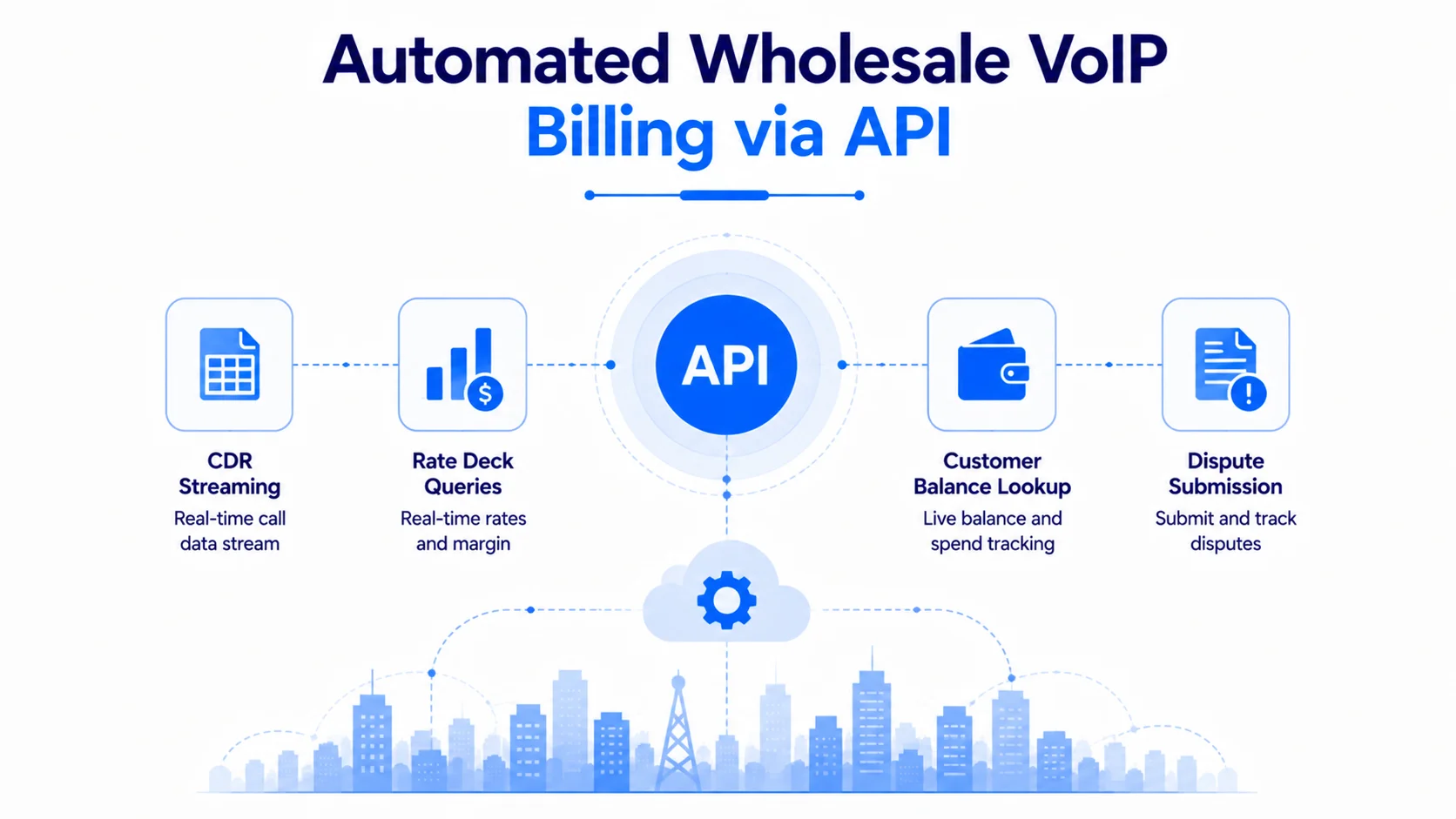
Modern wholesale VoIP billing is API-first. Real-time CDR streaming lets customers rate calls continuously rather than waiting for end-of-month invoices. Programmable rate deck queries let customer-facing BI systems compute margin per call as it happens.
Customer ledgers expose live balance and spend velocity for fraud detection and budget enforcement.
Twiching's wholesale VoIP billing platform exposes CDR streaming, rate-deck queries, customer balance lookups, and dispute submission as REST APIs. Customers integrate the stream into their own BI and finance stacks so wholesale VoIP billing reconciliation is automated end-to-end rather than a monthly fire drill.
Fraud Detection Inside the Billing Engine
IRSF (International Revenue Share Fraud) detection lives partly in the wholesale VoIP billing engine. The engine watches per-minute spend velocity, flags premium-rate prefixes, applies per-account caps, and pauses traffic when patterns look off. A wholesale VoIP billing platform without real-time fraud monitoring is one that turns the customer's compromised trunk into the carrier's unrecoverable exposure.
Customers should expect hard spend caps, destination whitelists, and real-time alerts as default features in any wholesale VoIP billing dashboard. Anything weaker is a billing system pretending to be a fraud control system — and the carrier eats the difference when an attack lands.
Choosing a Wholesale VoIP Billing Platform
- 01Real-time CDR streaming via API — not daily batches or weekly exports
- 02Per-destination rate deck published with billing increments and effective dates visible on every row
- 03Both prepaid and postpaid billing models supported, with seamless conversion
- 0430-day rate change notification with no retroactive adjustments
- 05Documented dispute process with named contacts and timeline commitments
- 06Hard spend caps, destination whitelists, and IRSF anomaly detection embedded in the billing engine
- 07Programmable APIs for rate-deck queries, balance lookups, and CDR streaming
Twiching's Wholesale VoIP Billing Platform
Twiching's wholesale VoIP billing engine rates every call in real time against per-customer rate decks, and streams CDRs via API for downstream reconciliation. It supports both prepaid and postpaid models, and enforces hard spend caps and IRSF detection inline.
Per-destination wholesale VoIP rates publish with billing increments and effective dates visible on every row. Route-quality scoring exposes live ASR per destination next to the rating data, and rate-change notifications go out 30 days ahead of the effective date. A 24/7 NOC monitors the billing pipeline alongside the softswitch and SBC layers.
Partners on the white-label reseller programme inherit the same wholesale VoIP billing platform underneath their own brand. Customer ledgers, automated invoicing, dispute workflows, and CDR streaming are exposed to their downstream customers as if they ran the engine themselves.
Wholesale VoIP billing accuracy depends on CDR integrity. CDRs must capture call start time, answer time, and release time precisely — discrepancies of even one second per call accumulate into significant billing errors at scale. Regularly reconcile your own CDRs against carrier CDRs for a 1% sample of traffic.
Common discrepancies include calls billed as answered when they were not (false answer supervision) and calls rounded up to higher billing increments. Others are charged at incorrect destination rates. A systematic reconciliation process recovers 0.5–2% of carrier spend annually.
Dispute resolution processes in wholesale VoIP billing can recover significant revenue when managed systematically. Common dispute causes include calls billed as answered that were actually rejected (false answer supervision), incorrect destination rate application when CLI prefixes route to wrong rate groups, and billing for calls that appear in carrier CDRs but not in your own records.
Establish a monthly CDR reconciliation workflow that compares your origination records against carrier invoice CDRs. Submit disputes within the contractual window, typically 30–60 days from invoice date.
Conclusion
Wholesale VoIP billing is a quiet competitive moat. Accurate CDR-driven rating, transparent rate decks with billing increments on every row, both prepaid and postpaid models, 30-day rate-change notification, documented dispute resolution, and inline IRSF fraud detection are the carrier-grade non-negotiables. A wholesale VoIP billing platform that exposes CDR streaming, rate-deck queries, and customer balances through REST APIs collapses end-of-month reconciliation into a continuous, automated process. Twiching is built around that model, so partners launch on carrier-grade wholesale VoIP billing from day one and scale on competitive wholesale VoIP rates without operating the billing engine themselves.