Introduction
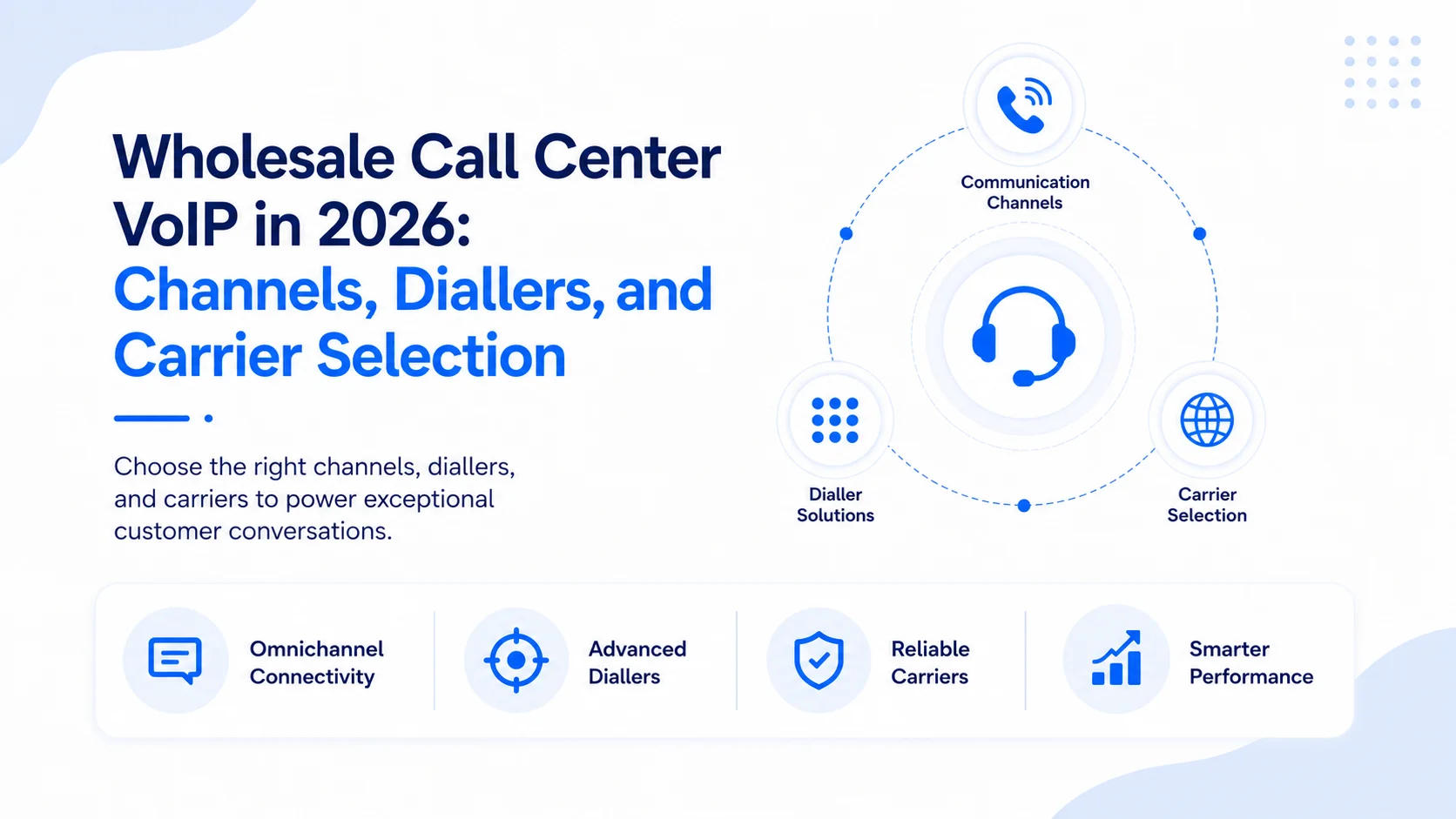
Wholesale call center VoIP is the carrier-level service layer that sits between a contact-centre platform and the PSTN. It covers concurrent channels, DID origination, outbound termination, real-time CDRs, and STIR/SHAKEN attestation, delivered at per-minute wholesale VoIP rates rather than per-seat retail pricing. This guide covers what it delivers, how to size channels, how diallers interact with the SIP trunk, and how to evaluate potential carriers against real campaign load.
Contact centres run very different traffic patterns from regular business voice. Predictive diallers can place three to five concurrent attempts per agent, and inbound queues spike on marketing flights.
ASR collapses fast on poor routes, and PDD over three seconds is a campaign killer.
Twiching is featured throughout as a worked example. It operates at the intersection of carrier-grade routing and a programmable platform built for contact-centre workloads.
Key Takeaways
- Wholesale call center VoIP is the carrier service layer behind contact-centre platforms — concurrent channels, DID origination, outbound termination, and CDR streaming at per-minute wholesale rates.
- Channel sizing depends on agent count, dialler ratio, and burst tolerance — plan one channel per concurrent attempt plus a 15–20% buffer.
- STIR/SHAKEN attestation is required for US-bound outbound caller ID — unsigned outbound traffic from a contact centre is routinely answered-rate suppressed.
- ASR and PDD are the operational quality metrics — target 60%+ ASR on major destinations and sub-3-second PDD for predictive dialler campaigns.
- Twiching delivers wholesale call center VoIP with carrier-grade routing, programmable APIs, real-time quality dashboards, and a 24/7 NOC sized for campaign-load support.
What Wholesale Call Center VoIP Actually Is
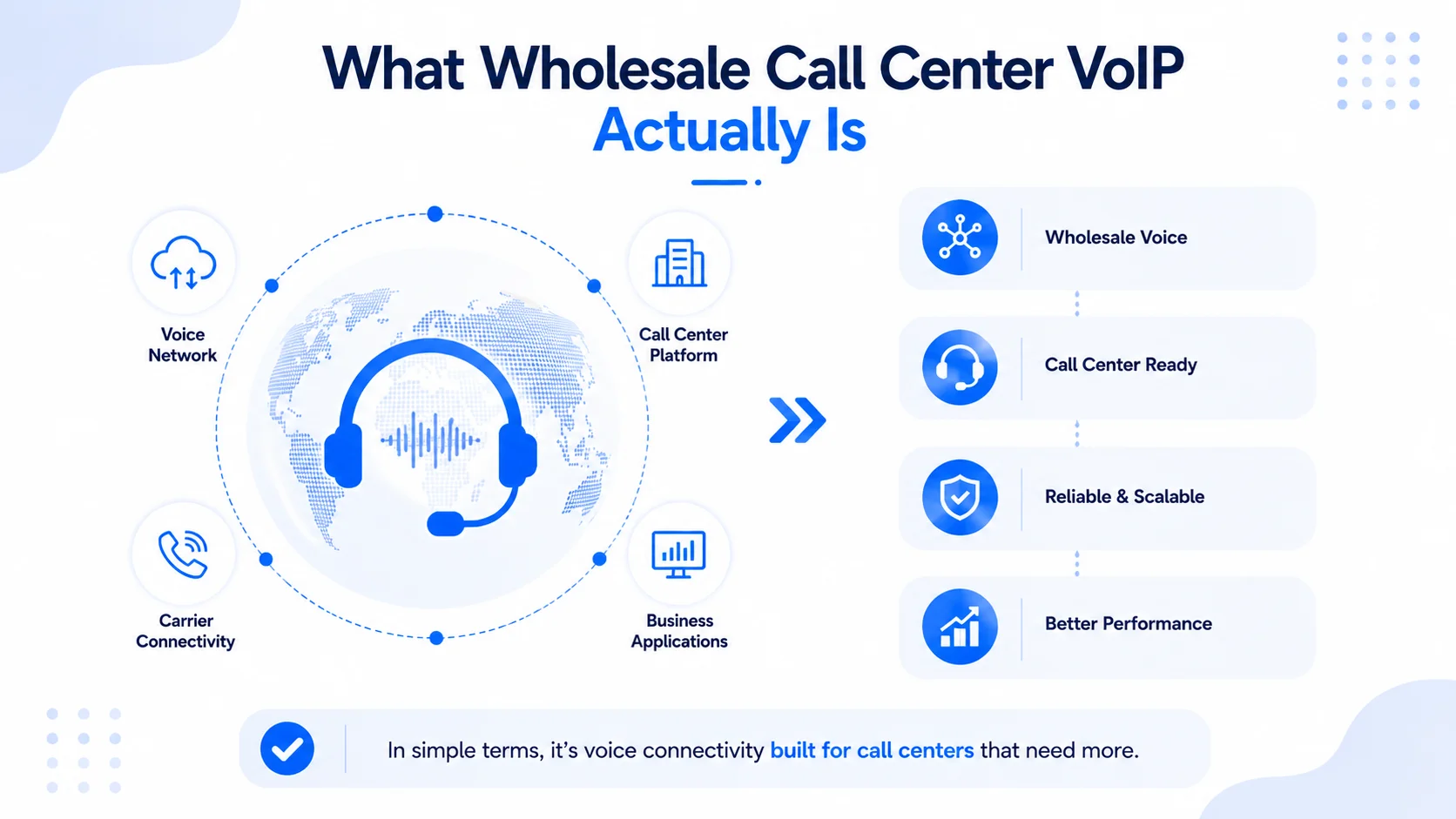
Wholesale call center VoIP is the layer of carrier-level voice service designed specifically for contact-centre workloads.
It provides concurrent SIP channels for inbound and outbound traffic, plus DID origination across the countries the centre takes calls in. It also provides outbound termination via least-cost routing across multiple carrier interconnects.
It also delivers CDR streaming for real-time analytics and STIR/SHAKEN attestation on US-bound outbound calls.
Unlike retail VoIP, it doesn't bundle seats, devices, and a softphone client. Instead, wholesale call center VoIP terminates at the contact-centre platform's session border controller and lets the platform handle the application layer.
The economics make sense because contact centres run high-volume, high-concurrency traffic.
A 200-agent centre running outbound campaigns at a 3:1 dialler ratio places six hundred concurrent call attempts at peak. That traffic at per-seat retail VoIP pricing would be uneconomic.
Wholesale call center VoIP rates are per-minute or per-second, billed against actual answered traffic, with overage handled smoothly through burst channels rather than hard channel caps.
Channel Sizing for Wholesale Call Center VoIP
Further reading: Wholesale pricing & rate deck
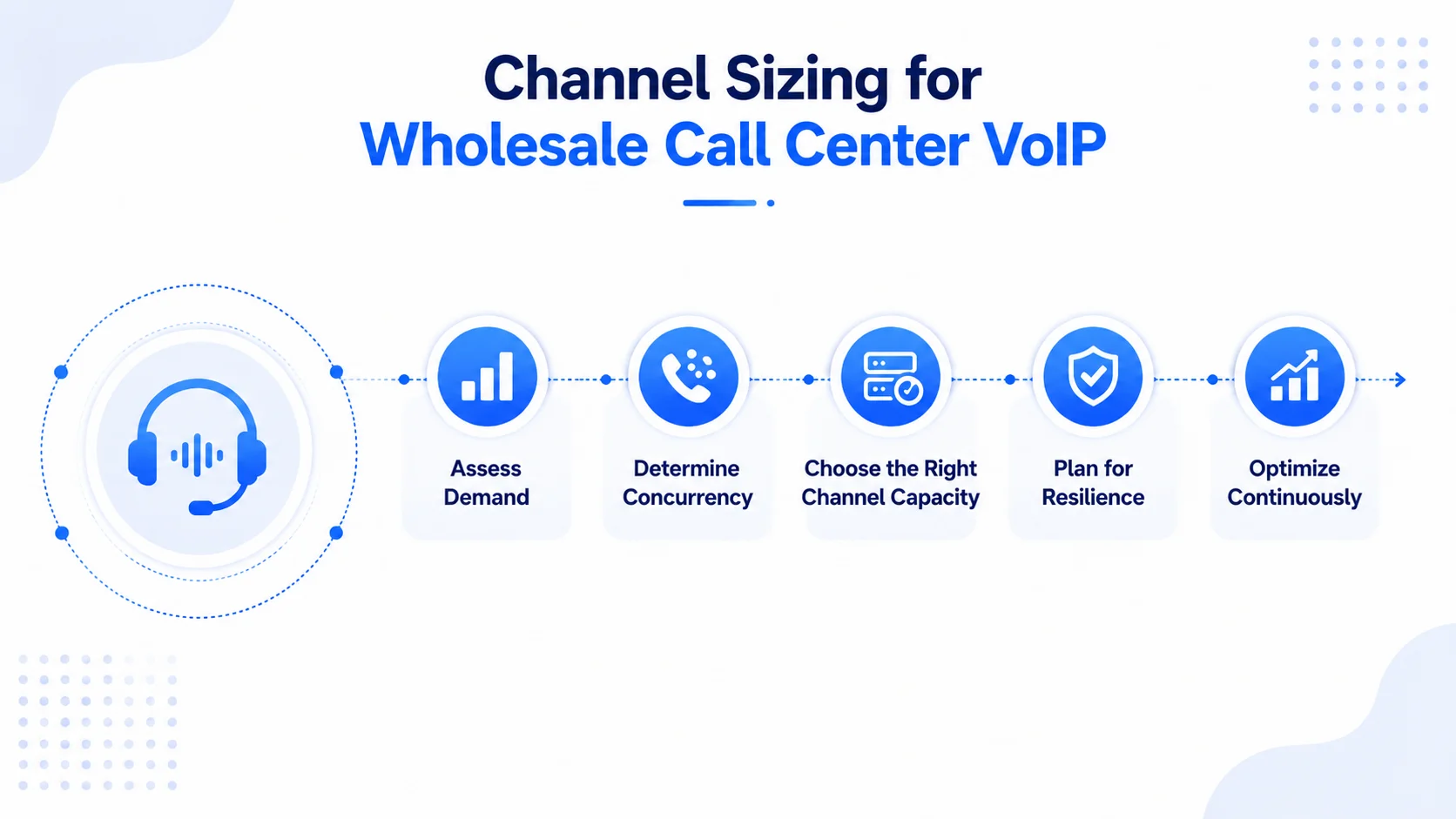
Sizing channels is the first technical question every contact-centre operator asks of a wholesale call center VoIP carrier. The naive answer — one channel per agent — is wrong in both directions.
For inbound queues, plan against peak concurrent calls, which is typically 60–80% of agent count plus a queue depth allowance for hold time.
For outbound predictive dialler campaigns, plan against concurrent attempts. At a 3:1 dialler ratio, a hundred agents need three hundred concurrent channels, and the carrier needs headroom for retries.
A 15–20% burst buffer above committed channels handles campaign spikes and marketing flights.
The right wholesale call center VoIP provider supports elastic burst on top of a committed channel base. Twiching for example provisions a contracted channel count with auto-burst up to a defined ceiling, billed at the standard wholesale VoIP rate.
That means campaign teams don't have to call the carrier to spin up extra capacity for a launch.
Predictive Diallers and SIP Trunk Behaviour
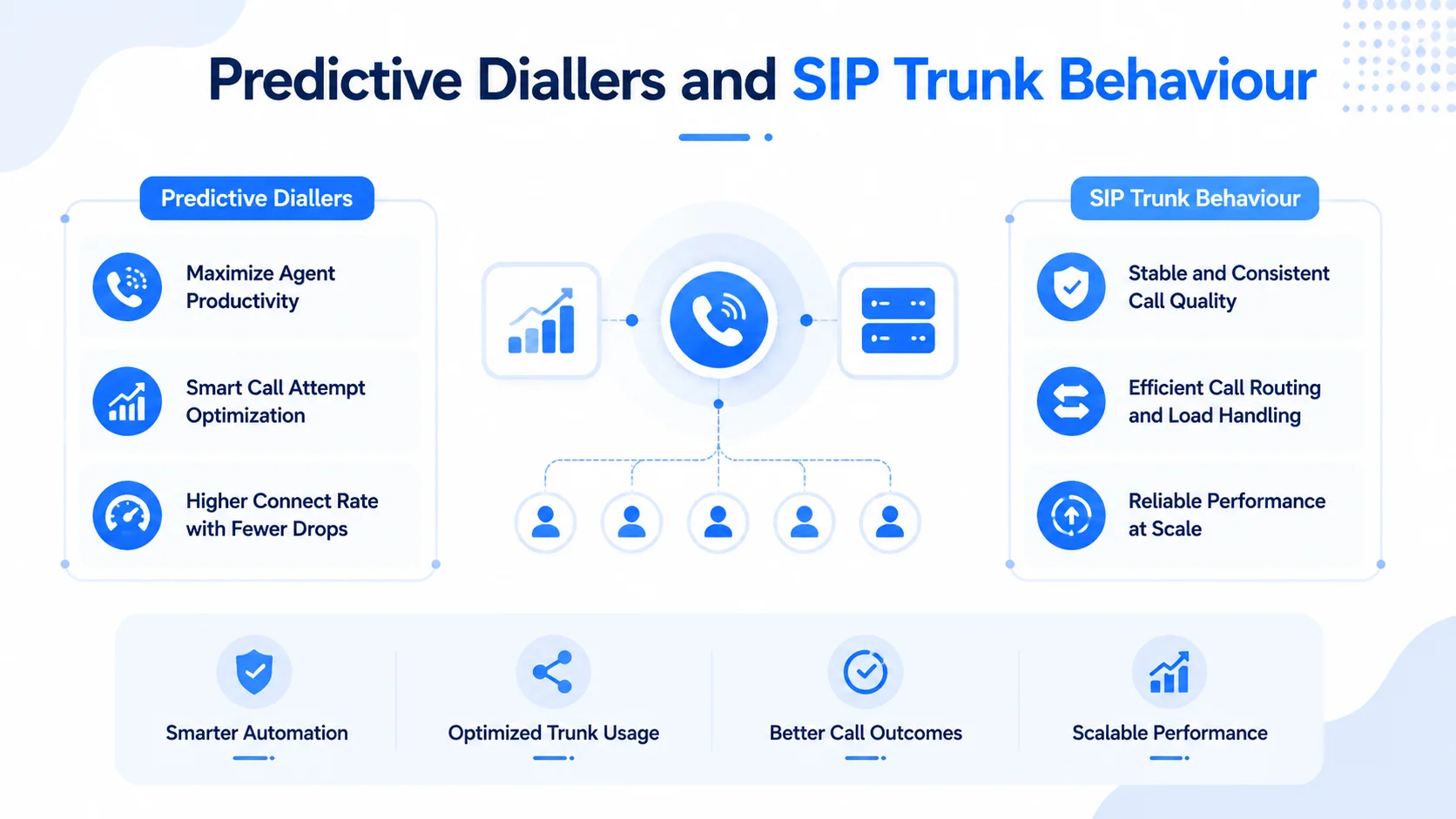
Predictive diallers are the most demanding traffic generators a wholesale call center VoIP trunk handles. They place several concurrent attempts per agent, abandon unconnected attempts after a brief ring window, and re-attempt failed numbers on different routes.
The trunk must absorb high INVITE rates without rate-limiting. It must return SIP responses within the dialler's abandon window. It must also propagate ringing and answer events accurately, so the dialler's pacing algorithm calibrates correctly.
Bad wholesale call center VoIP trunks fail predictive diallers in characteristic ways.
- SIP 4xx/5xx responses come too late and trigger dialler-side timeouts.
- False-answer events drop into voicemail with no agent connected.
- Rate-limiting under burst silently throttles attempts.
Good carriers publish their INVITE rate limits, expose real-time SIP response metrics in the customer portal, and engineer for dialler load.
STIR/SHAKEN and Outbound Caller ID
Further reading: Wholesale VoIP platform
STIR/SHAKEN attestation is required for US-bound outbound traffic in 2026.
A wholesale call center VoIP carrier signs each outbound INVITE with an attestation level — A (full), B (partial), or C (gateway).
The receiving carrier then surfaces that attestation to the analytics engines that score caller reputation.
Centres signing only at C attestation see their connection rates collapse. The major US carriers' spam analytics flag low-attestation traffic as likely robocall. They either label it 'Spam Likely' or block it outright.
A wholesale call center VoIP carrier can hold direct A-level attestation on the customer's outbound DIDs. This means the centre owns the numbers in the carrier's KYC records, which protects answered-rate.
A carrier that only offers B or C attestation is not workable for outbound campaign traffic in the US market in 2026. The same applies in modified form to the UK's CLI enforcement and the European number-presentation rules.
ASR, PDD, and MOS — The Quality Metrics That Matter
Three numbers determine whether a wholesale call center VoIP route is usable for contact-centre traffic.
ASR (Answer Seizure Ratio) is the percentage of placed calls answered. Target 60%+ on the major destinations, though mobile-only destinations and consumer-broadcast lists run lower.
PDD (Post-Dial Delay) is the time between INVITE and ringback — target under 3 seconds for predictive dialler use, under 5 seconds for general traffic.
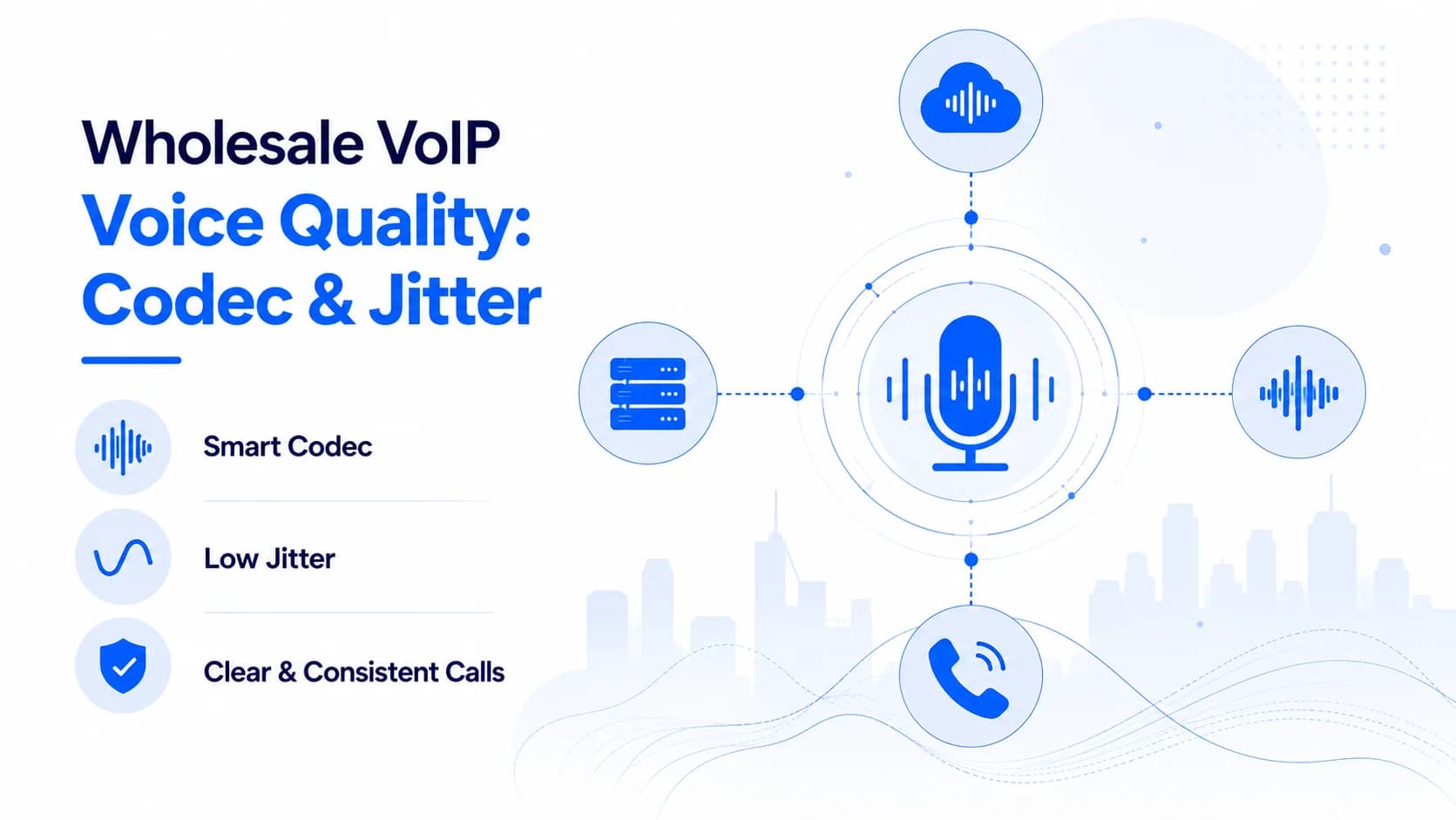
MOS (Mean Opinion Score) measures voice quality — target above 4.0 for English-language interactive voice.
Bad wholesale call center VoIP carriers hide poor route quality in aggregate dashboards. Good carriers publish per-destination ASR/PDD/MOS in real time and trigger automatic route switching when a route degrades.
Twiching's quality dashboard publishes per-prefix metrics with five-minute granularity, and the routing engine reroutes traffic away from degrading routes without operator intervention.
DID Origination for Inbound Contact Centres
Inbound contact centres need DID origination — phone numbers in the geographies where customers are calling from.
A wholesale call center VoIP carrier with broad DID coverage lets the centre present local numbers to callers in every market they support.
This greatly improves connect rates compared with publishing a single international number.
The carrier handles E.911 registration, regulatory compliance, number porting on customer churn, and the messy regional rules around toll-free, geographic, and mobile numbering.
Look for carriers that:
- Publish DID inventory with availability flags.
- Allow self-service number selection through an API.
- Handle porting through a single workflow rather than carrier-specific email exchanges.
Twiching supports DID provisioning via REST API across 80+ countries. A contact-centre platform can request a number in a specific area code and have it ringing through to a queue inside an hour.
Programmable APIs and Real-Time CDRs
Modern contact-centre platforms expect programmable access to the underlying wholesale call center VoIP carrier. REST APIs for provisioning, webhooks for call events, and streamed CDRs for real-time analytics are the baseline.
Without them, the centre has to scrape PDFs or wait for end-of-day reports. Neither approach works for live campaign tuning, agent productivity dashboards, or revenue-per-call attribution.
Real-time CDR streaming over Kafka or webhook is the modern shape. The centre's analytics platform receives a call-detail record within seconds of call disconnect, joins it against agent and campaign data, and updates dashboards live.
This is what makes wholesale call center VoIP a different product from generic SIP trunking — the data-plane integration is as important as the voice-plane quality.
Fraud Controls and IRSF Protection
Contact centres are a known fraud target. IRSF (International Revenue Share Fraud) attackers compromise centre credentials, then dial premium-rate international destinations until the centre's monthly bill explodes.
A wholesale call center VoIP carrier protects against this through hard spend caps configurable per trunk and blocked-prefix lists for high-risk destinations. It also uses real-time anomaly detection that flags unusual traffic patterns.
The defensive minimum is hard spend caps at the trunk level, a default-deny posture on premium-rate destinations, and 24/7 NOC monitoring with named escalation contacts.
Twiching's fraud platform applies all three by default and pages the customer's escalation contact when traffic anomalies cross threshold.
Evaluation Checklist for Wholesale Call Center VoIP Carriers
- 01Concurrent channel capacity matched to peak agent load plus dialler ratio plus 15–20% burst buffer
- 02Elastic burst on top of committed channels billed at the standard wholesale VoIP rate
- 03A-level STIR/SHAKEN attestation on customer-owned DIDs for US outbound traffic
- 04Per-destination ASR/PDD/MOS dashboards with five-minute granularity and route auto-switching
- 05Per-destination wholesale VoIP rates published with billing increments and effective dates
- 06DID origination via REST API across the centre's target markets, with self-service porting
- 07Real-time CDR streaming via webhook or Kafka for live analytics integration
- 08Hard spend caps and IRSF anomaly detection at the trunk level, default-deny on premium-rate destinations
- 09Documented SLA with 99.99% platform uptime, four-hour mean time to resolution, and named escalation contacts
- 10Onboarding under 48 hours with same-day production SIP trunks for standard business customers
Twiching for Wholesale Call Center VoIP
Twiching operates as a contact-centre-grade wholesale call center VoIP carrier. The platform supports elastic concurrent-channel burst on top of committed channels and A-level STIR/SHAKEN attestation on customer-owned DIDs.
It also delivers per-destination ASR/PDD/MOS dashboards with five-minute granularity and REST APIs for DID provisioning across 80+ countries. On top of that, it provides real-time CDR streaming and a 24/7 NOC with a 15-minute critical-incident SLA.
Wholesale call center VoIP rates publish per destination with billing increments and effective dates visible on every row, with no per-seat licensing layered on top.
Predictive-dialler customers get a dedicated SIP trunk configuration with INVITE rate limits sized for the dialler's peak placement rate. The platform also exposes the SIP response codes the dialler needs for accurate pacing.
Conclusion
Twiching delivers that shape — wholesale VoIP rates, programmable provisioning, dialler-aware SIP trunks, and a 24/7 NOC sized for campaign load — at terms accessible to both small contact centres and large multi-site operators. Compare current wholesale call center VoIP terms against Twiching's published rates to benchmark whether the carrier behind your contact-centre platform is still competitive.