Introduction
A VoIP wholesale platform is the integrated software stack that turns raw carrier interconnects into a usable wholesale voice product. It's the difference between a provider you can buy from in 48 hours and one that requires a six-week onboarding cycle. This guide walks through the components of a modern platform, the architecture choices that matter, and the evaluation criteria that separate strong platforms from weak ones.
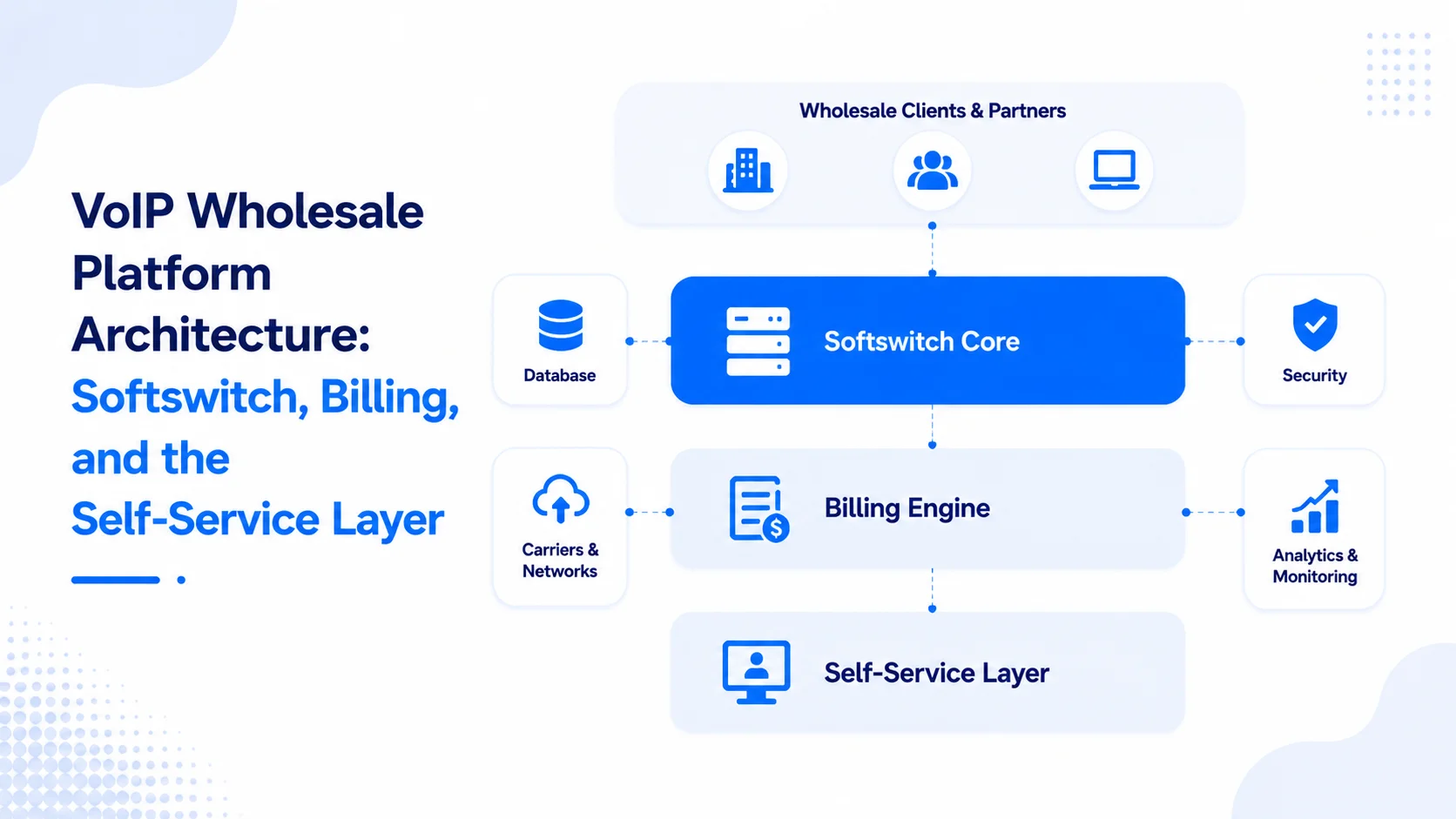
A strong platform combines a Class 4 softswitch for SIP routing, a real-time least-cost routing engine, and CDR-based billing that rates traffic per minute or per second.
It also needs a self-service customer portal with live dashboards and REST APIs for programmatic access. On top of that, fraud detection with automatic blocking and number management for DID and toll-free hosting are essential.
This guide covers the architecture choices that matter: cloud-native versus legacy, monolith versus microservice, in-house versus white-label. It also covers how Twiching's VoIP wholesale platform sits in that landscape. It is written for buyers evaluating wholesale VoIP providers, and for operators considering launching their own wholesale VoIP business on a white-label platform.
Key Takeaways
- A modern VoIP wholesale platform integrates a Class 4 softswitch, LCR engine, CDR billing, self-service portal, fraud detection, and number management into one stack.
- Cloud-native VoIP wholesale platforms scale horizontally and onboard customers in under 48 hours; legacy hardware-bound platforms cannot.
- REST APIs and webhook delivery for call events are now baseline expectations — without them, the platform cannot support modern programmable customers.
- STIR/SHAKEN attestation, IRSF fraud detection, and real-time spend caps belong in the platform itself, not as bolt-ons.
- Twiching operates a cloud-native VoIP wholesale platform with carrier-grade routing, programmable APIs, real-time CDR streaming, and a 24/7 NOC.
What a VoIP Wholesale Platform Actually Is
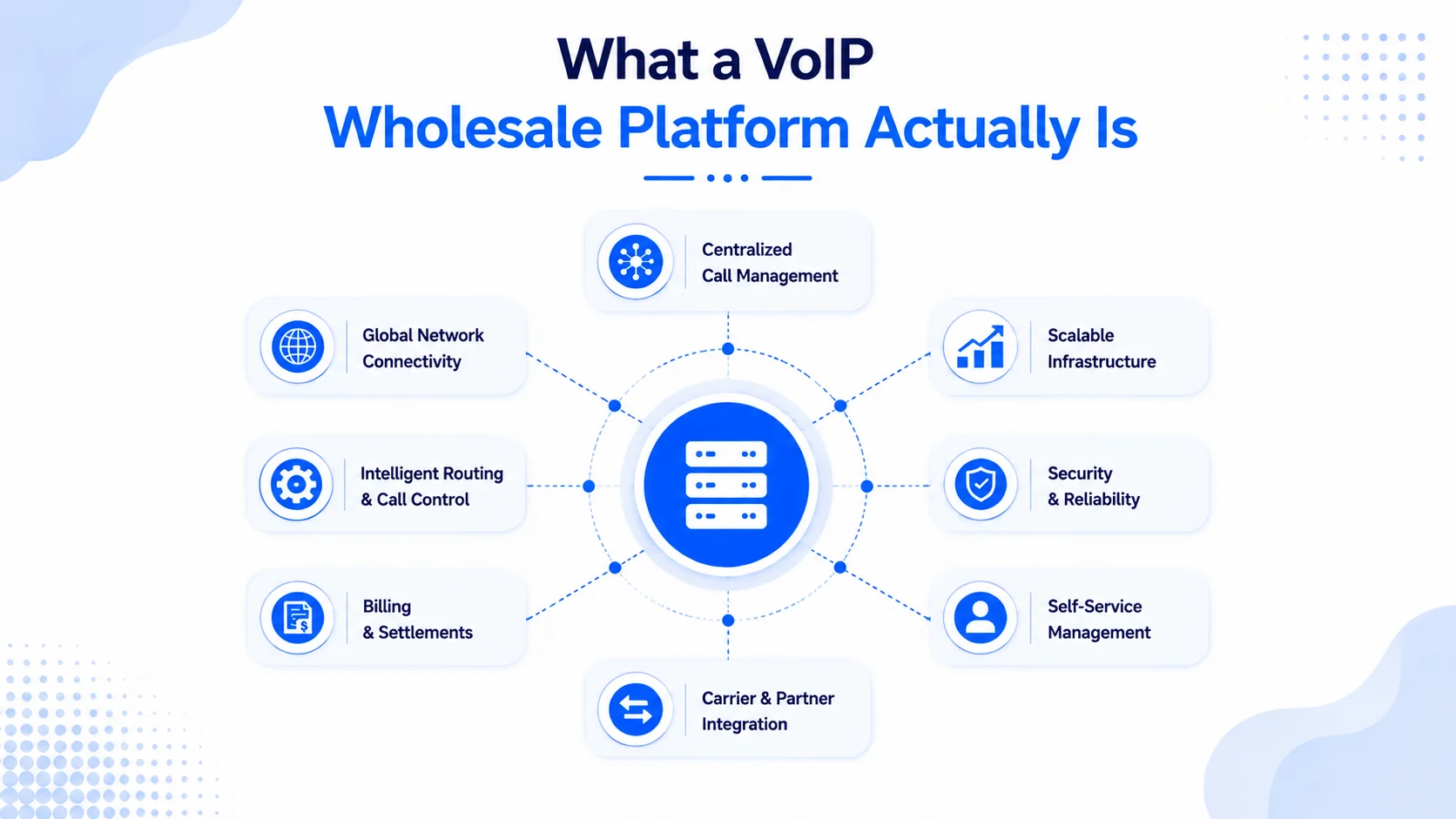
A VoIP wholesale platform is the layer of software and integrations that connects raw SIP interconnects with upstream carriers. It turns those connections into a sellable wholesale voice product.
The platform handles SIP routing, traffic rating, billing, fraud detection, customer self-service, number provisioning, regulatory compliance, and the reporting plane.
Without the platform, a wholesale VoIP business is a set of disconnected systems that requires manual operations work to onboard a customer or change a rate. With a good platform, the same business runs as software.
The components break down into three planes:
- Data plane — SIP signalling, media routing, real-time CDR generation.
- Control plane — LCR engine, rate decks, routing rules, fraud rules.
- Customer plane — portal, API, billing, support.
A modern VoIP wholesale platform exposes all three planes through APIs so that customers can integrate the wholesale VoIP business into their own systems.
The Class 4 Softswitch
Further reading: Wholesale pricing & rate deck
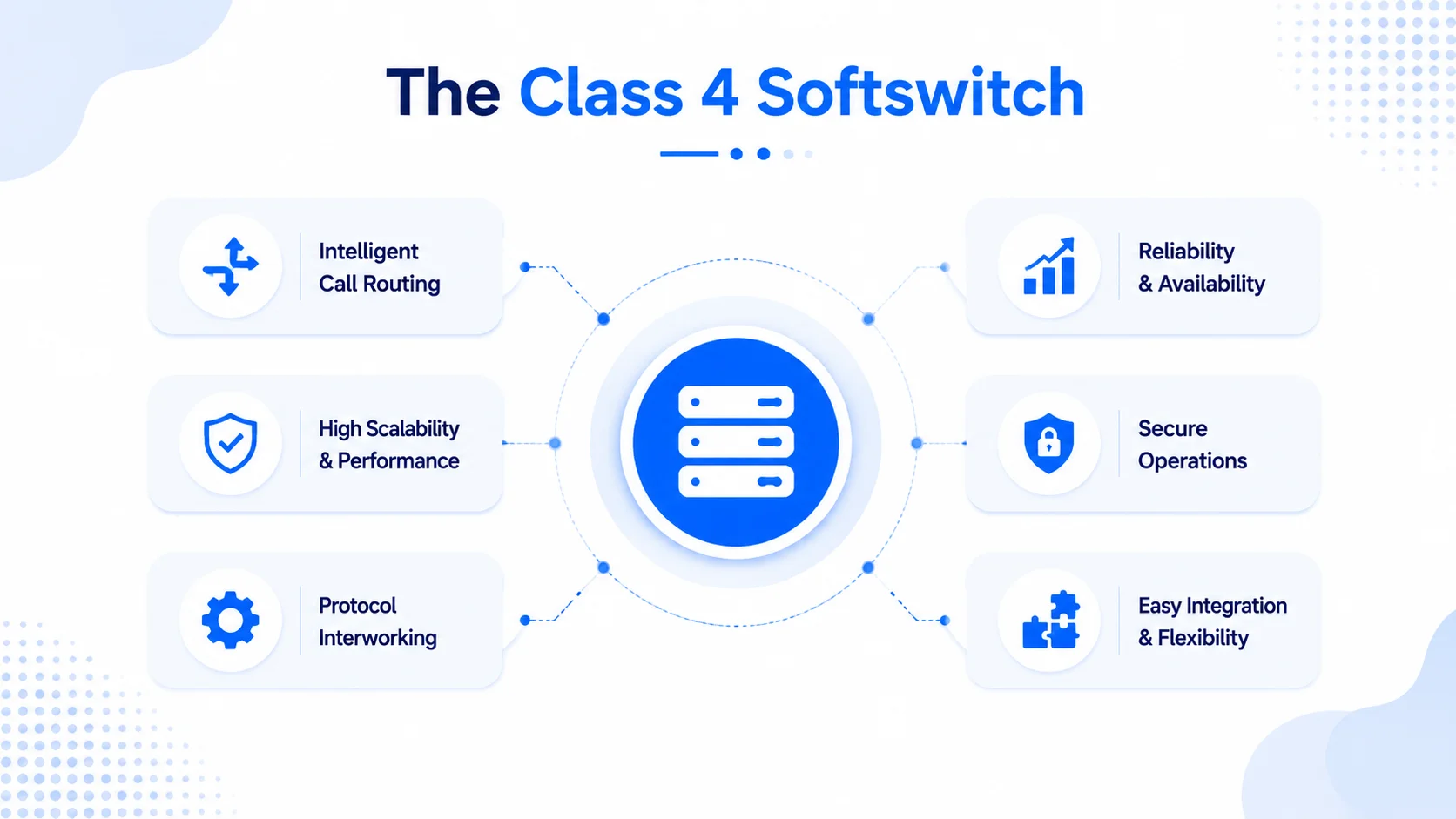
At the heart of any VoIP wholesale platform sits a Class 4 softswitch — the SIP routing engine that takes incoming calls.
It looks up the best route based on the LCR engine's instructions and forwards the call to the upstream carrier.
Class 4 distinguishes it from Class 5 (the end-user PBX/IVR layer): Class 4 is carrier-to-carrier interconnect routing at high concurrency. Modern Class 4 softswitches handle hundreds of thousands of concurrent calls across distributed instances.
The softswitch in a strong VoIP wholesale platform supports media-anchored and media-pass-through modes, picking the right one per route to minimise media latency. It also handles inline STIR/SHAKEN attestation, transcoding when carrier codecs don't match, and SIP header manipulation for carrier-specific quirks.
It also generates the CDR feed that the billing engine rates in real time.
The LCR Engine and Rate Decks
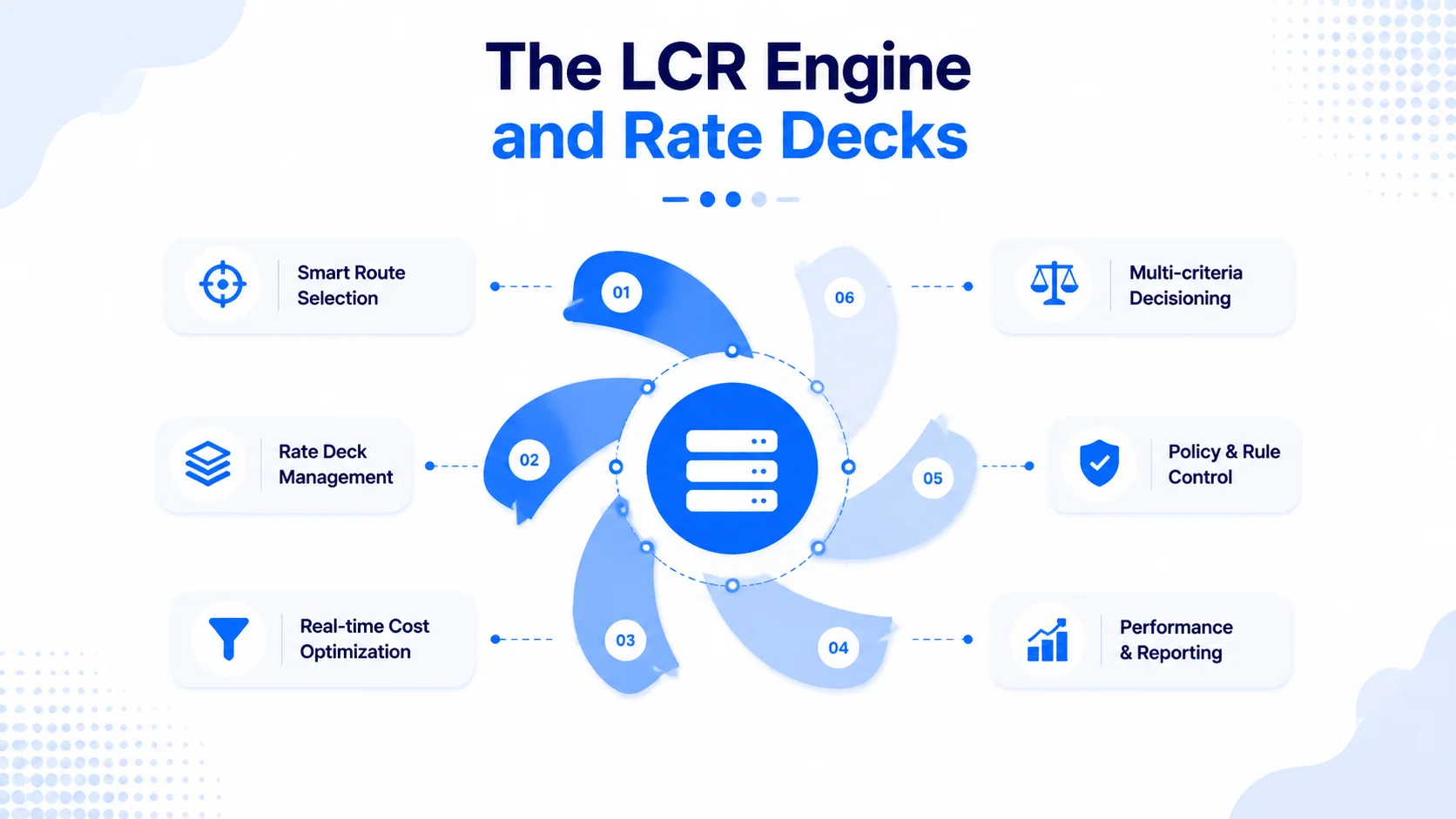
Least-cost routing is what makes a VoIP wholesale platform work as a business.
The LCR engine maintains rate decks for every upstream carrier. It scores each call against quality and cost criteria, then picks the route that hits the customer's quality target at the lowest price.
Modern LCR engines support multi-tier routing (premium / standard / economy) so customers can choose quality versus price per destination. They also support real-time quality-aware routing that demotes degrading routes within minutes.
Rate-deck management is the unglamorous heart of a wholesale VoIP business. The VoIP wholesale platform has to ingest upstream rate-deck changes daily and recompute customer-facing rate decks based on margin rules.
It also has to distribute new rate decks with notice periods that match contract terms, and let customers query effective rates by destination via API.
CDR-Based Billing and Real-Time Rating
Further reading: Wholesale VoIP platform
Billing is where most legacy VoIP wholesale platforms fall over.
Modern platforms rate CDRs in real time, within seconds of call disconnect. Customer balances accumulate live, and credit alerts trigger before customers run out.
Prepaid accounts get debited in real time; postpaid accounts get rated all the time and invoiced monthly.
Billing increments matter. 1-second increments after a 6-second minimum are the modern standard for wholesale VoIP rates. 60-second increments are legacy, carrier-friendly but customer-hostile, and should be priced accordingly.
The VoIP wholesale platform also has to handle multi-currency invoicing and credit-note handling. It needs tax computation per jurisdiction, which gets complicated fast in the EU and the US, plus integration with accounting systems via API.
Self-service balance top-up and automatic credit-card billing are basic features now, not selling points.
The Self-Service Portal
Modern wholesale VoIP customers expect to log into a portal and self-serve every routine operation:
- Provisioning new SIP trunks.
- Downloading rate decks.
- Querying CDRs.
- Viewing live quality dashboards.
- Paying invoices.
- Submitting support tickets.
A VoIP wholesale platform without a strong self-service portal forces every operation through email and a sales engineer. That's costly at scale and unacceptable for technical buyers.
The portal sits on top of the platform's API, so customers can also script the same operations if their volume justifies the integration work.
Twiching's portal exposes everything the API does: DID provisioning, rate-deck queries, and SIP trunk configuration. It also covers live ASR/PDD/MOS dashboards per destination, CDR search and download, and the IRSF spend-cap controls.
REST APIs and Webhook Delivery
The API layer is what makes a VoIP wholesale platform usable by modern programmatic customers.
The essential APIs are CDR retrieval (real-time stream and historical query), account balance and usage queries, and DID number provisioning and porting.
Round out the list with rate-deck download with effective dates and SIP trunk configuration. Add webhook delivery for call events (call started, call answered, call ended, with full CDR payload).
REST with JSON payloads is the modern shape; SOAP and XML are legacy carryover that signals an old platform.
Webhook delivery for call events is the bit that lets contact-centre platforms and CPaaS layers build on top of the wholesale VoIP business in real time.
The platform pushes call events to customer endpoints within seconds, retries on failure with exponential backoff, and signs payloads so the customer can verify authenticity.
Fraud Detection and IRSF Protection
International Revenue Share Fraud is the single largest financial risk in the wholesale VoIP business, and a VoIP wholesale platform without inline fraud detection is exposed.
The platform has to apply hard spend caps per customer trunk, blocked-prefix lists for high-risk destinations, and a default-deny posture on premium-rate ranges.
It also needs anomaly detection that flags unusual destination, time, and volume patterns within minutes, plus automatic suspension when thresholds are crossed.
These controls belong inside the platform itself, not as a separately purchased bolt-on. Twiching's platform applies all of them by default and exposes thresholds via the customer portal so customers can tune the controls without having to call support.
Number Management — DID and Toll-Free
Further reading: Wikipedia: VoIP overview
DID and toll-free number management is the unsexy but essential layer of a VoIP wholesale platform. Customers need to:
- Search inventory by area code.
- Reserve numbers.
- Port numbers in and out.
- Manage E.911 registration.
- Handle CNAM updates.
- Configure per-number routing.
Doing any of that by email doesn't work at modern volumes — the platform has to expose number management via the customer portal and API.
Coverage breadth matters too. A VoIP wholesale platform that only hosts numbers in three countries can't serve a global customer. One that hosts numbers in 80+ countries through a unified API can.
Twiching's DID inventory covers 80+ countries with self-service provisioning and porting.
Cloud-Native vs Legacy VoIP Wholesale Platforms
- 01Cloud-native architecture — horizontal scaling, no hardware capacity ceilings, deployment to multiple regions
- 02Stateless services — softswitch instances can be added and removed without disrupting active calls
- 03Container or Kubernetes deployment — fast release cadence, blue/green deployment, automatic recovery
- 04Streamed CDRs — real-time event delivery via Kafka or webhook, not batch end-of-day exports
- 05REST APIs as a first-class surface, not retrofitted on top of a legacy SOAP layer
- 06STIR/SHAKEN attestation built into the softswitch, not bolted on through a third-party signing service
- 07Multi-region failover — active-active across regions with automatic traffic shifting on regional failure
- 08Observability — Prometheus metrics, distributed tracing, structured logs for every call leg
- 09Self-service portal built on the same API the customer scripts use — the portal cannot do more than the API
- 10Infrastructure-as-code deployment — platform changes go through version control and code review
Twiching's VoIP Wholesale Platform
Twiching operates a cloud-native VoIP wholesale platform built around the architecture above.
The Class 4 softswitch runs across multiple regions with active-active failover. The LCR engine supports multi-tier routing with real-time quality-aware demotion, and CDRs stream in real time via webhook and Kafka.
The customer portal exposes every operation that the REST API exposes. STIR/SHAKEN attestation is inline on US-bound outbound traffic, IRSF detection runs by default with customer-configurable spend caps, and the DID inventory covers 80+ countries via self-service API.
Onboarding completes in under 48 hours for standard business customers — KYC, contract, SIP trunk provisioning, and first production traffic the same week.
Per-destination wholesale VoIP rates publish with billing increments and effective dates visible on every row. White-label partners launch a branded wholesale VoIP business on the same platform Twiching uses internally, with margin-rule configuration and customer-portal branding.
Conclusion
Walk through a live demo of the platform — softswitch routing, LCR engine, CDR streaming, portal, and APIs — against current wholesale VoIP rates to benchmark whether your current platform is keeping up.