Introduction
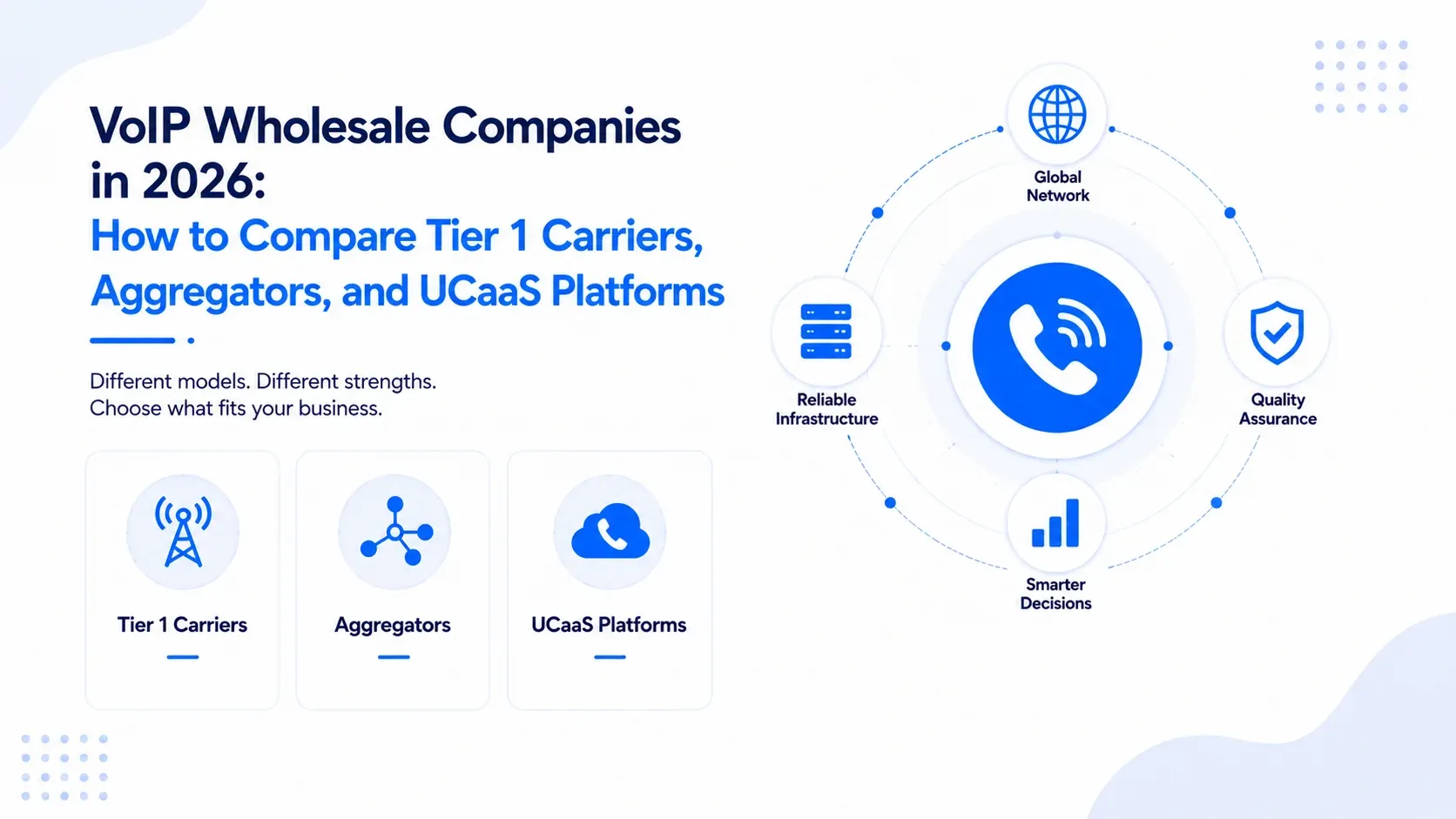
VoIP wholesale companies are not a uniform category — they range from Tier 1 carriers running owned infrastructure to thin aggregators reselling other operators' minutes. Picking the right one depends on traffic profile, volume, and regulatory needs.
This guide covers the archetypes and the criteria that matter.
The Five Archetypes of VoIP Wholesale Companies
The VoIP wholesale companies market clusters into five distinct archetypes. Tier 1 network operators own global infrastructure and sit at the top of the food chain. Regional Tier 2 carriers specialise in specific geographies — Latin America, EMEA, APAC — with deep route relationships in those markets.
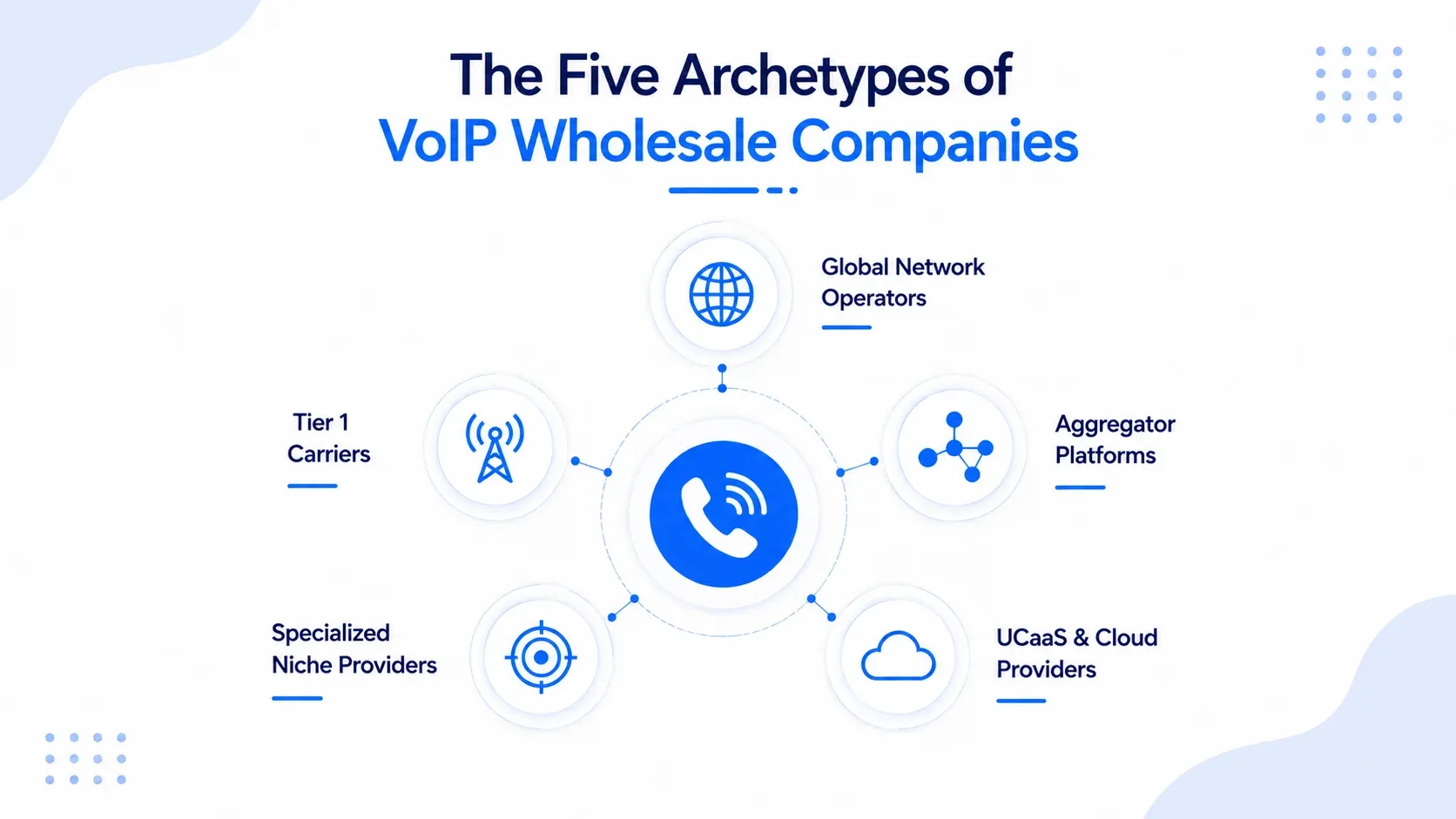
Aggregators combine multiple carrier routes under a single contract, layering their own routing intelligence on top. Technology-led UCaaS platforms ship voice as part of a broader programmable communications platform.
Niche specialists focus on a single vertical or traffic type — toll-free, SMS-adjacent voice, contact-centre dialler routes.
None of the five is universally better. The right choice among VoIP wholesale companies depends on the buyer's traffic mix, volume, regulatory exposure, and how much operational depth they want to outsource versus retain.
An ITSP shipping 50 million minutes per month to 200 countries needs different VoIP wholesale companies. A US-focused contact centre running 5 million minutes per month into US numbers only needs something else entirely.
Tier 1 Carriers Among VoIP Wholesale Companies
Further reading: Wholesale pricing & rate deck
Tier 1 carriers among VoIP wholesale companies own end-to-end network infrastructure. They hold direct interconnects with destination carriers in every major market. They also operate at a scale that lets them negotiate origination rates directly with national telcos.
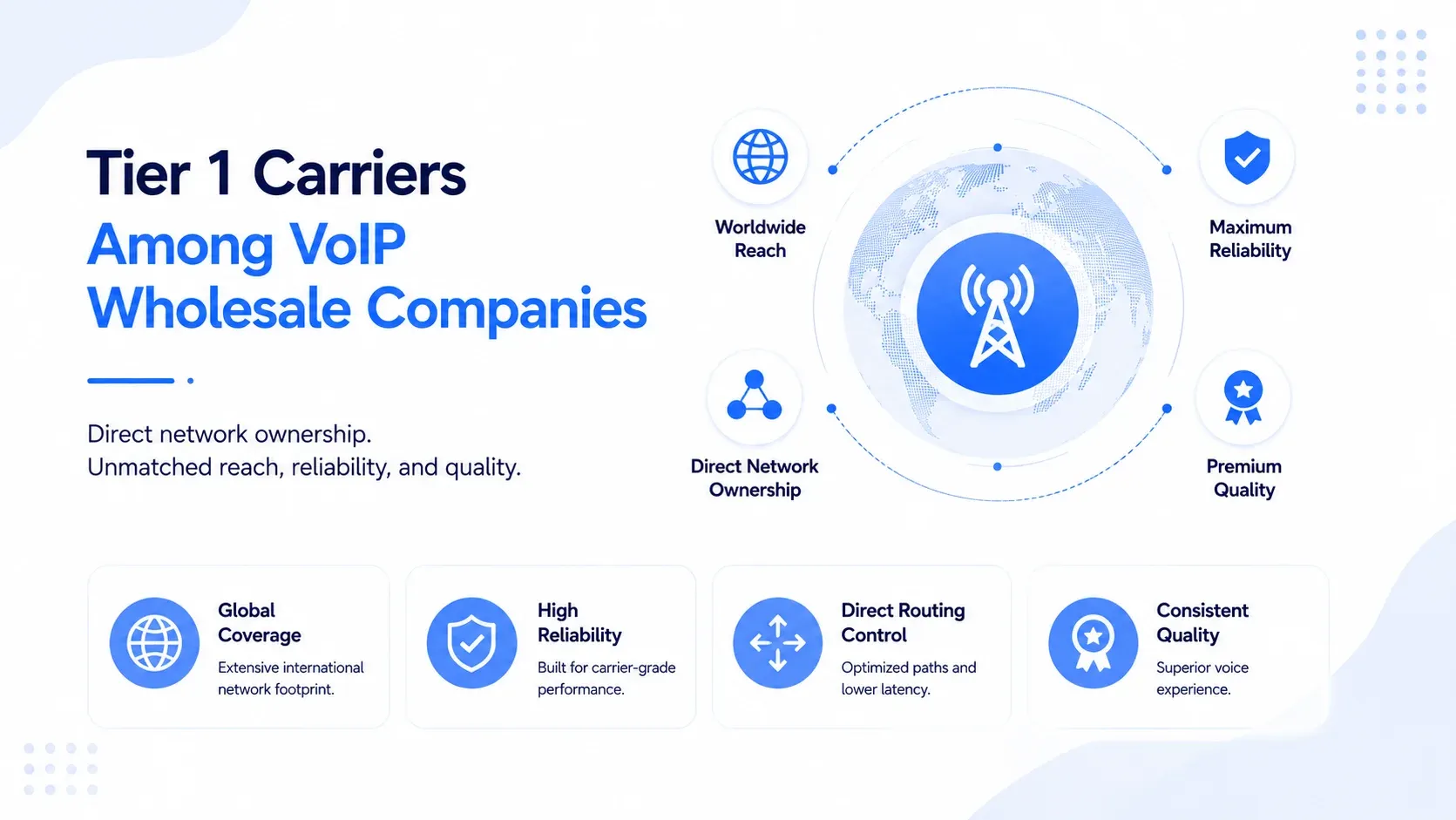
They offer the lowest per-minute wholesale VoIP rates on commodity routes and the highest baseline call quality.
The trade-off is that Tier 1 carriers usually have rigid commercial terms, large minimum volume commitments, and slow onboarding. Their processes are designed for other carriers, not mid-sized ITSPs.
For high-volume operators shipping hundreds of millions of minutes per quarter, the Tier 1 VoIP wholesale companies often make sense as a direct relationship.
For everyone else, Tier 1 carriers usually sit underneath an aggregator or a UCaaS platform that handles the operational friction.
Tier 2 Regional Carriers and Aggregators
Tier 2 regional VoIP wholesale companies specialise in specific geographies. A Tier 2 operator focused on LATAM termination holds direct interconnects in Mexico, Brazil, Colombia, and Argentina. Their route quality in those markets beats what Tier 1 generalist carriers can offer.
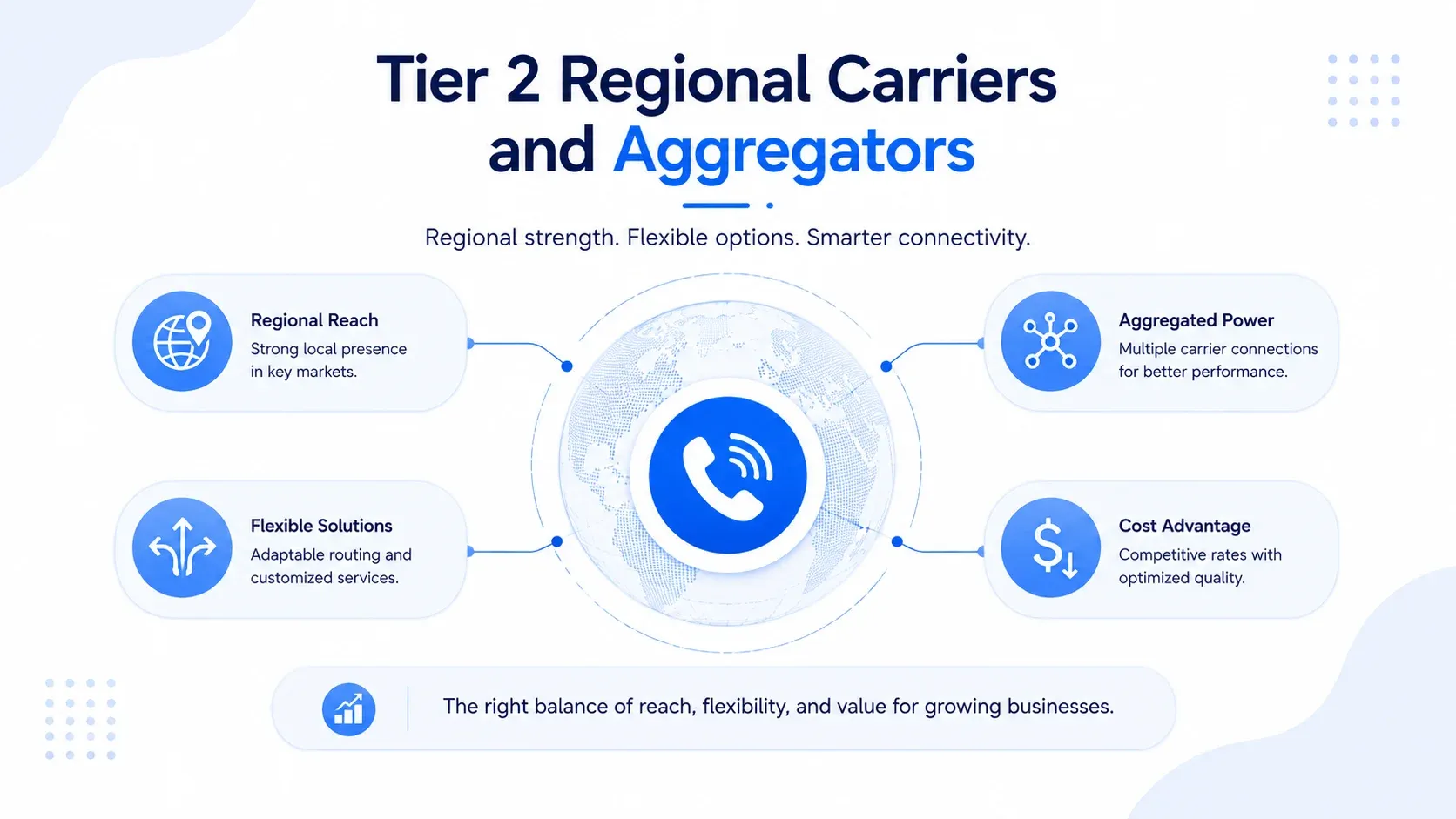
They typically out-perform Tier 1 carriers on their specialist routes and under-perform on routes outside their footprint. For buyers with concentrated regional traffic, a Tier 2 specialist is often the right answer for that geography.
Aggregators combine routes from multiple Tier 1 and Tier 2 carriers under a single contract, applying their own LCR and quality scoring on top.
The aggregator value proposition is operational simplicity — one contract, one billing relationship, one set of CDR streams — at a small margin uplift over going direct. Many of the most credible VoIP wholesale companies in 2026 operate this way, including Twiching.
Technology-Led UCaaS Platforms as VoIP Wholesale Companies
Further reading: Wholesale VoIP platform
Technology-led VoIP wholesale companies sell carrier-grade voice alongside programmable APIs, real-time CDR streaming, self-service dashboards, and modern developer tooling.
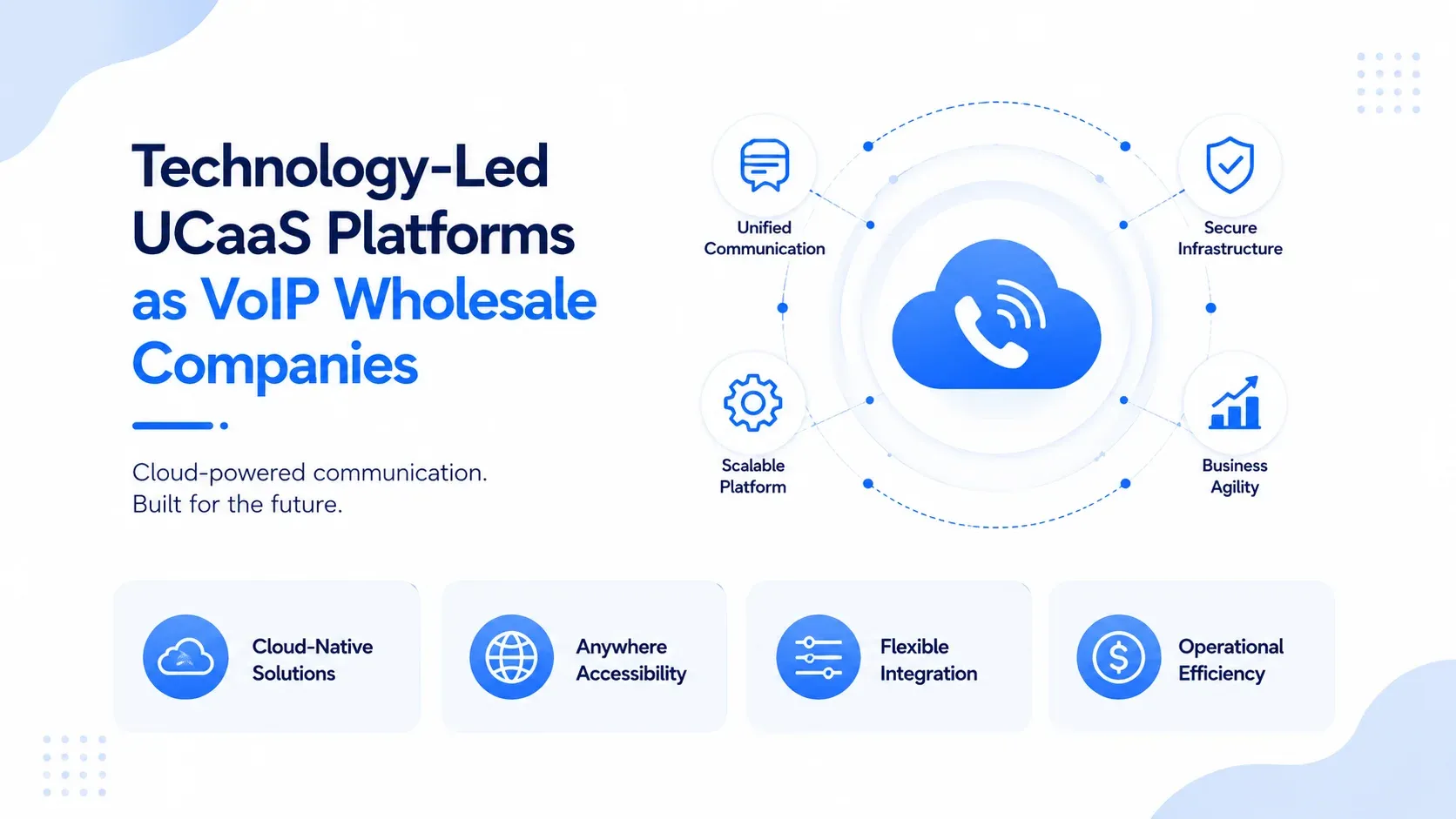
They are increasingly the right choice for ITSPs, contact-centre platforms, and CPaaS-style buyers who need automation rather than EDI-style monthly batch reports.
The trade-off versus traditional Tier 1 carriers is sometimes slightly higher per-minute pricing, since the technology layer has to be paid for somewhere. In exchange, operational overhead is materially lower.
Twiching is one of the technology-led VoIP wholesale companies. The carrier-grade backbone is real, with direct Tier 1 interconnects across 200+ countries. It is wrapped in a programmable platform with REST APIs, real-time dashboards, instant DID provisioning, and inline STIR/SHAKEN attestation.
The combination is what most mid-market ITSPs and contact-centre platforms actually need.
Niche Specialist VoIP Wholesale Companies
Niche specialist VoIP wholesale companies focus on a single vertical or traffic type. Toll-free origination specialists hold deep RespOrg inventory. Contact-centre dialler-route specialists tune softswitch capacity and IRSF detection for CC traffic patterns.
Healthcare-vertical specialists handle HIPAA-compliant call recording. SMS-adjacent voice specialists bundle voice with A2P messaging on optimised carrier relationships.
Niche specialists are the right answer when your traffic profile is genuinely specialised. They are the wrong answer when you also need broad coverage outside their focus.
At that point you end up signing two contracts and paying integration overhead. For most buyers, a generalist VoIP wholesale company with strong support for the specialist segment is more economic than a pure specialist.
Licensing and Regulatory Posture
Reputable VoIP wholesale companies hold the necessary carrier licences for each market they operate in. In the US this means FCC authorisation as an interstate carrier plus state PUC registrations for intrastate services.
In the EU it means national regulatory authorisation in each member state under the European Electronic Communications Code. Most major markets have their own equivalents.
Always ask a prospective VoIP wholesale company to confirm licensing status in writing and provide regulator-issued documentation.
STIR/SHAKEN attestation for US-bound traffic and GDPR compliance for European call data sit on top of the basic licensing posture. So do HIPAA for US healthcare and CALEA for lawful intercept.
A VoIP wholesale company without inline STIR/SHAKEN attestation is no longer commercially viable for US-bound outbound traffic in 2026. Connection rates collapse on unsigned calls.
Financial Stability and Acquisition Risk
Further reading: Wikipedia: VoIP overview
Financial stability varies considerably across VoIP wholesale companies. Large carriers and publicly listed companies provide the most transparency.
For private VoIP wholesale companies, ask for trade references and check for any history of service interruptions caused by financial issues. Also look at how long they have operated.
Carrier consolidation through M&A is a real risk. Provider acquisitions over the last five years have repeatedly disrupted customers. Terms that once felt stable got changed unilaterally by the acquiring company.
The defensive posture is a primary-plus-secondary VoIP wholesale company strategy. Run a secondary carrier alongside your primary, pre-configured for failover.
The marginal cost is small. The operational insurance against acquisition disruption is significant.
The same configuration also protects against routine outages. Most contact-centre and ITSP operators running mission-critical voice already work this way.
Comparison Criteria for VoIP Wholesale Companies
No single archetype wins on every criterion, which is why a side-by-side scorecard matters more here than in most buying decisions — a Tier 1 carrier and a technology-led aggregator will score very differently even when both are genuinely credible.
- 01Owned routes vs reseller — do the VoIP wholesale companies hold direct Tier 1 interconnects in your top destinations?
- 02Rate-deck transparency — per-destination wholesale VoIP rates published with billing increments, currency, and effective dates
- 03STIR/SHAKEN attestation — inline A-level signing on US-bound traffic with attestation level visible in CDRs
- 04SLA terms — minimum 99.9% uptime, ASR floors per destination, financial credits for breaches, defined escalation procedures
- 05Programmable APIs — CDR streaming, DID provisioning, rate-deck queries via REST
- 06Fraud controls — real-time IRSF detection with hard spend caps and blocked-prefix lists
- 07Onboarding speed — KYC under 48 hours, SIP trunk provisioning the same day, production traffic within a week
- 08Financial stability and licensing — documented carrier licences and demonstrable business continuity
- 0924/7 NOC — 15-minute critical-incident SLA with named escalation contacts
Weight the list against your own priorities rather than treating every row equally — a high-volume ITSP cares most about owned routes and rate transparency, while an enterprise buyer usually weighs SLA terms and financial stability more heavily.
Twiching Among VoIP Wholesale Companies
Twiching sits as a technology-led aggregator among VoIP wholesale companies. Direct Tier 1 interconnects across 200+ countries combine with a programmable platform, REST APIs, and real-time CDR streaming. Inline STIR/SHAKEN attestation and a 24/7 NOC with a 15-minute critical-incident SLA round it out.
Per-destination wholesale VoIP rates publish with billing increments and effective dates visible on every row, and onboarding completes in under 48 hours for standard business customers.
Unlike traditional Tier 1 VoIP wholesale companies, Twiching has no large volume minimums. Small ITSPs and growing platforms access the same carrier-tier wholesale VoIP rates through traffic aggregation.
The rate deck publishes per destination with effective dates and notice periods. Partners on the white-label reseller programme launch a branded wholesale voice business on the same carrier-grade infrastructure Twiching uses internally.
VoIP wholesale companies vary significantly in their approach to customer service. Some operate fully automated self-service models where customers configure routing and access CDRs without human interaction. Others assign dedicated account managers who proactively monitor customer traffic and surface optimisation opportunities.
For high-volume operators, the latter model delivers more value. Experienced account managers understand your traffic profile. They can identify routing improvements, negotiate better rates on your behalf, and escalate carrier issues faster than a support ticket system.
Conclusion
VoIP wholesale companies break into five archetypes — Tier 1 carriers, Tier 2 regionals, aggregators, technology-led UCaaS platforms, and niche specialists — and the right choice depends on volume, destinations, technical capability, and risk appetite. Evaluate prospective VoIP wholesale companies against owned-route depth, rate-deck transparency, STIR/SHAKEN attestation, programmable APIs, fraud controls, financial stability, and 24/7 NOC response.
Twiching combines carrier-grade infrastructure with a programmable platform — no minimums, instant provisioning, real-time quality dashboards, inline STIR/SHAKEN, and 24/7 support — making it a credible choice for both wholesale operators and direct business customers. Compare wholesale VoIP rates with Twiching to benchmark your current spend.