Introduction
Wholesale SIP is the umbrella term for buying SIP-based voice services at carrier-tier per-minute pricing rather than retail per-seat pricing. It covers three sub-products — SIP trunking, SIP termination, and SIP origination — sold to ITSPs, CPaaS layers, UCaaS platforms, and contact centres, never end consumers. This guide covers what each delivers and the criteria that separate strong providers from weak ones, using Twiching as a worked example.
Key Takeaways
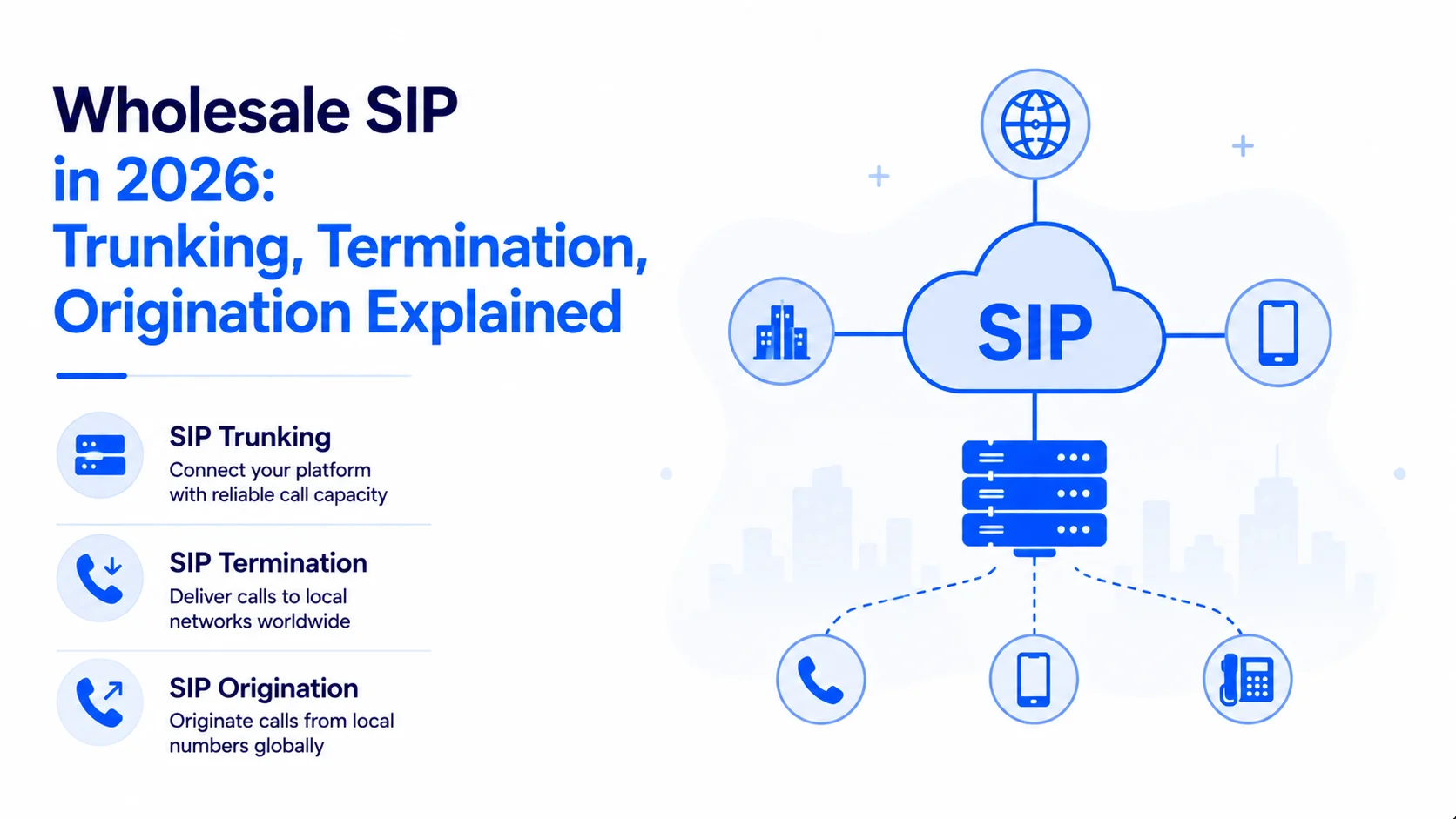
- Wholesale SIP splits into three sub-products — SIP trunking (channels), SIP termination (outbound), and SIP origination (inbound DID hosting) — each with distinct economics.
- Codec support matters: G.711 is the universal default; G.729 saves bandwidth at lower quality; G.722 and OPUS deliver HD voice when both endpoints support them.
- Registration via SIP credentials or static-IP authentication; static-IP whitelisting is simpler and more secure for fixed-location deployments.
- Bandwidth budget: roughly 100 kbps per concurrent call with G.711, lower with G.729; NAT/firewall handling is the single biggest source of new-trunk setup pain.
- Twiching exposes wholesale SIP across all three sub-products via REST API with per-destination rate decks, real-time CDR streaming, and a 24/7 NOC.
What Wholesale SIP Covers
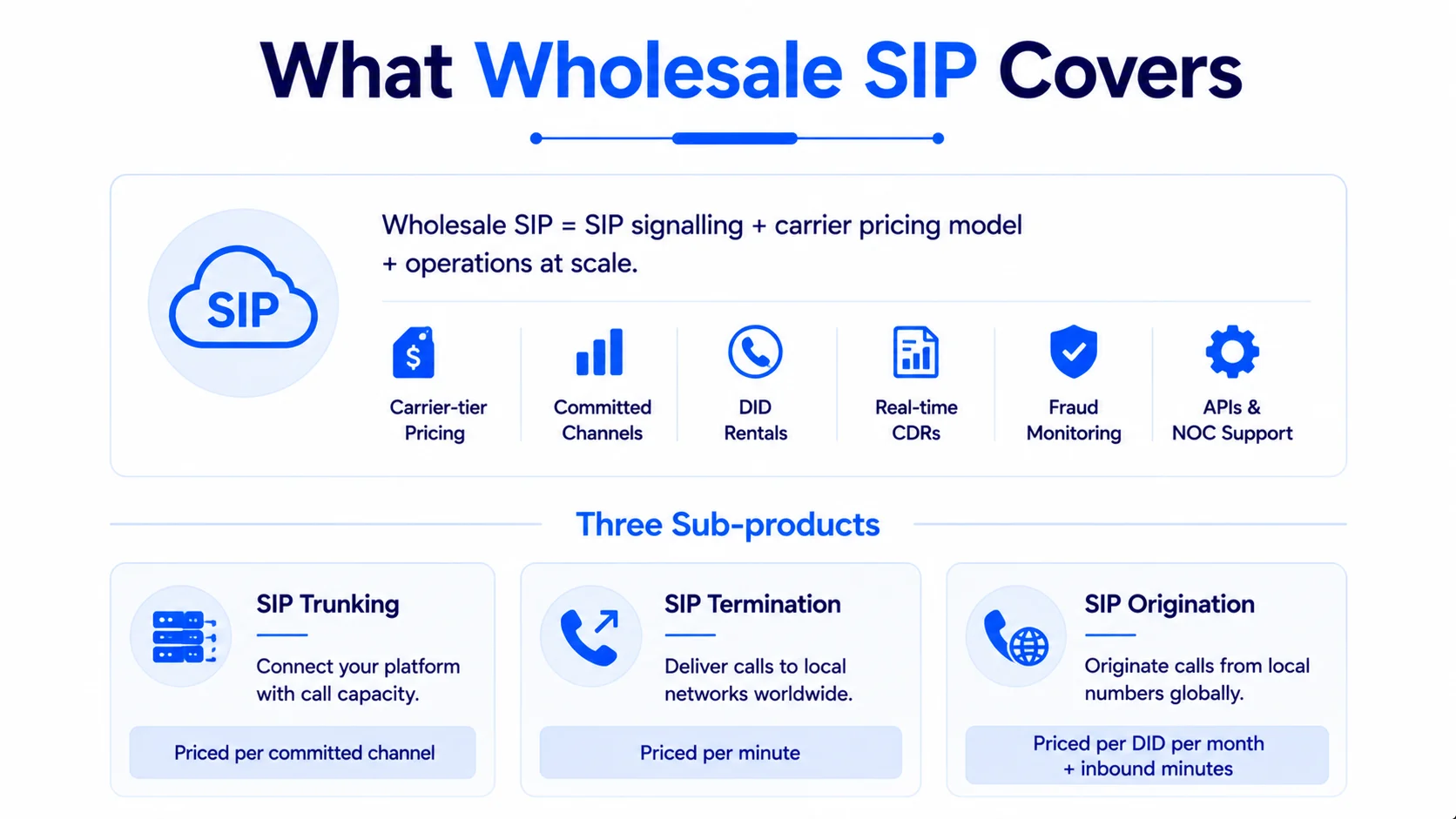
Wholesale SIP refers to the bulk provision of SIP-based voice services at carrier-tier pricing. The Session Initiation Protocol itself is just the signalling layer — it sets up, modifies, and tears down voice and video sessions over IP.
What 'wholesale SIP' adds is the carrier-tier commercial model — per-minute rates, committed concurrent channels, monthly DID rentals. It also adds the operations layer — real-time CDRs, fraud monitoring, REST APIs, NOC response — that makes SIP usable at production scale.
The three sub-products inside wholesale SIP are sold together or separately depending on the buyer's use case. A contact centre running outbound campaigns mainly buys SIP trunking + SIP termination.
A CPaaS layer building inbound voice apps mainly buys SIP origination plus DID inventory. A UCaaS platform handing out seats buys all three.
Pricing for each is structured differently — trunks per committed channel, termination per minute, origination per DID per month plus inbound minutes.
SIP Trunking — Concurrent Channels
Further reading: Wholesale pricing & rate deck
SIP trunking is the foundational wholesale SIP service. The provider commits a number of concurrent SIP channels to the buyer plus an elastic burst ceiling for traffic spikes. The buyer's PBX or UCaaS platform connects to the provider's SIP proxy (registration- or IP-authenticated) and uses the trunk for inbound and outbound traffic.
Modern wholesale SIP trunking platforms expose REST APIs for trunk configuration. The buyer can add channels, change routing, or adjust failover destinations without involving carrier support.
Channel sizing matters for contact-centre workloads. Predictive diallers place several concurrent attempts per agent. A 100-agent outbound centre running a 3:1 dialler ratio needs 300+ concurrent SIP channels plus burst headroom.
Inbound queues run lower concurrency. Plan committed channels against your peak realistic concurrency plus a 15–20% burst buffer.
SIP Termination — Outbound Routing
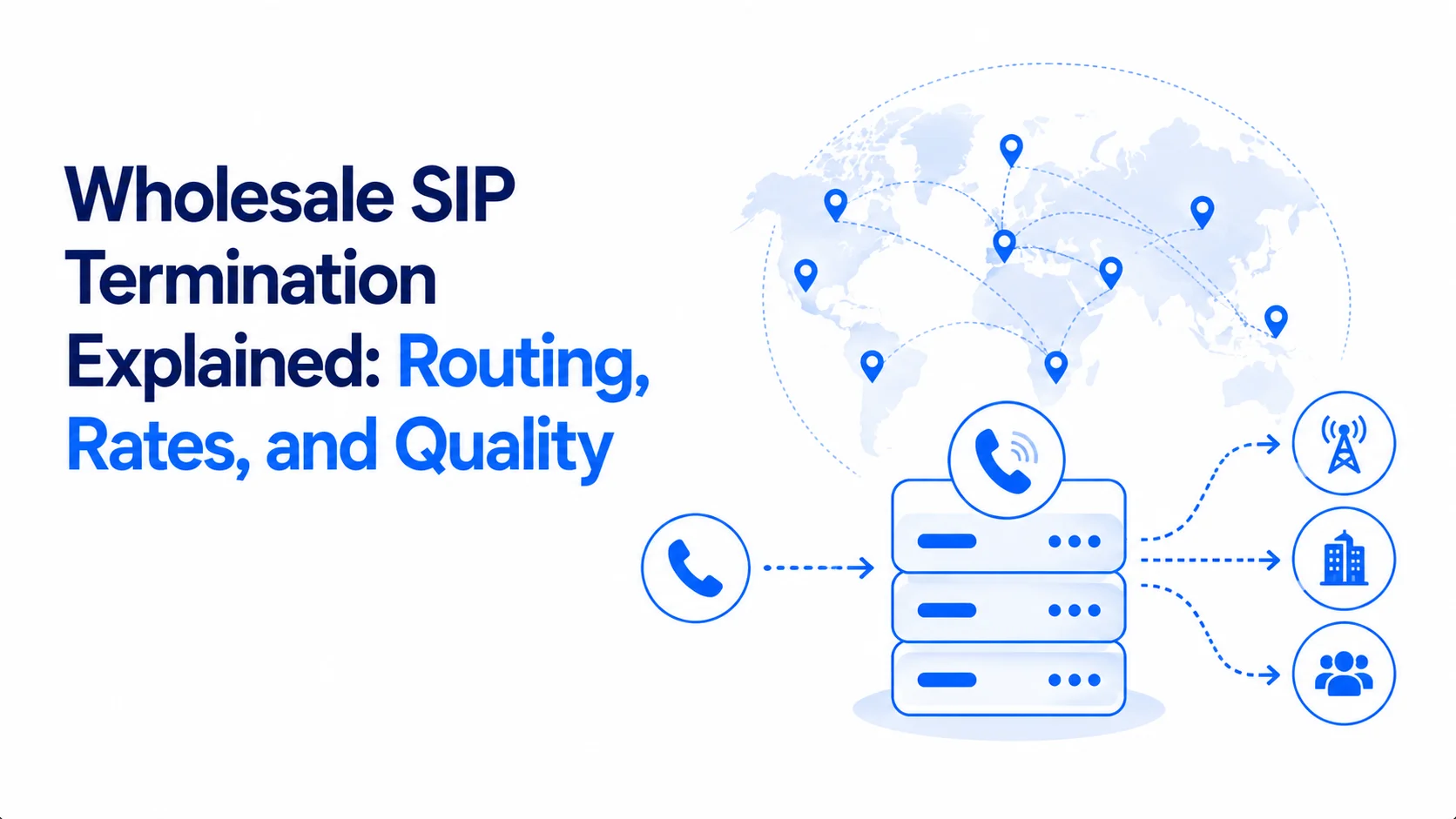
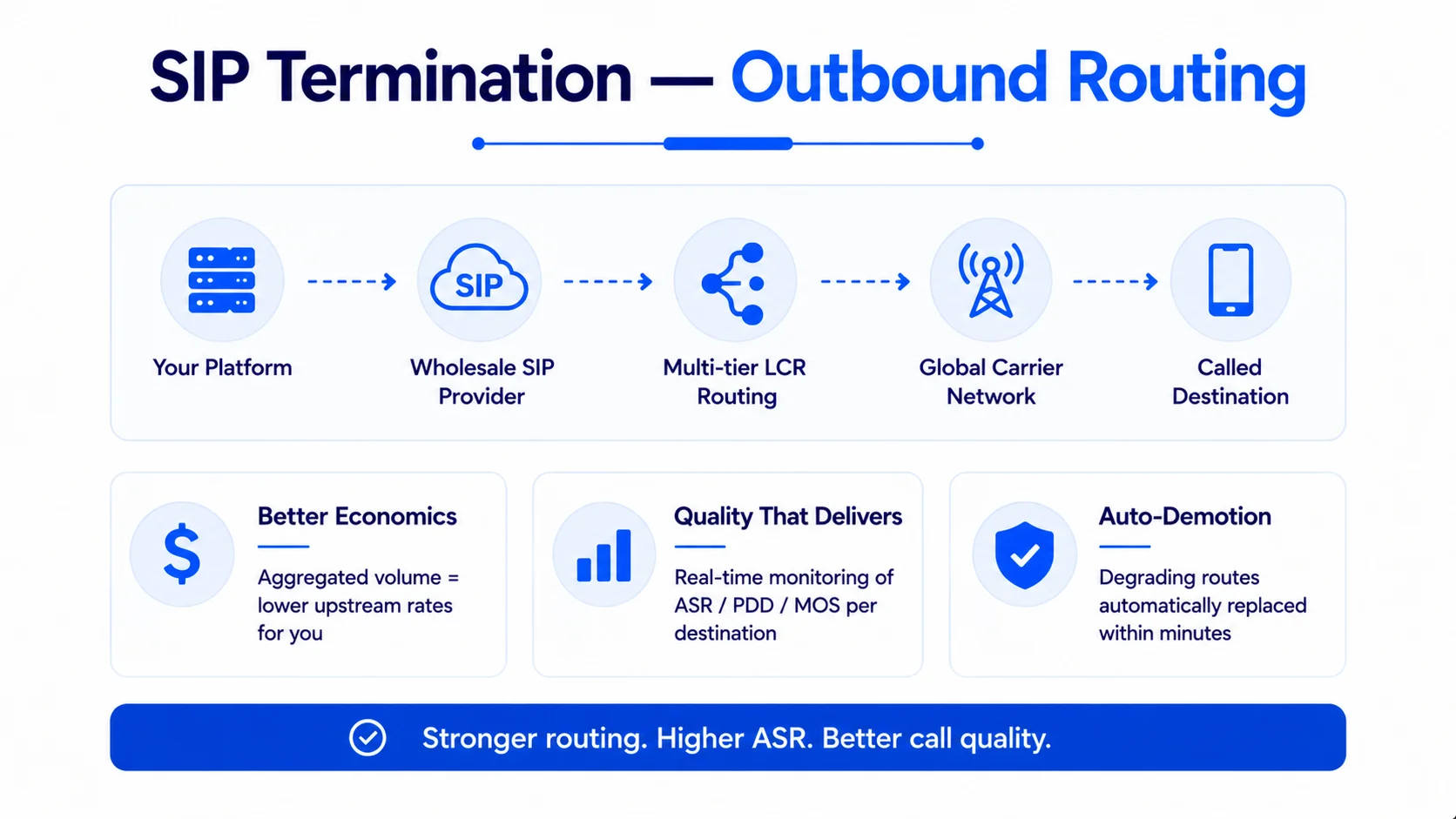
SIP termination is the outbound half of the wholesale SIP product. The provider routes the buyer's outbound calls across its interconnect base via multi-tier LCR, billing per minute at per-destination wholesale VoIP rates.
The economics make sense because the provider aggregates traffic from many buyers. This volume qualifies the provider for volume-tier discounts with upstream carriers that any individual buyer couldn't earn alone. The buyer pays a margin above the upstream rate.
Quality engineering on the SIP termination layer determines whether the buyer's outbound calls hold ASR/PDD/MOS under campaign load. Strong wholesale SIP providers monitor per-destination quality in real time and auto-demote degrading routes within minutes. Weak providers rely on stale quality data and let traffic pile up on routes that broke overnight.
SIP Origination — Inbound DID Hosting
Further reading: Wholesale voice solutions
SIP origination is the inbound half of the wholesale SIP product. The provider hosts Direct Inward Dialling numbers across the countries the buyer needs and delivers PSTN-originated calls back to the buyer's SIP endpoint via SIP INVITE.
Pricing is per-number monthly rental ($0.50–$3.00 for geographic, $5–$15 for US toll-free) plus per-minute inbound termination at wholesale VoIP rates.
Country coverage and per-country inventory depth matter more than headline per-number pricing. A wholesale SIP origination provider charging $0.50 for US DIDs but offering nothing in Singapore is less useful to a regional buyer.
One charging $1.50 with direct Singapore inventory serves that buyer better. Twiching's wholesale SIP origination covers 80+ countries via REST API provisioning.
Codecs and Bandwidth
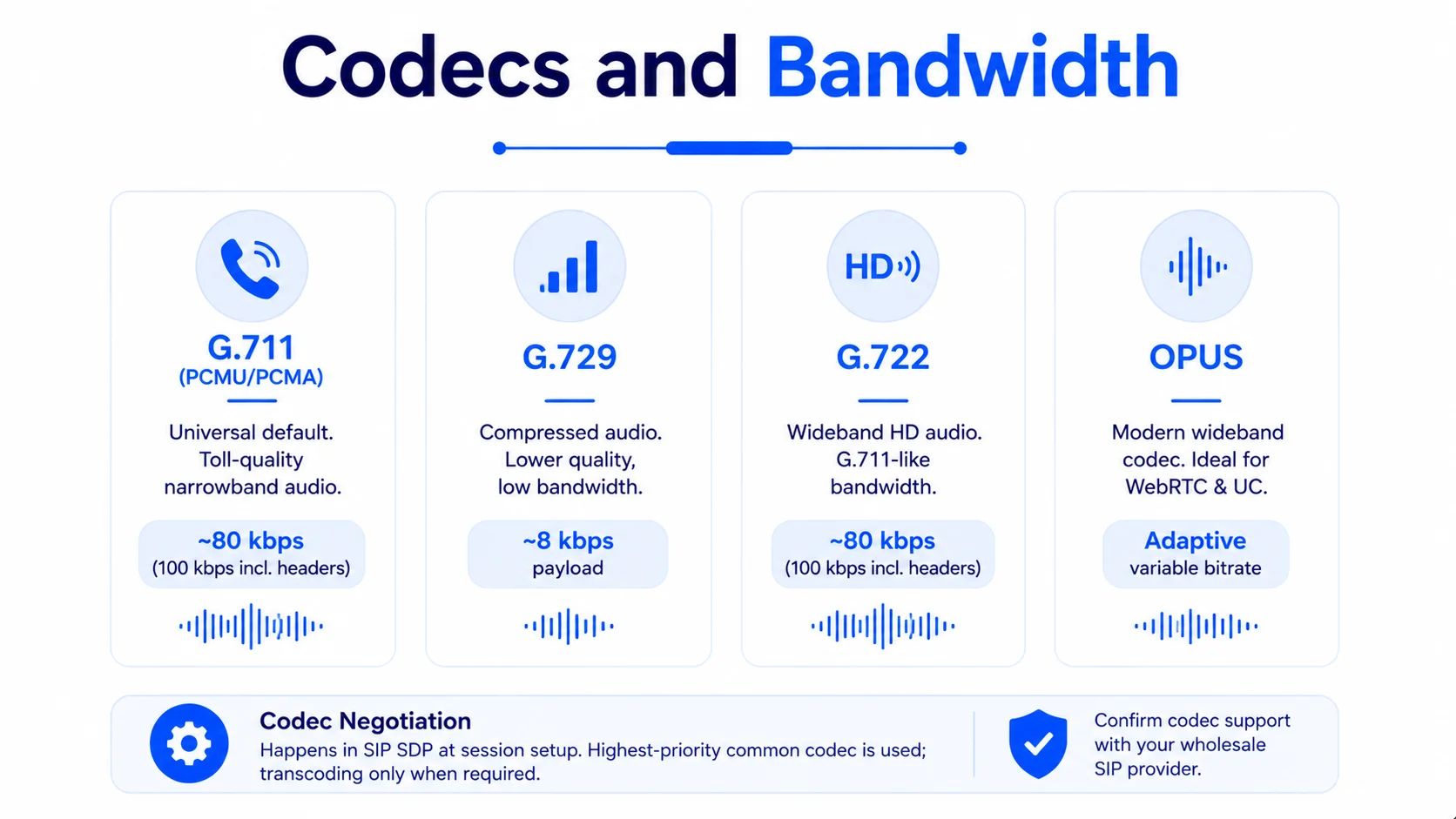
Wholesale SIP services support several codecs and the choice affects both quality and bandwidth. G.711 (PCMU/PCMA) is the universal default — toll-quality narrowband audio at about 80 kbps per call payload (100 kbps including headers). G.729 compresses to about 8 kbps payload at lower quality, good for bandwidth-constrained branch offices.
G.722 delivers wideband HD audio at G.711-like bandwidth when both endpoints support it. OPUS is the modern wideband codec used in WebRTC and increasingly in unified communications platforms.
Codec negotiation happens in SIP SDP at session setup. The buyer's PBX advertises its supported codecs in priority order. The provider's softswitch picks the highest-priority codec both sides support and applies transcoding only when the upstream carrier doesn't support the chosen codec.
Confirm with the wholesale SIP provider which codecs they support before signing — some carriers still don't handle OPUS end-to-end.
Registration and Authentication
SIP registration keeps the connection between the buyer's PBX and the provider's SIP proxy active so inbound calls can route correctly. Two auth models are common. SIP credentials use a username/password registered to the proxy with periodic refresh INVITEs.
IP authentication uses static-IP whitelisting on the provider side, with no registration message exchange. IP authentication is simpler and more secure for fixed-location deployments — there's no credential to leak and no registration cycle to misconfigure.
Multi-site customers often mix the two: head-office PBX on IP auth, branch-office endpoints on credential auth. Wholesale SIP providers should support both side-by-side per trunk. Twiching exposes both auth models with selectable per-trunk configuration through the customer portal.
NAT, Firewalls, and the Setup Pain
NAT and firewall handling is the single biggest source of new-trunk setup pain in wholesale SIP. SIP signalling runs on UDP/TCP 5060 (or 5061 for TLS). Media (RTP) runs on a dynamic port range, typically UDP 10000–20000.
NAT routers rewrite IP/port pairs in SIP headers (Via, Contact) and RTP needs symmetric path through the same NAT, breaking calls when handled incorrectly.
The standard fixes are SIP ALG disabled on the customer-side router (most ALGs are buggy) and a session border controller (SBC) on the customer side. SIP-over-TLS plus SRTP is another option to bypass the worst of the NAT meddling.
Strong wholesale SIP providers ship pre-tested configuration guides for the common PBXs (Asterisk, FreePBX, 3CX, Cisco, Avaya) plus the common SBCs. They also run a SIP-aware first-call test as part of provisioning. Weak providers leave NAT configuration to the buyer.
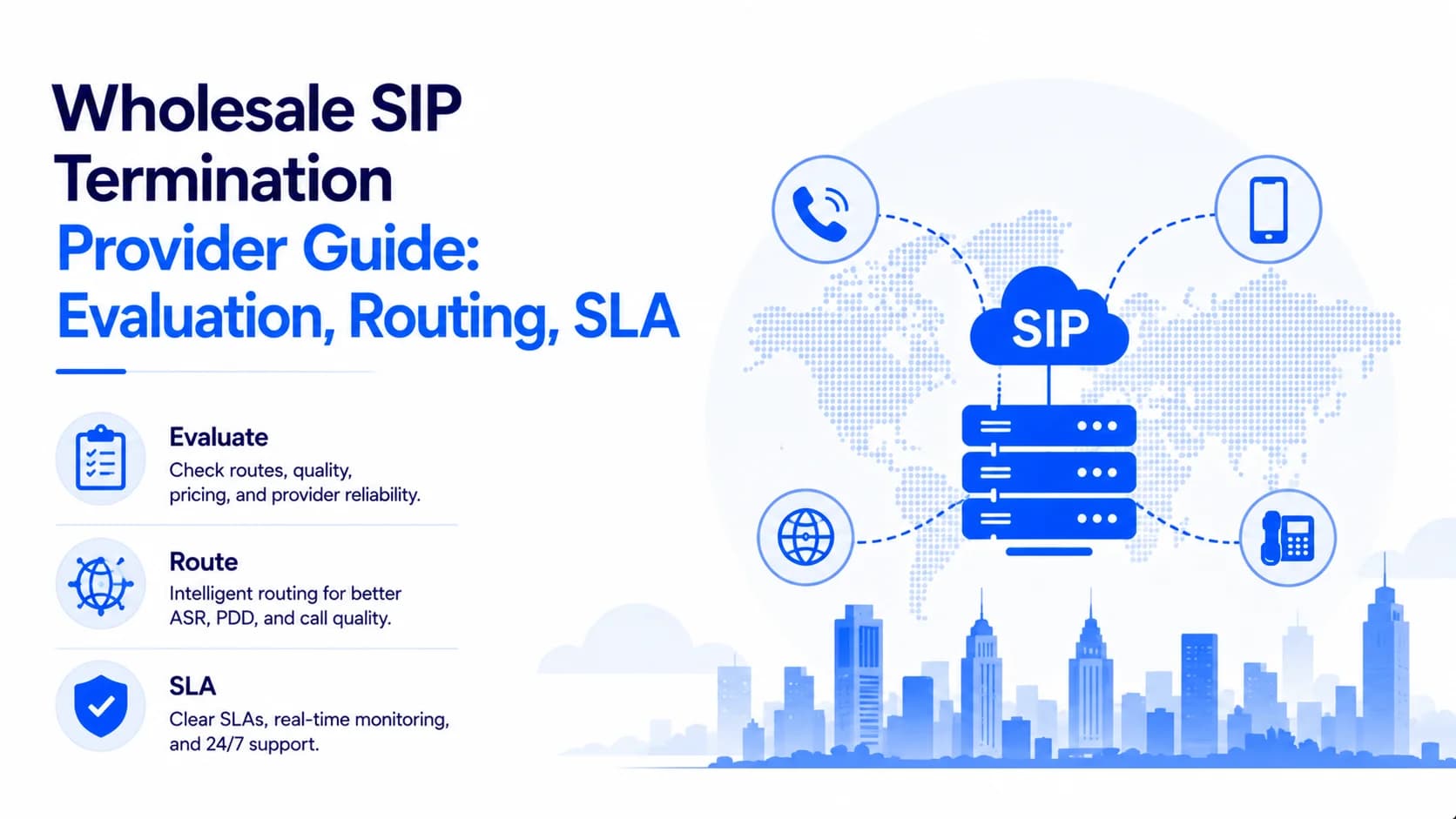
Wholesale SIP Provider Evaluation Checklist
- 01Full wholesale SIP coverage — trunking, termination, origination — under a single contract and platform
- 02Per-destination wholesale VoIP rate deck published with billing increments, currency, and effective dates
- 03Codec support — G.711 universal plus G.729, G.722, OPUS where the buyer's product needs them
- 04Both IP and credential auth supported, selectable per trunk through the customer portal
- 05REST API for trunk configuration, DID provisioning, CDR retrieval, and webhook delivery
- 06Multi-region active-active SIP proxy with documented 99.99% uptime and 12-month uptime history
- 07Real-time per-destination ASR/PDD/MOS monitoring with auto-demotion on degrading routes
- 08A-level STIR/SHAKEN attestation on US-bound outbound presenting hosted DIDs
- 09IRSF fraud protection with hard spend caps and default-deny premium-rate posture
- 1024/7 NOC with 15-minute critical-incident SLA and named escalation contacts
Twiching for Wholesale SIP
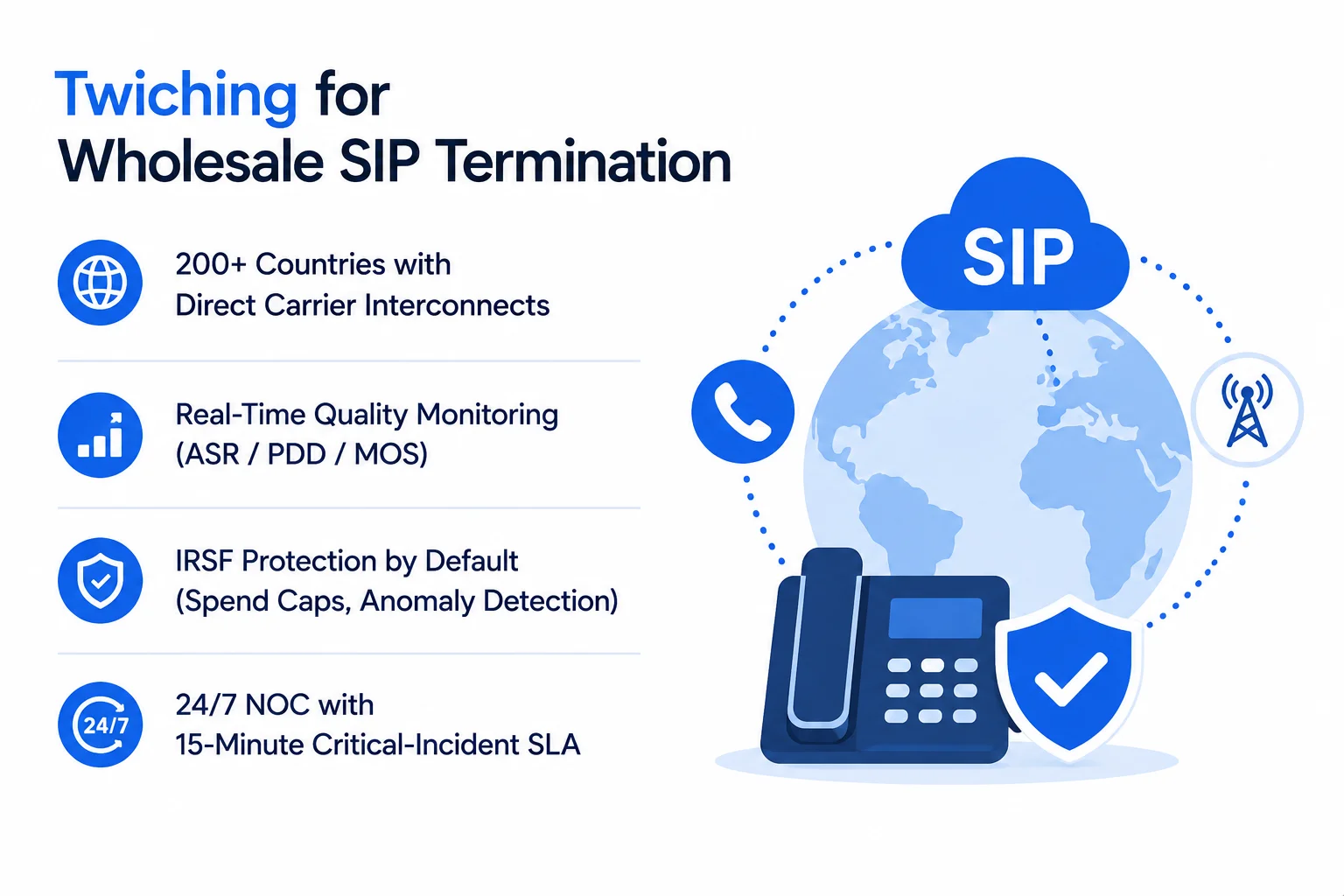
Twiching exposes the full wholesale SIP product — trunking, termination, and origination — through a single platform and contract. SIP trunks provision the same day with selectable IP or credential auth.
Outbound termination runs through multi-tier LCR across 200+ countries with per-destination ASR/PDD/MOS monitoring refreshed every 60 seconds and auto-demotion on degrading routes. SIP origination covers 80+ countries via REST API with stage-by-stage porting status visibility.
A-level STIR/SHAKEN attestation signs US-bound outbound calls presenting hosted DIDs by default. IRSF protection runs by default with customer-configurable spend caps.
Real-time CDR streaming feeds via webhook or Kafka, and the 24/7 NOC handles critical incidents within 15 minutes with named escalation contacts. Per-destination wholesale VoIP rates publish with billing increments and effective dates visible on every row, with no large volume minimums on standard business accounts.
Conclusion
Wholesale SIP is three distinct products sold as one bundle — trunking, termination, origination — and the provider evaluation question is whether the supplier ships all three competently. Codec support, auth model flexibility, NAT-aware provisioning, real-time quality engineering, A-level STIR/SHAKEN, fraud protection, and 24/7 NOC response together determine whether the wholesale SIP service holds under campaign load. Twiching ships the full stack — REST API across the lifecycle, multi-region active-active SIP proxy, per-destination quality monitoring with auto-demotion, A-level outbound attestation, named escalation contacts. Compare current wholesale SIP terms against Twiching's published rates to benchmark whether the provider behind your SIP estate is still the right one.