Introduction
Wholesale SIP termination is the per-minute service of carrying outbound voice traffic from a buyer's PBX or UCaaS platform to its destination, billed at wholesale VoIP rates. A routing engine picks carriers, a quality layer demotes degrading routes, and a regulatory layer keeps traffic compliant. This guide covers how it works, realistic rates by tier, and how to compare providers.
Key Takeaways
- Wholesale SIP termination is per-minute outbound voice routing from the buyer's PBX across the provider's carrier interconnect base at per-destination wholesale VoIP rates.
- Multi-tier LCR (premium / standard / economy) lets the buyer choose quality versus cost per destination class.
- Realistic wholesale VoIP rates: $0.001–$0.01 per minute on Tier 1 destinations, $0.005–$0.05 on Tier 2, much higher on regulated or premium-rate destinations.
- ASR, PDD, MOS are the per-destination quality metrics — target ASR above 60% on major destinations, PDD under 3 seconds for dialler traffic.
- Twiching delivers wholesale SIP termination with real-time per-destination quality monitoring, A-level STIR/SHAKEN by default, and a 24/7 NOC.
How Wholesale SIP Termination Works
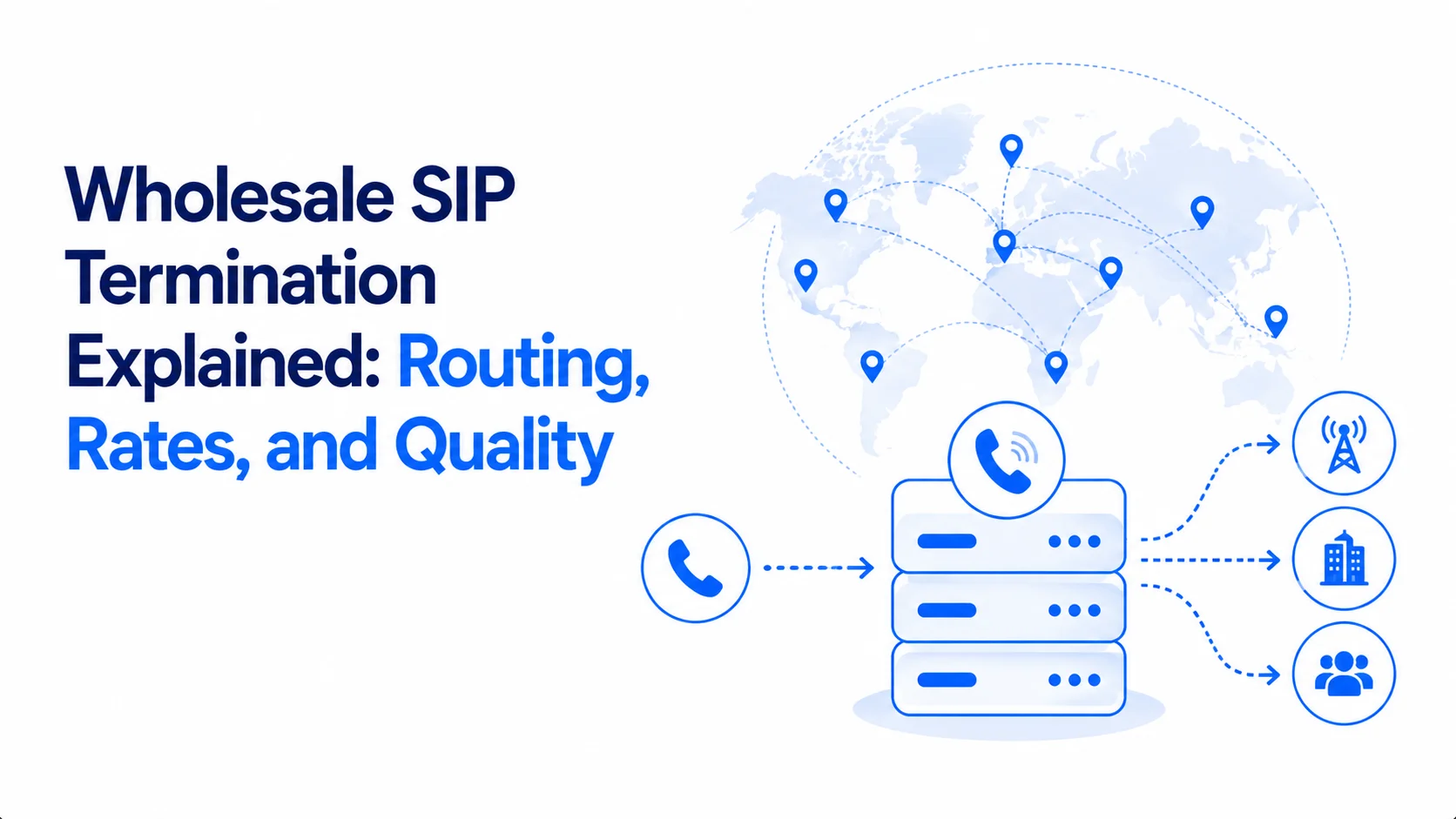
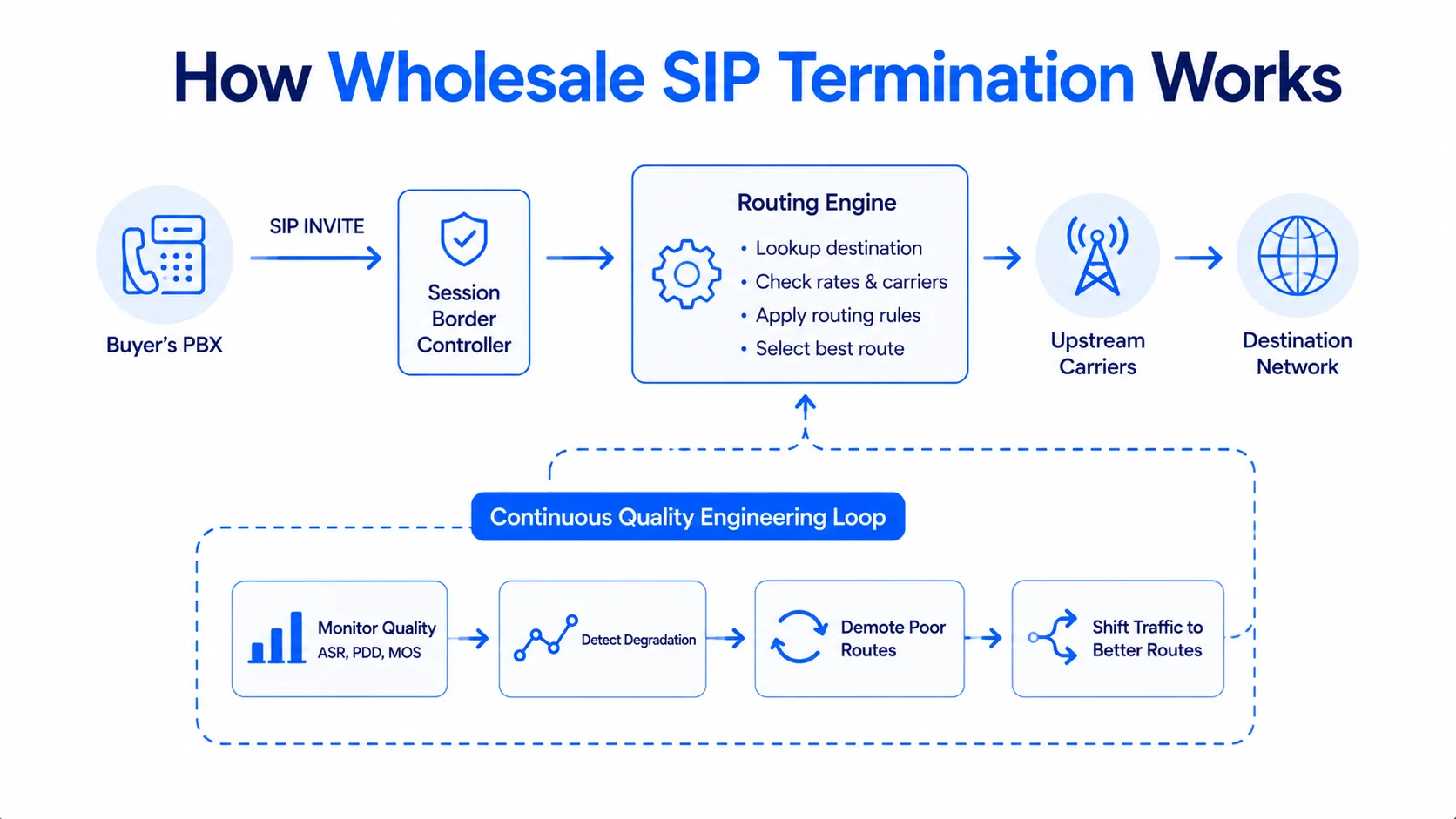
The buyer's PBX sends an outbound SIP INVITE to the wholesale SIP termination provider's session border controller. The provider's routing engine looks up the destination prefix and consults its rate deck across all upstream carriers that have a route to that destination.
It then applies the customer's routing tier and quality floor rules, picks the carrier that wins, and forwards the INVITE. Modern engines do this in single-digit milliseconds per call. Bad routing decisions cost the buyer margin on every call.
Behind the per-call routing decision sits a continuous quality engineering loop. The provider monitors per-destination ASR, PDD, and MOS in real time — refreshed every 60 seconds on strong platforms — and demotes degrading routes within minutes.
Traffic shifts away from a degraded upstream carrier before the buyer's CRM dashboard notices the drop. This is what separates serious wholesale SIP termination platforms from price-only operators.
Multi-Tier LCR — Choosing Quality vs Cost
Further reading: Wholesale pricing & rate deck
Multi-tier LCR lets the buyer pick premium, standard, or economy routing per destination prefix per traffic class. Premium routes use the highest-quality upstream carrier per destination regardless of cost (best for contact-centre outbound where every percentage point of ASR matters).
Standard routes balance cost and quality. Economy routes pick the cheapest qualifying carrier (best for background traffic where cost matters more than quality). Mixing tiers across the estate optimises total cost without sacrificing customer-facing quality.
Wholesale SIP termination providers that offer single-tier routing — just one route per destination — force a hard choice on the buyer. They either pay premium across everything or live with economy quality everywhere. Twiching's wholesale SIP termination engine supports per-prefix tier selection through the customer portal and API.
Realistic Wholesale VoIP Rates by Destination Tier
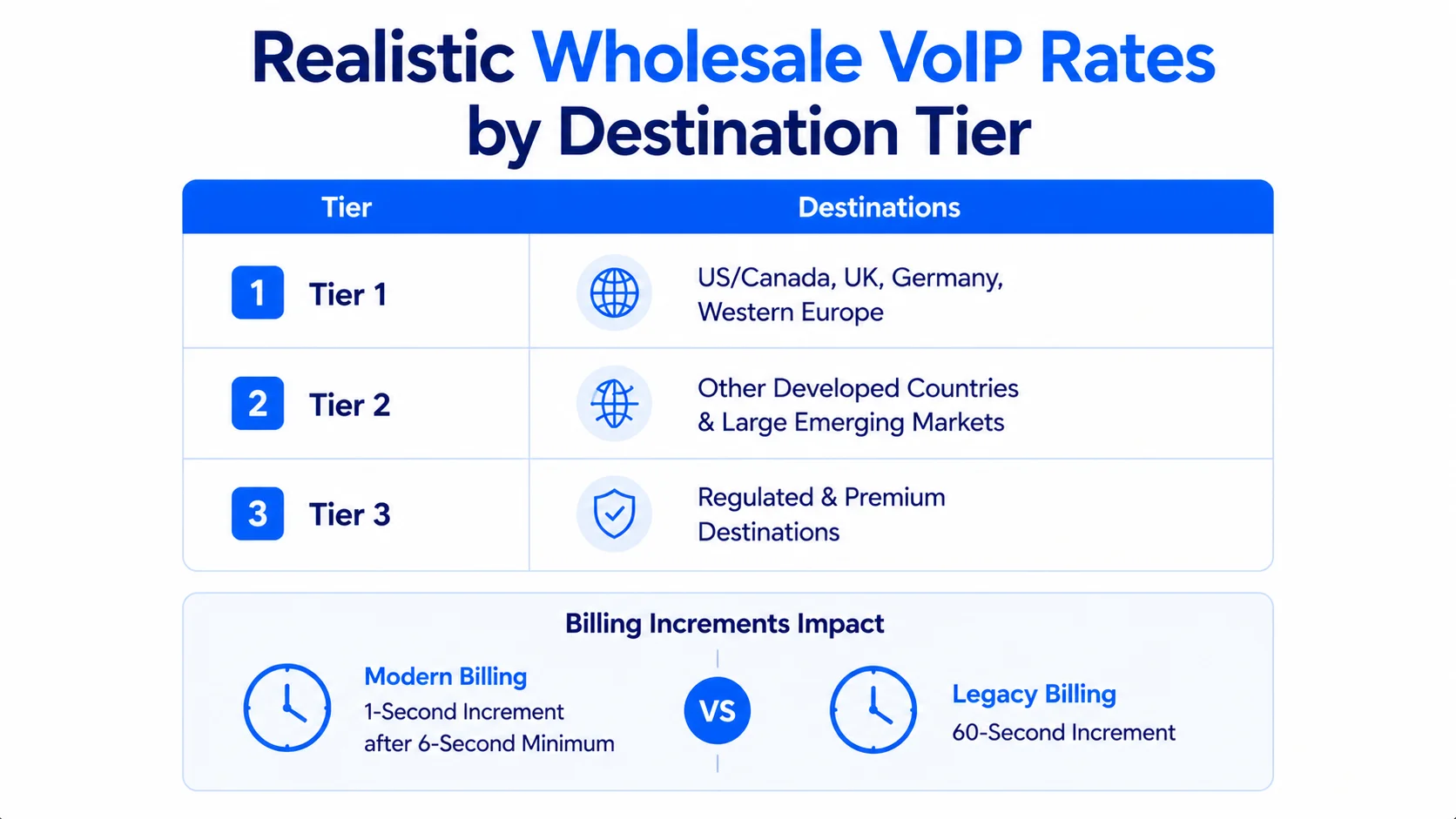
Wholesale VoIP rates split by destination tier. Tier 1 destinations — US/Canada landline and mobile, UK landline, Germany landline, most of Western Europe landline — run $0.001–$0.01 per minute on wholesale SIP termination. Tier 2 destinations — most other developed countries plus large emerging markets — typically run $0.005–$0.05.
Regulated destinations like India run higher because of mandatory ILD-licensed routing. Premium-rate destinations (international 900-equivalent prefixes, satellite networks, some emerging-market mobiles) can run $0.50–$5.00+ per minute and are fraud targets.
Billing increments materially affect realistic per-minute economics. Modern wholesale SIP termination decks bill in 1-second increments after a 6-second minimum — that pricing is customer-friendly. Legacy decks bill in 60-second increments which inflate effective rates by 20%+ on short calls common in contact-centre dialler traffic.
ASR, PDD, MOS — Operational Quality Metrics
Further reading: Wholesale voice solutions
Three numbers determine whether a wholesale SIP termination route is usable. ASR (Answer Seizure Ratio) is the percentage of placed calls answered — target 60%+ on major destinations. PDD (Post-Dial Delay) is the time between INVITE and ringback — target under 3 seconds for dialler traffic, under 5 for general use.
MOS (Mean Opinion Score) measures voice quality — target above 4.0 on English-language interactive voice. Wholesale SIP termination providers that don't publish these per-destination in real time are flying blind.
Twiching's wholesale SIP termination platform publishes per-destination ASR/PDD/MOS dashboards with five-minute granularity and switches routes automatically when a destination degrades. Customers see route quality on every CDR row so they can audit decisions rather than guess.
STIR/SHAKEN and Regulatory Layer
A-level STIR/SHAKEN attestation on US-bound outbound is non-negotiable in 2026. The wholesale SIP termination provider signs each outbound INVITE with an attestation level.
A-level on customer-owned DIDs protects answered-rate, while B/C-level triggers Spam Likely labelling that collapses answered-rate on US outbound campaigns. Outside the US, CLI compliance applies in modified form across the UK and EU.
Regulatory authorisation matters too. In the US, that means FCC interstate-carrier authorisation plus state PUC registrations for intrastate services.
In the EU, it means national regulatory authorisation in each member state, and equivalent licensing in every other major market the provider sells into. Wholesale SIP termination providers asking customers to take licensing on trust are a red flag.
Fraud — IRSF Risk on SIP Termination
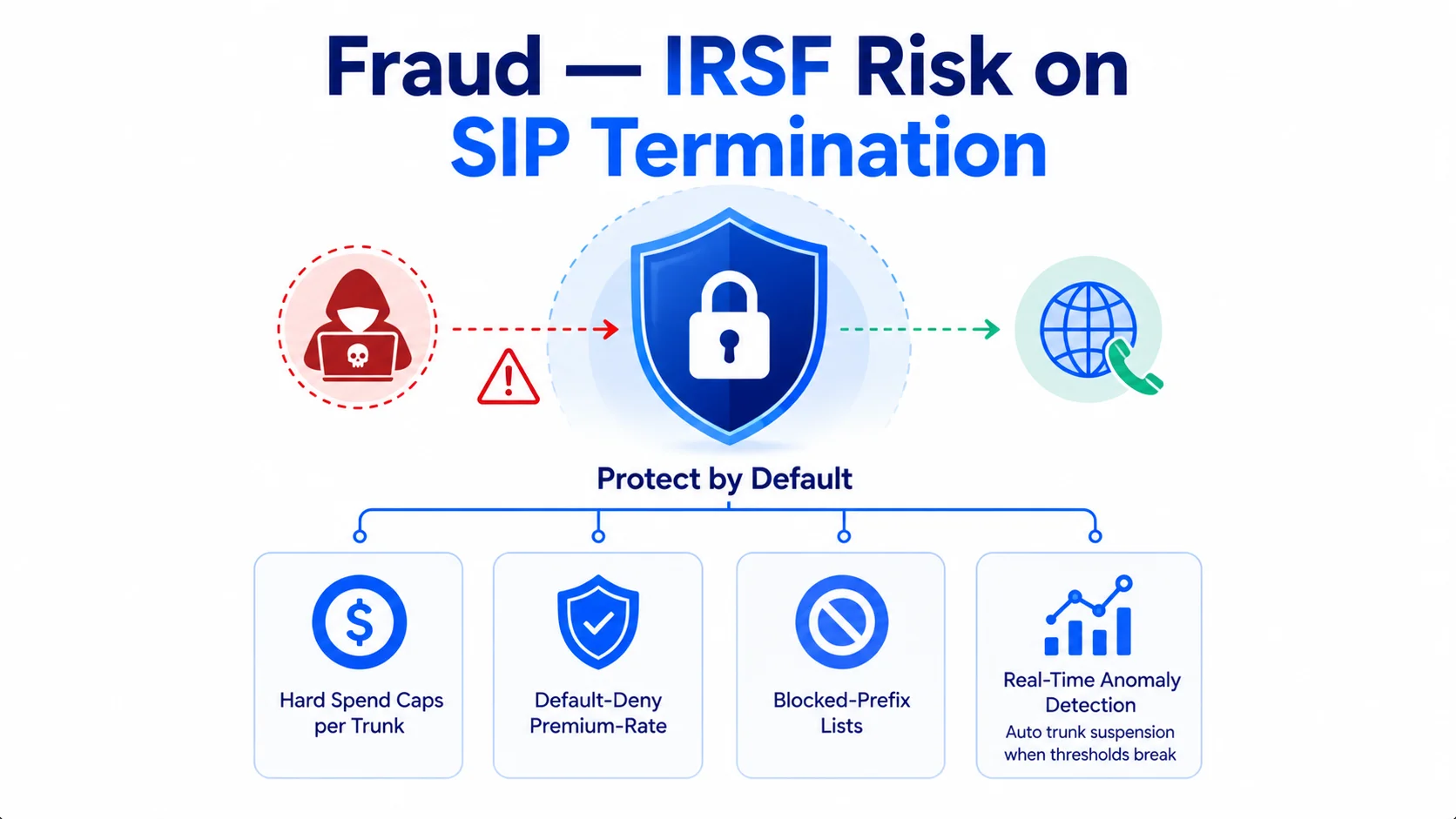
Wholesale SIP termination is the primary attack surface for International Revenue Share Fraud. Attackers compromise the buyer's SIP credentials and dial premium-rate international destinations to drain the buyer's account or run up the postpaid bill. The wholesale SIP termination provider must protect by default.
- Hard spend caps per trunk
- Default-deny premium-rate posture
- Blocked-prefix lists
- Real-time anomaly detection with automatic trunk suspension when thresholds break
Wholesale SIP Termination Comparison Checklist
Further reading: Wikipedia: VoIP overview
- 01Owned direct interconnects in your top destinations versus reseller routing
- 02Multi-tier LCR — premium / standard / economy — selectable per prefix per traffic class
- 03Per-destination ASR/PDD/MOS dashboards refreshed at least every 60 seconds with auto-demotion
- 04Per-destination wholesale VoIP rate deck with 1-second billing increments after 6-second minimum
- 05A-level STIR/SHAKEN attestation on US outbound presenting hosted DIDs by default
- 06Documented FCC and equivalent EU regulatory authorisation per market
- 07IRSF protection — hard spend caps, default-deny premium-rate, anomaly detection — all by default
- 08REST API for trunk configuration, rate-deck queries, CDR retrieval, and webhook delivery
- 0999.99% uptime SLA with 15-minute critical-incident response and named escalation contacts
- 10Real-time CDR streaming via webhook or Kafka for live customer-side analytics
Twiching for Wholesale SIP Termination
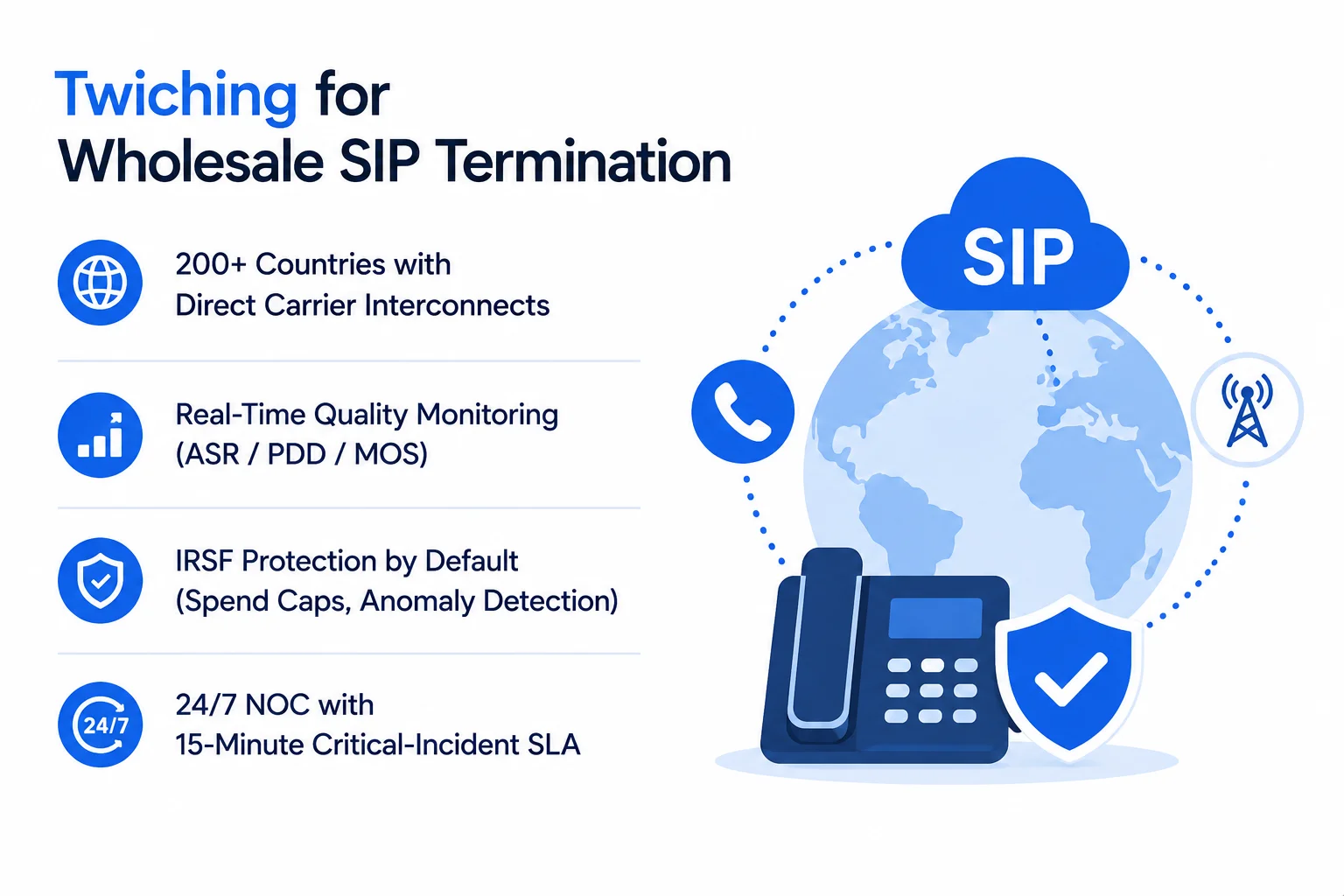
Twiching delivers wholesale SIP termination across 200+ countries with direct carrier interconnects and multi-tier LCR routing per destination prefix. Real-time per-destination ASR/PDD/MOS monitoring refreshes every 60 seconds with auto-demotion on degrading routes, and A-level STIR/SHAKEN attestation applies to US outbound by default.
IRSF protection runs by default with customer-configurable spend caps. That is backed by REST APIs across the lifecycle, real-time CDR streaming, and a 24/7 NOC with a 15-minute critical-incident SLA.
Per-destination wholesale VoIP rates publish with 1-second billing increments after a 6-second minimum. Effective dates are visible on every row, with notice periods that match modern contract norms. White-label partners launch a branded wholesale SIP termination business on the same routing platform Twiching uses internally.
Wholesale SIP termination quality is measured at the codec and network layers simultaneously. At the codec layer, ensure your provider supports your required codecs without unnecessary transcoding. At the network layer, monitor jitter (variation in packet arrival time), packet loss, and round-trip latency.
Jitter above 30ms and packet loss above 0.5% cause perceptible audio degradation. Round-trip latency above 150ms introduces conversational awkwardness. These metrics should be monitored continuously and included in SLA minimums.
Volume-based pricing in wholesale SIP termination creates incentive to consolidate traffic with fewer carriers. However, concentration risk is the danger that your primary carrier experiences an outage affecting all your traffic. This risk argues for maintaining at least two carriers for each major destination.
The optimal balance for most operators is 70–80% of volume with a primary carrier, for best pricing. The remaining 20–30% goes to a secondary carrier, for failover and pricing competition. Review this split quarterly as carrier pricing and performance change.
SIP trunk security hardening is essential for any wholesale SIP termination deployment. Exposed SIP ports are constantly probed by automated scanners looking for misconfigured systems that accept calls without authentication. Implement IP allowlisting so only your registered customer IP addresses can send SIP signalling.
Use strong SIP authentication credentials and rotate them quarterly. Enable TLS for SIP signalling encryption and SRTP for media encryption on trunks carrying sensitive traffic. Rate-limit SIP REGISTER and INVITE messages to prevent brute-force attacks.
Security hardening prevents fraud losses that can reach five figures in hours on an unprotected trunk.
Conclusion
Wholesale SIP termination is the operational layer that decides whether your outbound voice campaigns succeed or fail. Multi-tier LCR, real-time per-destination quality engineering, A-level STIR/SHAKEN attestation, IRSF protection, REST APIs, and 24/7 NOC response together determine whether the platform holds ASR/PDD/MOS under campaign load.
Twiching delivers all of it — direct interconnects across 200+ countries, real-time quality monitoring with auto-demotion, A-level attestation by default, IRSF protection by default, REST API surface, named escalation contacts, 15-minute critical-incident SLA, and per-destination wholesale VoIP rates with 1-second billing increments after a 6-second minimum. Compare your current wholesale SIP termination terms against Twiching's published rates to benchmark whether the provider behind your outbound traffic is still the right one.