Introduction
Wholesale call termination is the carrier-tier service of carrying outbound telephone traffic to its destination network, billed at per-minute wholesale VoIP rates. Every ITSP, UCaaS platform, and contact centre ultimately runs on this layer, and two providers quoting the same rate can still deliver very different ASR, PDD, and MOS. This guide covers how it works and how to evaluate providers, using Twiching as a worked example.
Key Takeaways
- Wholesale call termination carries outbound voice traffic from the buyer's network across the provider's interconnect base to the destination at per-minute wholesale VoIP rates.
- Direct interconnect ownership versus reseller routing is the dominant quality differentiator — fewer hops, better commercial terms, more stability.
- Multi-tier LCR (premium / standard / economy) lets the buyer pick quality vs cost per destination prefix and per traffic class.
- Real-time per-destination ASR/PDD/MOS monitoring with auto-demotion is what separates serious wholesale call termination platforms from price-only operators.
- Twiching delivers wholesale call termination with direct interconnects across 200+ countries, A-level STIR/SHAKEN by default, IRSF protection, and a 24/7 NOC.
What Wholesale Call Termination Actually Is
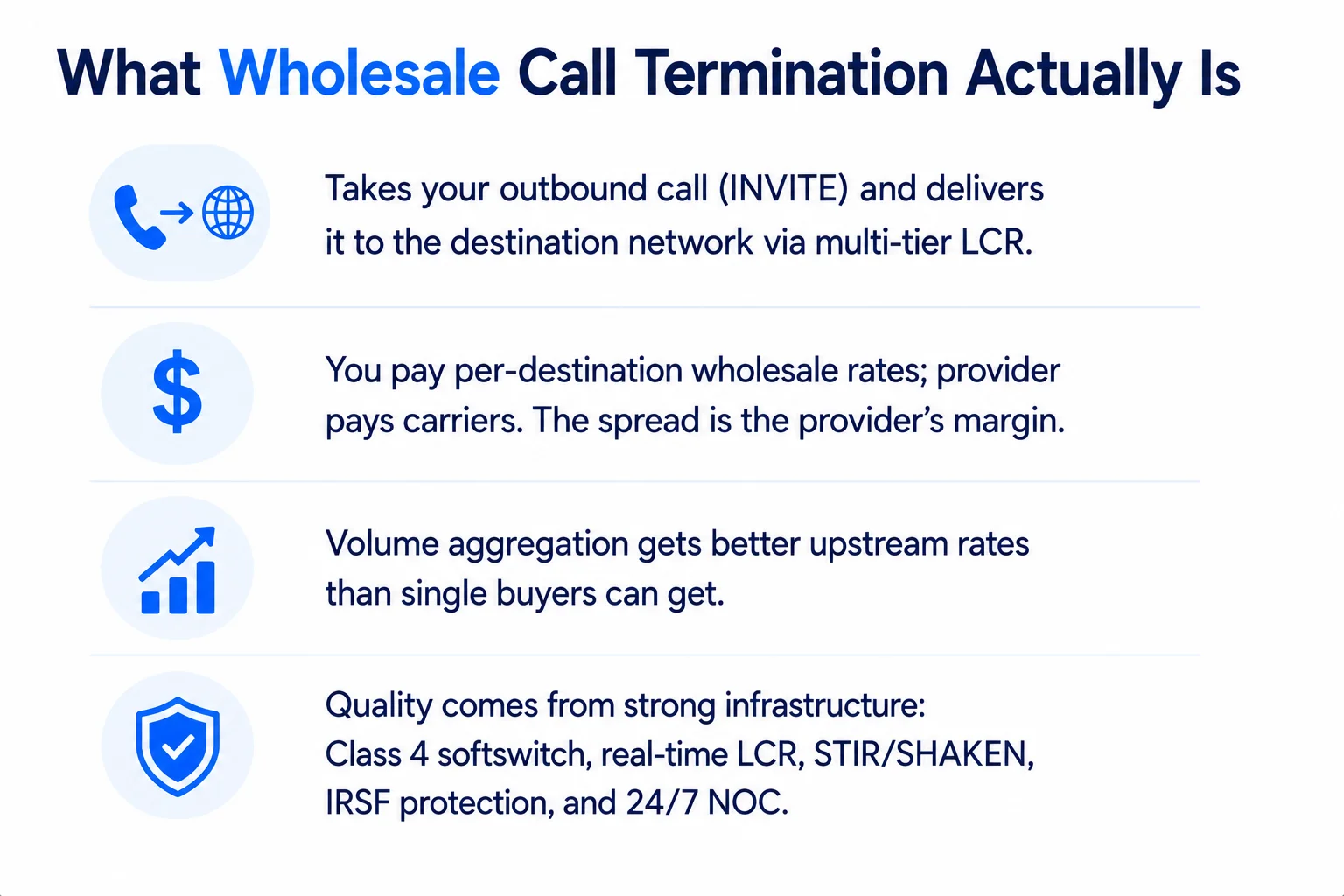
Wholesale call termination is the act of taking the buyer's outbound INVITE and routing it across the wholesale provider's carrier interconnect base via multi-tier LCR. The provider then hands the call off to the destination network.
The buyer pays per minute at per-destination wholesale VoIP rates. The provider pays its upstream carriers the wholesale rate, and the spread is the provider's margin.
The economics work because the provider aggregates traffic from many buyers and earns volume-tier discounts with upstream carriers that single buyers couldn't qualify for.
What sits between the INVITE and the destination network determines quality. Strong wholesale call termination platforms run a Class 4 softswitch with multi-region active-active failover and a real-time LCR engine with quality-aware demotion.
They also add inline STIR/SHAKEN attestation, IRSF fraud protection, and a 24/7 NOC.
Weak platforms run a single softswitch in a single region with email-based support.
Direct Interconnects vs Reseller Routing
Further reading: Wholesale pricing & rate deck
The dominant quality differentiator across wholesale call termination providers is whether they own direct interconnects in the destinations the buyer cares about.
Direct interconnects mean fewer hops between the buyer's network and the destination. They also mean better media quality and lower latency.
They bring better commercial terms too — the volume-tier discount gets passed through — plus more stability against upstream changes.
Reseller-routed paths are fine for low-volume long-tail destinations but should not dominate the buyer's top destinations.
Ask each wholesale call termination provider for a published map of their direct interconnects. Strong providers publish it country-by-country with quality metrics. Weak providers obscure it because most of their routes are reseller-routed.
Multi-Tier LCR Routing
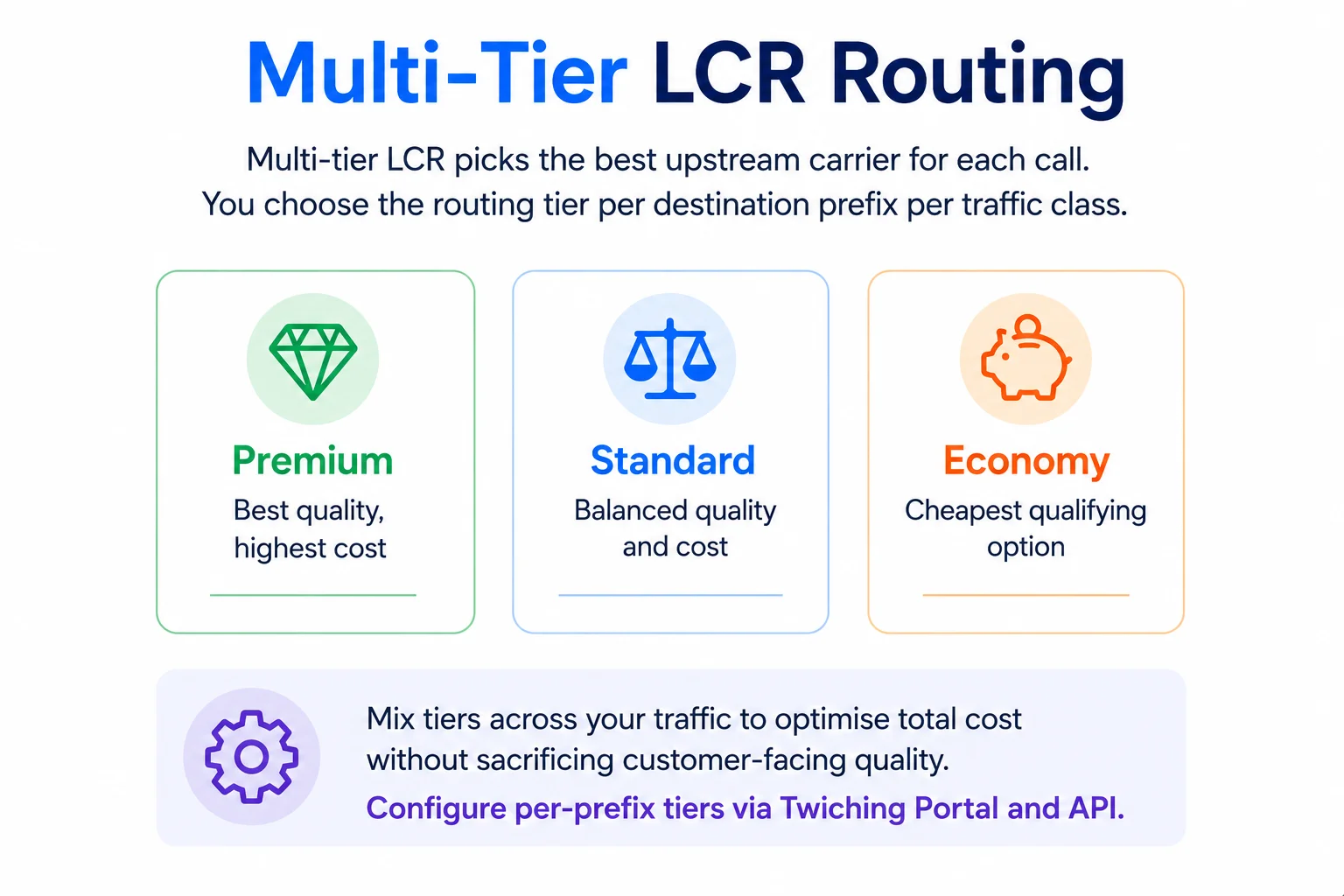
Multi-tier least-cost routing is the engine that picks which upstream carrier carries each call. The buyer selects a routing tier per destination prefix per traffic class — premium (best quality, highest cost), standard (balanced), or economy (cheapest qualifying).
Premium routing is correct for contact-centre outbound, where every percentage point of ASR matters. Economy routing is correct for background traffic, where cost dominates.
Mixing tiers across the estate optimises total cost without sacrificing customer-facing quality.
Wholesale call termination providers that ship single-tier routing force the buyer to pay premium across everything or live with economy quality everywhere. Twiching's wholesale call termination engine supports per-prefix tier selection through the portal and API.
Real-Time Quality Engineering
Further reading: Wholesale voice solutions
The other half of routing intelligence is real-time quality engineering. The provider's platform monitors per-destination ASR/PDD/MOS in real time — refreshed every 60 seconds on strong platforms — and auto-demotes degrading routes within minutes.
Traffic shifts away from a degraded upstream carrier before the buyer's dashboard notices the drop. The CDR feedback loop updates the quality model continuously so the next call to the same destination uses the latest data.
Wholesale call termination providers without real-time quality data and an automated demotion engine fly blind. Twiching publishes per-destination ASR/PDD/MOS with five-minute granularity and exposes routing tier on every CDR row so customers can audit decisions.
STIR/SHAKEN and Compliance
A-level STIR/SHAKEN attestation on US-bound outbound is the gatekeeper in 2026. Wholesale call termination providers signing only at C-level gateway attestation deliver outbound traffic that US carrier spam analytics flag as Spam Likely or block outright.
Confirm before signing that the provider signs at A-level on outbound calls presenting your hosted DIDs. Outside the US, CLI compliance in the UK and EU applies in modified form.
Regulatory authorisation sits underneath attestation. In the US that means FCC interstate-carrier authorisation plus state PUC registrations.
It also means national regulatory approval in each EU member state. On top of that, it means equivalent licensing in every major market the provider sells into.
Providers asking customers to take licensing on trust are a red flag.
IRSF Protection
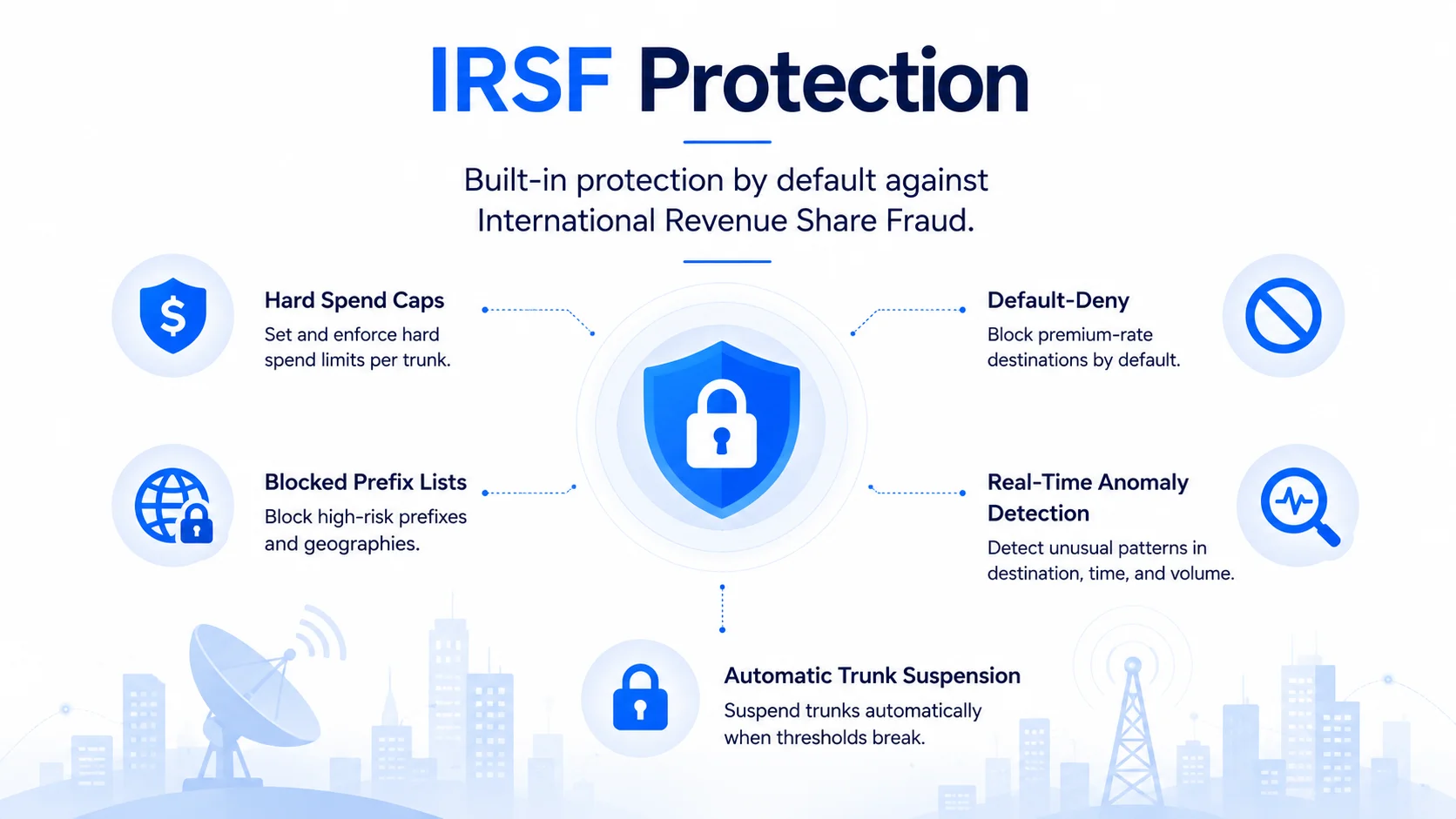
International Revenue Share Fraud is the primary financial risk on wholesale call termination. The provider has to protect against it by default.
That means hard spend caps per trunk, a default-deny posture on premium-rate destinations, and blocked-prefix lists for high-risk geographies. It also means real-time anomaly detection on destination/time/volume patterns, plus automatic trunk suspension when thresholds break.
Providers that ship IRSF protection only as a paid bolt-on are exposing customers to risk that should be platform-default.
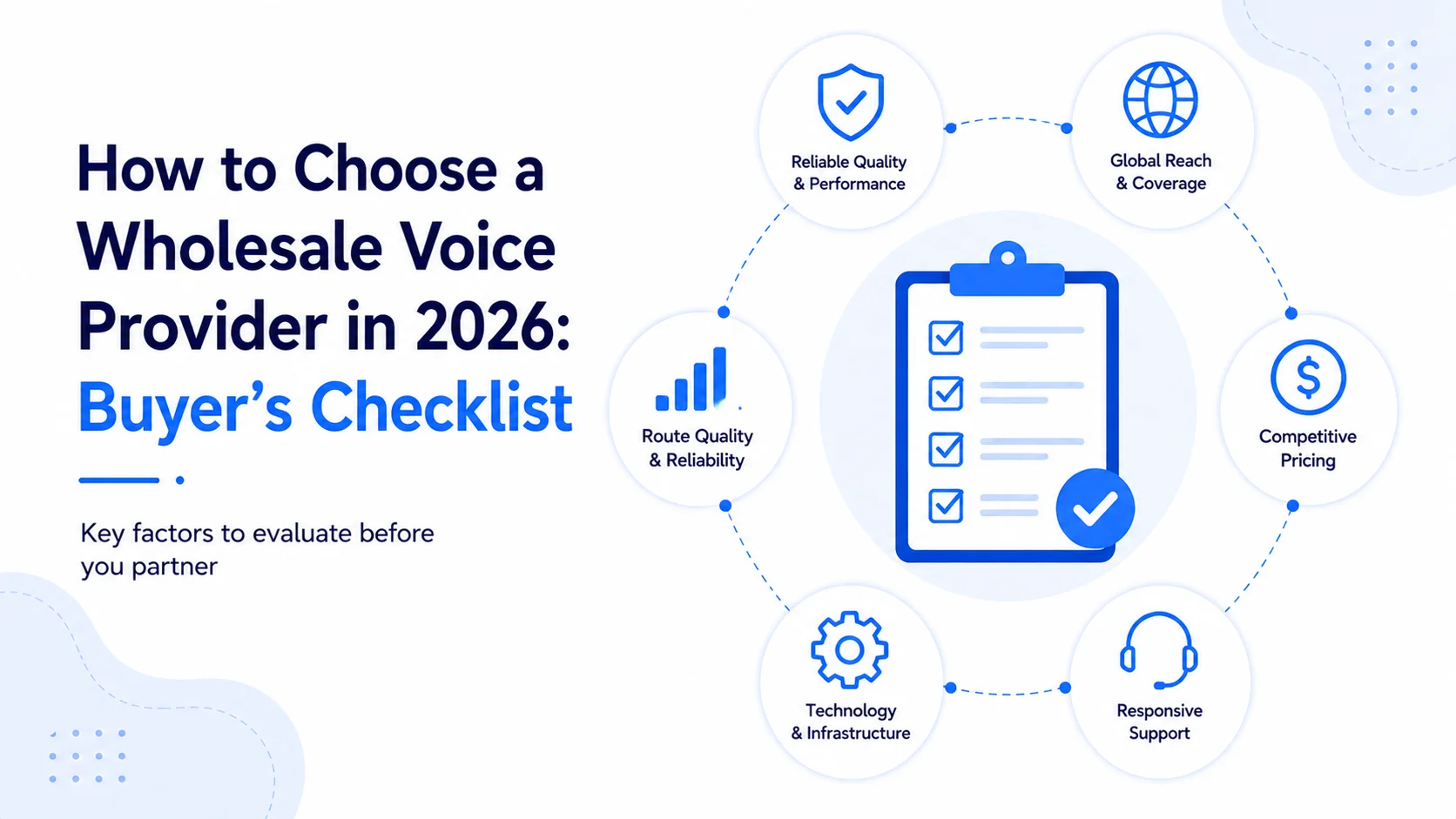
Provider Evaluation Checklist
- 01Owned direct interconnects in the buyer's top destinations, published country-by-country
- 02Per-destination wholesale VoIP rate deck with 1-second billing increments after 6-second minimum
- 03Multi-tier LCR — premium / standard / economy — selectable per prefix per traffic class
- 04Real-time per-destination ASR/PDD/MOS monitoring refreshed every 60 seconds with auto-demotion
- 05A-level STIR/SHAKEN attestation on US outbound presenting hosted DIDs by default
- 06FCC interstate-carrier authorisation and equivalent EU regulatory approval, documented per market
- 07IRSF protection — hard spend caps, default-deny premium-rate, anomaly detection — all by default
- 08REST APIs for trunk configuration, rate-deck queries, CDR retrieval, webhook delivery
- 0999.99% uptime SLA with 15-minute critical-incident response, named escalation contacts
- 10Real-time CDR streaming via webhook or Kafka for live customer-side analytics integration
Twiching for Wholesale Call Termination
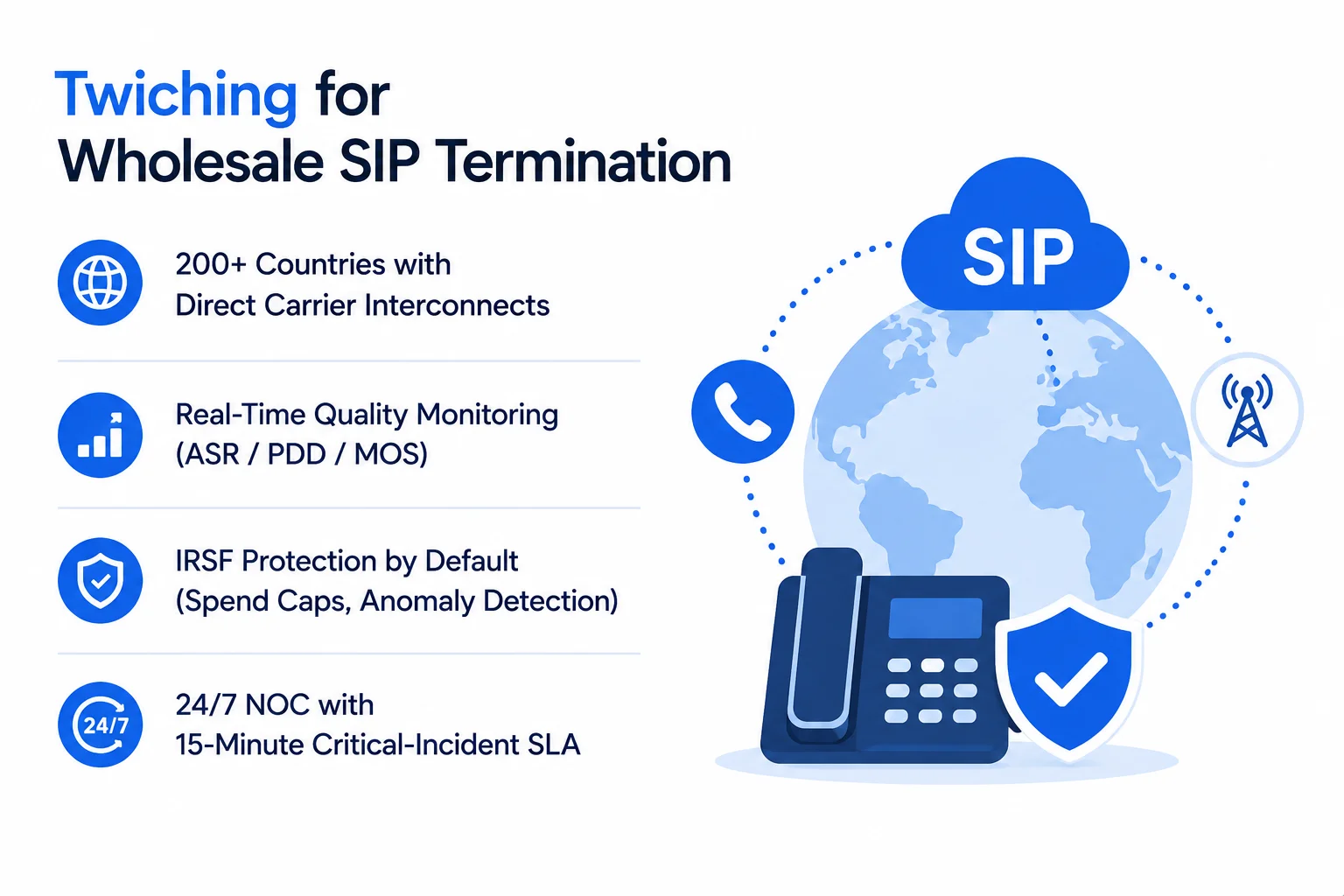
Twiching operates as a technology-led wholesale call termination provider. It runs direct interconnects across 200+ countries on a multi-region active-active Class 4 softswitch. Multi-tier LCR provides real-time per-destination quality monitoring plus auto-demotion.
The platform also ships A-level STIR/SHAKEN attestation on US outbound presenting hosted DIDs, and IRSF protection by default with customer-configurable spend caps. REST APIs are available across the lifecycle, along with real-time CDR streaming via webhook and Kafka.
It's backed by a 24/7 NOC with a 15-minute critical-incident SLA and named escalation contacts.
Per-destination wholesale VoIP rates publish with 1-second billing increments after a 6-second minimum, with effective dates visible on every row. There are no large volume minimums on standard business accounts.
Onboarding completes in under 48 hours, from KYC submission to production traffic.
White-label partners launch a branded wholesale call termination business on the same routing platform.
Wholesale call termination encompasses both SIP-based VoIP termination and traditional TDM (Time-Division Multiplexing) interconnects for carriers operating legacy infrastructure. SIP has largely replaced TDM for new deployments.
Even so, many national incumbents still interconnect via E1/T1 circuits in certain markets.
When terminating to these networks, SIP-to-TDM gateways at the carrier's PoP handle the conversion.
Verify that your provider has direct TDM interconnects in countries where PSTN quality is critical. Avoid routing through SIP-only intermediaries — they can introduce additional quality hops.
The economics of wholesale call termination depend on your ability to negotiate below published rates. Published rate cards are starting points for negotiation, not fixed prices.
Volume commitments unlock tiered discounts. Route specialisation unlocks deeper discounts still.
That means guaranteeing volume to specific destinations, rather than spreading traffic across all routes.
The most effective negotiating position is a detailed traffic analysis showing carriers exactly what volume you will deliver to their most profitable routes.
Traffic type compliance is critical in wholesale call termination agreements. Most carrier contracts distinguish between business telephony, calling card traffic, call centre/dialler traffic, and automated calling. Each traffic type has different quality characteristics, fraud risk profiles, and sometimes different pricing.
Mis-classifying autodialler traffic as business telephony violates most carrier agreements. It can trigger immediate traffic suspension or clawback of previously paid invoices.
Always disclose your actual traffic types accurately to your termination carriers.
Capacity planning for wholesale call termination must account for both average and peak concurrent call volumes. The Erlang B formula calculates the number of trunks required to handle a given traffic intensity at an acceptable blocking probability.
For business telephony, design for a maximum 1% blocking rate. For call centre traffic with burst patterns, reduce the blocking target to 0.1% and provision accordingly.
Review capacity headroom monthly against your actual peak concurrent call records to ensure you have buffer for unexpected traffic spikes.
Conclusion
Wholesale call termination is the operational layer that decides whether your outbound voice business holds quality under campaign load. Direct interconnect ownership, multi-tier LCR, real-time per-destination quality engineering, A-level STIR/SHAKEN attestation, IRSF protection by default, REST API surface, and 24/7 NOC response together determine whether the provider survives at scale. Twiching ships the full stack — direct interconnects across 200+ countries, real-time quality monitoring with auto-demotion, A-level attestation by default, IRSF protection by default, REST APIs across the lifecycle, named escalation contacts, 15-minute critical-incident SLA, and per-destination wholesale VoIP rates with 1-second billing increments after a 6-second minimum. Compare your current wholesale call termination provider against Twiching's published terms to benchmark whether the supplier behind your outbound traffic is still the right one.