Introduction
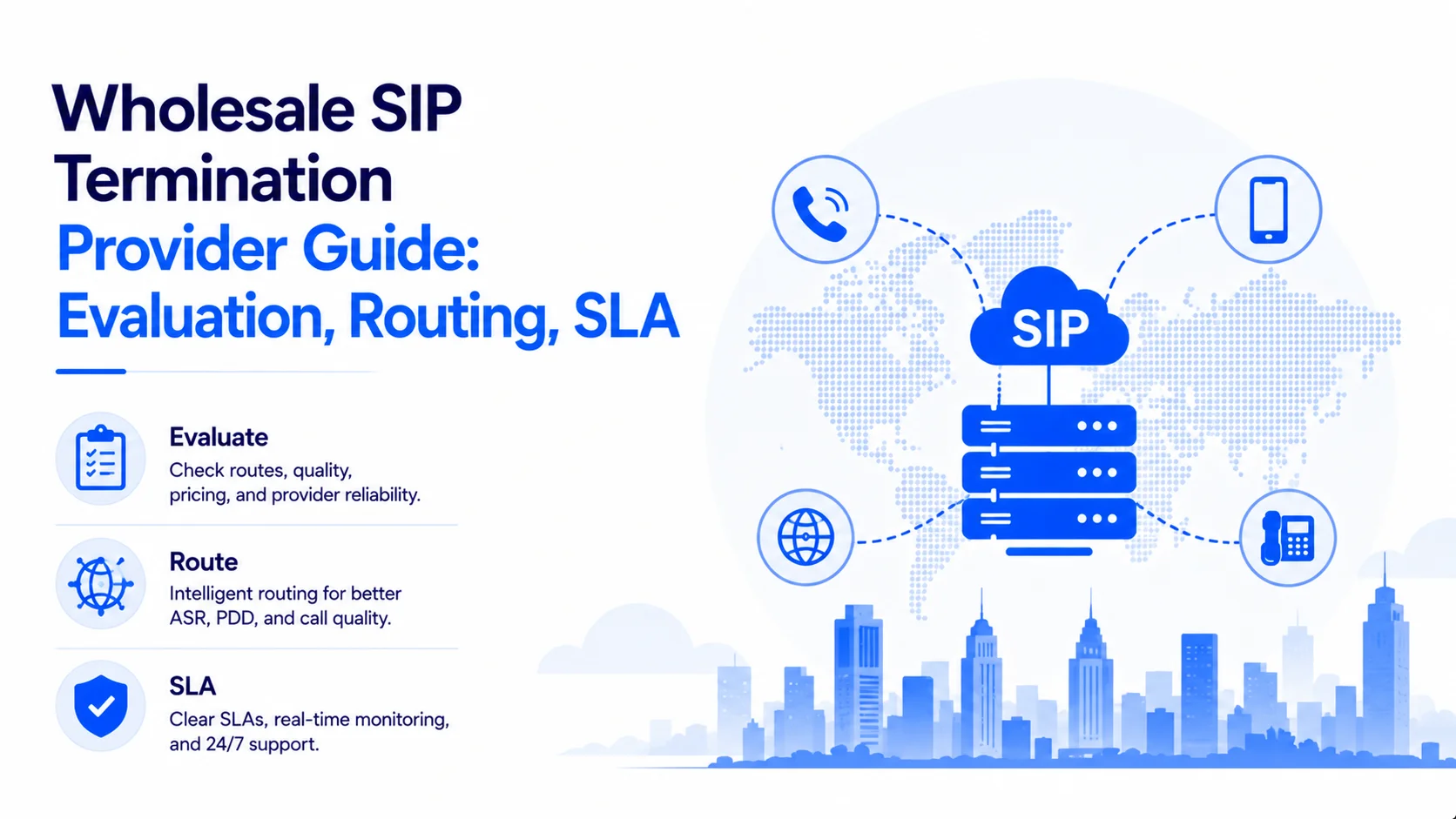
A wholesale SIP termination provider carries the buyer's outbound voice traffic from a PBX or UCaaS platform to the destination network. The product looks simple — per-minute pricing — but quality varies dramatically by interconnects, caller ID verification, and real-time quality engineering. This guide covers how to evaluate a provider and how migration works safely.
Key Takeaways
- A wholesale SIP termination provider carries the buyer's outbound voice traffic via SIP from the buyer's PBX to the destination network at per-minute wholesale VoIP rates.
- Owned direct interconnects in your top destinations beat reseller-routed paths — better quality, fewer hops, and stability against upstream changes.
- Real-time per-destination ASR/PDD/MOS monitoring with auto-demotion on degrading routes is the operational core that separates strong providers from weak ones.
- A-level STIR/SHAKEN attestation on US-bound outbound is non-negotiable in 2026 — anything less triggers Spam Likely labelling that collapses answered-rate.
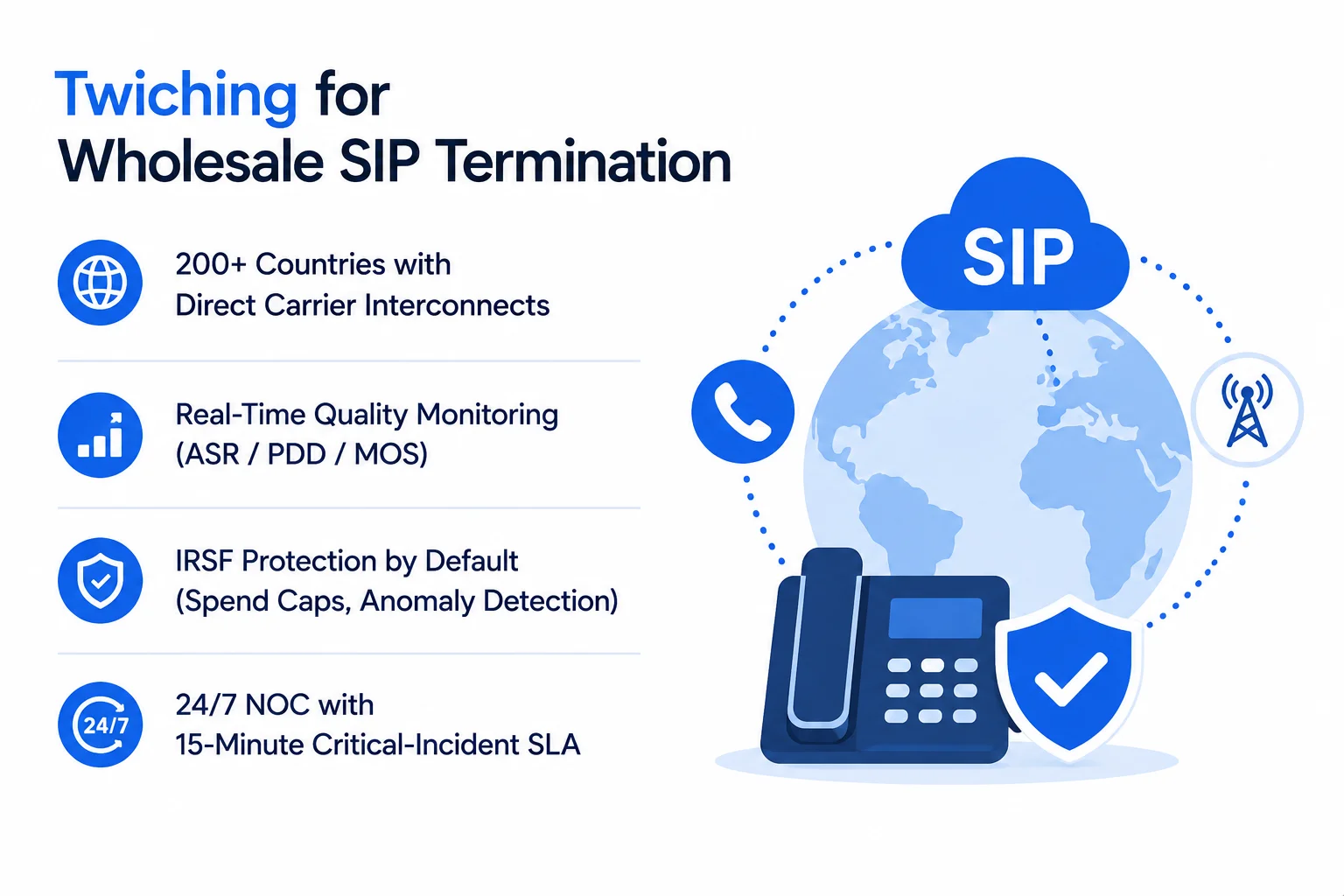
- Twiching operates as a wholesale SIP termination provider with direct interconnects across 200+ countries, real-time quality engineering, A-level attestation by default, and 24/7 NOC.
What a Wholesale SIP Termination Provider Does
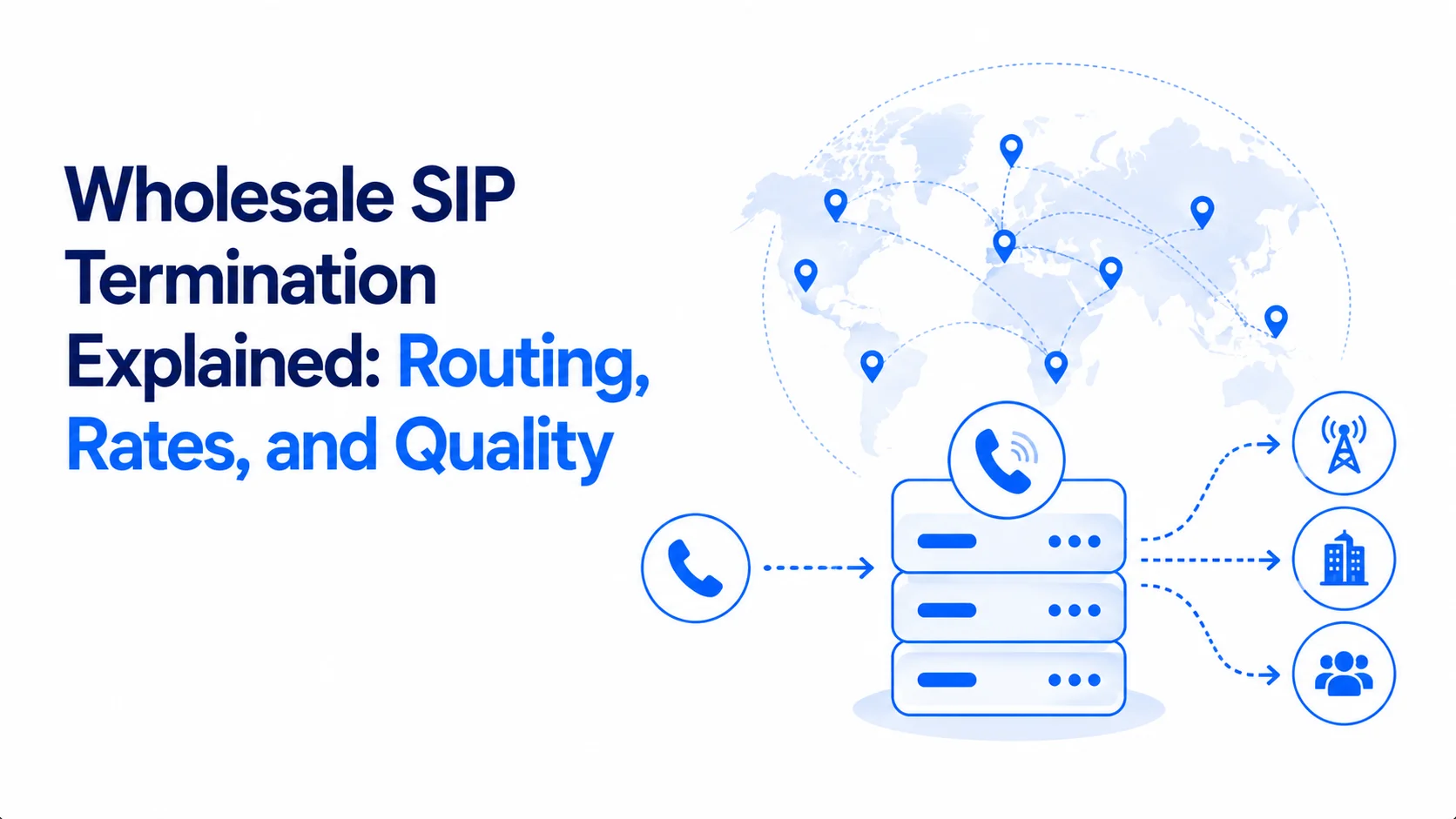
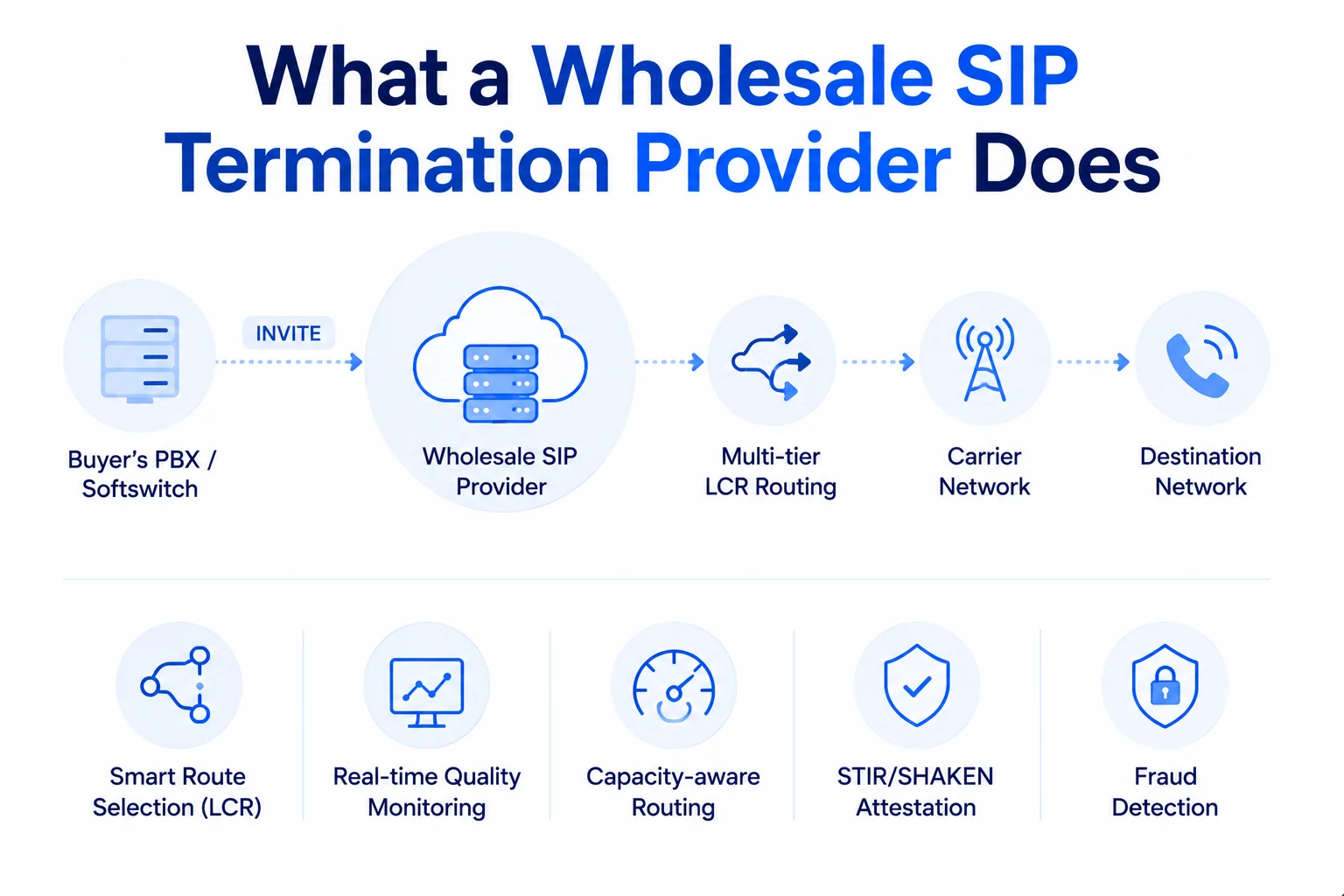
A wholesale SIP termination provider takes the buyer's outbound INVITEs from the buyer's PBX or softswitch. It routes them across its own carrier interconnect base via multi-tier LCR, then delivers the call onto the destination network.
Billing is per minute at per-destination wholesale VoIP rates with billing increments (modern standard is 1-second after a 6-second minimum).
The economics make sense because the provider aggregates traffic from many buyers and earns volume-tier discounts with upstream carriers that single buyers couldn't qualify for.
What the provider's customer-side stack does behind the scenes determines quality.
- Route selection (LCR)
- Real-time quality monitoring
- Capacity-aware decisions so the cheapest carrier doesn't get oversold
- STIR/SHAKEN attestation
- Fraud detection
All of these layered together produce the answered-rate the buyer's customers experience.
Strong providers do all of it; weak providers leave most of it to luck.
Owned Routes vs Reseller-Routed Paths
Further reading: Wholesale pricing & rate deck
A wholesale SIP termination provider that owns direct interconnects with carriers in your top destinations delivers materially better quality than one reselling someone else's routes.
Direct interconnects mean fewer hops — lower latency, better MOS. They also mean better commercial terms, since the provider passes through the volume-tier discount. And they mean stability against upstream changes, since no third-party reseller can decide to change terms overnight.
Reseller routing is acceptable for low-volume long-tail destinations but should not dominate your top destinations.
Ask each wholesale SIP termination provider on the shortlist for a map of their direct interconnect base. Strong providers publish it. Weak providers obscure it because most of their routes are reseller-routed.
Twiching publishes direct interconnects across 200+ countries with country-by-country quality metrics.
Real-Time Quality Engineering
Quality engineering on a wholesale SIP termination provider's platform decides whether your outbound traffic holds ASR/PDD/MOS under campaign load.
The minimum-viable engineering covers four things.
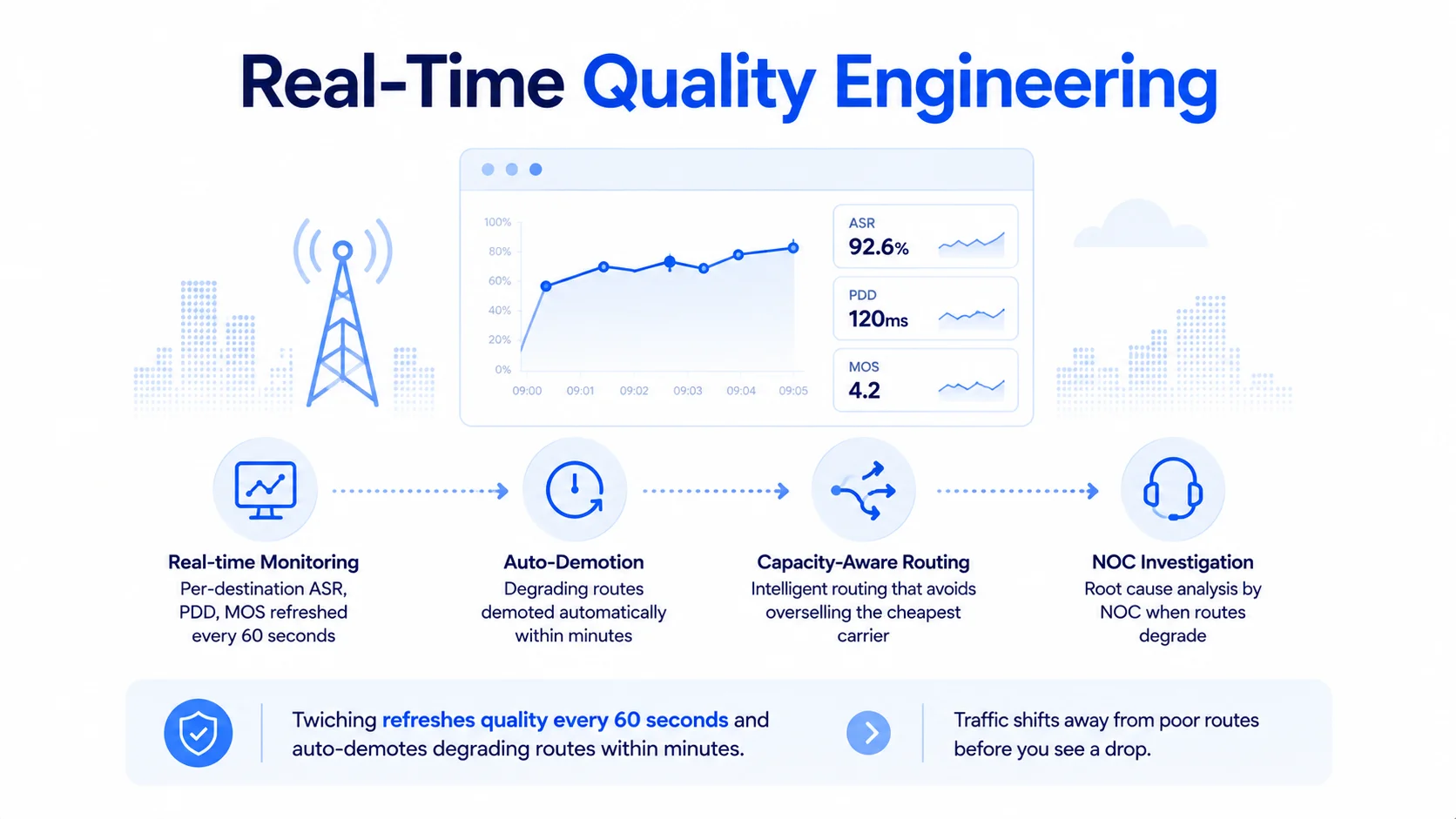
- Per-destination ASR, PDD, MOS monitored in real time, refreshed at least every 60 seconds
- Auto-demotion of degrading routes within minutes
- Capacity-aware routing that doesn't oversell the cheapest carrier
- A NOC team that investigates root causes when a route degrades
Strong providers run all four; weak providers run none and rely on the buyer to complain when things break.
Twiching's wholesale SIP termination platform refreshes per-destination quality every 60 seconds and demotes degrading routes automatically within minutes. The routing engine shifts traffic away from a degraded carrier before the buyer's CRM dashboard reports the drop.
STIR/SHAKEN Attestation
Further reading: Wholesale voice solutions
A-level STIR/SHAKEN attestation on US-bound outbound calls is the gatekeeper in 2026. The wholesale SIP termination provider signs each outbound INVITE with an attestation level — A (full), B (partial), or C (gateway). US carrier spam analytics use that signal to score caller reputation.
A-level signing on customer-owned DIDs protects answered-rate. B/C-level signing triggers Spam Likely labelling that collapses answered-rate on outbound campaigns.
Confirm with each wholesale SIP termination provider on the shortlist that they will sign at A-level for outbound calls presenting your hosted DIDs. Providers offering only C-level gateway attestation should be assumed to be poison for US outbound contact-centre traffic.
Twiching signs A-level by default for any DID hosted in the same account.
Fraud Controls and IRSF Protection
International Revenue Share Fraud is the single largest financial risk in wholesale SIP termination. An attacker who compromises the buyer's SIP credentials can dial premium-rate international destinations until the buyer's bill explodes.
The wholesale SIP termination provider has to protect the buyer by default.
- Hard spend caps per trunk
- Default-deny posture on premium-rate destinations
- Blocked-prefix lists for high-risk geographies
- Real-time anomaly detection on destination/time/volume patterns
- Automatic trunk suspension when thresholds break
The defensive minimum is all four controls on by default, with customer-configurable thresholds through the portal. Wholesale SIP termination providers that ship IRSF protection as a separately-priced bolt-on are exposing their customers to fraud risk that should be platform-default.
SLA Terms
The SLA is the contract that protects the buyer when something breaks. The minimum terms a serious wholesale SIP termination provider ships are these.
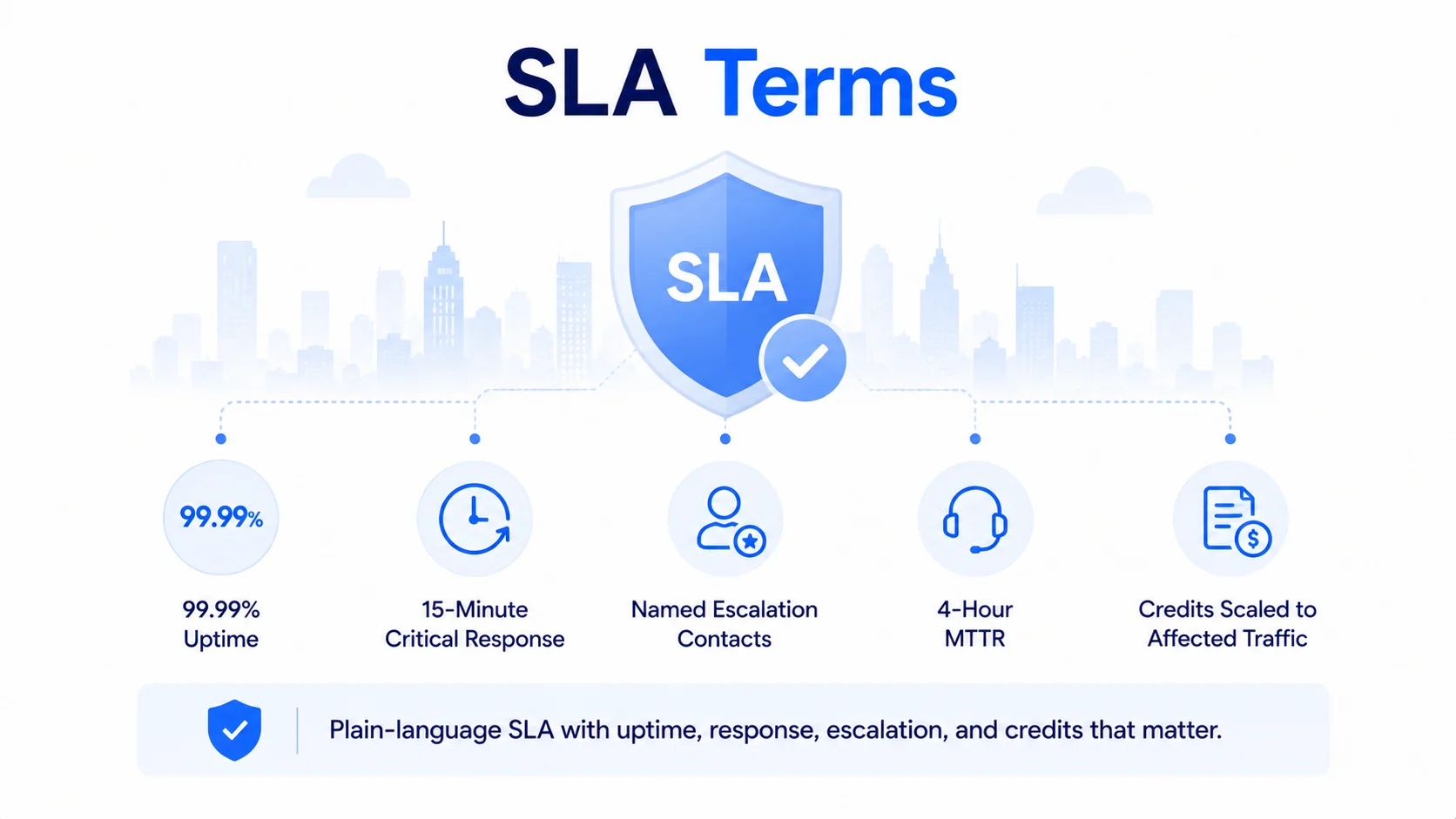
- 99.99% platform uptime
- 15-minute critical-incident response
- Named escalation contacts updated in writing
- 4-hour mean-time-to-resolution on degraded service
- Financial credits scaled to the affected traffic
Beyond the headline numbers, look at the small print — does the SLA cover degraded routing or only complete outage? Does it cover one region or the whole estate? Are credit caps cosmetic?
Twiching publishes its wholesale SIP termination provider SLA in plain language.
- 99.99% uptime
- 15-minute critical-incident response
- Named escalation contacts in the portal
- Credits scaled to traffic affected by the breach
Provider Evaluation Checklist
- 01Owned direct interconnects in your top destinations — map published, not obscured
- 02Per-destination wholesale VoIP rate deck with billing increments, currency, effective dates, and notice periods
- 03Multi-tier LCR — premium / standard / economy — selectable per destination per traffic class
- 04Real-time per-destination ASR/PDD/MOS dashboards refreshed every 60 seconds with auto-demotion
- 05A-level STIR/SHAKEN attestation on US outbound presenting hosted DIDs, by default
- 06IRSF fraud protection with hard spend caps, default-deny premium-rate, anomaly detection — all by default
- 07REST API for trunk configuration, rate-deck queries, CDR retrieval, and webhook delivery
- 0899.99% uptime SLA with 15-minute critical-incident response and named escalation contacts
- 09Real-time CDR streaming for live customer-side analytics integration
- 10Onboarding under 48 hours for standard business customers, with same-day trunk provisioning
Twiching as a Wholesale SIP Termination Provider
Twiching operates as a technology-led wholesale SIP termination provider with direct interconnects across 200+ countries, multi-region active-active softswitch, and multi-tier LCR with real-time quality-aware auto-demotion.
Rounding out the platform:
- A-level STIR/SHAKEN attestation on US outbound presenting hosted DIDs
- IRSF protection by default with customer-configurable spend caps
- REST APIs across the lifecycle
- Real-time CDR streaming via webhook and Kafka
A 24/7 NOC backs it with a 15-minute critical-incident SLA and named escalation contacts.
Per-destination wholesale VoIP rates publish with billing increments and effective dates visible on every row. There are no large volume minimums on standard business accounts, and onboarding completes in under 48 hours for standard KYC.
The SLA covers 99.99% platform uptime with financial credits scaled to the affected traffic.
A wholesale SIP termination provider's SBC infrastructure determines the quality ceiling for all traffic it carries. Session Border Controllers handle codec normalisation, NAT traversal, topology hiding, and security screening.
Providers with modern SBCs (Ribbon, AudioCodes, Oracle ACME) can handle G.711/G.729 transcoding, early media, and DTMF relay reliably. Older or misconfigured SBCs introduce audio clipping, DTMF failures, and one-way audio problems that are difficult to diagnose remotely.
Ask providers for their SBC vendor and firmware versions as part of due diligence.
Security is a critical concern when selecting a wholesale SIP termination provider. Exposed SIP infrastructure is a target for toll fraud, where attackers generate high-volume calls to premium-rate destinations at your expense.
Providers should operate IP allowlisting so only your registered SBCs can send traffic, implement real-time fraud detection with automatic route blocking, and carry cyber insurance.
Ask for details of their fraud prevention architecture and historical fraud incident rate before routing live traffic.
Monitoring your wholesale SIP termination provider's performance requires access to real-time metrics. The best providers offer dashboards showing concurrent calls, ASR, PDD, and MOS updated every minute.
Less sophisticated providers only offer daily CDR summaries, which means quality degradation goes undetected for hours.
Implement your own call quality monitoring using your SBC's built-in reporting. Most commercial SBCs (AudioCodes, Ribbon, Cisco) log per-call quality metrics that you can aggregate in a monitoring dashboard independent of your provider's reporting.
Conclusion
Evaluating a wholesale SIP termination provider is a structured exercise — owned direct interconnects, real-time quality engineering, A-level STIR/SHAKEN, IRSF protection by default, REST API surface, and SLA terms that actually protect production traffic. Headline per-minute rates lie on their own; the whole bundle and the operations layer determine whether the provider holds ASR/PDD/MOS under campaign load. Twiching ships the full stack — direct interconnects across 200+ countries, real-time per-destination quality monitoring with auto-demotion, A-level attestation by default, IRSF protection by default, REST API across the lifecycle, named technical contacts, 15-minute critical-incident SLA — and publishes per-destination wholesale VoIP rates with billing increments and effective dates on every row. Run the checklist against your current wholesale SIP termination provider, then compare against Twiching's published terms to benchmark whether your current supplier is still the right one.