Introduction
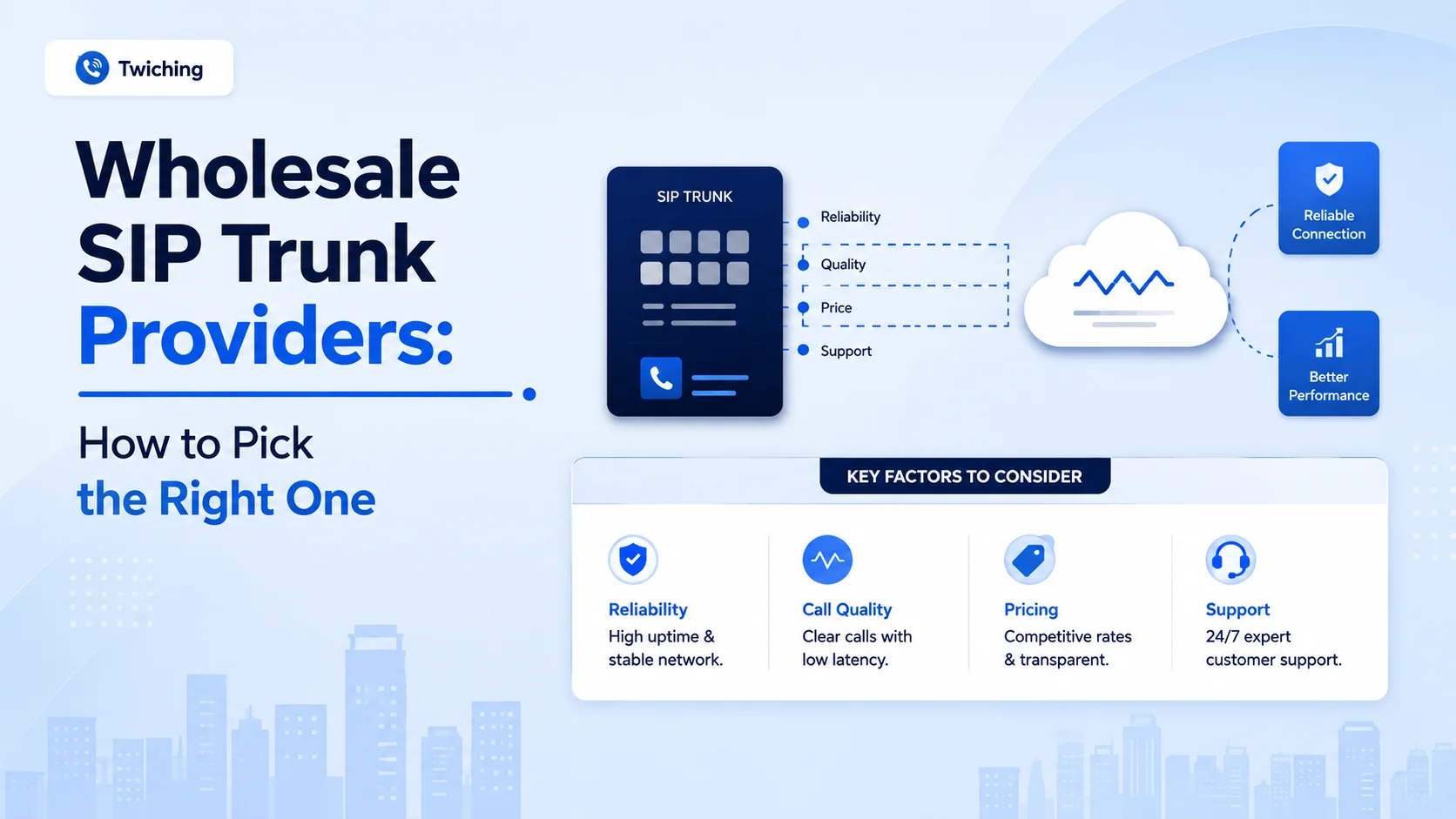
SIP trunking has become the standard connection between business phone systems and the public telephone network. Whether you operate an on-premise PBX, a cloud contact center, or an AI voice agent platform, the wholesale SIP trunk provider you choose determines call quality, regulatory compliance, and long-term cost efficiency.
The challenge is that not all wholesale SIP trunk providers are built the same. Some hold their own carrier licenses and operate dedicated network infrastructure.
Others resell capacity purchased from upstream carriers, adding a layer of abstraction that affects everything from call attestation to troubleshooting speed. With the SIP trunking market projected to reach $85 billion in 2026 and growing at over 16% annually, more providers are entering the space — making careful evaluation more important than ever.
This guide walks through the technical and regulatory factors that matter most when selecting a wholesale SIP trunking partner, from carrier status and STIR/SHAKEN compliance to PBX compatibility and AI-readiness.
Carrier vs. Reseller: Why Provider Status Changes Everything
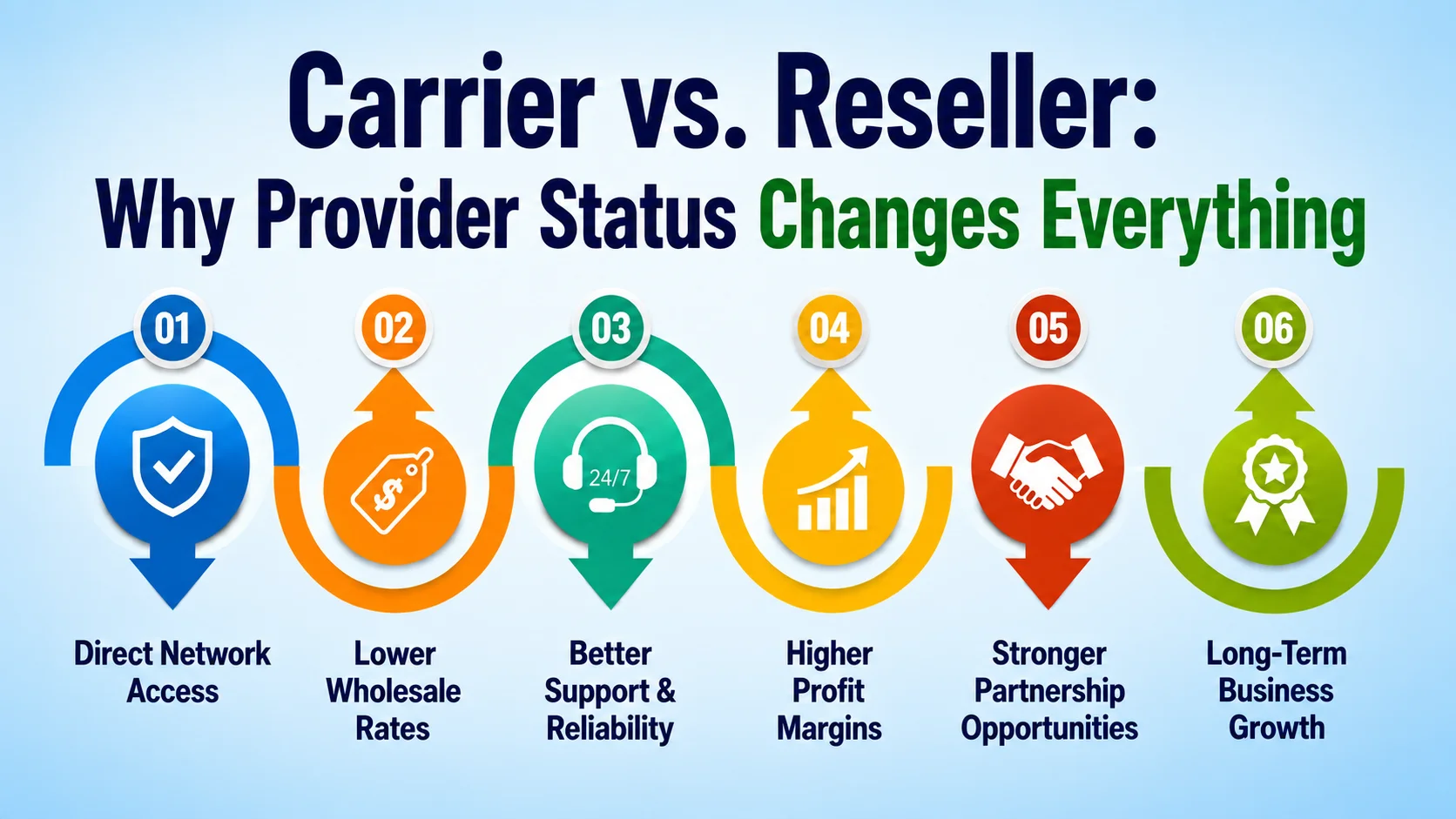
The single most overlooked distinction among wholesale SIP trunk providers is whether the company is a licensed carrier or a reseller buying capacity upstream.
A facilities-based carrier holds an FCC authorization (in the US), operates its own switching infrastructure, and maintains direct interconnects with other carriers. This status gives them control over call routing, the ability to issue their own STIR/SHAKEN certificates, faster number provisioning, and direct access to resolve network issues without escalating to a third party.
A reseller, by contrast, purchases SIP trunking capacity from one or more upstream carriers and repackages it. Resellers can offer competitive pricing and sometimes bundle value-added services, but they depend on their upstream provider for network quality, attestation, and troubleshooting. When a call quality issue arises, the reseller must coordinate with the upstream carrier — adding time and complexity to resolution.
This distinction has practical consequences. Carriers provision new DIDs within minutes; resellers may take hours or days. During outages, carriers see network telemetry in real time, while a SIP trunk reseller waits for upstream status updates. Before signing, ask directly: do you hold your own carrier license, or do you resell another carrier's infrastructure?
Further reading: best wholesale VoIP service
STIR/SHAKEN Attestation: The Compliance Factor Most Buyers Overlook
If your outbound calls are being flagged as spam or going unanswered, your SIP trunk provider's STIR/SHAKEN attestation capability is likely a factor. This caller-ID authentication framework has moved from optional to operationally critical, and the FCC continues tightening enforcement.
Further reading: FCC: Robocall Mitigation Database
Understanding Attestation Levels
STIR/SHAKEN assigns one of three attestation levels to every outbound call:
- A — Full Attestation: the carrier verified the caller's identity and confirmed the caller has the right to use the displayed number
- B — Partial Attestation: the carrier authenticated the caller but cannot confirm ownership of the number
- C — Gateway Attestation: the carrier received the call from another network and cannot verify the caller or the number
A-level attestation produces the highest answer rates because downstream carriers and analytics engines treat these calls as trustworthy. Calls with B or C attestation are more likely to be flagged, labeled "Spam Risk," or silently blocked.
What Changed in 2026
The FCC now requires annual Robocall Mitigation Database (RMD) recertification by March 1 each year. Providers that miss recertification risk having their traffic blocked by downstream carriers. Additionally, an FCC rulemaking proposed in May 2026 introduces stricter Know-Your-Upstream-Provider requirements, further closing loopholes in the attestation chain.
When evaluating wholesale SIP trunk providers, confirm that the provider holds its own SP-KI certificate for signing calls, can deliver A-level attestation for DIDs assigned to your account, and maintains current RMD registration. Providers that rely on upstream carriers for attestation typically deliver B or C levels — a meaningful disadvantage for any business that depends on outbound calling.
SIP Trunk Pricing: What the Rate Card Doesn't Show
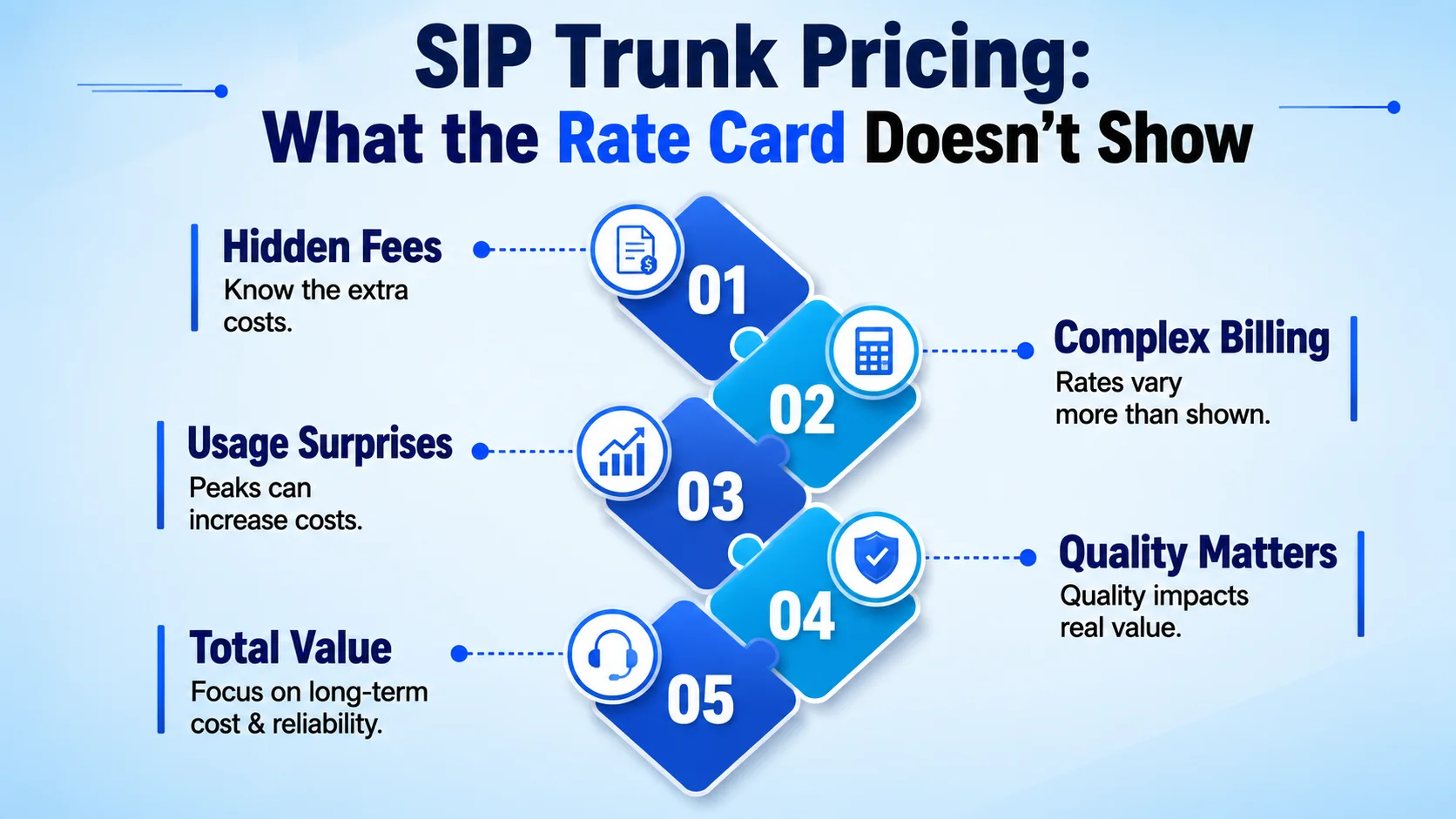
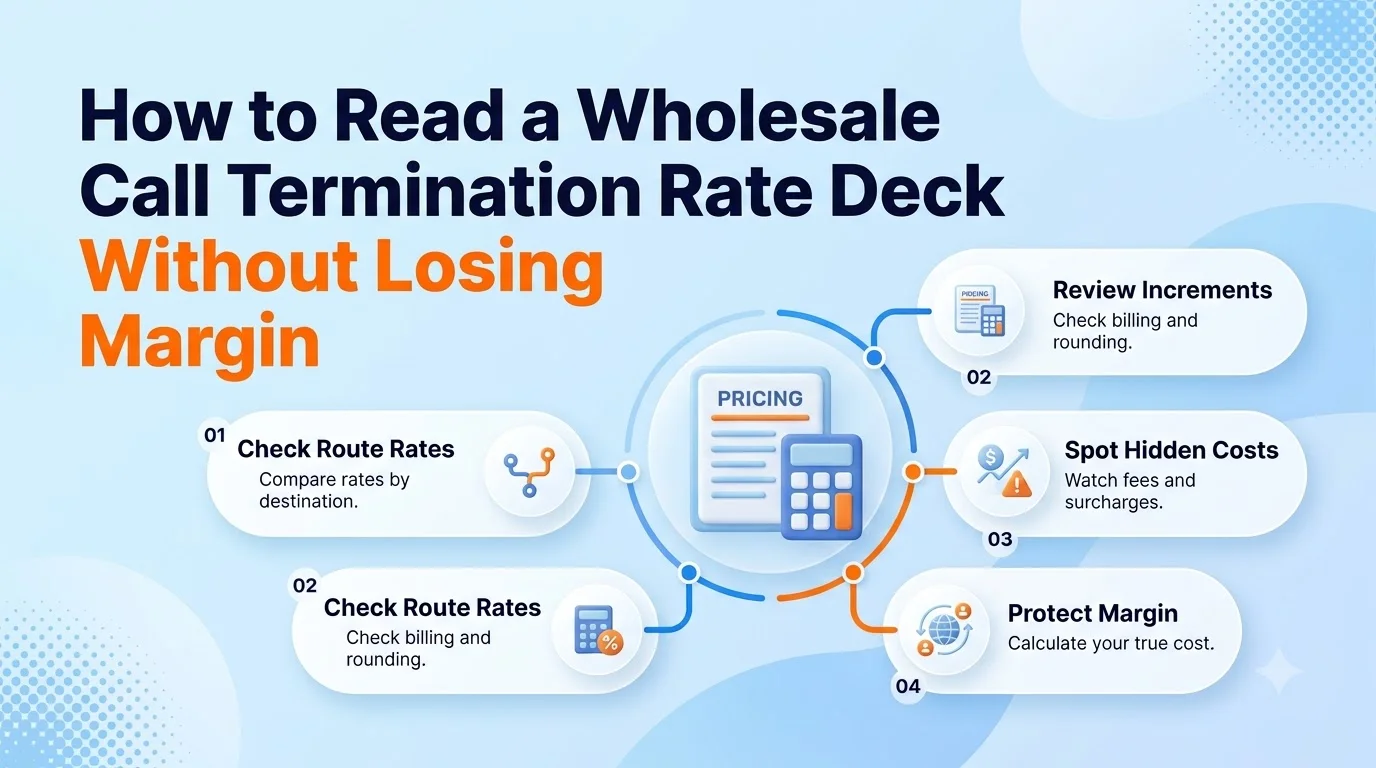
Wholesale SIP trunk pricing looks straightforward on paper but often conceals costs that inflate your actual bill by 15% to 25%.
Core Pricing Models
Per-minute pricing charges based on actual usage and varies by destination. US domestic rates typically fall between $0.001 and $0.004 per minute at wholesale volumes. This model suits businesses with variable or unpredictable call volumes.
Per-channel pricing offers unlimited calling on a fixed number of concurrent call paths. Wholesale channel rates range from under $10 to around $25 per channel monthly, depending on volume commitments. Contact centers and AI voice platforms with steady, high-volume traffic benefit most from this structure.
Committed-use discounts reduce per-minute rates in exchange for monthly volume guarantees. Missing the commitment typically means paying a higher fallback rate, so accurate traffic forecasting is essential.
The Hidden 15–25%
Most published rate cards quote prices before regulatory surcharges. In the United States, SIP trunking bills can include Universal Service Fund (USF) contributions, E911 fees, PICC charges, state and local telecom taxes, and FCC regulatory fees. These surcharges routinely add 15% to 25% on top of the quoted rate.
Always request an all-in cost estimate for your expected traffic volume. A provider quoting $0.002 per minute before surcharges may cost more than one quoting $0.003 with surcharges included.
PBX and Platform Compatibility
A wholesale SIP trunk is only useful if it integrates cleanly with your existing phone system. Compatibility issues — particularly around NAT traversal, codec negotiation, and authentication methods — cause the majority of deployment headaches.
On-Premise PBX Systems
The most widely deployed on-premise platforms — Asterisk, FreePBX, and 3CX — all support standard SIP trunking, but each configures it differently:
- Asterisk — requires manual editing of configuration files (pjsip.conf or sip.conf), registration strings, and dial plan rules in extensions.conf
- FreePBX — exposes the same settings through a web GUI under Connectivity → Trunks, simplifying setup but still requiring correct PJSIP endpoint configuration
- 3CX — uses its own trunk wizard with provider-specific templates, supporting both IP-based and registration-based authentication
The most common integration failure across all platforms is NAT misconfiguration, which causes one-way audio. Verify that your provider supports both IP-based and credential-based authentication, provides clear configuration guides for major PBX platforms, and offers technical support during initial trunk setup.
Cloud PBX and UCaaS Platforms
Cloud systems like Microsoft Teams (via Direct Routing), RingCentral, and Zoom Phone connect through session border controllers (SBCs) or native SIP interfaces. Confirm your provider supports the required SBC or gateway and verify TLS/SRTP encryption compatibility — most cloud platforms mandate encrypted signaling.
SIP Trunking for AI Voice Agents and Automation
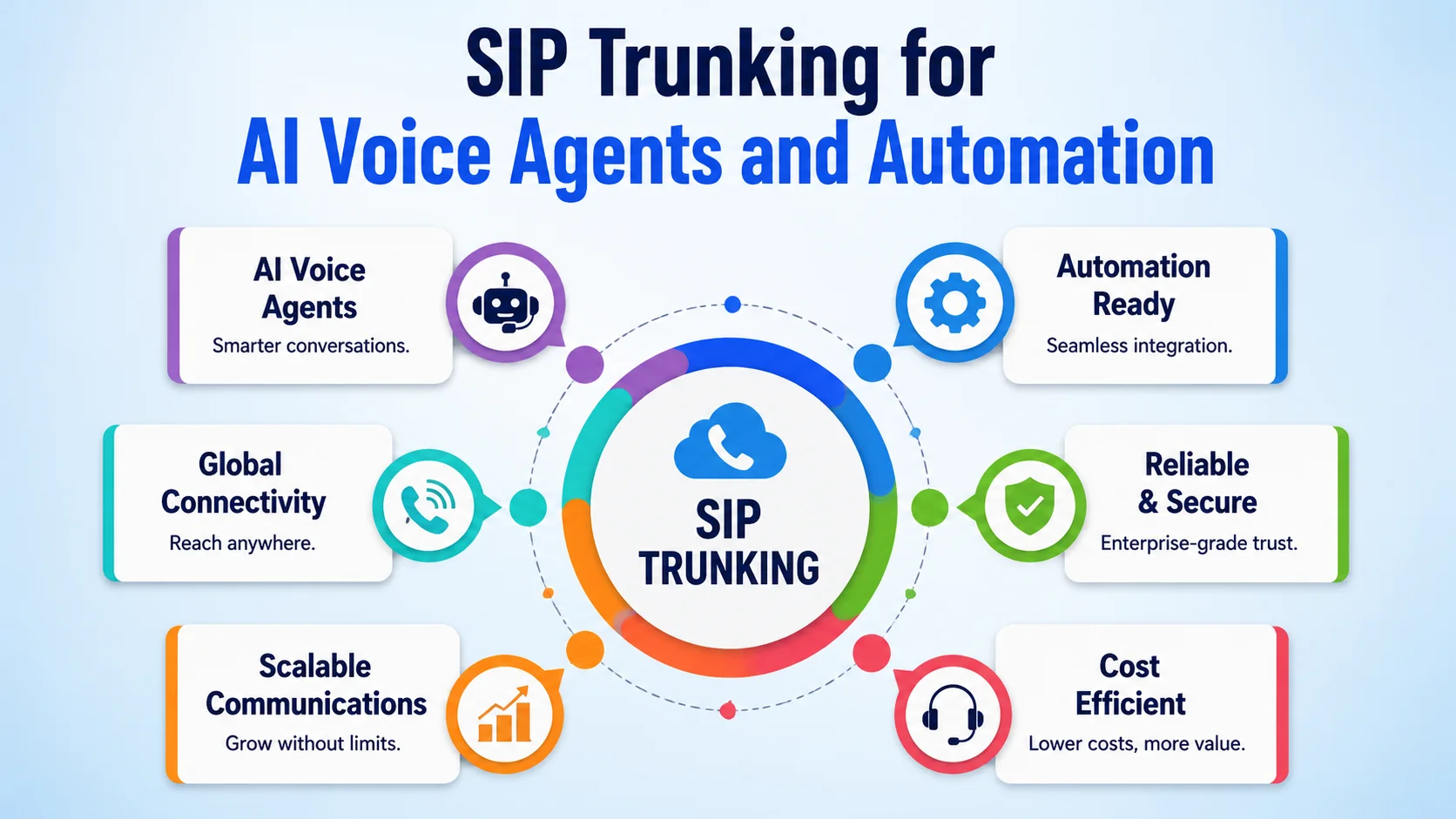
One of the fastest-growing use cases for wholesale SIP trunking is connecting AI voice agents to the telephone network. Voice AI platforms need low-latency PSTN access to handle inbound and outbound calls at scale, and SIP trunks provide that bridge.
The technical requirements differ from traditional PBX trunking. AI platforms need high concurrent channel capacity — a single deployment might handle hundreds of simultaneous calls. They require real-time media streaming (often via WebSocket or MRCP) so the AI engine processes audio with minimal delay, and they demand elastic scaling since call volumes spike rapidly during campaigns.
For AI workloads, prioritize a SIP trunking service that offers per-channel pricing with burst capacity, sub-100ms media latency, API-driven trunk provisioning for automated scaling, and A-level attestation to keep AI-placed outbound calls from being flagged as spam. With voice AI spending projected to grow at 37% annually through 2029, providers investing in low-latency infrastructure and developer APIs hold a clear advantage.
Further reading: AI receptionist
Reliability Indicators That Predict Real-World Performance
Uptime claims on a provider's website mean little without the infrastructure and contractual commitments to back them. Here is what to verify before trusting a wholesale SIP trunking provider with your production traffic.
- Geo-redundant points of presence (PoPs) — a provider with data centers in at least two regions can reroute traffic during localized outages; ask for a PoP map and confirm each location runs independent switching equipment, not just a failover pointer to one primary site
- SLA with financial teeth — look for 99.999% uptime guarantees backed by service credits that escalate with downtime duration; an SLA without financial penalties is a marketing statement, not a commitment
- Proof-of-concept testing — route 10–15% of traffic through the new provider for two to four weeks, measuring post-dial delay, call completion rates, and audio quality across top destinations
- Real-time monitoring dashboards — the best providers show live trunk status, call detail records, and quality metrics, letting you detect issues before end users report them
Number Portability and DID Management
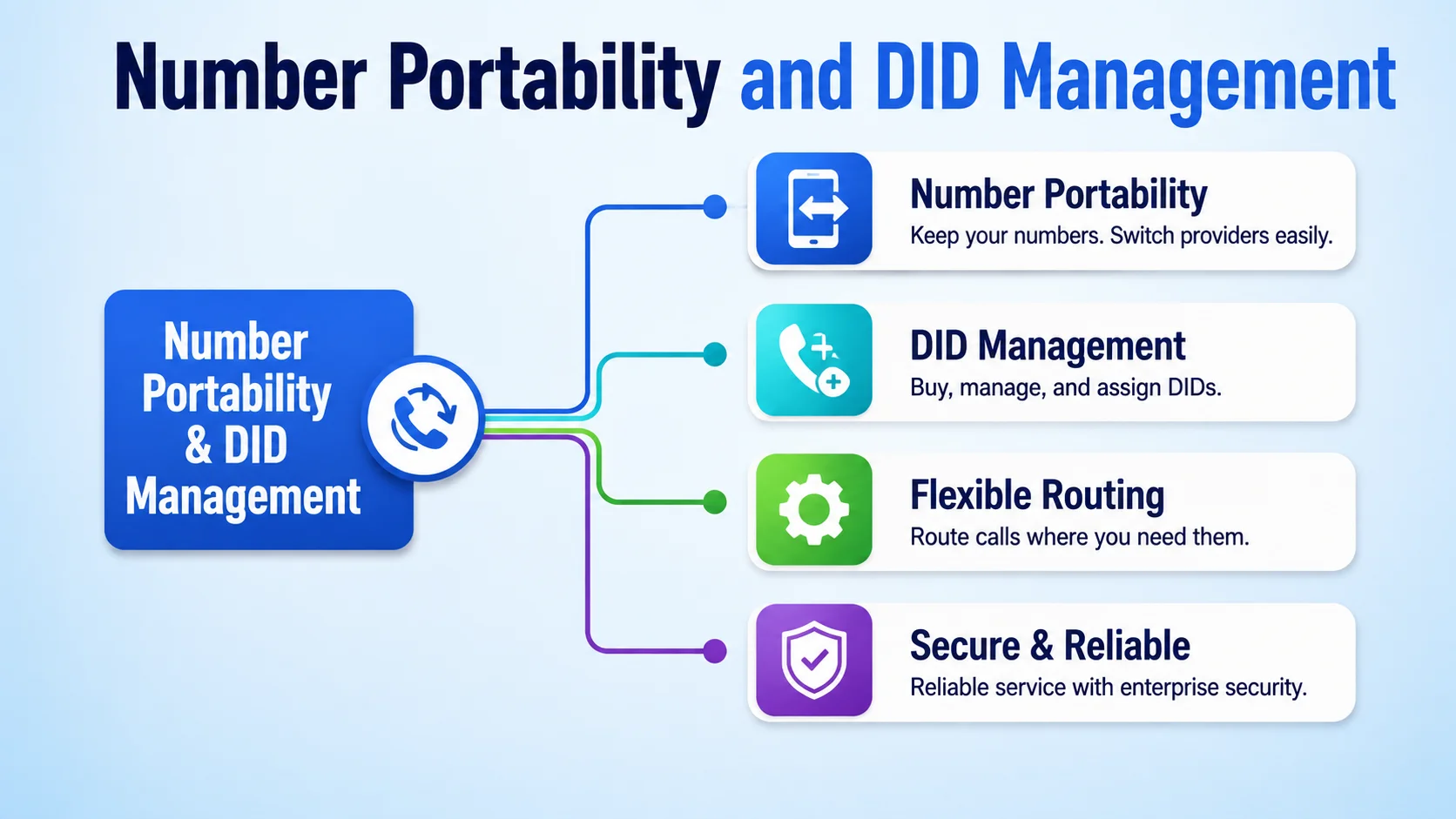
Your ability to move phone numbers between carriers and manage your DID inventory directly affects business continuity and operational flexibility.
Local Number Portability (LNP) in the US typically takes two to four weeks for standard ports, though simple single-number ports can complete in days. Confirm your provider handles porting paperwork, provides tracking visibility, and guarantees no service interruption during cutover.
Beyond porting, evaluate the provider's DID inventory:
- Local numbers — across a wide geographic footprint
- Toll-free numbers — with real-time provisioning
- International DIDs — for global operations
- API-based number management — self-service search, ordering, and release
Self-service number management through an API or portal eliminates support tickets for routine operations and becomes essential at scale.
Conclusion
Selecting the right wholesale SIP trunk provider is a decision with direct financial and operational consequences. Carrier status determines your attestation capabilities and troubleshooting speed.
STIR/SHAKEN compliance dictates whether your outbound calls reach their destination or get flagged as spam. PBX compatibility and AI-readiness define how smoothly the service integrates with your current and future infrastructure.
And the real cost only becomes clear when you account for regulatory surcharges that add 15–25% beyond the quoted rate. Test before you commit, demand transparency on pricing and attestation, and choose a provider whose infrastructure matches where your business is heading — not just where it is today.