Introduction
Wholesale voice termination rates are the per-minute prices a wholesale provider charges to carry outbound voice traffic to a destination. Headline rates are easy to compare, but effective rates after billing increments and fees are not. This guide breaks rates down by tier and the total-cost model buyers should run.
Key Takeaways
- Wholesale voice termination rates split by destination tier — Tier 1 $0.001–$0.01/min, Tier 2 $0.005–$0.05/min, regulated higher, premium-rate $0.50–$5.00+.
- Billing increments materially change effective economics — 1-second after 6-second minimum is customer-friendly; 60-second increments inflate effective rates by 20%+ on short calls.
- Multi-tier LCR (premium / standard / economy) lets the buyer pick quality vs cost per destination prefix per traffic class.
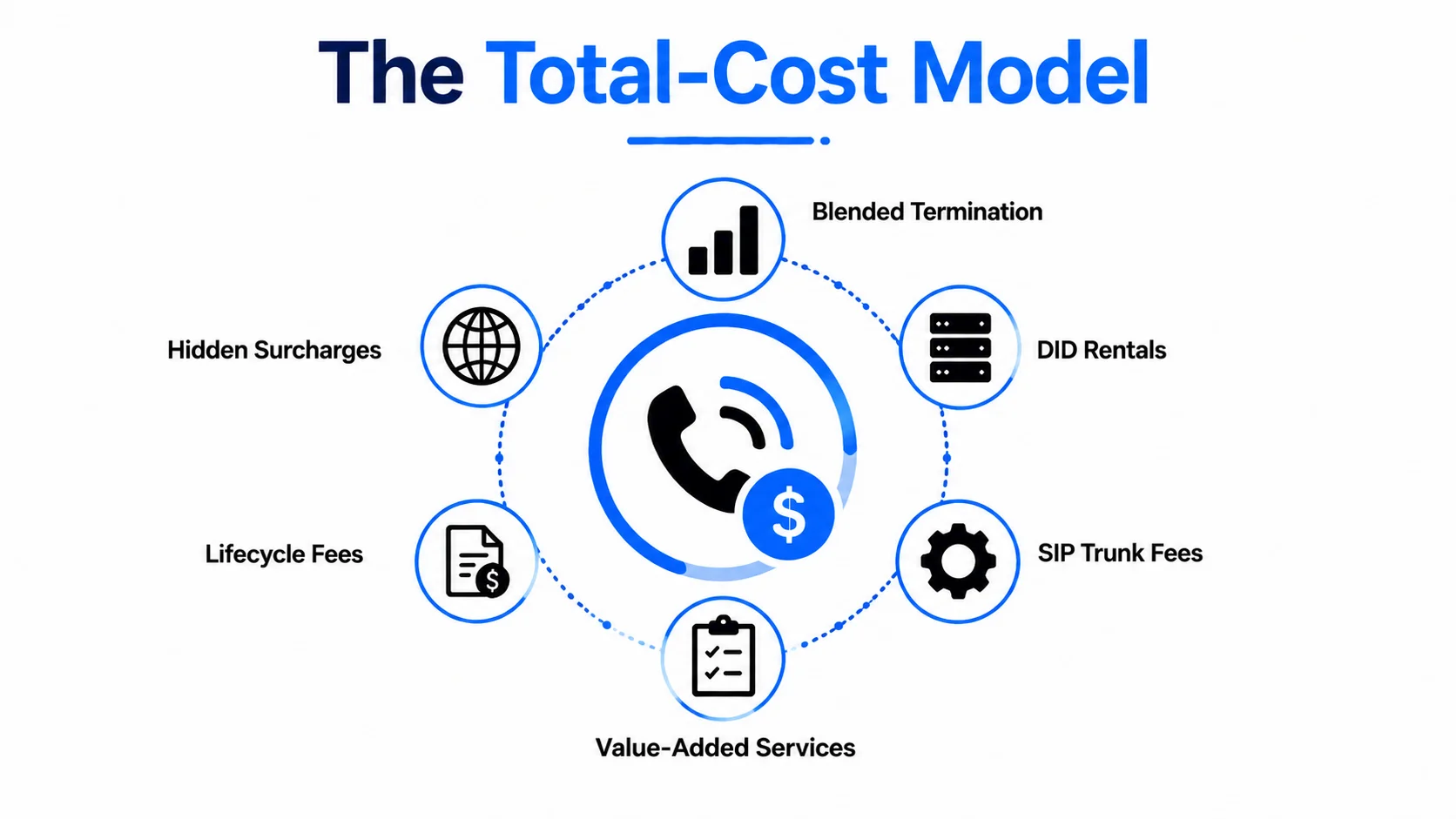
- Total cost = blended termination + DID rentals + SIP trunk fees + value-added subscriptions + lifecycle fees. Headline rates alone are misleading.
- Twiching publishes per-destination wholesale voice termination rates with 1-second billing increments after a 6-second minimum, effective dates visible on every row.
What Wholesale Voice Termination Rates Actually Mean
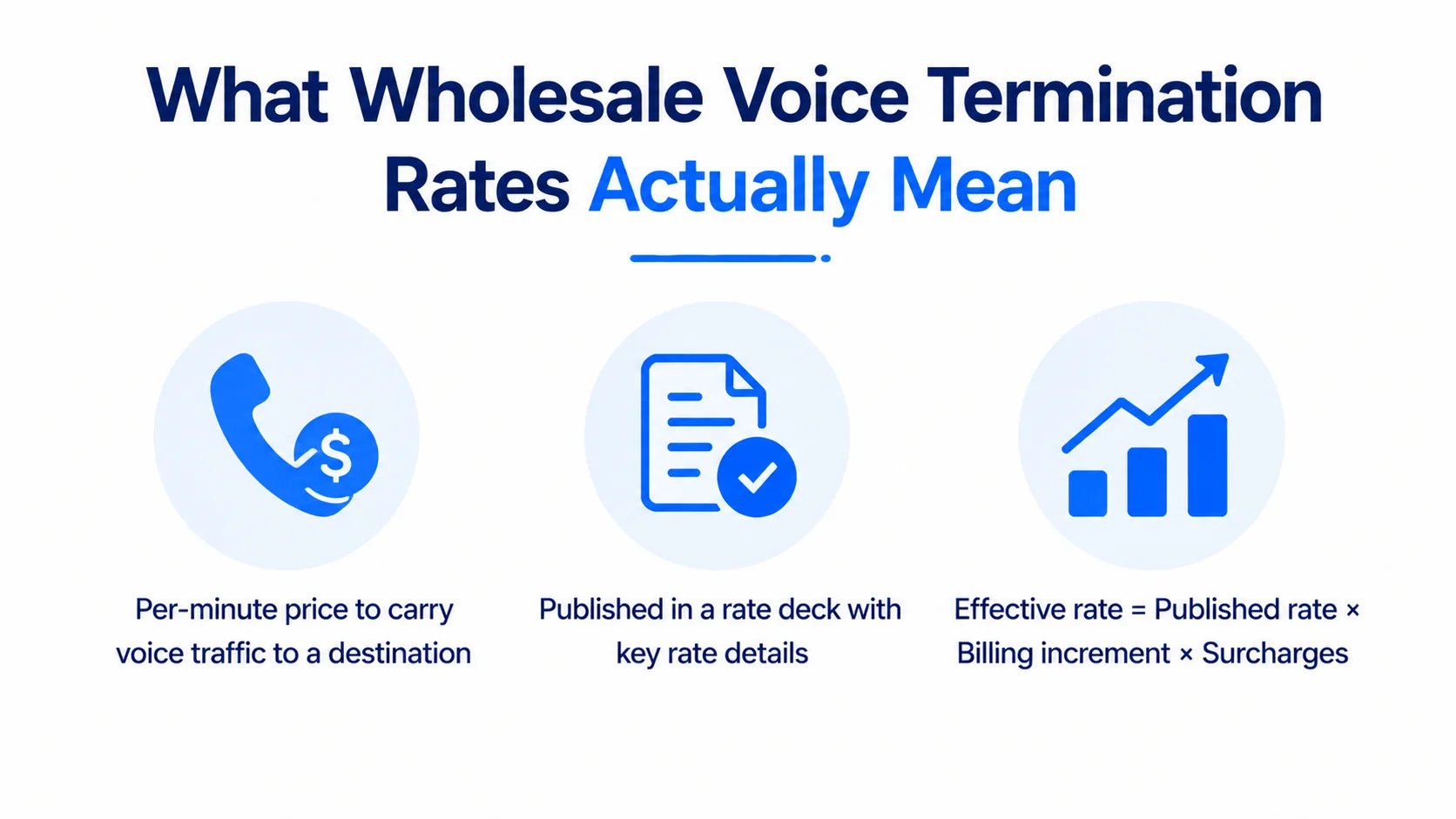
Wholesale voice termination rates are the per-minute prices a wholesale voice provider charges to carry outbound voice traffic to a specific destination prefix. The rate is the upstream-carrier wholesale rate plus the provider's margin.
Rates publish in a per-destination rate deck — typically tens of thousands of entries covering country prefixes and within-country sub-prefixes (mobile operator prefixes, premium-rate prefixes, regulated-tariff prefixes). Strong providers ship the rate deck with billing increments, currency, effective dates, and notice periods on every row; weak providers obscure the deck behind sales conversations.
Headline rates are easy to compare; effective rates after billing increments and surcharges are not. The buyer's actual cost per minute is the published rate × billing-increment factor × any per-call surcharges. Compare like-for-like by running the providers' rate decks against your actual destination mix from your last three months of CDRs.
Rates by Destination Tier
Further reading: Wholesale pricing & rate deck
Wholesale voice termination rates split by destination tier. Tier 1 destinations — US/Canada landline and mobile, UK landline, Germany landline, most Western European landline — typically run $0.001–$0.01 per minute on wholesale voice termination. Tier 2 destinations — most other developed countries plus large emerging markets — typically run $0.005–$0.05 per minute.
Regulated destinations like India, Brazil, China run higher because of mandatory licensed-carrier termination. Premium-rate destinations (international 900-equivalent prefixes, satellite networks, some emerging-market mobiles) can run $0.50–$5.00+ per minute and are IRSF fraud targets.
Mobile vs landline pricing differs in most countries. Mobile termination is usually more expensive because of mandatory mobile-terminating-rate (MTR) regulation that sets a floor. Wholesale voice termination rate decks should publish mobile and landline pricing per country separately so the buyer can model traffic mix accurately.
Billing Increments — The Math That Changes Economics
Billing increments are the granularity at which the wholesale provider bills connected call duration. The modern customer-friendly default is 1-second increments after a 6-second minimum (1/1 after 6). The buyer pays for actual answered duration after a brief floor that protects the provider against signalling overhead.
Legacy decks bill in 60-second increments (60/60) which inflate effective rates by 20%+ on short calls common in contact-centre dialler traffic. Some predatory decks bill 60-second increments after a 60-second minimum — every call costs at least a full minute regardless of actual length.
Compare wholesale voice termination rates with billing increments visible. A $0.005/min rate at 60/60 increments is more expensive than a $0.006/min rate at 1/1 after 6 for contact-centre traffic with high short-call volume. Model the difference against your actual call-duration distribution before signing.
Multi-Tier LCR — Premium vs Standard vs Economy
Further reading: Wholesale voice solutions
Wholesale voice termination platforms offer multi-tier LCR routing per destination prefix. Premium routes use the highest-quality upstream carrier per destination regardless of cost — best for contact-centre outbound where every percentage point of ASR matters. Standard routes balance cost and quality.
Economy routes pick the cheapest qualifying carrier — best for background traffic. Premium routes typically run 20–50% more expensive than economy on the same destination; the spread is the cost of higher ASR/PDD/MOS.
Wholesale voice termination rates published as a single column hide the multi-tier choice. Strong providers publish premium / standard / economy rates per destination so buyers can pick tier per traffic class. Twiching's wholesale voice termination rate deck publishes the three tiers per destination prefix.
The Total-Cost Model
Headline wholesale voice termination rates lie when consumed alone. Total cost = blended termination (rate × destination mix × volume) + monthly DID rentals + SIP trunk fees.
It also includes value-added subscriptions (call recording, analytics, fraud monitoring) and lifecycle fees (E.911 registration, address-of-record changes, CNAM updates, porting, disconnection). Build the model against three months of real CDRs before signing.
Watch for hidden surcharges that don't show up in the headline rate deck.
- Per-call signalling surcharges on certain destinations
- Regulatory surcharges in specific countries
- Currency-conversion margins on multi-currency invoicing
- Minimum monthly commits that inflate effective per-minute cost when volume drops
Strong wholesale voice termination providers disclose all of it; weak ones bury surcharges in contract small print.
Rate-Deck Evaluation Checklist
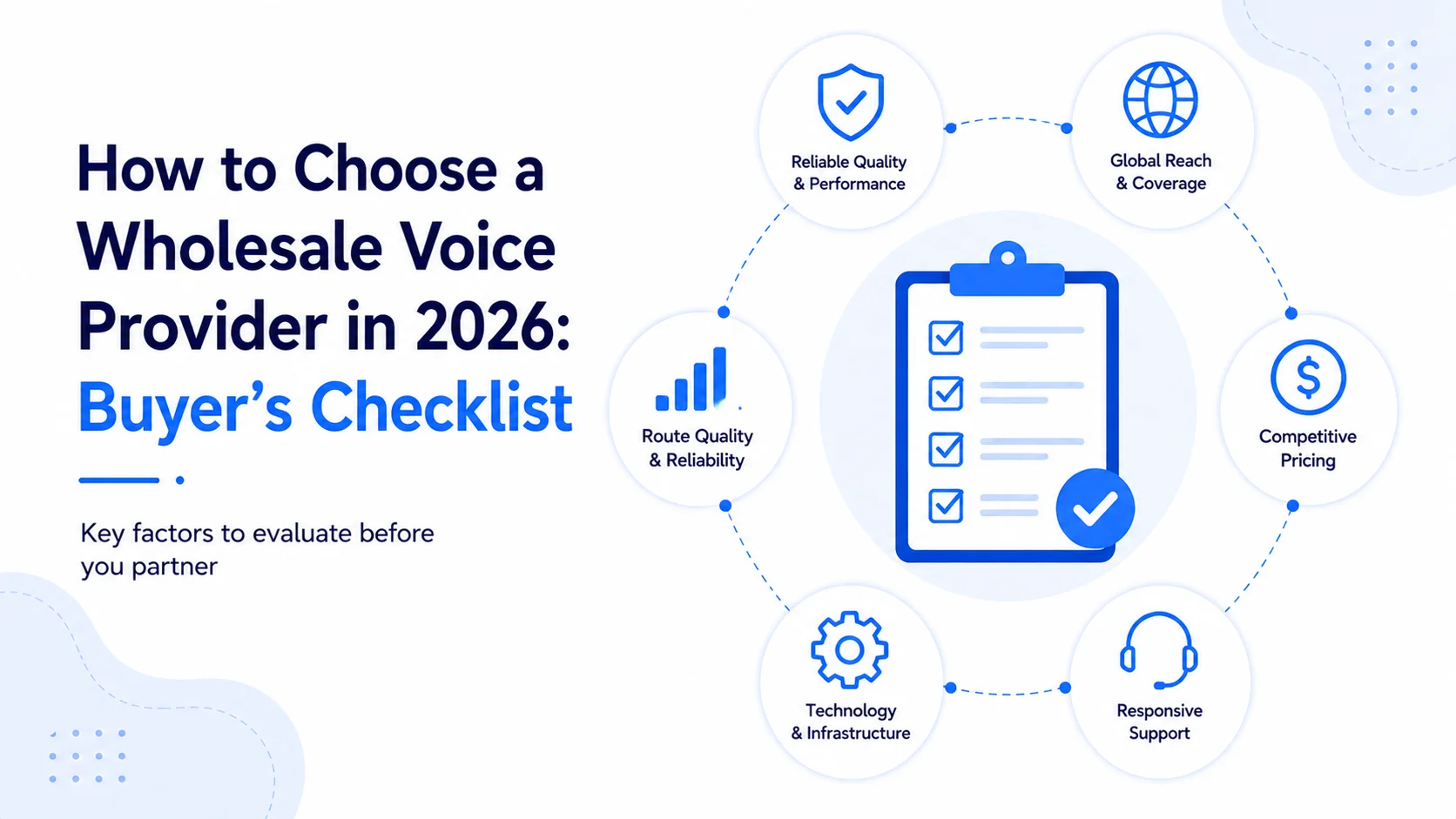
- 01Per-destination wholesale voice termination rates published with currency, billing increments, effective dates, and notice periods on every row
- 021-second billing increments after 6-second minimum — modern customer-friendly default
- 03Multi-tier rates per destination — premium / standard / economy — published, not gated behind sales conversation
- 04Mobile and landline pricing per country published separately for accurate traffic-mix modelling
- 05Quality data per destination (ASR/PDD/MOS) published alongside rates so buyers can compare cost-per-completed-call, not cost-per-attempt
- 06No hidden surcharges on signalling, regulatory tariffs, or currency conversion outside the published deck
- 07Volume-tier rate progression documented as monthly volume scales into higher bands
- 08Minimum monthly commits, if any, disclosed clearly with the effective per-minute cost at the commit
- 09Real-time rate-deck change notification via API and email when upstream changes affect customer rates
- 10Rate-deck download via REST API for automated cost modelling on the buyer side
Twiching's Wholesale Voice Termination Rates
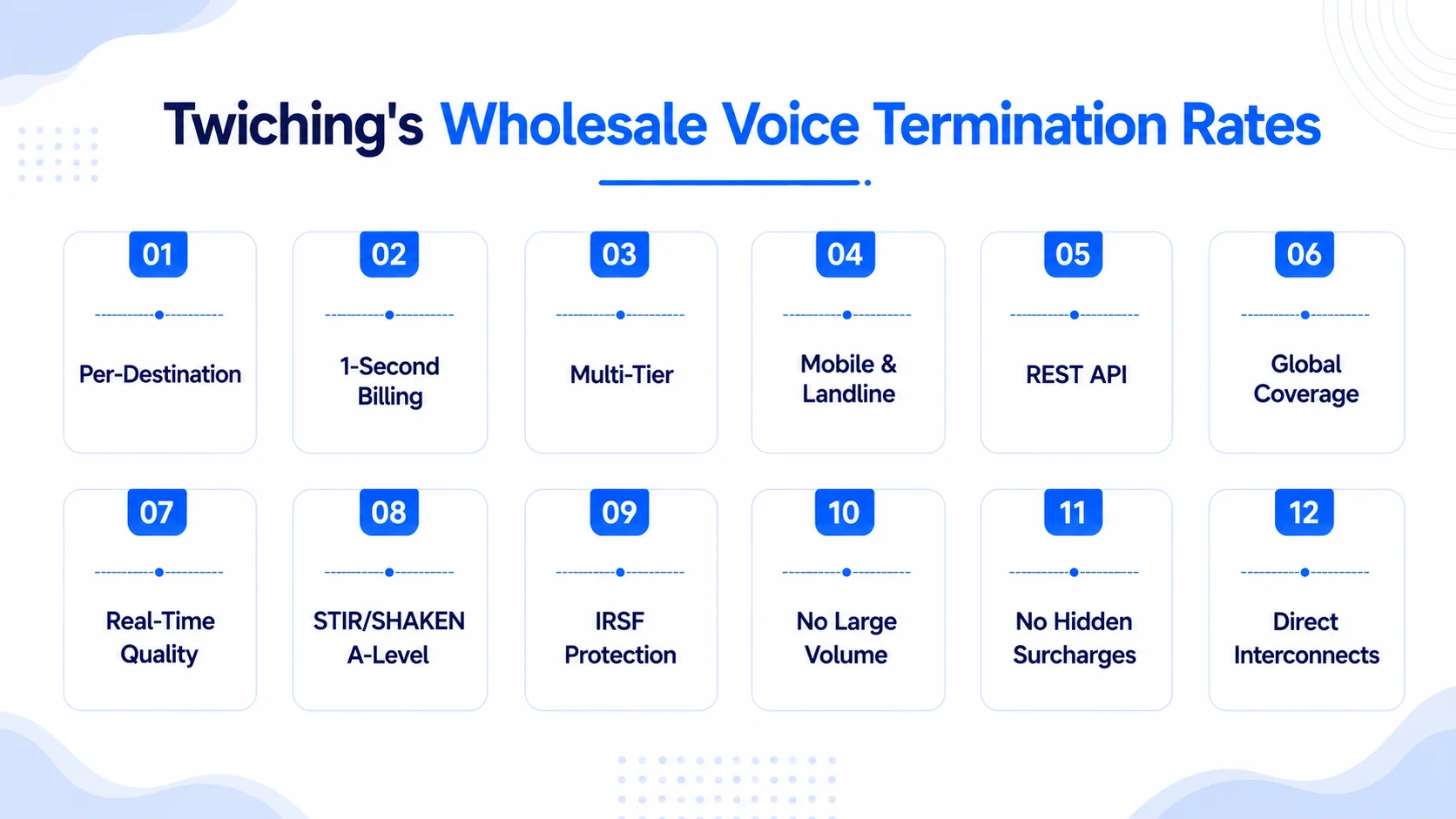
Twiching publishes per-destination wholesale voice termination rates with 1-second billing increments after a 6-second minimum. Effective dates are visible on every row, with notice periods that match modern contract norms. Premium, standard, and economy routes publish per destination so buyers can choose tier per traffic class.
Mobile and landline pricing publishes per country separately for accurate modelling. Rate decks download via REST API for automated cost modelling.
Behind the rate deck, Twiching runs direct interconnects across 200+ countries with a multi-region active-active platform and real-time per-destination quality monitoring with auto-demotion. A-level STIR/SHAKEN attestation applies by default, along with IRSF protection by default and a 24/7 NOC with 15-minute critical-incident SLA. No large volume minimums on standard business accounts; no hidden surcharges outside the published deck.
Wholesale voice termination rates are published as per-minute charges but should be evaluated as total cost per billable minute. The total cost includes the per-minute rate, billing increment (60+60 vs 6+6), minimum call duration charges, and any regulatory surcharges.
Take a route with a $0.003 per-minute published rate, 60+60 billing, and a $0.0015 per-minute USF contribution. The effective total cost per answered minute is approximately $0.0055 for a call lasting 23 seconds — 83% higher than the headline rate.
Benchmarking your wholesale voice termination rates against market levels is essential for maintaining competitive pricing. Services like ROCCO's carrier benchmarking reports, or informal comparisons through industry associations, reveal whether your current rates are at, above, or below market for key destinations.
Operating with above-market rates on high-volume routes means overpaying thousands of dollars monthly that could be recaptured through renegotiation. Schedule rate renegotiation conversations with your primary carriers at least annually, bringing market benchmark data to support your position.
Invoice audit methodology for wholesale voice termination rates should cover four checks.
- Destination rate accuracy — are calls billed at the correct rate for the dialled number prefix?
- Billing increment accuracy — are sub-minute calls rounded to the correct increment?
- Answered vs unanswered classification — are unanswered calls billed?
- Surcharge legitimacy — are all surcharges contractually authorised?
Running these checks on a 5% random sample of monthly CDRs typically takes 2–4 hours and reliably identifies systematic billing errors worth recovering.
Conclusion
Wholesale voice termination rates only mean something when compared against billing increments, multi-tier routing options, and the actual traffic mix. Headline per-minute pricing alone is misleading — modern customer-friendly 1-second increments after a 6-second minimum versus legacy 60-second increments change effective economics by 20%+; multi-tier LCR routing changes the cost vs quality trade-off per destination; hidden surcharges on signalling and regulatory tariffs inflate the real bill at scale. Twiching publishes per-destination wholesale voice termination rates with billing increments, currency, effective dates, premium/standard/economy tier options, and rate-deck download via REST API. No hidden surcharges, no large volume minimums on standard business accounts, no per-seat licensing layered on top. Run the rate-deck comparison against your last three months of CDRs to benchmark whether your current wholesale voice termination provider is still the right one.