Introduction
Wholesale voice termination providers are the suppliers behind ITSPs, CPaaS layers, UCaaS platforms, and contact centres, and the headline per-minute rate rarely tells you which one is actually reliable. What separates them is bundle completeness, redundancy architecture, support tier, compliance record, and SLA terms. This guide walks through those evaluation criteria, the safe migration pattern between providers, and realistic total cost, with Twiching as a worked example.
Key Takeaways
- Wholesale voice termination providers carry the buyer's outbound voice traffic at per-minute wholesale VoIP rates — bundle completeness and operations layer matter more than headline rate.
- Redundancy architecture — multi-region active-active softswitch, carrier diversity, automatic failover — determines whether the platform survives at scale.
- Support tier varies a lot; named technical contacts with 15-minute critical-incident SLA at 3am is what protects production voice.
- Migration between wholesale voice termination providers is safe when done in small steps — secondary route, 10–20% test traffic, gradual share shift, 30-day failback overlap.
- Twiching operates as a technology-led wholesale voice termination provider with direct interconnects across 200+ countries, programmable APIs, and a 24/7 NOC.
What Wholesale Voice Termination Providers Do
Wholesale voice termination providers carry the buyer's outbound voice traffic across their carrier interconnect base from the buyer's PBX to the destination network.
The customer-side is always another business — ITSPs reselling minutes, CPaaS layers building voice into apps, UCaaS platforms running seats, contact centres running campaigns.
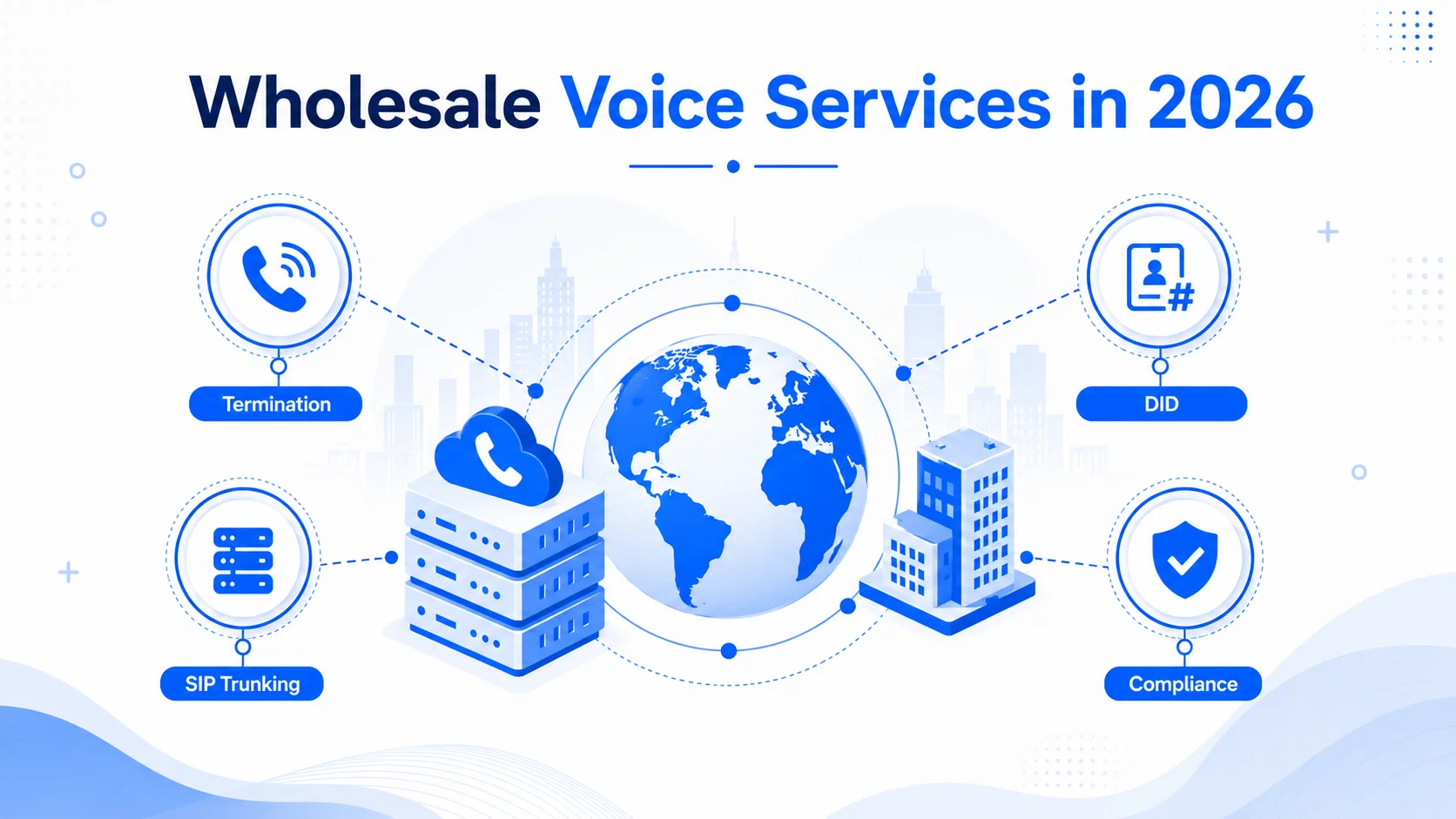
Pricing is per-minute at per-destination wholesale VoIP rates. Monthly DID rentals stack on top for inbound. Value-added subscriptions cover analytics, recording, fraud monitoring, and REST APIs.
What sits behind the per-minute rate determines whether the provider holds quality under load.
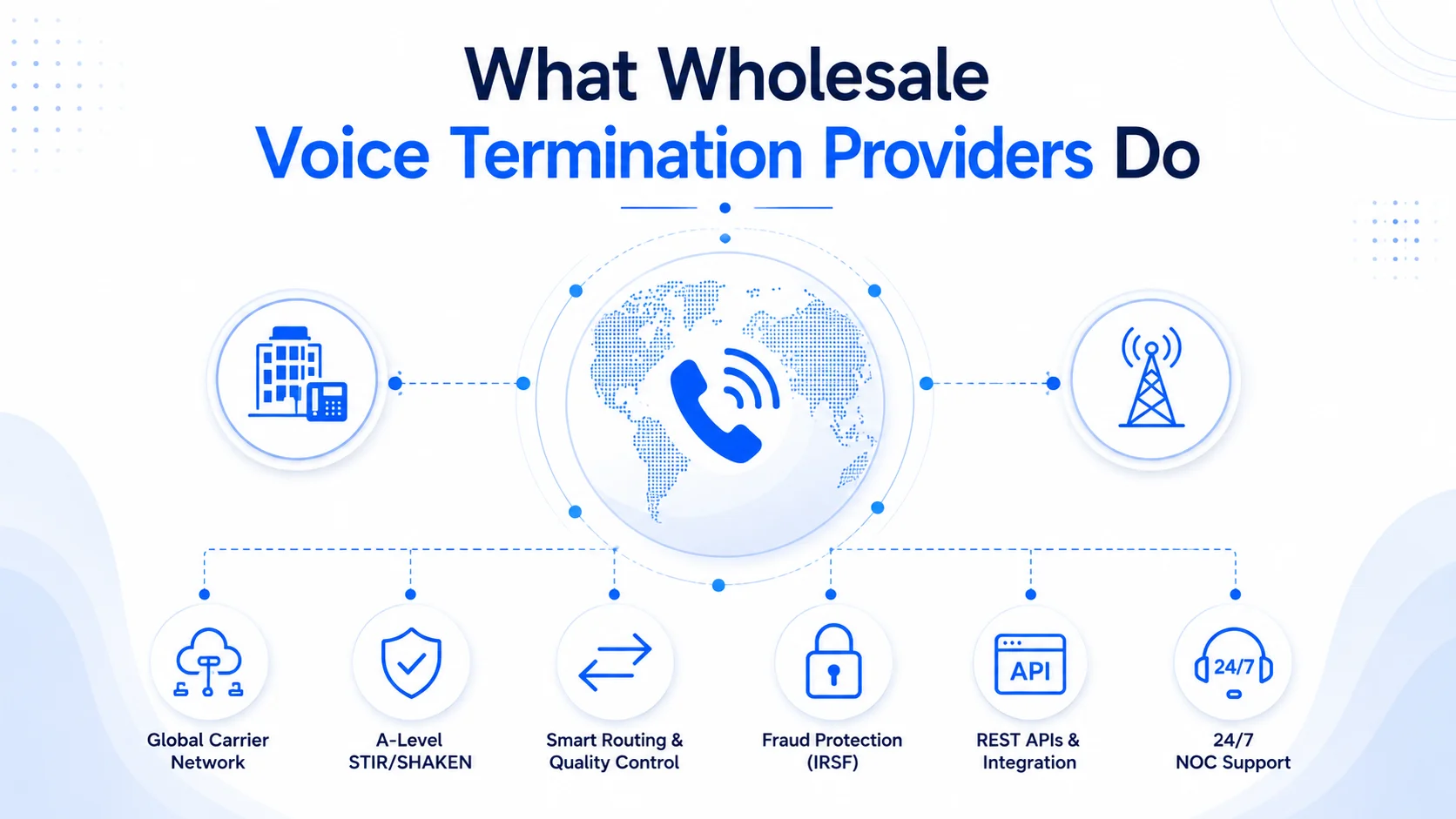
Strong wholesale voice termination providers run a Class 4 softswitch with multi-region active-active failover. They also run multi-tier LCR with real-time quality-aware demotion, A-level STIR/SHAKEN attestation, IRSF fraud protection, REST APIs across the lifecycle, and a 24/7 NOC.
Weak providers run none of it and rely on price to win deals they can't deliver on.
Redundancy Architecture
Further reading: Wholesale pricing & rate deck
Redundancy is what separates wholesale voice termination providers that survive Friday-afternoon traffic spikes from those that don't.
The architecture that holds starts with spread-out softswitch clusters running active-active across multiple regions. It also needs multiple upstream carrier interconnects per major destination. That way, any single carrier outage triggers automatic LCR re-routing within minutes.
It also needs diverse internet transit, so single-ISP failures don't take the platform out.
On top of that, real-time per-destination quality monitoring demotes degrading routes on its own.
Wholesale voice termination providers running a single softswitch in a single data centre are single points of failure, no matter what the marketing says. Ask for the architecture diagram and 12-month uptime history before signing.
Support Tier — What 3am Looks Like
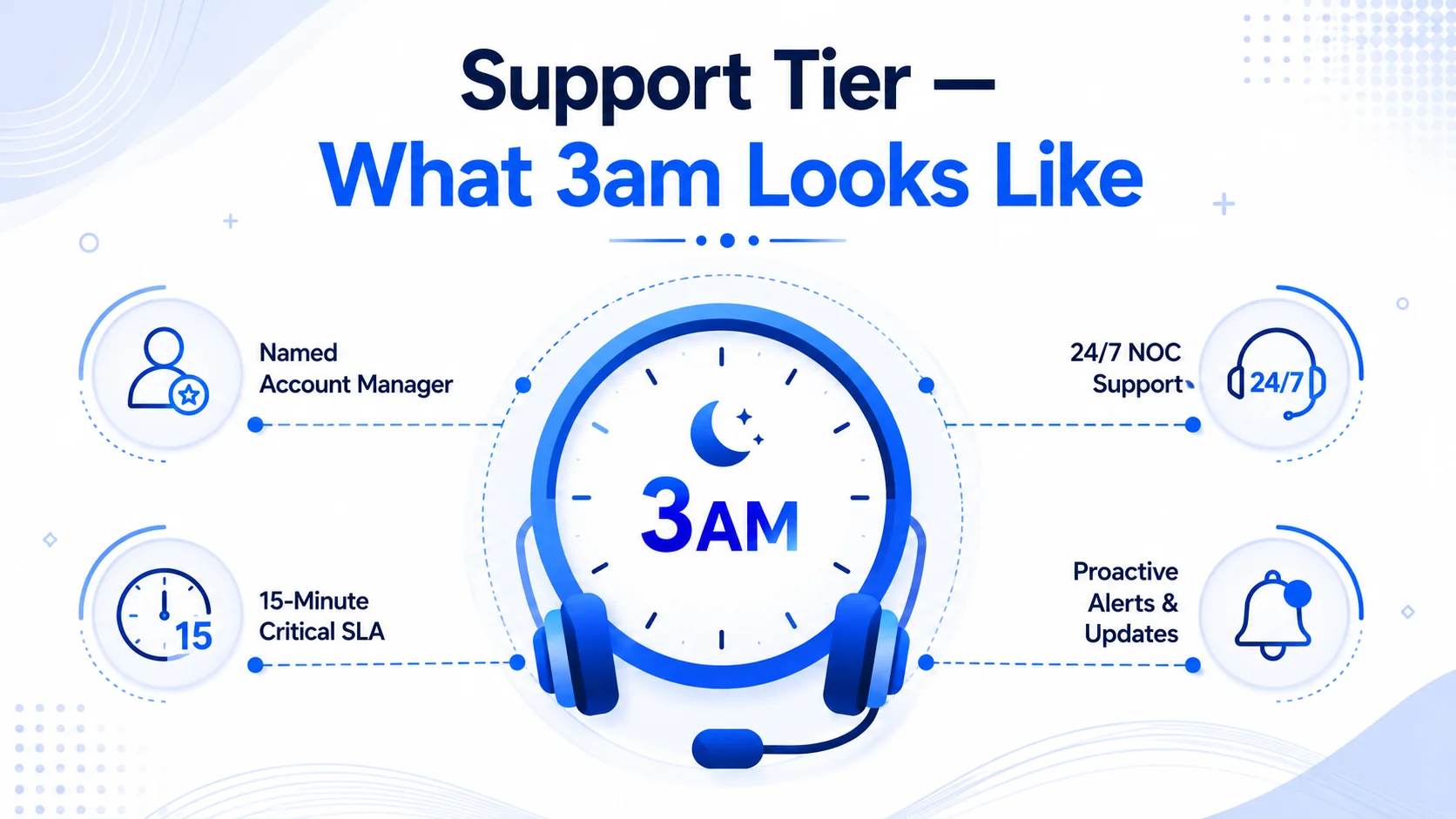
Support tier varies a lot across wholesale voice termination providers. The minimum-viable tier is a self-service portal plus email queue with a 24-hour response SLA. That's fine for routine provisioning, but useless when production traffic is degrading at 3am.
The enterprise tier is a named technical account manager plus 24/7 NOC with a 15-minute critical-incident SLA.
It also includes proactive outreach when monitoring detects route degradation, before the customer even notices.
Contact-centre and ITSP customers running mission-critical voice need the enterprise tier. Twiching's enterprise tier ships with named escalation contacts in the customer portal. It also includes 24/7 NOC response on critical incidents within 15 minutes, and proactive notification on detected route degradation.
Compliance Posture
Further reading: Wholesale voice solutions
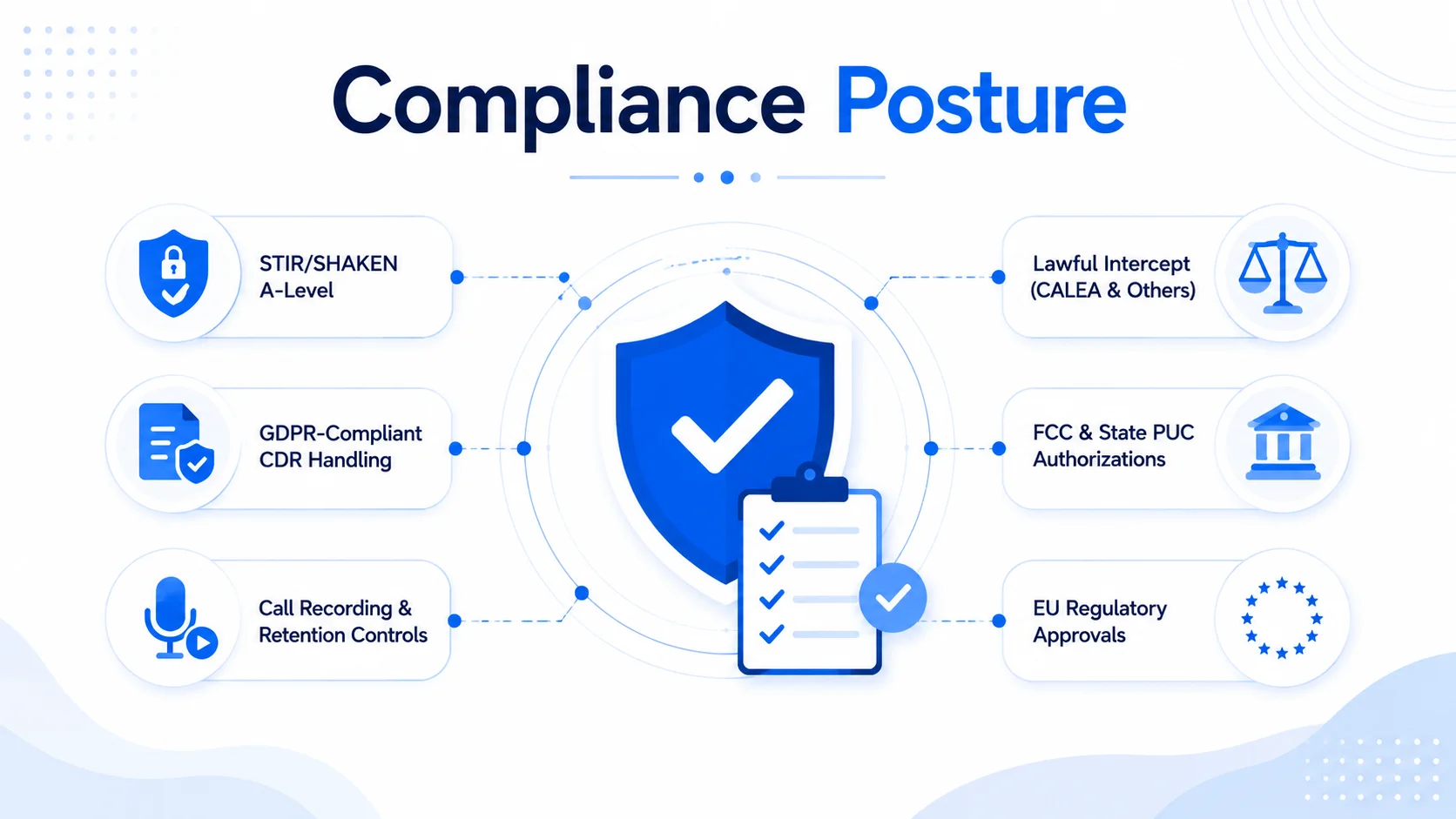
Compliance is no longer optional for wholesale voice termination providers. A-level STIR/SHAKEN attestation on US outbound is the gatekeeper.
B/C-level attestation triggers Spam Likely labelling that collapses answered-rate. GDPR-compliant CDR handling matters for any traffic touching EU regions.
Call recording with retention controls and lawful intercept (CALEA in the US, similar rules elsewhere) is required for regulated fields.
Documented FCC interstate-carrier approval, state PUC registrations, and similar EU regulatory approval per market form the licensing baseline. Providers who ask customers to take compliance on trust without paper are a red flag.
Safe Migration Pattern
Migration between wholesale voice termination providers is safe when done in small steps.
Set up the new provider as a secondary route, then send 10–20% test traffic for 1–2 weeks. Measure per-destination ASR/PDD/MOS against the incumbent — compare destination by destination, not on combined averages.
If the test traffic holds quality, slowly shift share — 30%, 50%, 70%, 100% — over 4–6 weeks. Keep the incumbent active for 30 days post-migration as failback while the new provider's quality settles under full load.
Big-bang cutover between wholesale voice termination providers is the failure mode. The new provider's quality may collapse at production volume even if it held at 20%.
Keep the failback option open until production-load data shows it's stable.
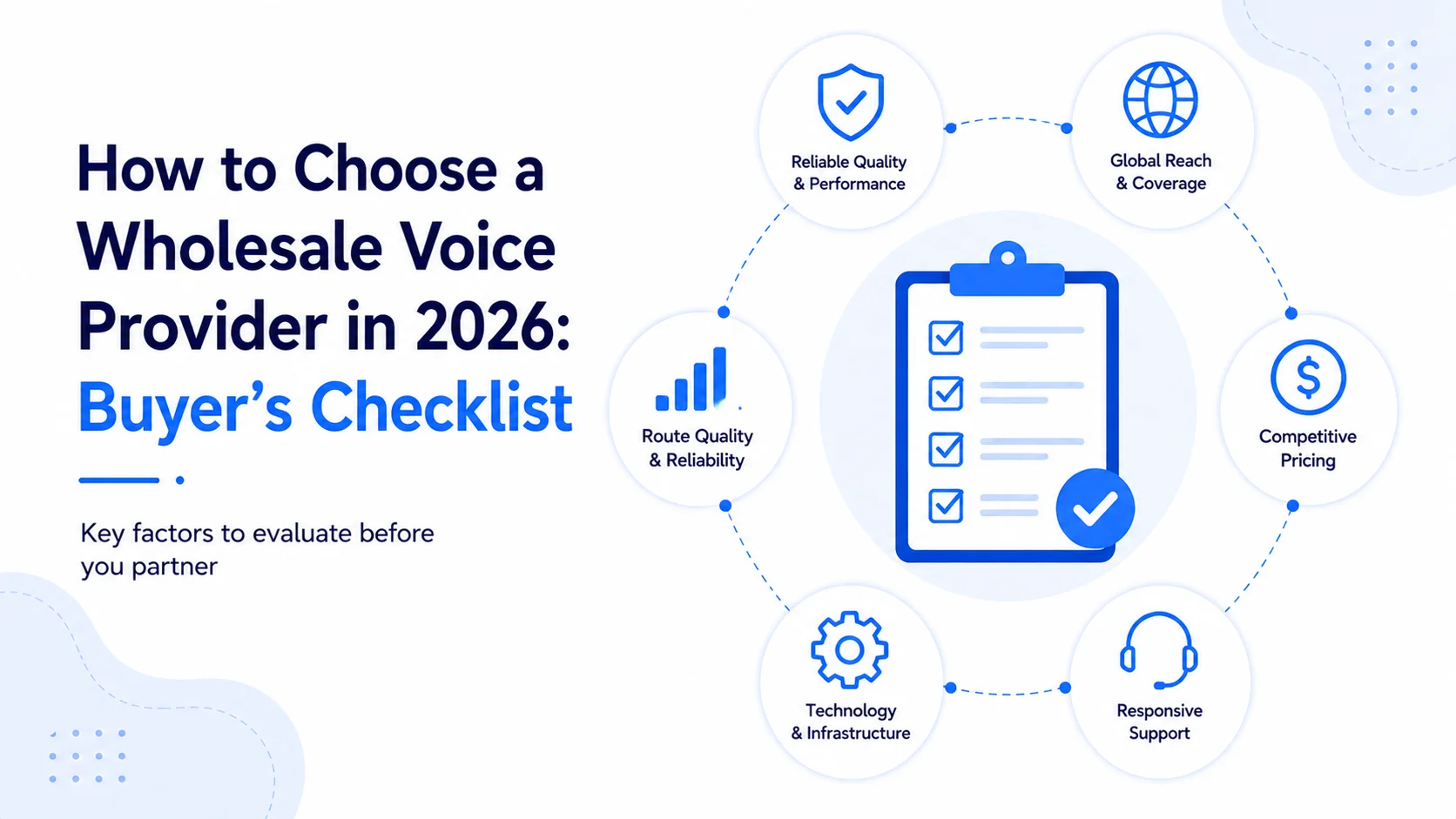
Evaluation Checklist
Further reading: Wikipedia: VoIP overview
- 01Bundle completeness — trunking, termination, origination, value-added layers under one contract
- 02Owned direct interconnects in the buyer's top destinations, country-by-country quality published
- 03Multi-region active-active softswitch with documented 12-month uptime above 99.99%
- 04Multi-tier LCR with real-time per-destination ASR/PDD/MOS monitoring refreshed every 60 seconds
- 05A-level STIR/SHAKEN attestation on US outbound presenting hosted DIDs by default
- 06Documented FCC and equivalent EU regulatory approval per market
- 07IRSF protection — hard spend caps, default-deny premium-rate, anomaly detection — all by default
- 08REST APIs for trunk configuration, rate-deck queries, CDR retrieval, webhook delivery
- 09Enterprise support tier with named technical contact and 15-minute critical-incident SLA at 3am
- 10Test-account access for live traffic testing before commercial commitment
Twiching for Wholesale Voice Termination
Twiching operates as a technology-led wholesale voice termination provider with direct interconnects across 200+ countries and a multi-region active-active platform.
It also runs multi-tier LCR with real-time per-destination quality monitoring and auto-demotion, A-level STIR/SHAKEN attestation by default, and IRSF protection by default with customer-configurable spend caps.
It also ships REST APIs across the lifecycle and real-time CDR streaming via webhook and Kafka. Add documented FCC and EU regulatory approval per market, plus a 24/7 NOC with 15-minute critical-incident SLA.
Per-destination wholesale VoIP rates publish with billing increments and effective dates visible on every row. There are no large volume minimums on standard business accounts.
Onboarding completes in under 48 hours.
Test accounts are available for live traffic testing across destinations before any commercial commitment is required.
Tier 1 vs Tier 2 Providers
Wholesale voice termination providers serve different market segments with different service tiers.
Tier 1 providers have direct PSTN interconnects in major markets. They offer the highest quality but need minimum monthly commitments.
Tier 2 aggregators offer strong rates on a wider range of destinations without high minimums. They suit operators building scale.
For most growing wholesale operators, the cheapest approach is to start with a Tier 2 aggregator. Then move to direct Tier 1 relationships as volume grows.
Service Resilience at Enterprise Quality
Service strength sets apart wholesale voice termination providers at enterprise quality.
- Redundant PoPs in spread-out data centres
- Automatic failover between upstream carriers
- 24/7 network operations centre coverage
These are the baseline for carriers claiming enterprise-grade service.
Ask providers for their uptime numbers over the past 12 months, the length of their longest unplanned outage, and their incident response process. Carriers proud of being reliable are open about these numbers.
Planning a Provider Switch
Switching wholesale voice termination providers is a big job. Plan it carefully.
The safest migration approach runs new and existing providers in parallel for 2–4 weeks. Route bigger shares of traffic to the new provider while checking quality against your baseline.
Keep an emergency rollback option throughout migration, so you can redirect all traffic back to your existing provider within minutes if quality suddenly drops.
Document all quality benchmarks before migration begins. This gives you objective data for comparison.
It also helps settle disputes if the new provider's performance falls short of their SLA commitments.
Verifying Compliance and Escalation Contacts
Compliance requirements for wholesale voice termination providers include STIR/SHAKEN setup, FCC 499-A registration (US), Ofcom registration (UK), and country-specific interconnect licences where required. Providers who operate without these registrations expose their customers to downstream compliance risk.
Ask any provider for copies of their regulatory registrations. Check them with the relevant regulator's online registry before routing traffic.
This check takes 15 minutes. It protects you from working with non-compliant carriers whose licences could be revoked.
Review each provider's compliance paperwork every year, since rules change over time. Providers who stay current with their filings cut your downstream regulatory risk.
Keep updated contact records for your NOC escalation chain at each wholesale voice termination provider.
That way, when incidents occur outside business hours, your team can reach the right person immediately instead of navigating a generic support queue.
Conclusion
Checking wholesale voice termination providers is a step-by-step process. Check bundle completeness, redundancy architecture, support tier, compliance record, REST API surface, SLA terms, and the safe migration pattern.
Headline per-minute rates are good, but not enough. The whole bundle and the operations layer decide whether the provider holds quality under campaign load and survives at 3am when something breaks.
Twiching ships the full stack: direct interconnects across 200+ countries, a multi-region active-active platform, A-level STIR/SHAKEN attestation, and IRSF protection by default. It also includes a REST API across the lifecycle, named technical contacts, a 15-minute critical-incident SLA, and per-destination wholesale VoIP rates with billing increments and effective dates on every row.
Run the evaluation checklist against your current wholesale voice termination provider. Then compare total cost against Twiching's published terms, to see whether your current supplier is still the right one.