Introduction
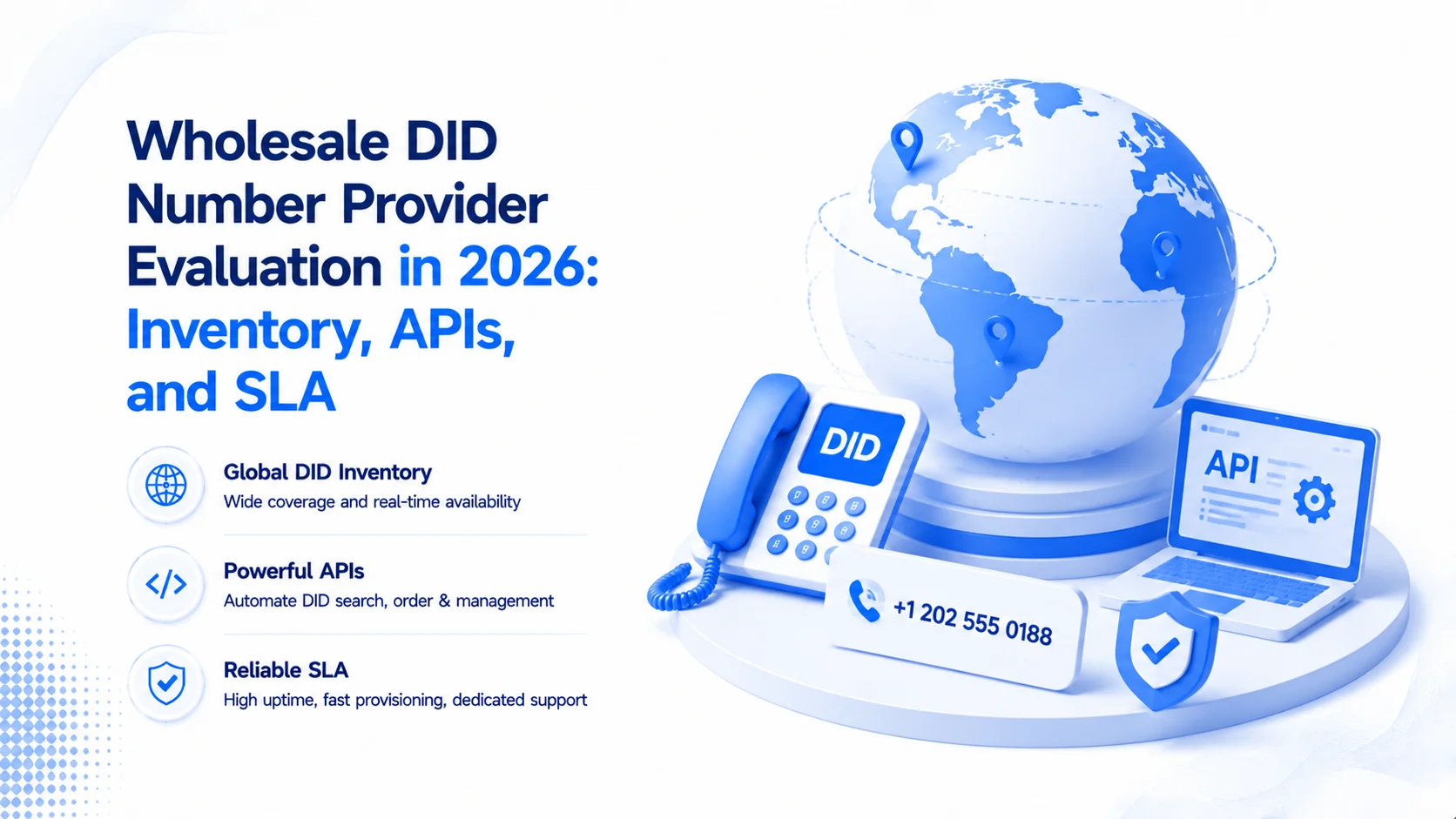
A wholesale DID number provider supplies the number inventory, APIs, porting workflow, and STIR/SHAKEN attestation that ITSPs, CPaaS platforms, and UCaaS providers build on. Choosing one comes down to coverage depth, provisioning speed, and SLA terms that protect the DID estate. This guide breaks down each factor and shows how Twiching stacks up.
Key Takeaways
- A wholesale DID number provider sources inventory through direct regulator allocations, bilateral carrier agreements, and number portability — the mix determines coverage breadth and stability.
- Country coverage and per-country inventory depth, not headline pricing, is the dominant evaluation criterion for multi-country buyers.
- Self-service provisioning via REST API and stage-by-stage porting status visibility are baseline modern provider expectations.
- A-level STIR/SHAKEN attestation on outbound caller ID using hosted DIDs is mandatory for US outbound traffic; providers without it cannot serve US contact-centre customers.
- SLA terms matter — 99.99% inbound routing uptime, 15-minute critical-incident response, and named escalation contacts protect the DID estate against routing failures.
How a Wholesale DID Number Provider Sources Inventory
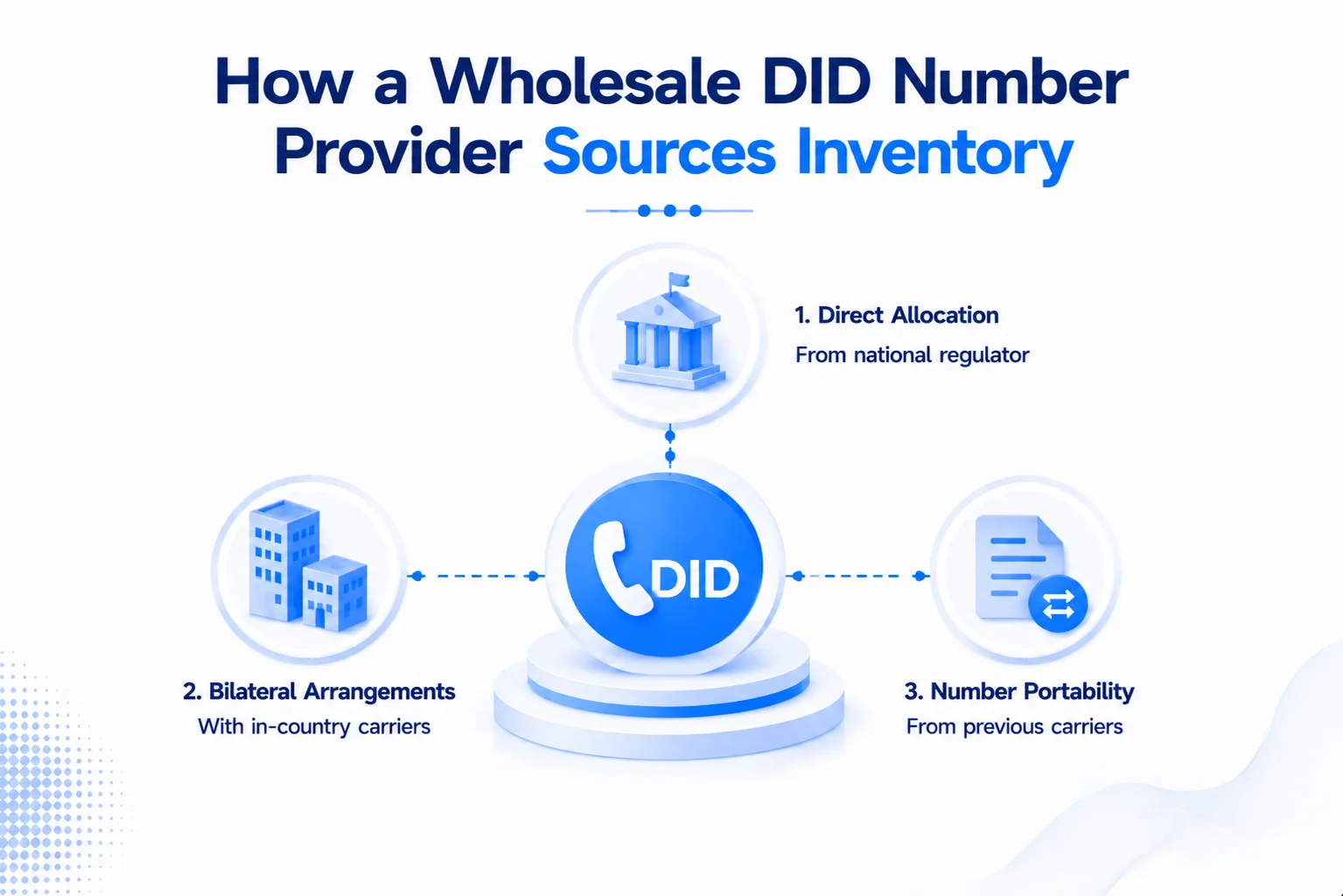
A wholesale DID number provider sources its inventory three ways. Direct allocation from the national regulator gives the provider its own number blocks.
This is better for stability, but it's only available where the provider has a regulatory presence and meets local carrier-licensing rules.
Bilateral arrangements with in-country carriers let the provider sell numbers from another carrier's allocation. This is the fastest path to coverage. But it adds upstream reliance that can affect routing and stability.
Number portability flows let the provider bring numbers in from previous carriers as customers port. This is the main source for second-time-buyer numbers in established markets.
The inventory mix matters because it shows whether the provider can keep stable service if an upstream carrier changes terms, exits the market, or is bought out.
Wholesale DID number providers built mostly on bilateral reseller arrangements face more upstream risk than providers with direct allocations.
Twiching's wholesale DID inventory mixes direct allocations in the major markets where it operates as a licensed carrier. In other markets, it uses bilateral arrangements where direct licensing doesn't make business sense.
Country Coverage and Per-Country Depth
Further reading: Wholesale pricing & rate deck
Coverage is the top factor to check for any wholesale DID number provider serving multi-country buyers. A headline number like '80+ countries' is good, but not enough. What matters underneath is depth per country.
A provider claiming Brazil coverage that only has São Paulo and Rio area codes is useful for branding. But it doesn't serve a contact centre that needs local numbers in 27 Brazilian state capitals.
Confirm depth by searching the provider's actual inventory for the area codes you need, not by reading the country list.
Coverage breadth compounds against pricing. A provider charging $0.50/month for US DIDs but with no Singapore inventory is less useful to a regional buyer.
Compare that against one charging $1.50/month per US DID with direct Singapore inventory. Build the comparison against your actual destination list, then compare on total estate cost rather than headline US per-number price.
Provisioning Speed and the API Surface
Provisioning speed is a proxy for how much of the buyer's workflow can run as software.
A modern wholesale DID number provider exposes REST APIs for two core jobs. Inventory search filters by country, area code, number type, and feature flags. Provisioning attaches a DID to a SIP trunk in a single call.
The API surface also covers routing setup — destination, time-of-day rules, failover, simultaneous-ring. It covers porting submission and status too, plus CDR retrieval and webhook delivery for inbound call events.
The same surface drives the customer portal — the portal does no more than the API exposes.
Providers without a programmable API force every task through a support ticket. That kills DID-estate operations at modern scale, for example:
- A CPaaS layer adding numbers per app
- A UCaaS platform provisioning numbers per seat
- An ITSP onboarding a new customer per week
None of these workflows can run through email.
Twiching's wholesale DID number provider platform exposes everything via REST and webhook, and the portal sits on the same API.
Porting Workflow
Further reading: Wholesale voice solutions
Porting numbers into a new wholesale DID number provider is the hardest part of switching providers, and it's where weak providers hurt customers the most.
The provider has to handle several steps behind the scenes:
- Letter of Authorisation submission
- Customer service record retrieval
- FOC (Firm Order Commitment) negotiation with the losing carrier
- The technical cutover
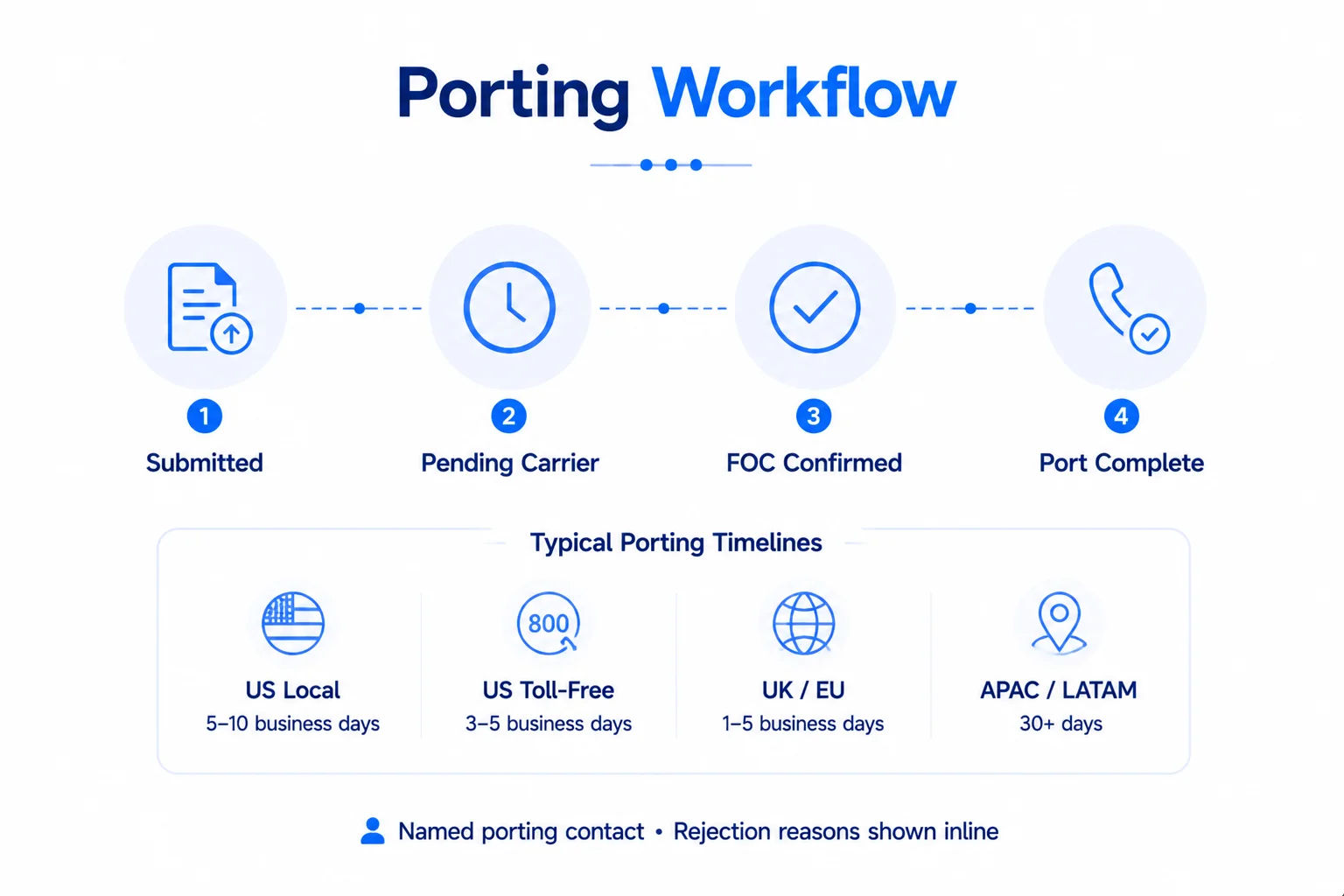
Strong providers expose porting status stage-by-stage in the portal: Submitted, Pending Carrier, FOC Confirmed, Port Complete. Each stage carries a timestamp. Rejection reasons surface inline, and a single named porting contact stays attached to each submission.
- US local number portability: 5–10 business days
- US toll-free (via the Toll-Free Number Database): 3–5 business days
- UK and many EU countries: 1–5 business days
- Several APAC and LATAM markets: 30+ days
Keep the losing carrier active until port-complete is confirmed. Twiching's wholesale DID number provider portal shows porting status stage-by-stage with named contacts and rejection-reason explanations inline.
STIR/SHAKEN Attestation Behaviour
Outbound caller ID using DIDs hosted with a wholesale DID number provider requires A-level STIR/SHAKEN attestation in the US.
A-level signing means the originating carrier confirms it knows the caller. It also confirms the caller has the right to present that number.
B- and C-level signing produce calls that get flagged 'Spam Likely' or blocked outright by US carrier spam analytics.
Confirm before signing that the provider will sign at A-level for any DID hosted with it — not just at C-level gateway attestation.
Outside the US, similar CLI-enforcement and number-presentation rules apply in the UK, the EU, and most major markets.
The pattern is similar: the provider has to own the caller-ID claim. The buyer's outbound traffic is at risk if it doesn't.
Twiching signs at A-level by default for outbound calls presenting any hosted DID.
SLA Terms That Matter
The SLA between a wholesale DID number provider and the buyer is the contract that protects the DID estate against routing failures.
The minimum terms to look for are:
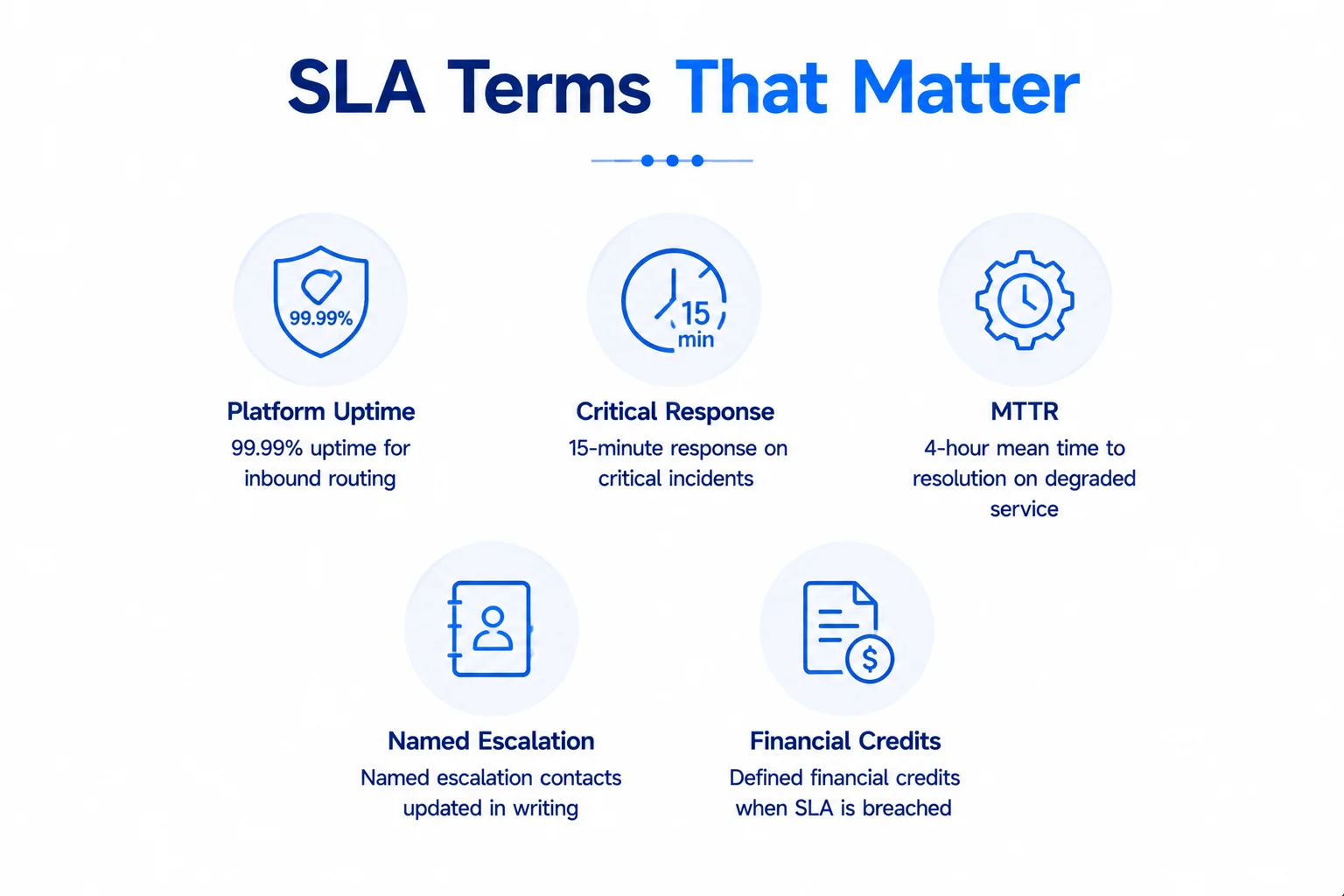
- 99.99% platform uptime for inbound routing
- 15-minute response on critical incidents (loss of inbound routing on hosted DIDs)
- Four-hour mean time to resolution on degraded service
- Named escalation contacts updated in writing
- Defined financial credits when the SLA is breached
Anything weaker leaves the buyer with no options when inbound routing goes down on a Friday afternoon.
Beyond the headline numbers, look at the small print. Does the SLA cover degraded routing or only complete outage?
Does it cover one country, one region, or the whole estate? Are there per-event credit caps that make the credits just for show?
Twiching publishes its wholesale DID number provider SLA terms in plain language: 99.99% uptime, 15-minute critical-incident response, and named escalation contacts updated in the portal. Credits scale to the affected DID-month rentals.
Provider Evaluation Checklist
Further reading: Wikipedia: Direct inward dialing
- 01Country coverage matched to your target markets with confirmed depth — search the actual inventory, don't trust the headline country count
- 02Inventory sourcing mix — direct allocations preferred for stability; bilateral resellers are acceptable but raise upstream-disruption risk
- 03REST API surface covering search, provisioning, routing configuration, porting, CDRs, and webhook delivery
- 04Stage-by-stage porting status visible in the portal with named contacts and rejection-reason surfacing
- 05A-level STIR/SHAKEN attestation on outbound caller ID using any hosted DID
- 06E.911 registration integrated for US DIDs; address-of-record service for EU jurisdictions that require it
- 07Per-number monthly rental published per country with no hidden setup, E.911, or lifecycle fees
- 0899.99% inbound uptime SLA with 15-minute critical-incident response and named escalation contacts
- 09Real-time inbound CDR streaming via webhook or Kafka for live analytics integration
- 10Bulk operations — CSV import/export, range provisioning, batched configuration changes for large estates
Twiching as a Wholesale DID Number Provider
Twiching runs as a wholesale DID number provider across 80+ countries. In markets where it holds a carrier licence, it uses direct regulator allocations. Elsewhere, it uses bilateral arrangements where direct licensing doesn't make sense.
Inventory search filters by country, area code, number type, and feature flags, through both the portal and the REST API. Provisioning attaches a DID to a SIP trunk in a single API call.
Porting status is visible stage-by-stage with named contacts and rejection-reason surfacing; A-level STIR/SHAKEN attestation signs outbound calls presenting any hosted DID by default.
E.911 registration is built in for US DIDs; address-of-record service covers EU jurisdictions that require it.
Per-number monthly rental publishes per country with no hidden setup, E.911, or lifecycle fees.
The SLA covers 99.99% inbound uptime, 15-minute critical-incident response, named escalation contacts updated in the portal, and credits scaled to affected DID-month rentals.
Inbound CDRs stream in real time via webhook or Kafka, and bulk operations (CSV import/export, range provisioning) support customers running large DID estates.
Conclusion
Checking a wholesale DID number provider is a step-by-step process. Look at the inventory sourcing mix, per-country coverage depth in the markets your customers actually need, the REST API surface, porting workflow visibility, STIR/SHAKEN attestation behaviour, and the SLA terms that protect the DID estate against routing failures. Headline pricing matters less than total estate cost across the actual coverage list, and provider differences add up at scale. Twiching's wholesale DID number provider platform covers 80+ countries with a direct-allocation-plus-bilateral inventory mix, REST API across the full lifecycle, stage-by-stage porting visibility, A-level outbound STIR/SHAKEN, and a 99.99%-uptime SLA with 15-minute critical-incident response. Run the checklist above against your current provider. Then compare total estate cost against Twiching's published wholesale DID terms, to see whether the provider behind your DID estate is still the right one.