Introduction
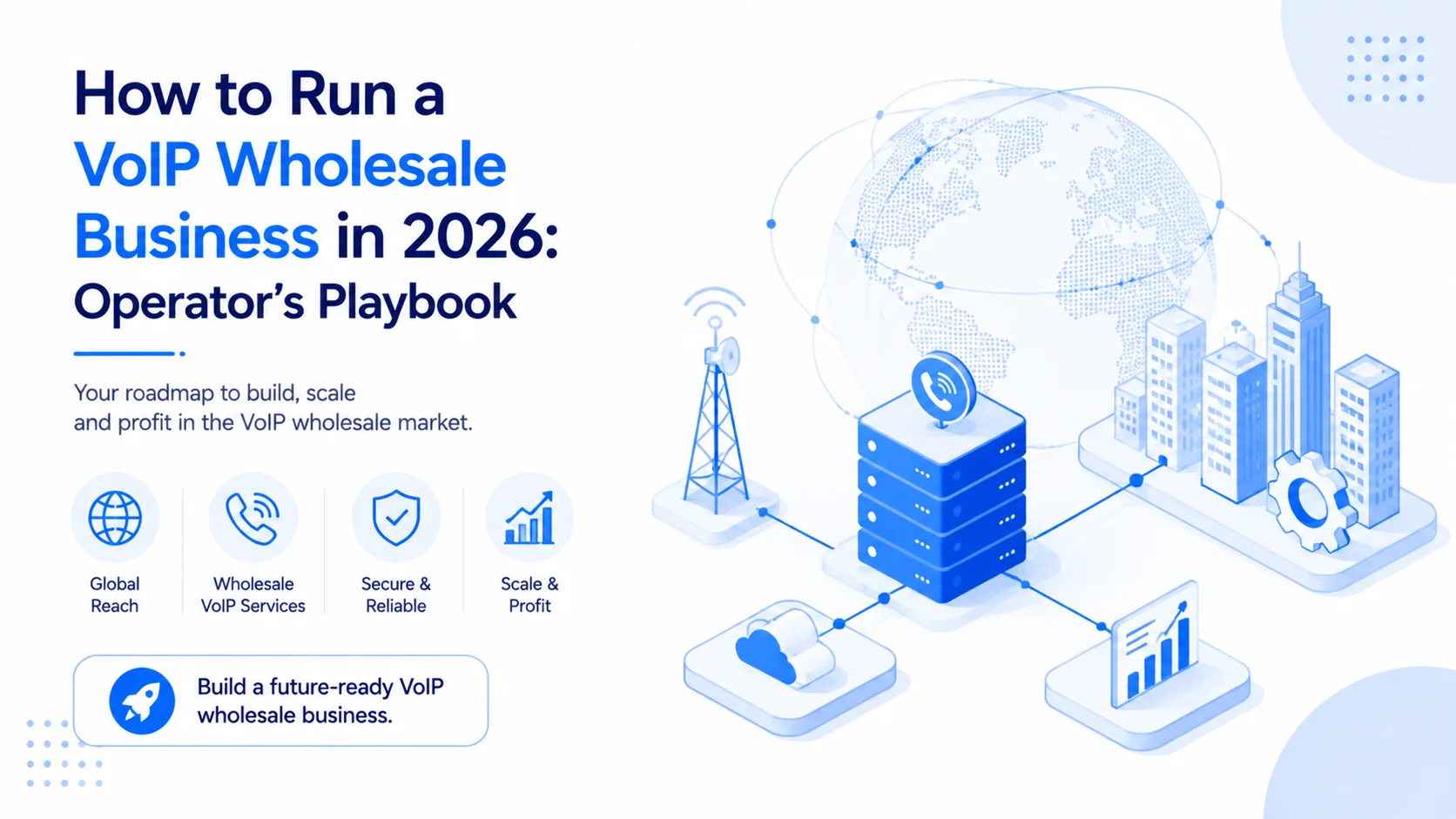
The VoIP wholesale business sells bulk voice capacity to other operators — resellers, ITSPs, and enterprises with high outbound volume. It's a carrier business with software-margin economics when run well, and a margin trap when it isn't. This guide covers how it actually works, and where the margin really lives.
What a VoIP Wholesale Business Actually Sells
A VoIP wholesale business sells bulk voice capacity. That includes outbound termination minutes, inbound DID numbers, SIP trunking, A2P SMS, and the LCR routing, CDR billing, and STIR/SHAKEN attestation that sit underneath all of it.
Customers are other operators rather than retail end users. The economics work because the VoIP wholesale business aggregates traffic across many customers, buys upstream capacity in bulk, and passes scale back as carrier-tier per-minute pricing.
The category covers a wide quality spectrum. Tier 1 operators run direct interconnects with destination carriers in every major market. Thin resellers re-price minutes purchased from someone upstream and pretend to be a carrier.
The difference shows up immediately in ASR, fraud exposure, and how a real incident gets handled at 2am. A serious VoIP wholesale business sits on the carrier side of that line, not the reseller side.
Starting a VoIP Wholesale Business: The Real Capital Requirements
Further reading: Wholesale pricing & rate deck
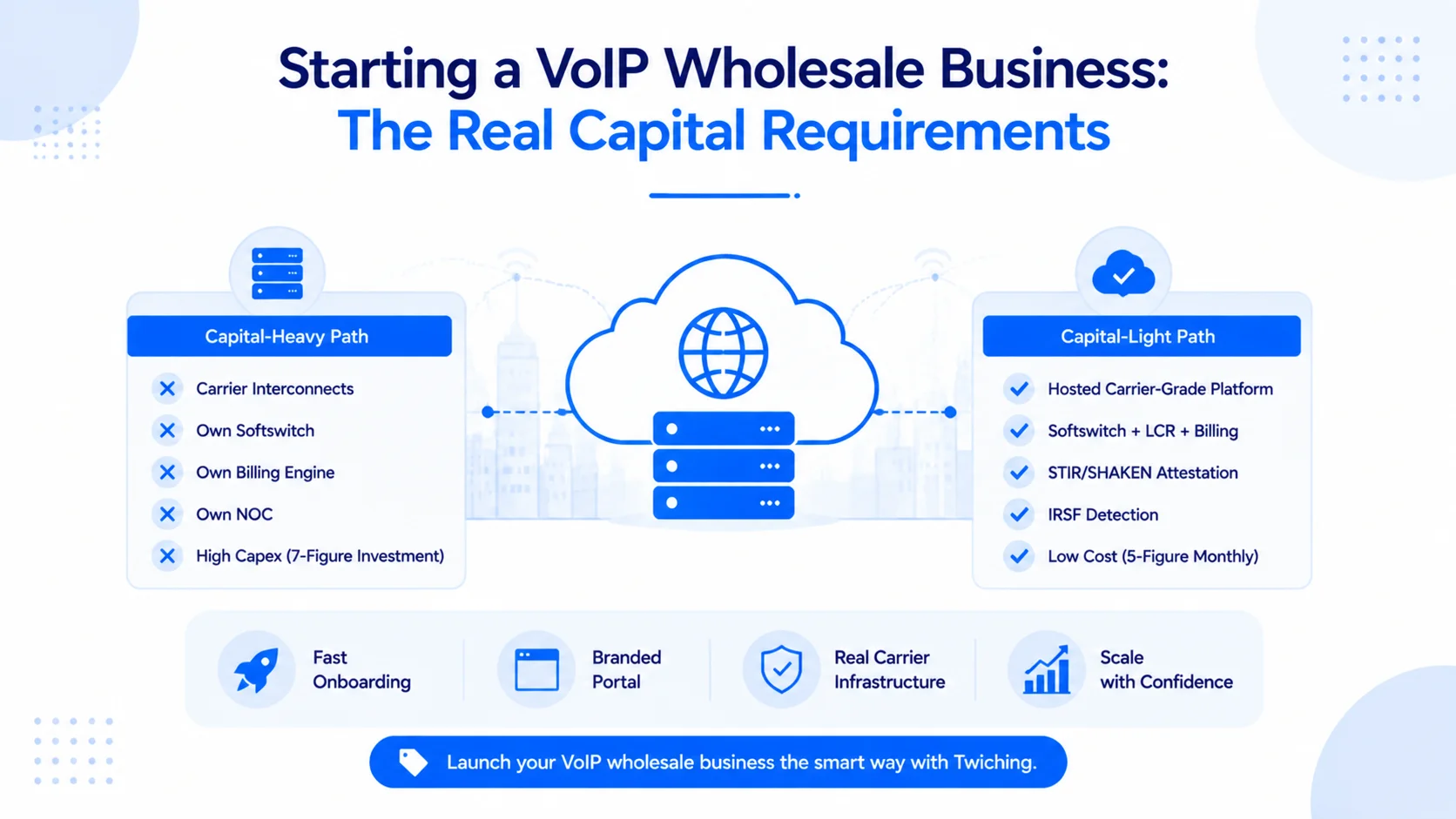
Starting a VoIP wholesale business in 2026 means one of two paths. The capital-heavy path is direct carrier interconnect agreements, your own softswitch, your own billing engine, and your own NOC.
The capital-light path is partnering with a hosted carrier-grade platform that already owns those primitives. You then layer your customer relationships and brand on top — the white-label model.
For most new entrants, the capital-light path is the right answer. Hosted softswitch, LCR, billing, STIR/SHAKEN attestation, and IRSF detection let a new VoIP wholesale business launch with five-figure monthly infrastructure cost, replacing seven-figure capex.
Twiching's white-label programme is designed exactly for that — fast onboarding, branded portal, real carrier infrastructure underneath.
Revenue Streams Inside a VoIP Wholesale Business
Pure outbound termination is the largest revenue line in most VoIP wholesale business P&Ls, and the lowest-margin. Termination gross margins typically sit between 15 and 25 percent on commodity routes. The way operators actually compound margin is by layering value-added services on the same carrier infrastructure.
- Wholesale VoIP termination — per-minute revenue, the foundation of most VoIP wholesale business P&Ls
- Monthly SIP trunk channel fees — recurring, predictable revenue
- DID number rental — local, mobile, toll-free DIDs billed monthly per number
- A2P SMS — wholesale messaging at higher margins than commodity voice
- Call recording, analytics, AI features — 40–60% gross margin add-on subscriptions
- White-label reseller programme — revenue share with downstream partners scaling distribution
- API access and CPaaS — usage-based fees on programmable voice and messaging
Margin Economics: How Big Does the Customer Base Need to Be?
Further reading: Wholesale VoIP platform
A VoIP wholesale business becomes operationally viable with roughly 5 to 10 active reseller or platform customers generating consistent monthly traffic. Below that, fixed costs — infrastructure, NOC staffing, regulatory compliance — eat any margin from the per-minute spread. Most operators need USD 10,000 to USD 30,000 per month in revenue before the business covers its own carrying cost.
The way to get there fast is concentration on a small number of higher-volume customers rather than spreading thin across many small accounts. One contact-centre platform shipping a million minutes per month is worth a hundred small SMBs in operational simplicity, even at lower per-minute margin.
IRSF Fraud: The Single Biggest Risk to Plan For
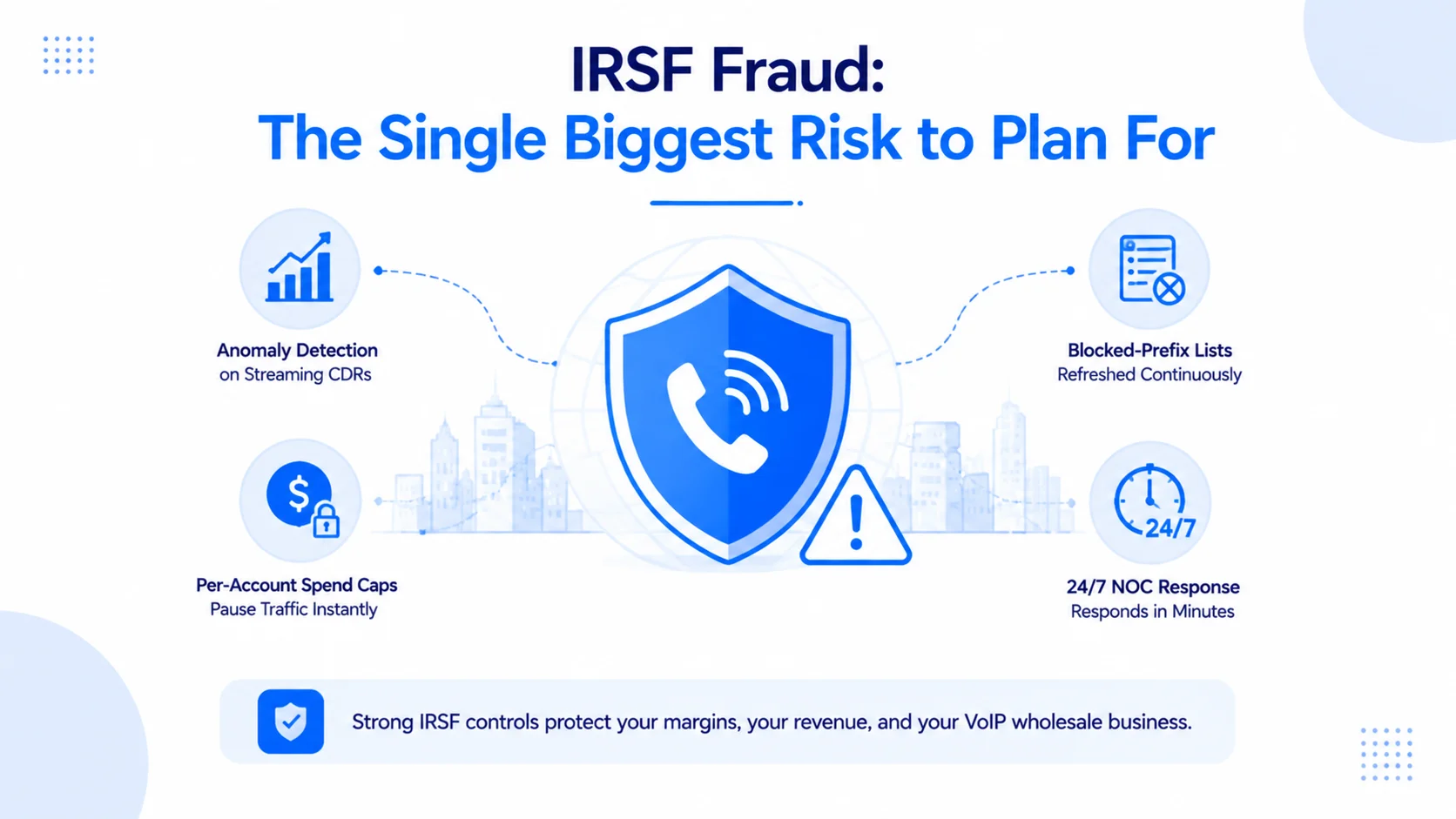
International Revenue Share Fraud (IRSF) is the existential operational risk inside every VoIP wholesale business. A compromised customer trunk can generate six-figure exposure overnight if controls are not real-time.
The carrier on the other end of the call still bills you for the minutes, regardless of whether your customer paid you for them. This is how unprepared VoIP wholesale business operators go from healthy to insolvent in a single weekend.
Serious IRSF protection inside a VoIP wholesale business means anomaly detection on streaming CDRs and hard per-account spend caps that pause traffic instantly. It also means blocked-prefix lists refreshed continuously, and a NOC that responds inside minutes. Anything weaker turns the business model into a fraud exposure hidden inside a margin spreadsheet.
Other Risks Worth Planning For
- 01Customer churn driven by quality issues — invest heavily in route-quality monitoring before scaling sales
- 02Carrier rate increases squeezing termination margin — diversify upstream and re-quote your customers quarterly
- 03Regulatory change (STIR/SHAKEN expansions, EU compliance updates) requiring compliance investment
- 04Payment default from reseller customers — credit-check new accounts and start with prepaid before opening postpaid terms
- 05Concentration risk — one large customer leaving can collapse the P&L; balance the book across multiple anchors
Competing Against Large Incumbent VoIP Wholesale Operators
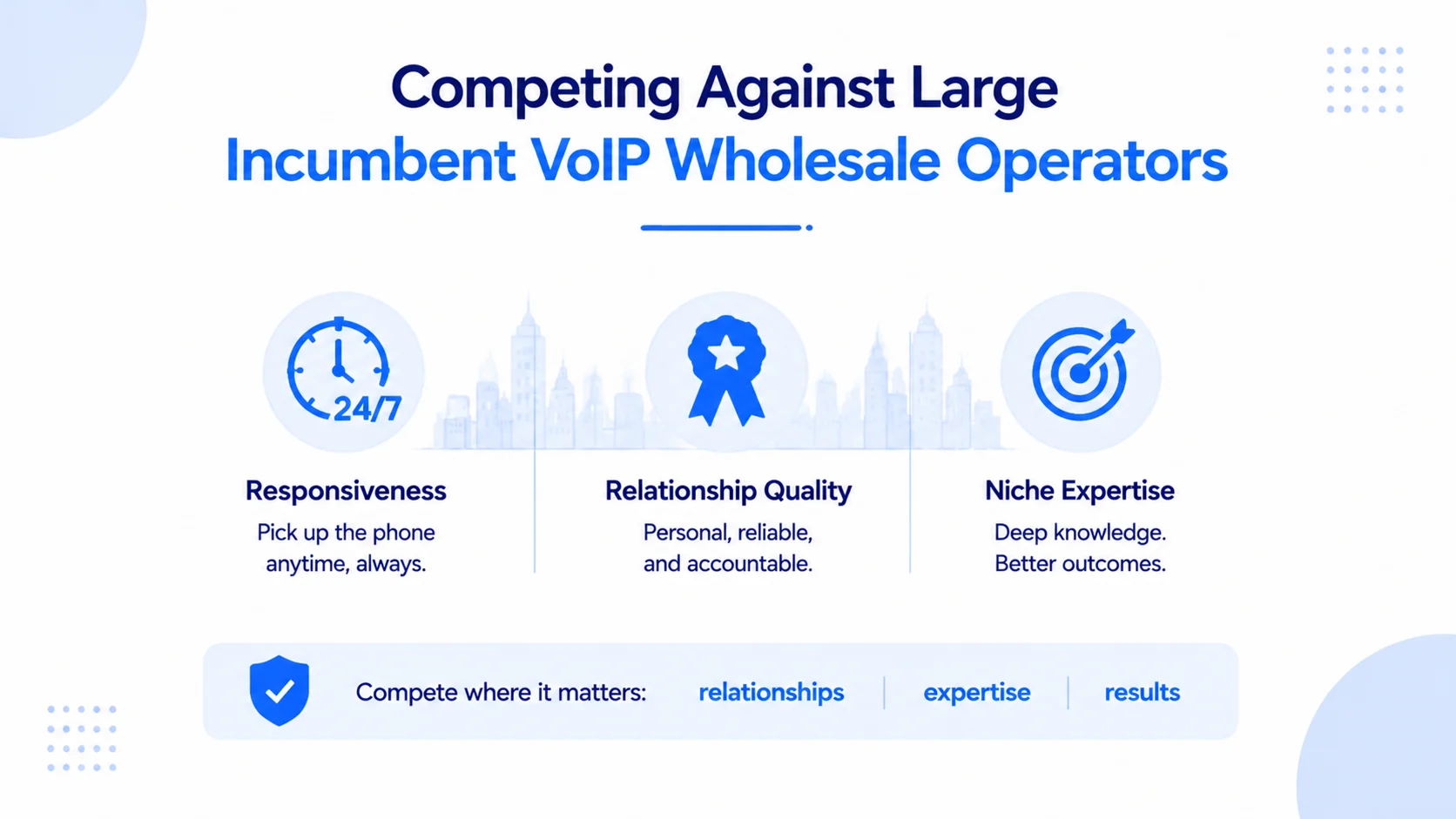
Pure price competition against Tier 1 VoIP wholesale operators is a fight you cannot win — they buy capacity at scale you cannot match. The winning strategies for a smaller VoIP wholesale business are responsiveness, niche expertise, and relationship quality. Large providers are often slow and impersonal; a smaller operator who picks up the phone at 2am beats them on every metric customers actually care about.
Vertical specialisation compounds that advantage. A VoIP wholesale business optimised for healthcare contact centres, legal-tech outbound, or financial-services dialling can defend higher per-minute rates. The customer is buying compliance, route quality, and domain understanding — not just minutes.
Scaling the VoIP Wholesale Business Through a White-Label Programme
A white-label reseller programme is the cleanest growth lever in any VoIP wholesale business. Resellers carry their own brand, sell to their own customer base, and pay you wholesale rates on the traffic they generate.
The underlying VoIP wholesale business handles carrier interconnects, billing, fraud controls, and NOC support. Distribution scales sub-linearly with operating cost — which is exactly the economics needed for the business to compound.
Fair commissions paired with fast onboarding make the programme work. Twiching's white-label programme combines competitive wholesale VoIP rates with a branded portal at signup and KYC under 48 hours. It also gives full access to the same carrier-grade VoIP wholesale business infrastructure direct customers consume.
Twiching as the Platform Underneath a VoIP Wholesale Business
Twiching is purpose-built to run as the carrier underneath someone else's VoIP wholesale business. The platform combines direct Tier 1 interconnects across 200+ countries, full STIR/SHAKEN attestation on US-bound traffic, and real-time CDRs. IRSF anomaly detection runs with hard spend caps, A2P SMS sits alongside voice, and a 24/7 NOC operates with a 15-minute critical-incident SLA.
Partners launch their own branded VoIP wholesale business in days on the same infrastructure Twiching uses internally. Onboarding completes under 48 hours, and per-destination wholesale VoIP rates publish transparently with billing increments visible on every row.
A VoIP wholesale business plan must account for the regulatory burden of operating as a telecom carrier. In the US, FCC 499-A registration is required for interstate service providers. The EU requires national authorisation in each member state where services are offered, and UK operations require Ofcom registration.
These filings take 4–12 weeks and must be renewed annually. Compliance costs — including legal counsel, regulatory filing fees, and STIR/SHAKEN implementation — should be built into your financial model from the outset.
Regulatory compliance is a non-negotiable foundation of any VoIP wholesale business. Operating without proper carrier registrations exposes you to FCC, Ofcom, or national regulator enforcement actions that can include fines and service suspension.
In the US, FCC 499-A registration is required for interstate service providers, and STIR/SHAKEN implementation is mandatory. In the EU, each member state has separate national authorisation requirements.
Build regulatory compliance review into your annual business planning cycle and engage telecoms legal counsel to track regulatory changes that affect your operations.
Pricing strategy in a VoIP wholesale business evolves as your cost structure matures. Early-stage operators often price reactively, matching competitor rates without fully understanding their own cost structure.
As you build route data and carrier relationships, develop cost-plus pricing models for each destination class, then set sell rates that achieve your target margin while remaining competitive.
Periodically review destinations where margins are compressed and either renegotiate upstream costs or rationalise them from your offering if they cannot be operated profitably.
Conclusion
A VoIP wholesale business is an infrastructure business pretending to be a software business — and the operators that treat it that way win. Carrier interconnects, route quality, LCR routing discipline, IRSF protection, regulatory compliance, and 24/7 NOC depth are the real moat. Layered on top, value-added services like analytics, recording, AI features, and a white-label reseller programme are where margin actually compounds. Twiching runs the carrier-grade infrastructure underneath that model, so partners can launch a VoIP wholesale business on competitive wholesale VoIP rates and credible carrier-grade primitives from day one — without operating the underlying carrier themselves.