Introduction
A VoIP termination service is the carrier-tier offering that delivers your outbound minutes onto the PSTN, mobile networks, and other VoIP carriers worldwide. Picking the right one shapes call quality, fraud exposure, and the rates that flow through to your P&L.
This guide covers activation, KYC, and the contract terms to demand.
What a VoIP Termination Service Actually Is
A VoIP termination service routes outbound calls from a VoIP platform to their final PSTN or mobile destination, charging per-minute for successful call delivery. It is the essential link between internet-based voice communication and the traditional telephone network.
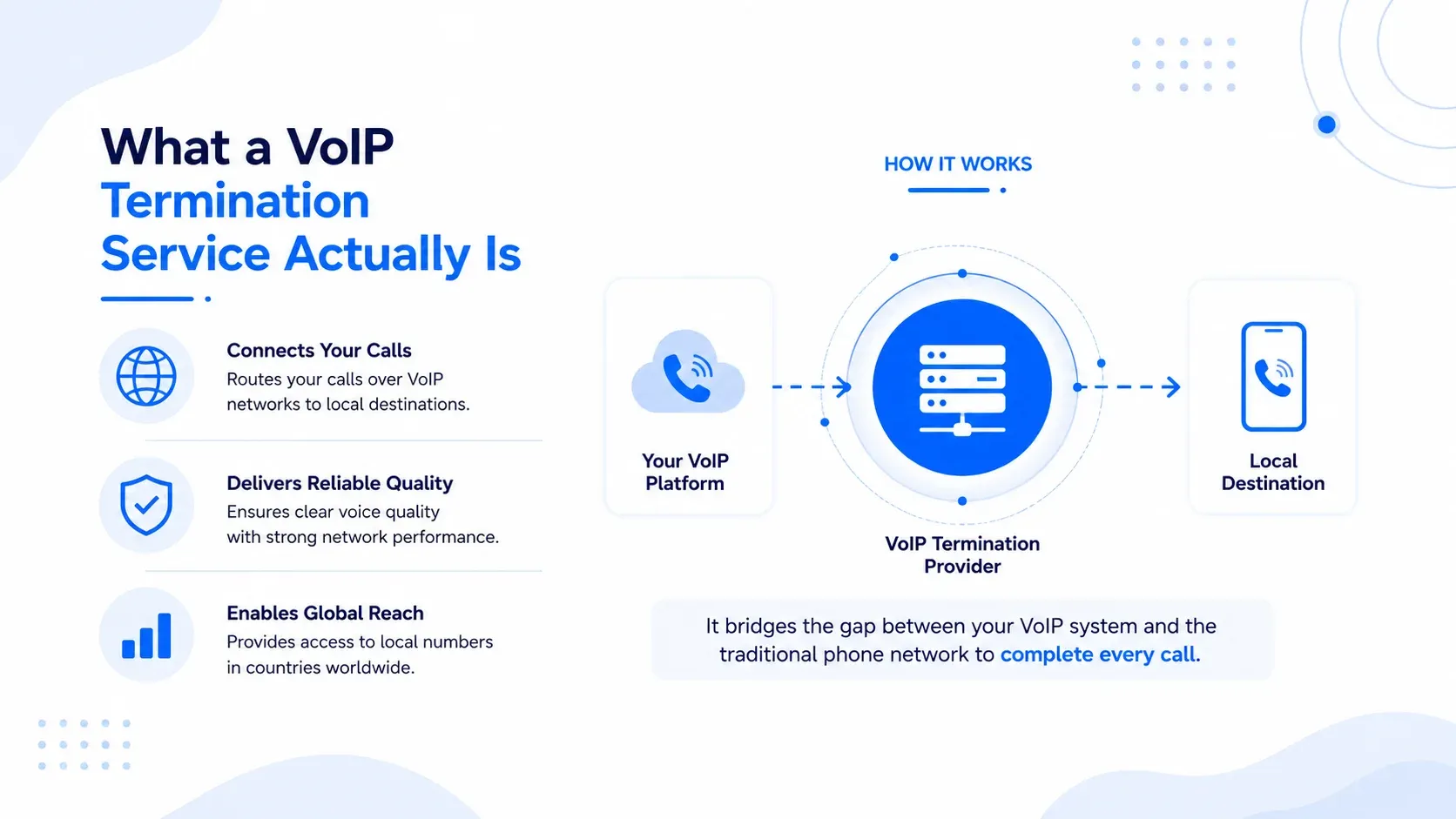
The VoIP termination service provider holds the carrier interconnects and runs the LCR routing engine. It also generates real-time CDRs, signs STIR/SHAKEN attestation for US-bound traffic, and runs the 24/7 NOC. The customer brings the SIP trunk and the traffic.
For ITSPs, contact centres, and platform companies, a VoIP termination service is what makes the unit economics of the outbound termination product line work. Direct bilateral interconnects with every destination network would take years to assemble.
A credible VoIP termination service abstracts that outbound termination footprint into a single SIP endpoint with per-minute pricing on a published rate deck.
How a VoIP Termination Service Is Activated
Further reading: Wholesale pricing & rate deck
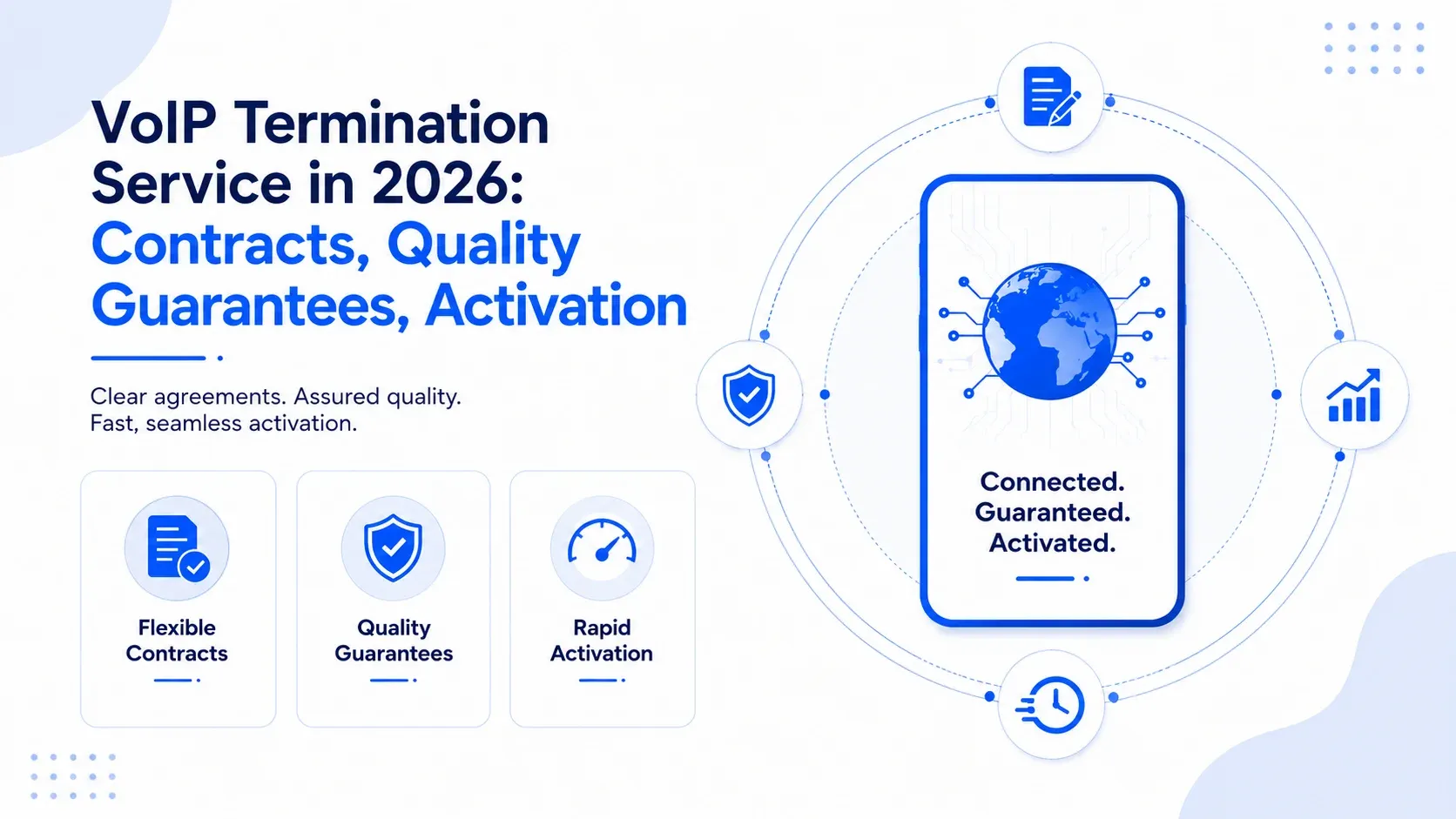
Activation of a VoIP termination service follows a predictable sequence in 2026. Account creation with KYC verification, SIP credential provisioning, and rate deck delivery come first.
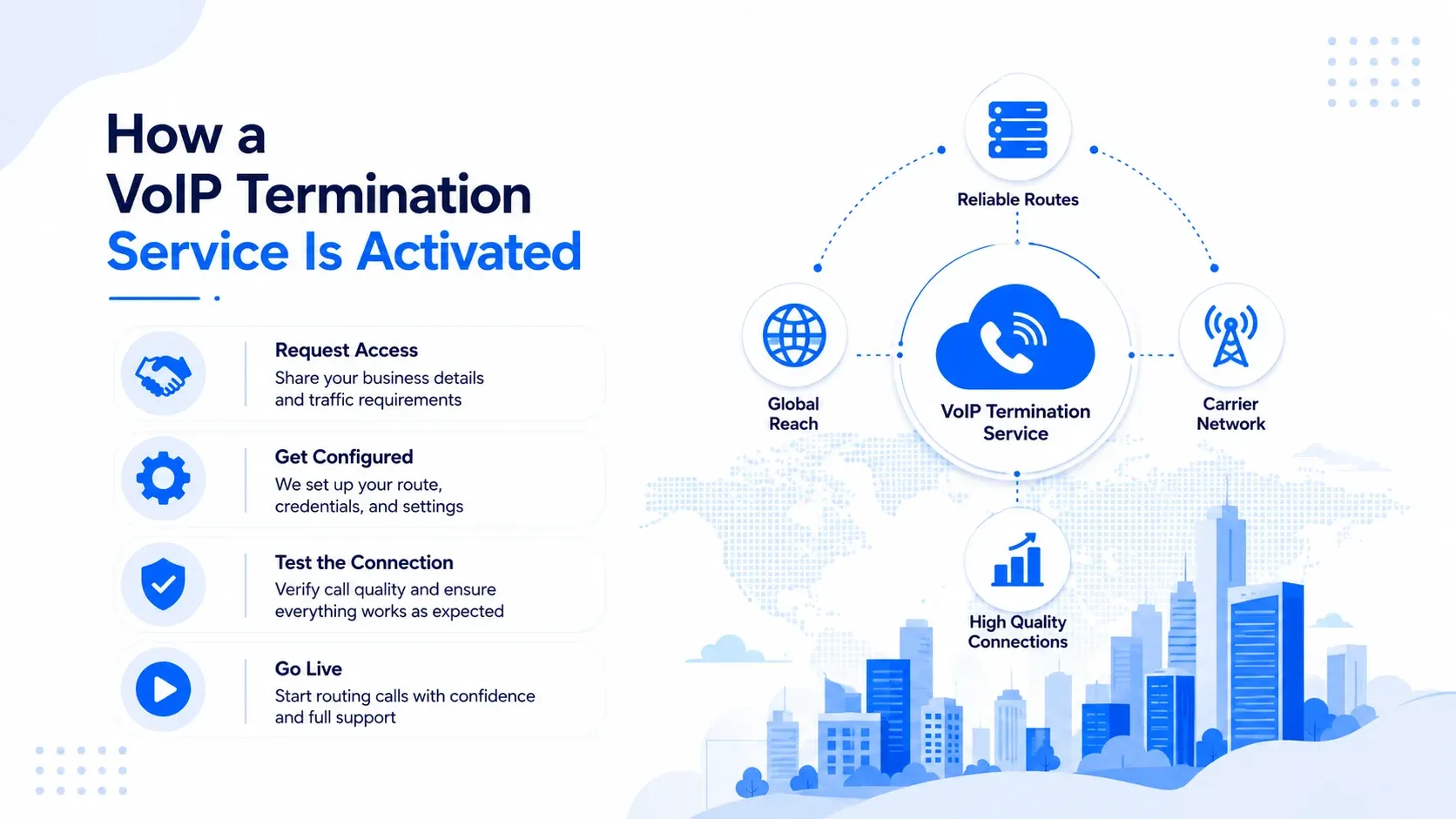
Then comes technical configuration of your PBX or platform to register to the provider's SIP proxy. A small batch of test calls verifies quality before routing live traffic.
Modern VoIP termination service providers complete KYC in under 48 hours and provision SIP trunks the same day. Real production traffic typically starts within a week of first contact for standard integrations.
Anything significantly slower indicates manual carrier interconnect operations behind the marketing copy — a tell that the operator may not be a real carrier underneath.
What Should Be in a VoIP Termination Service Contract
A VoIP termination service agreement is a commercial contract, not a marketing brochure. It should specify uptime SLA with financial remedies, ASR guarantees by destination, and billing increment. It should also cover rate change notification period (typically 30 days), fraud liability limits, data retention policy, and dispute resolution procedure.
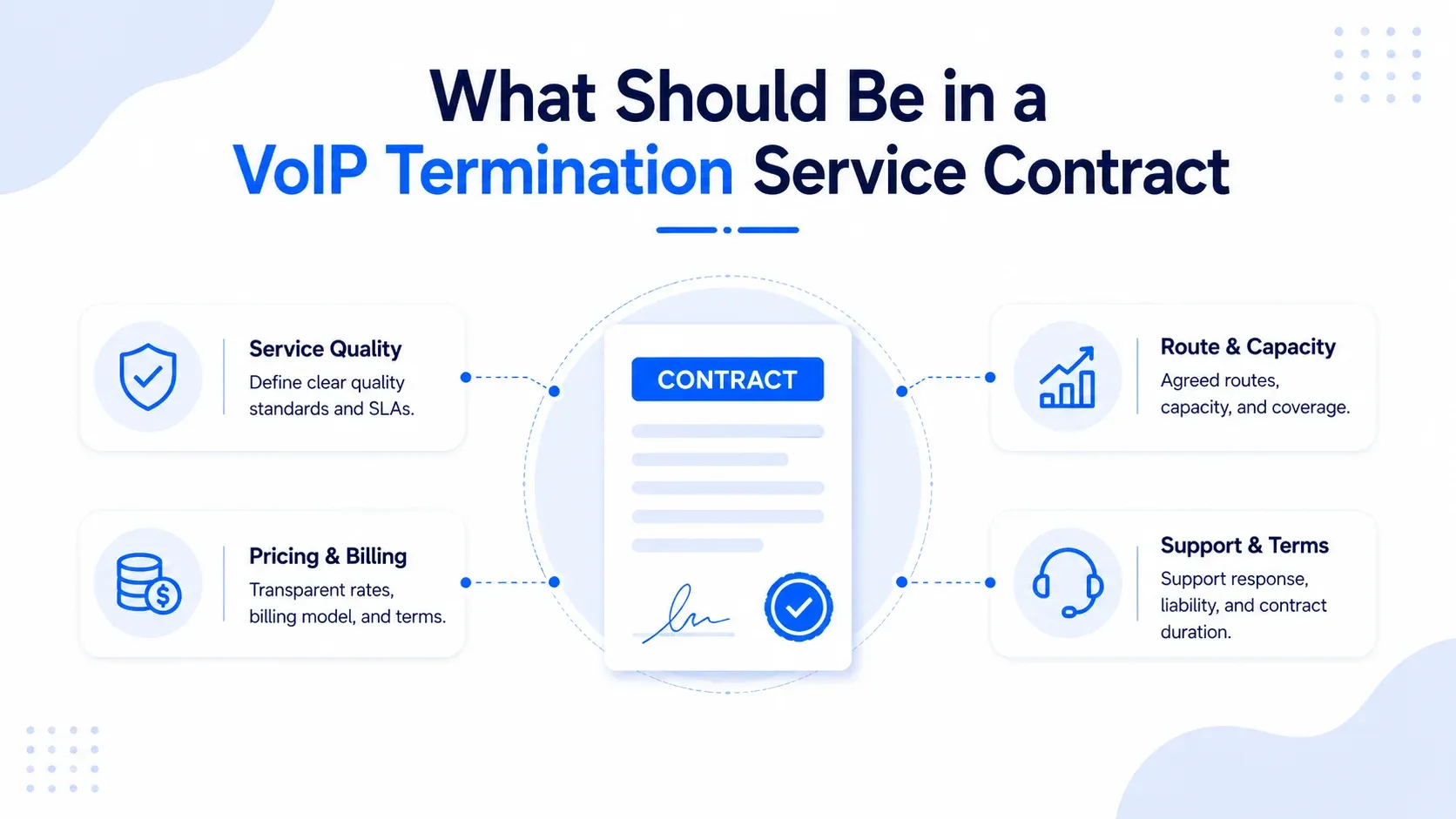
Verbal commitments that are not in writing are not enforceable, regardless of how friendly the sales call was.
- Uptime SLA — at least 99.9% with documented financial credits when missed
- ASR floors by destination — concrete minimum percentages, not aspirations
- Maximum PDD commitment — usually under 5 seconds
- Billing increment — 1/1, 6/6, or 30/6 — explicit on every rate-deck row
- Rate change notification — typically 30 days in advance, with no retroactive adjustments
- Fraud liability cap — defined customer-side exposure on IRSF incidents
- Data retention and GDPR posture — explicit on call recordings and CDR storage
Quality Guarantees: ASR, PDD, MOS
Further reading: Wholesale VoIP platform
A serious VoIP termination service publishes quality guarantees as enforceable contract terms, not aspirational marketing claims. Expect guaranteed ASR thresholds, typically 55 to 70 percent depending on destination class. Also expect maximum PDD commitments under 5 seconds and uptime SLA of at least 99.9 percent.
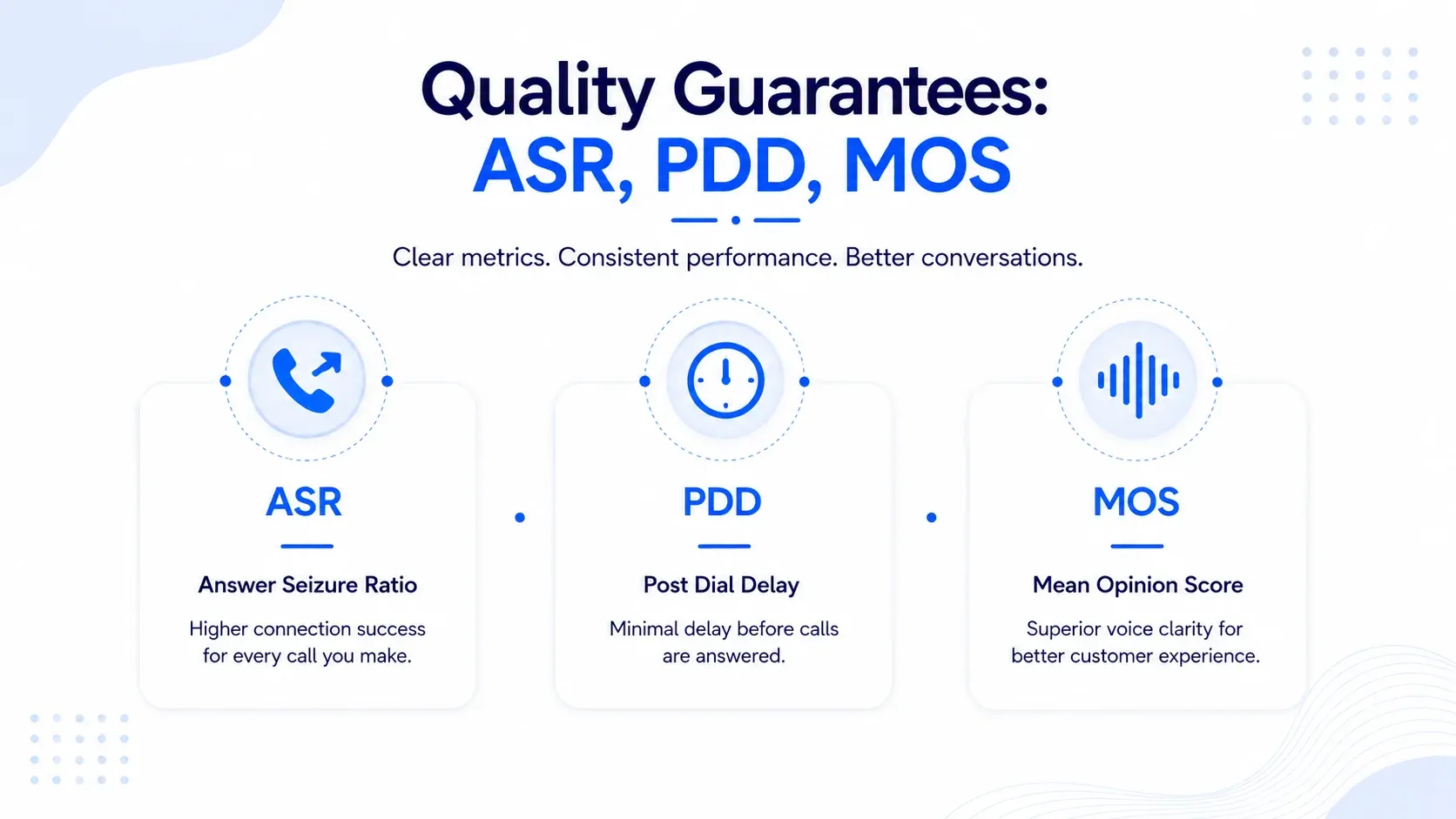
The contract should also include a defined process for quality incidents with root-cause analysis delivered inside 24 hours of any reported issue.
Beyond contract terms, the day-to-day quality of any VoIP termination service comes from continuous CDR monitoring. ASR, ACD, PDD, and MOS feed back into the LCR engine in real time, demoting underperforming upstream routes automatically until carriers remediate.
A VoIP termination service that batches quality reports weekly is operating a generation behind any modern carrier-grade peer.
STIR/SHAKEN on US-Bound VoIP Termination
For any VoIP termination service handling US-bound traffic, STIR/SHAKEN attestation has become a route-level attribute. A-attested calls get higher downstream ASR and fewer spam labels.
Unattested calls are aggressively filtered, dropping connection rates on US destinations by double-digit percentages over time. A VoIP termination service without integrated STIR/SHAKEN signing is silently costing connection rates on every US destination.
A modern VoIP termination service signs every US-bound call inline based on the customer's KYC posture. Twiching does this by default — there is no separate attestation product to buy.
The attestation level surfaces in every CDR row so customers can audit their own US compliance posture without raising a support ticket.
Toll-Free Outbound and Special Number Types
Outbound toll-free termination is a specialised offering inside any VoIP termination service. Calls to 800/888/877 numbers require the originating carrier to pay the receiving network's toll-free access charge, which makes per-minute pricing slightly higher than standard domestic termination.
Most credible VoIP termination service providers support toll-free outbound, but the rate deck row is usually listed separately so customers can see the cost difference clearly.
Special-rate destinations — premium-rate numbers, emergency services, satellite, and some Caribbean ranges — also carry distinct per-minute pricing and often distinct routing.
A serious VoIP termination service blocks the high-risk premium-rate ranges by default and requires explicit opt-in. That is how operators protect customers against IRSF blast attempts targeting expensive prefixes.
Fraud Protection Inside a VoIP Termination Service
IRSF (International Revenue Share Fraud) is the existential risk inside any VoIP termination service relationship. A compromised customer trunk can rack up six-figure exposure overnight if controls are not real-time.
Effective VoIP termination service platforms monitor spending velocity, apply hard per-account spend caps, maintain blocked-prefix lists refreshed continuously, and pause traffic the instant a pattern looks off.
Customers should expect spend caps, destination whitelists, and real-time alerts as default features in any VoIP termination service dashboard. Anything weaker turns the customer's trunk into the carrier's fraud problem, and that is the contract worth declining rather than signing.
Failover Planning for VoIP Termination Service Outages
Further reading: Wikipedia: VoIP overview
Every VoIP termination service has outages eventually. The variable is whether your platform survives one.
The right approach is a secondary VoIP termination service pre-configured for immediate failover. The LCR engine on your softswitch should be ready to redirect traffic in under five minutes. Test the failover procedure quarterly so the runbook works when you actually need it.
Twiching's customers typically run a primary + secondary VoIP termination service relationship for exactly this reason. The cost overhead is small, the operational insurance is significant, and the test cadence keeps the runbook fresh.
Choosing a VoIP Termination Service
Weight the contract and SLA items alongside the technical ones — a fast provider with a vague contract is just a fast provider you have no recourse against once something actually goes wrong.
- 01Owned carrier interconnects in your top destinations — not transit-only reseller paths
- 02Per-destination rates published with billing increments and effective dates
- 03Live ASR, ACD, PDD, MOS per destination, accessible via API
- 04STIR/SHAKEN attestation on US-bound traffic, surfaced in CDRs
- 05Contractual SLAs — 99.9% uptime, ASR floors, financial credits for breaches
- 06Fraud controls — real-time spend caps, IRSF detection, blocked-prefix lists
- 07Onboarding speed — KYC under 48 hours, production traffic within a week
- 0824/7 NOC with 15-minute critical-incident SLA and named escalation contacts
Ask to see the actual SLA document, not a summary of it, before signing — the credit structure and the definition of a qualifying incident are usually where a weak contract hides.
Twiching as a VoIP Termination Service
Twiching delivers a carrier-grade VoIP termination service across 200+ countries on direct Tier 1 interconnects.
Per-destination rates publish with billing increments and effective dates visible on every row. Full STIR/SHAKEN attestation runs on every US-bound call, and IRSF anomaly detection on streaming CDRs pauses traffic the instant a pattern looks off.
Onboarding completes in under 24 hours for standard business customers. The SLA includes ASR floors with financial credits for breaches, and a 24/7 NOC responds to critical incidents within 15 minutes.
Partners on the white-label reseller programme launch a branded VoIP termination service on Twiching's carrier-grade infrastructure under their own brand.
Activating a VoIP termination service involves more than configuring SIP credentials. The onboarding process typically includes KYC documentation submission, traffic type declaration (calling card, business telephony, call centre, etc.), test call validation, and capacity provisioning.
Allow 3–7 business days for enterprise activations, longer for regulated traffic types. Have your technical team ready to participate in a joint test call session — most carriers require this before activating live traffic.
Understanding the technical requirements for VoIP termination service activation helps you onboard faster. Most carriers require SIP connectivity from a fixed IP address or IP range — dynamic IP addresses are rarely supported in wholesale environments. They also require G.711 or G.729 codec support, proper SIP signalling with correct From and To headers, and DTMF relay using RFC 2833 (out-of-band).
Verify these requirements against your platform configuration before submitting activation documentation to avoid configuration rejections that delay your go-live.
Conclusion
A VoIP termination service is the carrier sitting underneath every outbound call your platform makes — and the variable that drives ASR, fraud exposure, and the wholesale VoIP rates flowing through your P&L. Direct carrier interconnects, transparent per-destination pricing with billing increments, real-time route quality data, STIR/SHAKEN attestation on US-bound traffic, contractual SLAs with measurable financial credits, and a 24/7 NOC with named escalation contacts are the carrier-grade non-negotiables.
Pair the primary VoIP termination service with a pre-configured secondary for failover and test the runbook quarterly. Twiching delivers all of that on one platform, so partners launch on a carrier-grade VoIP termination service from day one without operating the underlying carrier themselves.