Introduction
Quality in voip wholesale termination is a measurable engineering property, not a marketing claim. Four numbers define a route: ASR above 45 percent, MOS above 4.0, PDD under 6 seconds, and ACD above 60 seconds. This guide breaks down each metric and the contract language needed to make an SLA enforceable.
Key Takeaways
- Quality wholesale VoIP termination is defined by four measurable numbers, not a marketing claim.
- ASR above 45% on major destinations separates a real route from a degraded one.
- MOS above 4.0 and PDD under 6 seconds are the thresholds that keep calls sounding and connecting like PSTN.
- ACD above 60 seconds signals genuine human conversations rather than failed or dropped attempts.
- An enforceable SLA names these exact numbers and the remedy when a provider misses them — vague language protects the provider, not the buyer.
The Four Numbers That Define Termination Quality
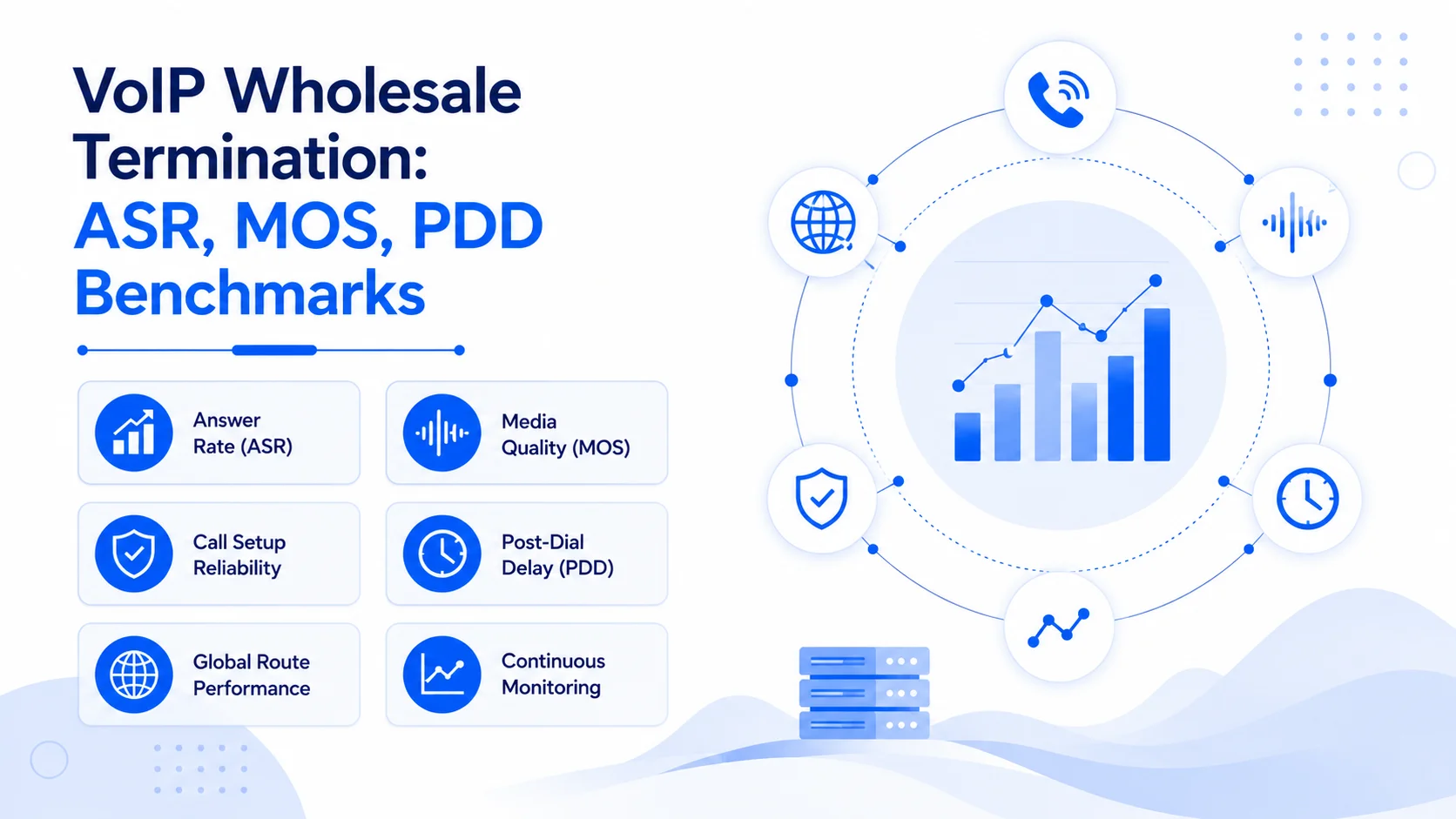
Answer-Seizure Ratio (ASR), Mean Opinion Score (MOS), Post-Dial Delay (PDD), and Average Call Duration (ACD) are the four metrics that matter. Together they separate a genuinely well-run termination route from one dressed up in sales copy.
Each metric measures a different failure mode.
- ASR catches routes that simply don't connect.
- MOS catches routes that connect but sound bad.
- PDD catches routes that are slow to set up.
- ACD catches routes where calls connect but drop before a real conversation happens.
The Floors That Matter
- ASR above 45% on major destinations — lower signals congestion, bad routing, or blocked numbers.
- MOS above 4.0 — the threshold where voice quality is indistinguishable from PSTN to most listeners.
- PDD under 6 seconds — longer feels like satellite delay and increases caller hang-ups before connection.
- ACD above 60 seconds — shorter durations, averaged across a route, usually mean calls are dropping early.
How Providers Actually Measure These Metrics
Further reading: Wholesale VoIP
Real-time CDR (Call Detail Record) streaming is what makes these numbers meaningful. A provider computing ASR and PDD from an hourly batch job is already too slow to catch degradation before it affects a full day of traffic.
MOS in production is estimated algorithmically per call, using the jitter, packet loss, and codec observed on that specific call. This is far more accurate than an occasional manual test. Twiching publishes all four metrics per route in a live dashboard so a degrading path is visible immediately, not discovered after a customer complains.
Writing an SLA That's Enforceable, Not Decorative
Further reading: Wholesale VoIP platform
Most wholesale SLAs promise "high quality" and "reliable service" without a single measurable number — language that protects the provider because it can never actually be breached.
- 01Name the exact floor for each metric — ASR, MOS, PDD, ACD — per destination tier, not as a single blended average.
- 02Specify the measurement window (real-time per-route, not monthly aggregate) and who has access to the raw data.
- 03Define the remedy for a breach — a credit, a route replacement SLA timeline, or a termination right — in writing, not as a goodwill gesture.
- 04Require a NOC response time commitment for quality incidents, with a named escalation path.
- 05Get it in the contract, not a sales deck — decks aren't enforceable, signed SLAs are.
Common Ways Termination Quality Degrades
Quality problems are rarely constant. They typically show up as one of a few common patterns.
- Intermittent congestion at specific times of day.
- A carrier partner's border gateway partially failing.
- Codec negotiation issues on specific destination networks.
- Firewall and NAT traversal problems on particular geographic paths.
This is exactly why per-route, real-time monitoring matters more than a one-time quality test. A route that looks perfect during a demo call can degrade under real peak-hour load, and only continuous measurement catches that gap.
Conclusion
Wholesale VoIP termination quality is a measurable engineering property: ASR above 45%, MOS above 4.0, PDD under 6 seconds, and ACD above 60 seconds, tracked per route in real time rather than promised in a sales deck. Twiching publishes exactly these metrics per destination and backs them with an SLA that names the floor and the remedy — so buyers can verify quality instead of taking it on faith.