Introduction
Wholesale VoIP operators are the carrier-grade companies that build the voice transport every retail VoIP brand relies on. They hold the licences, run the softswitches, staff the 24/7 NOC, and shape route quality, margin, and how fast you can launch new markets. This guide explains what serious wholesale VoIP operators do, and how Twiching runs carrier-grade wholesale voice on one global platform.
What Wholesale VoIP Operators Actually Do
Wholesale VoIP operators build and run carrier-grade networks. These networks route large volumes of voice traffic between originating and terminating carriers. They are not retail brands — they sit one layer up.
They provide the interconnect infrastructure, LCR routing intelligence, fraud controls, and billing systems. Retail providers, ITSPs, and resellers all depend on these systems. The term wholesale VoIP carrier usually means the same type of operator.
The difference matters. A true carrier-grade wholesale VoIP operator owns its softswitches, holds the licences, and signs direct interconnect deals with destination networks.
A reseller branded as one of the wholesale VoIP operators is usually buying capacity from somebody upstream. That layered margin shows up as higher wholesale VoIP rates and slower fixes.
Licences and Regulatory Posture
Further reading: Wholesale pricing & rate deck
Real wholesale VoIP operators face heavy rules. In the US, they usually hold FCC approval as an interstate carrier and state PUC filings for services within a state.
They sign STIR/SHAKEN attestation agreements, sign up for number portability database access, and keep emergency-services routing where needed.
In the EU, wholesale VoIP operators need national approval in each member state. They must also follow the European Electronic Communications Code and meet GDPR rules for call-data storage.
Across emerging markets, the picture changes again. A trusted wholesale VoIP operator tracks every per-country rule in one place. This means customers inherit the rules instead of building them from scratch.
Core Infrastructure Wholesale VoIP Operators Maintain
- Geographically redundant Class 4 softswitches with sub-millisecond LCR routing decisions
- SIP proxy farms tuned for millions of concurrent calls
- Real-time CDR engines feeding billing, fraud detection, and quality analytics
- Multi-gigabit carrier interconnect capacity at major financial and contact-centre hubs
- DDoS mitigation, IRSF detection, and STIR/SHAKEN attestation built into the call path
- 24/7 NOC staffing across multiple time zones with named escalation paths
This is the setup that separates Tier 1 wholesale VoIP operators from a software shop reselling someone else's network.
Each part took years of engineering work and money to build. That is exactly why most ITSPs partner with a wholesale VoIP operator instead of building from scratch.
How Wholesale VoIP Operators Interconnect with Mobile Carriers
Further reading: Wholesale VoIP platform
Mobile interconnection is where wholesale VoIP operators earn their margin. Each mobile network operator in each country needs its own direct agreement. These agreements set agreed termination rates and quality SLAs.
Some markets control the termination rate; almost all still need direct deals with the actual MNO.
Direct mobile interconnects deliver clearly better ASR and lower latency than indirect routing through a transit carrier. That is why trusted wholesale VoIP operators publish the list of direct MNO ties they hold per market.
This is also why a reseller branded as one of the wholesale VoIP operators cannot match the same call quality on mobile destinations.
How Wholesale VoIP Operators Differentiate
Pure price fights between wholesale VoIP operators are a race to the bottom. The strongest operators compete on route quality, lower PDD, and smarter fraud protection.
They also compete on fast carrier-grade support and extra services such as AI-driven traffic analytics, real-time spend caps, and white-label VoIP reseller portals.
For buyers, this is the lens that matters. A wholesale VoIP operator that offers low rates but no clear ASR data per destination is selling cost, not quality.
A trusted Tier 1 wholesale VoIP carrier publishes live route quality, named upstream ties, and STIR/SHAKEN status alongside every rate quote.
Wholesale VoIP Operators and SIP Trunking
Most wholesale VoIP operators package outbound wholesale voice termination, SIP trunking, and inbound DID provisioning together. SIP trunking is the entry door for enterprise customers. Wholesale VoIP termination supplies the bulk-minute volume, and DID ranges round out the inbound side.
The biggest wholesale VoIP operators expose all three on a single billing engine and dashboard.
Bundling SIP trunking with wholesale VoIP solutions also unlocks higher-margin enterprise deals. Buyers prefer one provider for PRI replacement, outbound termination, and inbound number management. This keeps buying simple and keeps billing matched across the wholesale VoIP carrier tie.
Fraud Controls Wholesale VoIP Operators Run
IRSF (International Revenue Share Fraud) is the biggest threat to any wholesale VoIP operator. A hacked customer trunk can rack up six-figure losses overnight if the operator's controls are not real-time.
Modern wholesale VoIP operators run anomaly detection on streaming CDRs and enforce destination whitelists. They also apply hard spend caps that stop traffic fast, and block known IRSF prefixes ahead of time.
STIR/SHAKEN attestation adds another layer for US-bound traffic. Digitally signed caller ID makes spoofing harder and improves ASR on networks that favor A-attested calls.
Wholesale VoIP operators that have not set up STIR/SHAKEN are quietly costing their customers both connection rates and downstream-carrier standing.
How to Evaluate Wholesale VoIP Operators
- 01Licensing — FCC, EU national authorisations, and per-country regulatory compliance.
- 02Infrastructure — owned softswitches, direct interconnects, and named Tier 1 relationships.
- 03Route quality — live ASR, ACD, and PDD per destination, exposed via API.
- 04Mobile coverage — direct MNO interconnects in target markets, not transit routing.
- 05STIR/SHAKEN — full attestation on US-bound wholesale voice termination.
- 06Fraud posture — real-time CDR streaming, IRSF detection, and instant spend caps.
- 07Support depth — 24/7 NOC with 15-minute critical-incident SLA.
How Twiching Operates as a Wholesale VoIP Operator
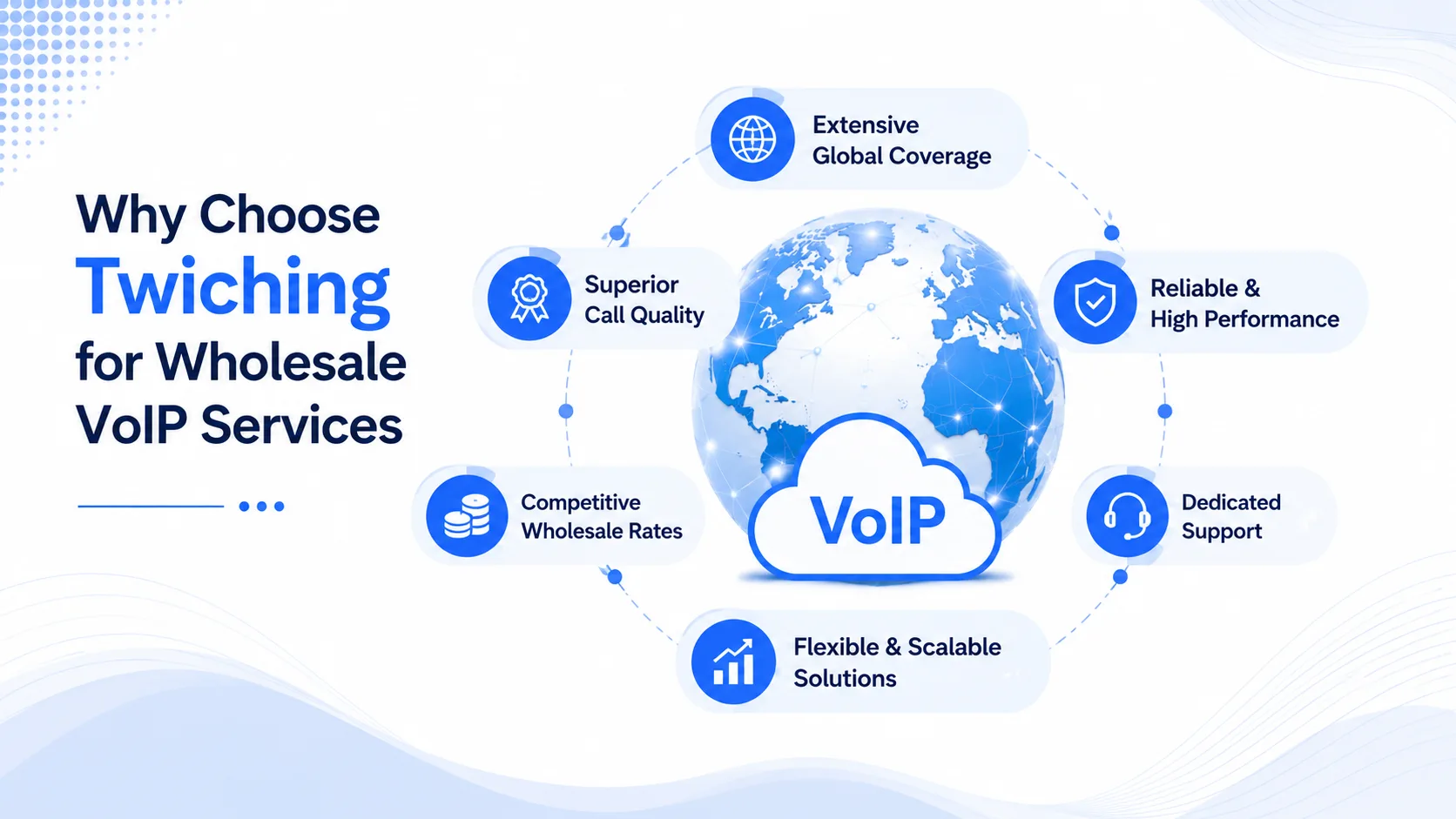
Twiching is built as a carrier-grade wholesale VoIP operator for ITSPs, resellers, contact-centre platforms, and enterprises with high-volume outbound.
The platform combines several core features:
- Geographically redundant Class 4 softswitches
- Direct Tier 1 interconnects across 200+ countries
- Full STIR/SHAKEN attestation
- A 24/7 NOC that responds to critical incidents within 15 minutes
Customers see live route quality, real-time CDRs, and spend caps in the same dashboard — the basic tools every serious wholesale VoIP operator needs to deliver.
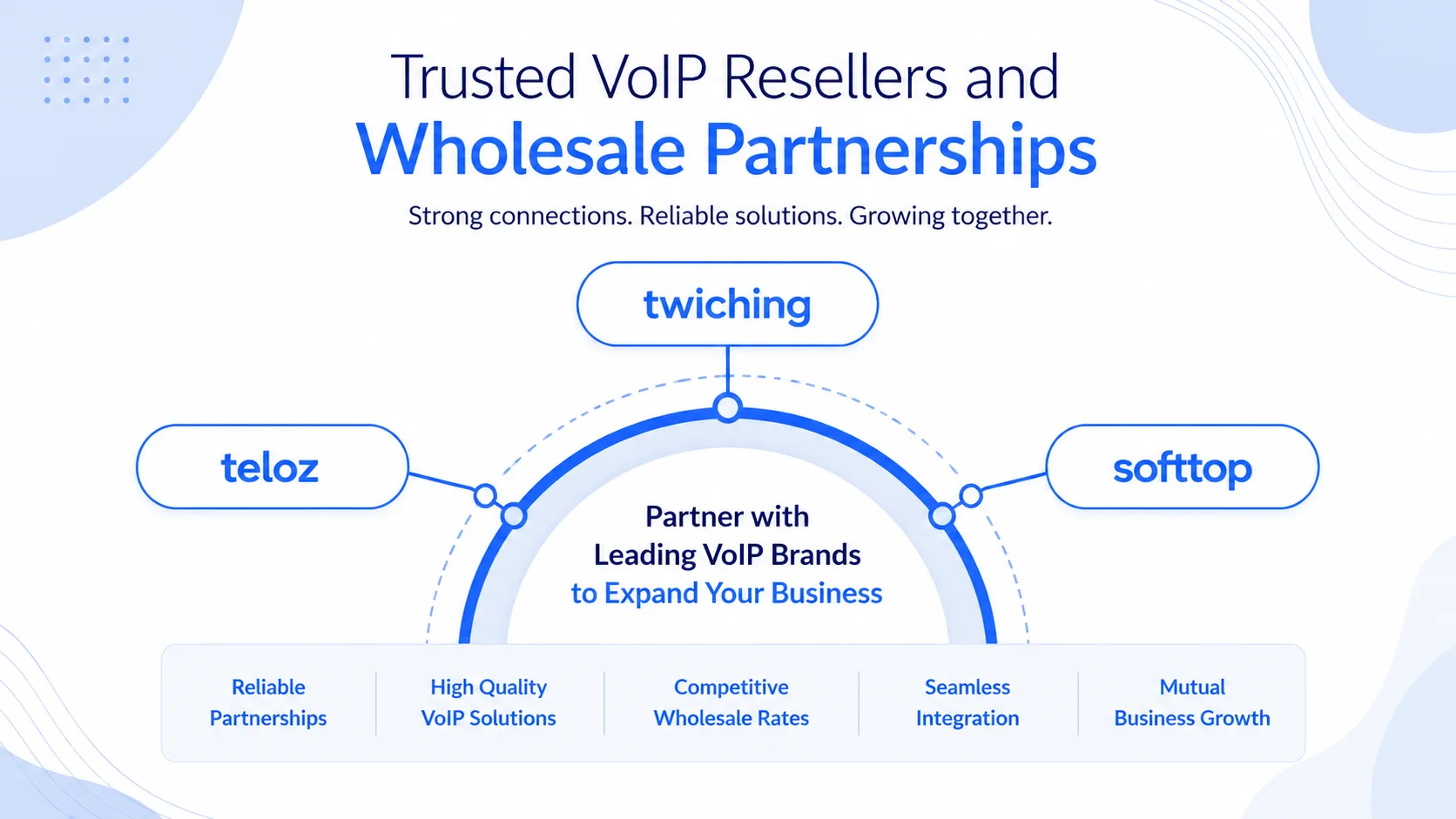
The wholesale VoIP platform also offers a white-label VoIP reseller programme. Partners can launch under their own brand on Twiching's wholesale VoIP carrier infrastructure. This puts them in a small set of trusted wholesale VoIP carriers with full wholesale VoIP solutions behind their go-to-market.
What Separates Wholesale VoIP Operators
Wholesale VoIP operators stand apart in three areas: route coverage, platform features, and financial stability.
Route coverage means direct interconnects with Tier 1 carriers in key markets, not just bundled routes bought from other wholesalers.
Platform features include self-service portals, real-time CDR access, and API connections.
Financial stability matters too. Look for years in business, credit references, and clear ownership as proof.
Switching wholesale operators is hard. A provider that shuts down or weakens service leaves your customers hurt.
Serving Enterprise Customers
Wholesale VoIP operators serving enterprise customers face different needs than those serving ITSPs and resellers. Enterprises need SLAs with money penalties and an assigned account manager.
They also need to follow GDPR and industry-specific rules, plus connect with current UC platforms like Microsoft Teams, Cisco Webex, and Zoom Phone.
Direct Routing for Microsoft Teams routes PSTN calls through an approved SBC to Teams users. Operators that offer it can reach a fast-growing enterprise group. That group brings big per-seat income above basic VoIP termination margins.
Negotiating Interconnect Agreements
Interconnect agreements between wholesale VoIP operators need careful talks. Key terms include liability caps, payback clauses, and ways to settle disputes. When quality drops and customers complain, it can be hard to tell which operator is at fault.
Interconnect agreements should clearly define three things:
- Which party is responsible for quality SLAs
- What monitoring data is authoritative for SLA measurement
- What the claims process looks like
Industry-standard interconnect agreements from GSMA, or two-way templates from carriers' legal teams, are good starting points for talks.
Documenting Carrier Relationships
Operators should write down their interconnect setup in a formal network layout register. This makes vendor management, incident escalation, and legal audits much easier.
Keep updated records of every carrier tie, including contact details, contract expiry dates, and unpaid SLA credits.
Keep this register centralised, and include:
- IP addresses and SIP profiles
- Contract expiry dates
- Escalation contacts
This cuts the day-to-day risk from staff turnover and speeds up incident response.
Conclusion
Wholesale VoIP operators are infrastructure businesses, not just software products — and the credible ones know it. Licences, owned softswitches, direct Tier 1 interconnects, mobile MNO ties, STIR/SHAKEN attestation, and a real 24/7 NOC are the must-haves. These are what separate Tier 1 wholesale VoIP operators from thin resellers. Twiching is built on this base, so ITSPs, resellers, and enterprises can launch on a carrier-grade wholesale VoIP carrier without running the infrastructure themselves.