Introduction
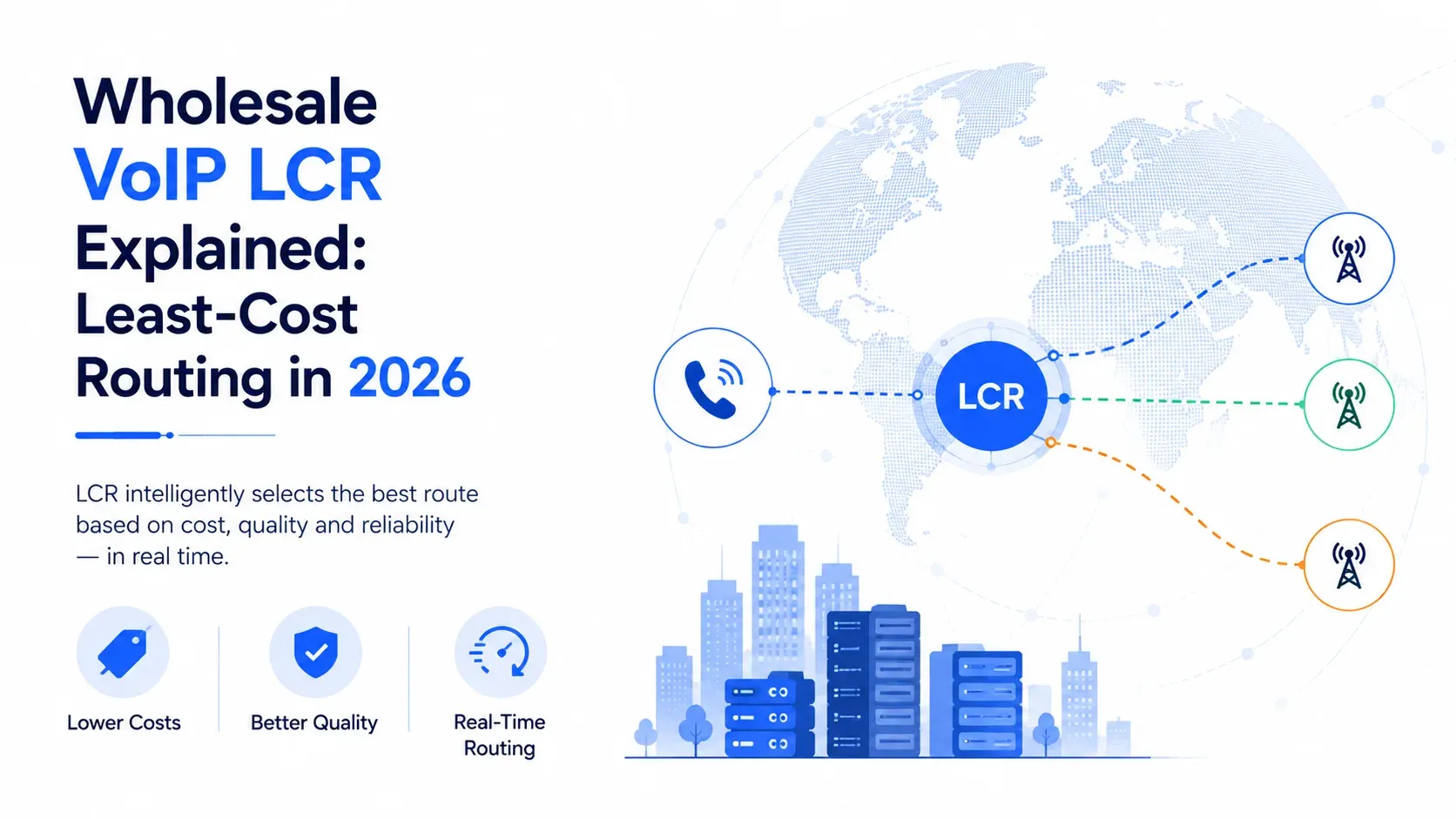
Wholesale VoIP LCR — least-cost routing — is the algorithm at the centre of every carrier-grade wholesale VoIP network. For each call, the LCR engine consults rate decks across upstream carriers, applies quality floors, and selects the cheapest path that still meets ASR and MOS thresholds.
This guide explains how LCR routing actually works and how Twiching delivers wholesale VoIP LCR routes on a carrier-grade platform.
What Wholesale VoIP LCR Actually Is
Wholesale VoIP LCR (least-cost routing) is the automated process of selecting the cheapest available carrier path for each call while still meeting a defined quality threshold. The LCR engine sits inside the softswitch and consults rate decks from every upstream carrier the operator buys from.
It picks the lowest-cost path that passes quality filters for the specific destination. The buyer sees a single SIP endpoint; the LCR routing engine does the work invisibly.
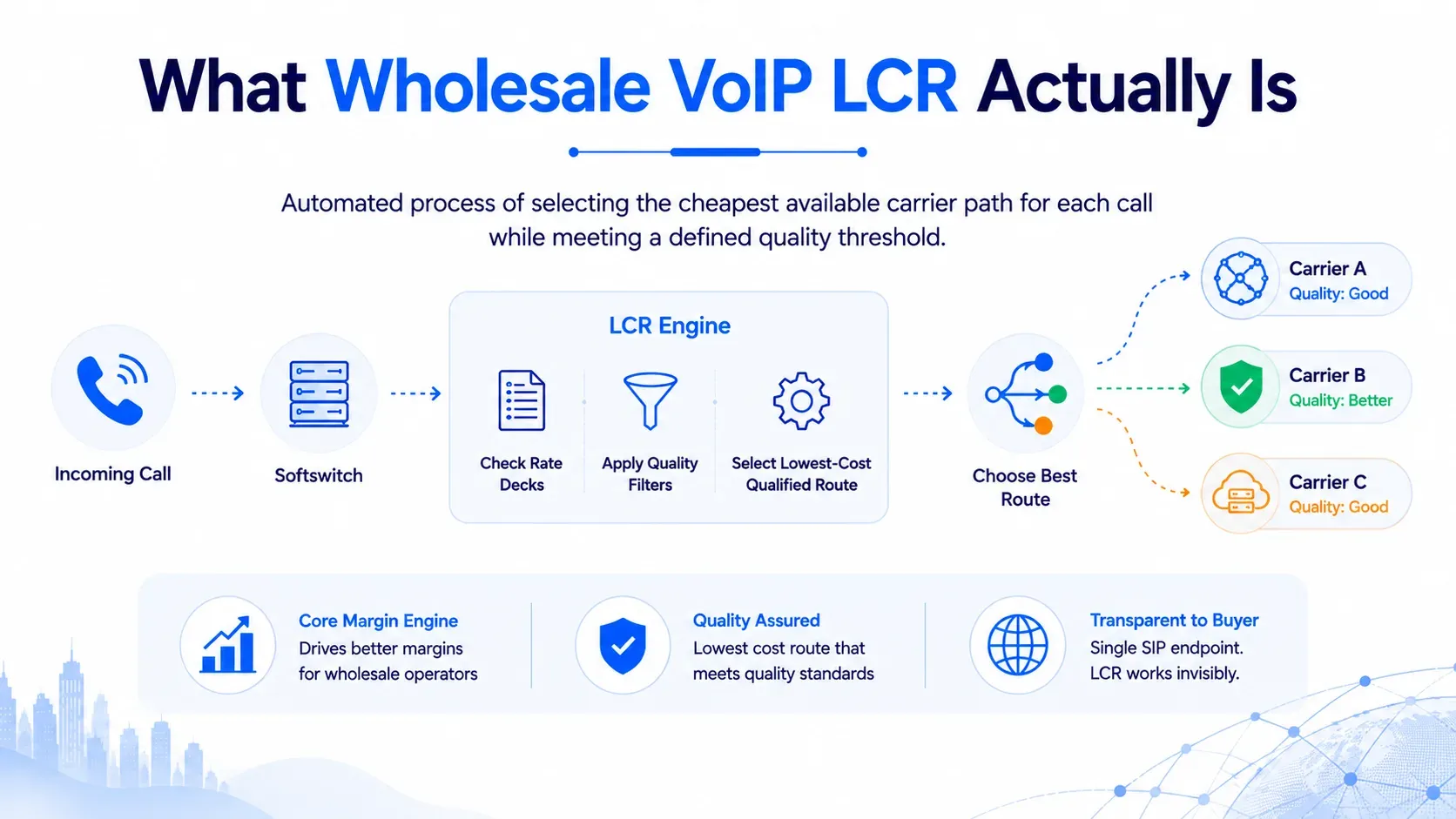
For a wholesale VoIP LCR provider, this is the core margin engine. Two operators with identical upstream contracts and identical wholesale VoIP rates can deliver completely different P&L outcomes — purely because of how disciplined the LCR routing is. Wholesale VoIP LCR done well is the difference between a healthy gross margin and a quietly bleeding network.
How a Wholesale VoIP LCR Engine Works
Further reading: Wholesale pricing & rate deck
Inside the softswitch, every inbound SIP INVITE triggers the wholesale VoIP LCR pipeline. The engine extracts the destination prefix and pulls the rate deck for every available upstream carrier.
It filters by minimum ASR and MOS quality floors, sorts what remains by per-minute price, and dispatches the call on the cheapest qualifying route. If that route refuses the call or fails setup, LCR routing fails over to the next-best path automatically.
Modern wholesale VoIP LCR engines run these decisions in well under a millisecond per call, even across thousands of concurrent attempts. The intelligence is not just speed.
It is the live feed of CDR data that updates quality scores per route per destination. The LCR engine learns which carriers degrade at peak hours and pre-emptively reroutes.
Rate Decks: The Input to Wholesale VoIP LCR
A rate deck is a destination-by-destination per-minute price list from a single upstream carrier. Every wholesale VoIP LCR system holds one rate deck per carrier, refreshes them whenever the carrier publishes updates, and ranks them on each call. Stale rate decks are how operators end up sending traffic at outdated pricing — and quietly losing margin to the carrier on the other end.
Automated rate-deck import via API or scheduled email parser is now standard for any serious wholesale VoIP LCR provider. Manual rate-deck management is fine for ten destinations; for thousands across A-Z termination, it is an inevitable source of error. Twiching ingests rate decks automatically and surfaces changes in the LCR routing dashboard before they reach production traffic.
Quality Floors and ASR / MOS Filters
Further reading: Wholesale VoIP platform
Pure cheapest-route routing is dangerous. Some carriers offer aggressive wholesale VoIP rates on poor-quality routes — and a wholesale VoIP LCR engine that ignores quality will happily send traffic onto them.
The result is collapsing ASR, customer complaints, and eventually churn. Quality floors are the safety rail.
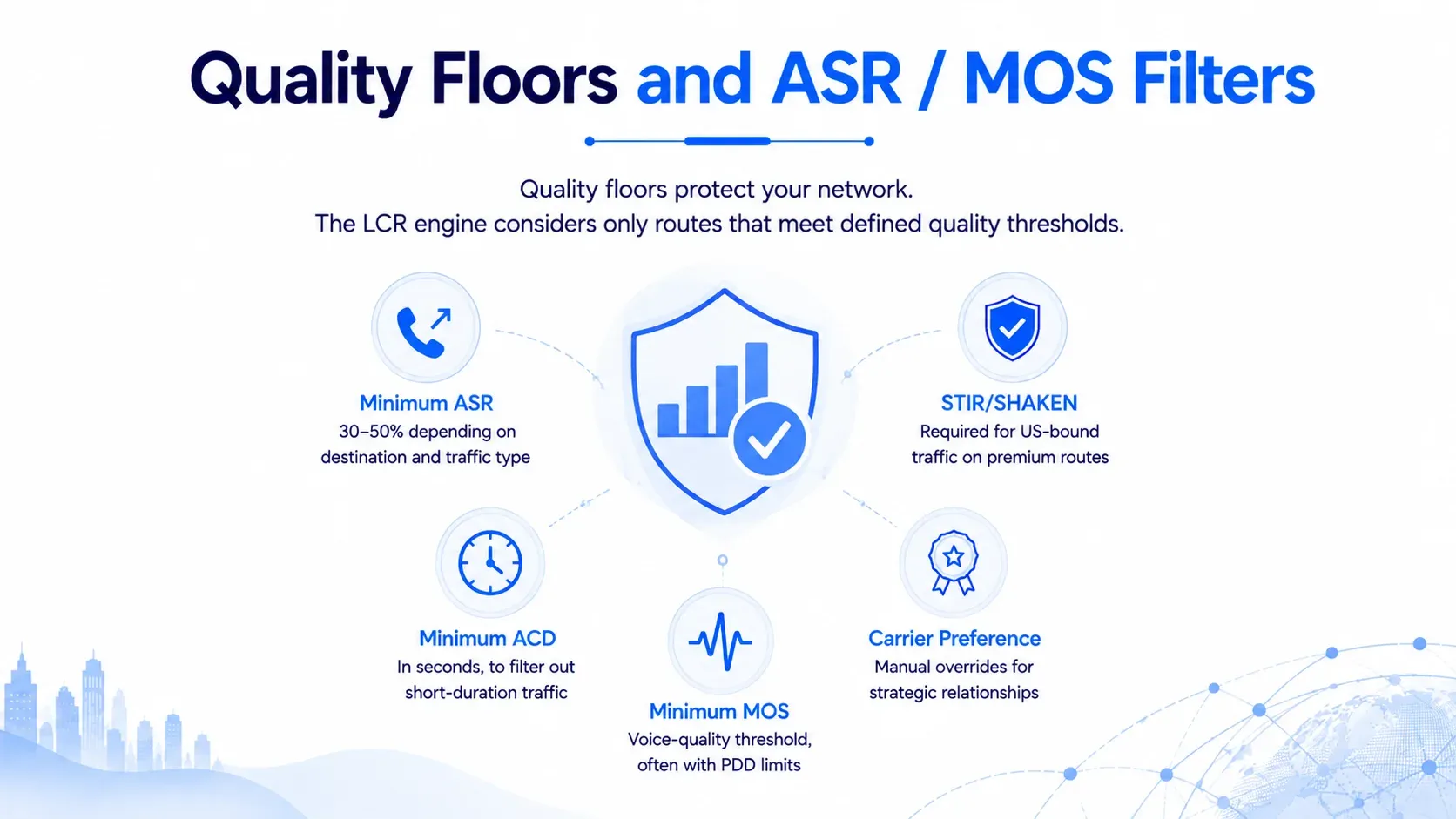
Most wholesale VoIP LCR systems support per-destination minimum ASR (answer-seizure ratio), ACD (average call duration), and MOS (mean opinion score) thresholds. Routes failing the floor drop out of the cost comparison entirely, regardless of price. The wholesale VoIP LCR engine then selects the cheapest qualifying route — not simply the cheapest route.
- Minimum ASR — typically 30 to 50 percent depending on destination and traffic type
- Minimum ACD — usually expressed in seconds, to filter out short-duration abusive traffic
- Minimum MOS — voice-quality threshold, often combined with PDD limits
- STIR/SHAKEN attestation level — required for US-bound traffic on premium routes
- Carrier preference weight — manual overrides for strategic upstream relationships
Failover Logic Inside Wholesale VoIP LCR
Routes fail. Carriers go down, interconnects saturate, and individual calls run into temporary glitches. Wholesale VoIP LCR systems handle this with two failover models: sequential and parallel.
Sequential tries the cheapest qualifying route first, then the second, then the third — useful when concurrent invitations would confuse downstream carriers. Parallel forks the call to multiple routes simultaneously and accepts the first answer.
Setup failures are recoverable inside the LCR routing engine; mid-call drops are not. That is why the cheapest qualifying route still has to clear the ASR and MOS floor.
Consider a route that connects 95% of the time but drops 30% of in-progress calls. No wholesale VoIP LCR system should route to it, regardless of price.
AI-Driven LCR Routing in 2026
Static wholesale VoIP LCR — pure cost ranking with quality floors — is being replaced by AI-driven LCR routing. The model ingests historical CDRs per route per destination per hour-of-day, predicts route degradation before it happens, and rebalances pre-emptively.
The same upstream contracts deliver measurably higher ASR as a result. The wholesale VoIP LCR engine moves traffic away from soon-to-fail carriers before the failure shows up in the metrics.
For wholesale VoIP LCR providers, this is the new competitive moat. Two operators paying the same per-minute rates can deliver materially different margin and customer-experience numbers. The difference comes down to which one runs a smarter LCR routing engine on top of the same rate decks.
LCR vs. Quality-Based Routing (QBR)
Further reading: Wikipedia: VoIP overview
Quality-based routing (QBR) inverts the LCR question: instead of cheapest qualifying route, it selects the highest-quality route regardless of price. QBR is useful for premium customer segments where ASR matters more than per-minute economics — financial services dialling, executive contact, regulated outbound. The cost premium is the price of guaranteed audio.
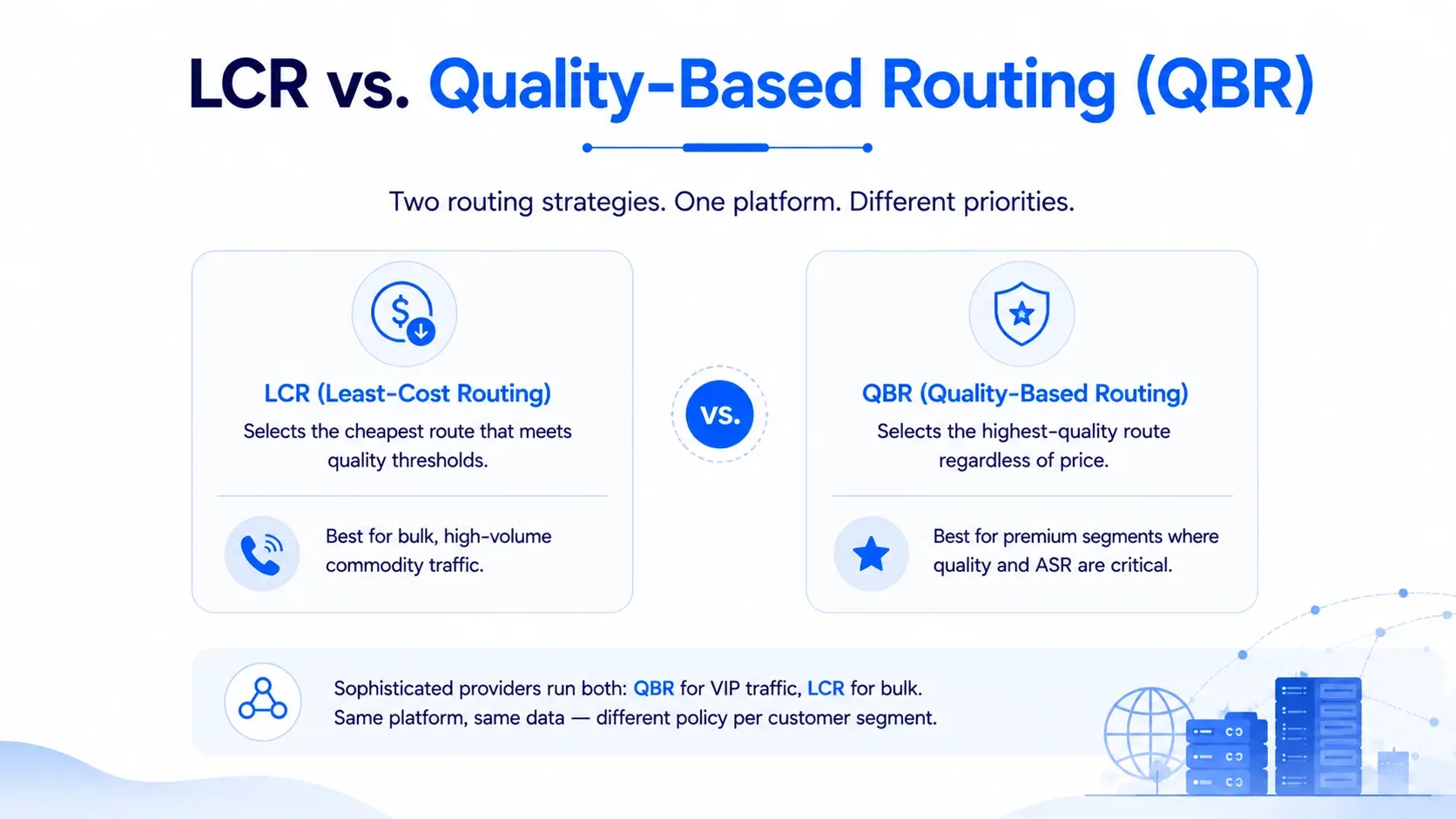
Sophisticated wholesale VoIP LCR providers run both simultaneously. QBR applies to VIP customer traffic; LCR routing applies to bulk commodity calls. The same softswitch, the same rate decks, the same quality data — different routing policy per customer segment.
That flexibility is what makes a modern wholesale VoIP LCR platform genuinely useful across enterprise and high-volume use cases.
Wholesale VoIP LCR Routes at Twiching
Twiching runs a cloud-native wholesale VoIP LCR engine across the global softswitch fabric. Every inbound call is routed against live rate decks from every upstream carrier.
It is filtered by per-destination ASR, ACD, MOS, and STIR/SHAKEN attestation requirements, then dispatched to the cheapest qualifying route. CDRs stream back into the same scoring model in real time.
Customers see the result as consistent wholesale VoIP LCR routes — high ASR, predictable wholesale VoIP rates, and competitive total cost across A-Z termination. Partners using Twiching's white-label reseller programme inherit the same wholesale VoIP LCR infrastructure underneath their own brand, with 24/7 NOC support layered on top.
How to Evaluate a Wholesale VoIP LCR Provider
Ask a shortlisted provider to walk through a live LCR decision on one of your own destinations rather than describing the logic in the abstract — the gap between a documented routing policy and what the engine actually does under load is where most disappointment starts.
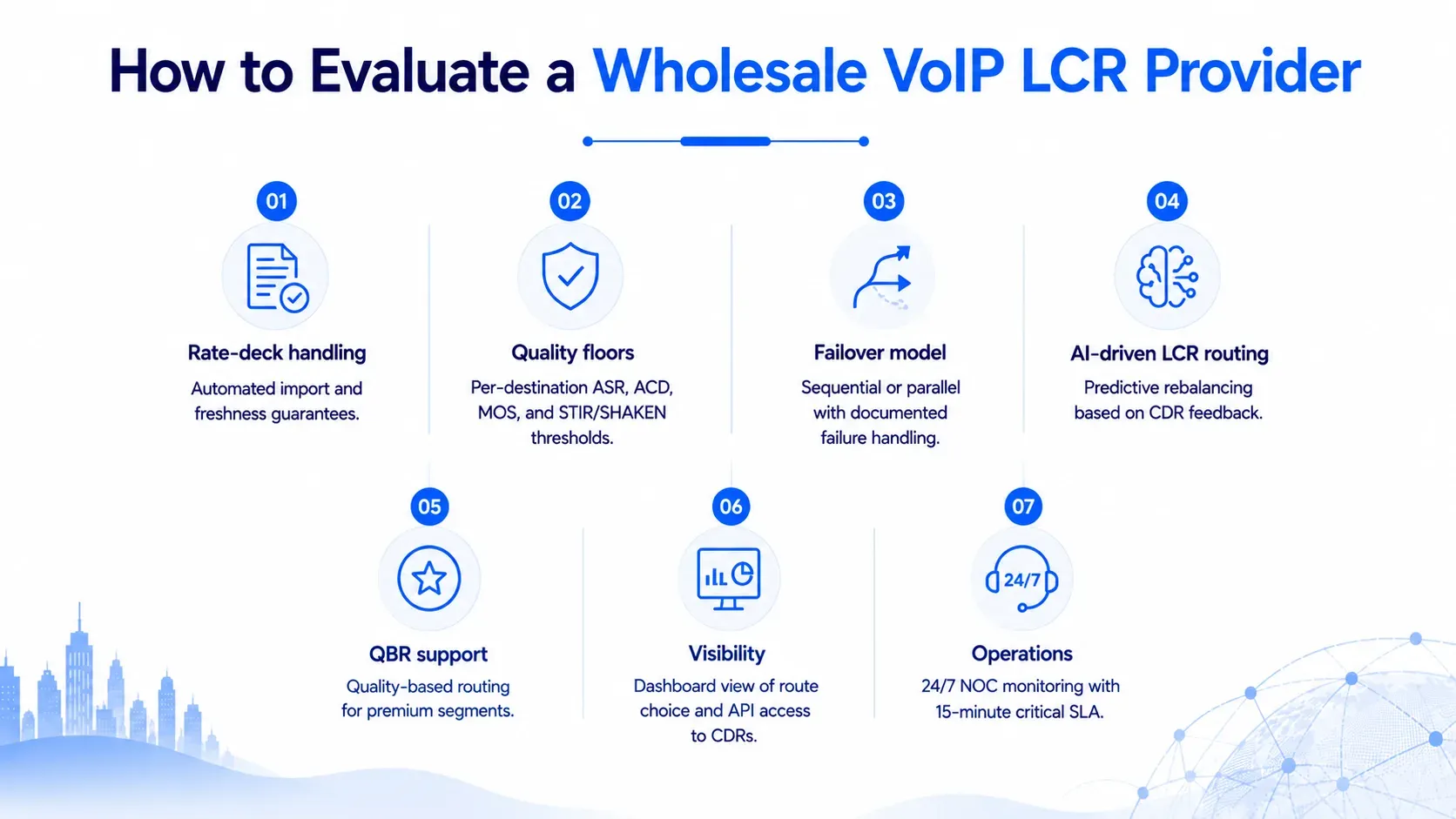
- 01Rate-deck handling — automated import, freshness guarantees, and audit history.
- 02Quality floors — per-destination ASR, ACD, MOS, and STIR/SHAKEN thresholds configurable per customer.
- 03Failover model — sequential or parallel, with documented behaviour on setup vs. mid-call failures.
- 04AI-driven LCR routing — predictive rebalancing based on streaming CDR feedback.
- 05QBR support — quality-based routing alongside LCR for premium customer segments.
- 06Visibility — dashboard exposure of route choice per call, with API access to CDRs.
- 07Operations — 24/7 NOC monitoring the LCR routing engine with 15-minute critical-incident SLA.
Least-cost routing in wholesale VoIP requires constant rate deck maintenance. Carrier rates change monthly, sometimes weekly for volatile destinations. Automated rate deck ingestion pulls carrier rate decks via API or CSV on a scheduled basis and updates your routing tables automatically.
It is essential for keeping your LCR engine accurate. Manual updates introduce lag that causes you to route traffic at higher-than-necessary rates. The savings from keeping rate decks current typically pay for automation tooling within the first quarter of deployment.
LCR routing decisions must balance cost against quality floors. A purely cost-optimised LCR engine will route to the cheapest available carrier regardless of quality. This degrades customer experience and increases repeat call attempts, which paradoxically raises costs.
Effective LCR implementations set minimum ASR and MOS thresholds per destination and route to the cheapest carrier that meets those thresholds. When no carrier meets the quality floor, the system should alert operations rather than routing to a degraded carrier.
Conclusion
Wholesale VoIP LCR is the quiet margin engine behind every healthy wholesale voice business. The mechanics — rate decks, quality floors, failover, AI-driven LCR routing, optional QBR for premium traffic — sound technical, but they are the difference between an operator that compounds margin and one that competes on price alone.
A credible wholesale VoIP LCR provider treats LCR routing as a first-class product surface, not a back-office script. Twiching is built around that discipline, so partners inherit competitive wholesale VoIP rates and carrier-grade LCR routing on a single platform from day one.