Introduction
A VoIP termination provider is the carrier that delivers your outbound minutes from your VoIP platform onto the PSTN, mobile networks, and other VoIP carriers. The provider you choose shapes call quality, fraud exposure, ASR, and the wholesale VoIP rates that flow through to your P&L.
This guide explains what a credible provider actually does and the carrier-grade primitives to demand.
What a VoIP Termination Provider Actually Does
Further reading: VoIP termination service SLAs, contracts and activation
A VoIP termination provider receives outbound SIP calls from your VoIP platform and picks the cheapest qualifying upstream carrier route for each destination. It dispatches the call and bills you on a per-minute basis.
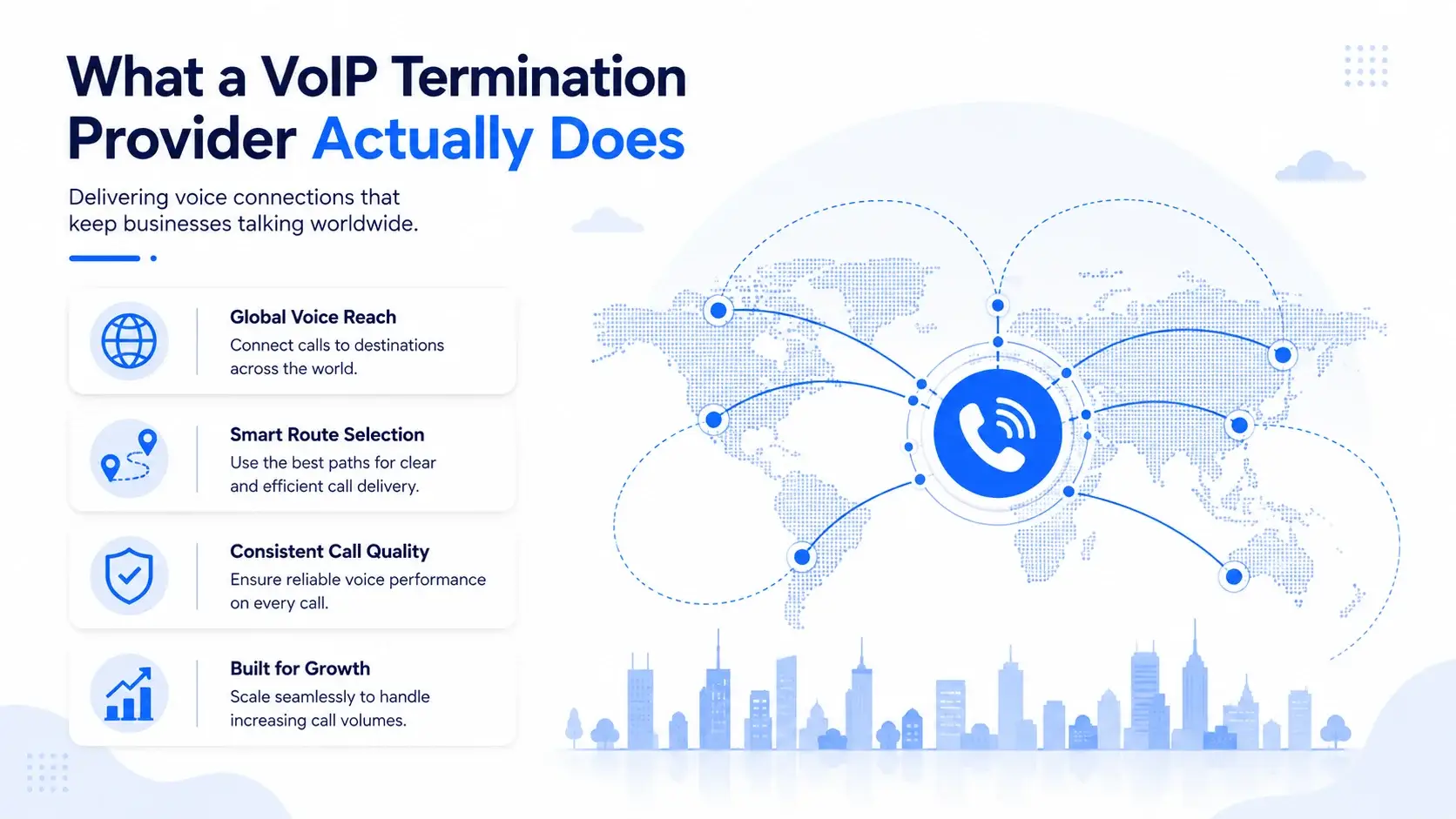
The provider holds the carrier interconnects, runs the LCR engine, generates real-time CDRs, signs STIR/SHAKEN attestation for US-bound traffic, and maintains the 24/7 NOC. You bring the application; the VoIP termination provider brings the global carrier reach.
This is the outbound half of the wholesale voice stack — the natural pair to a wholesale VoIP origination provider on the inbound side.
A serious VoIP termination provider does both on a single billing account, so reconciliation across inbound and outbound stays unified. The same NOC handles incidents on either side of the call.
Carrier Interconnects: The Heart of Any VoIP Termination Provider
Further reading: Wholesale pricing & rate deck
What a VoIP termination provider ultimately sells is access to carrier interconnects. Direct interconnects with Tier 1 partners and in-country operators deliver tighter ASR, lower PDD, and stronger STIR/SHAKEN posture than transit routes purchased from another upstream wholesaler.
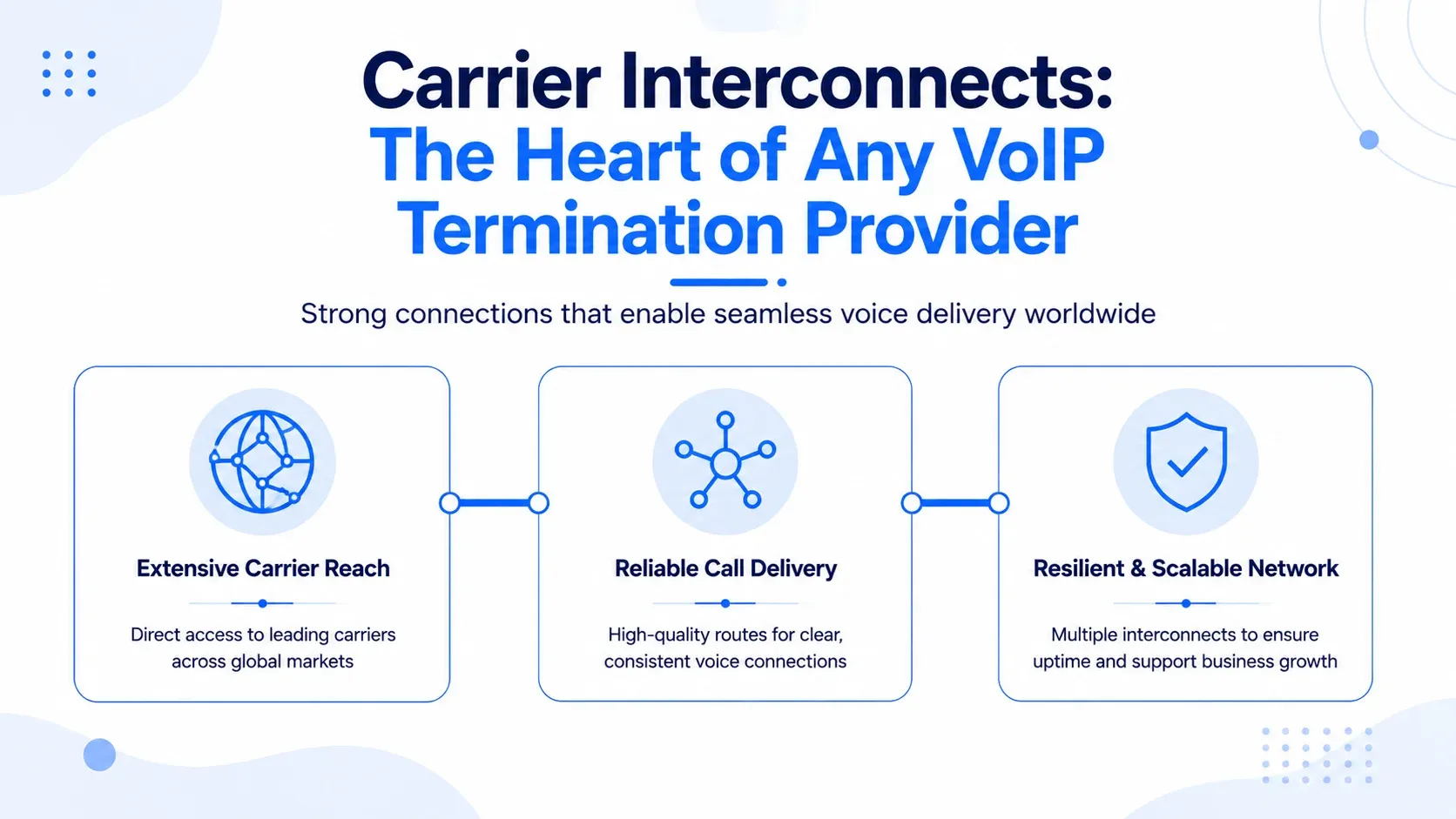
A VoIP termination provider that publishes the carrier handling each destination — and shows it in CDRs — is operating at the carrier layer. It is not just reselling minutes.
Coverage depth matters too. Leading VoIP termination provider operators maintain direct routes across 190+ countries with the long-tail destinations handled through curated transit relationships.
A VoIP termination provider that cannot quote ASR per destination on your top markets is asking you to trust marketing copy in place of operational data.
Route Quality, ASR, and Continuous Monitoring
A serious VoIP termination provider runs real-time route quality scoring against streaming CDRs. ASR, ACD, PDD, and MOS feed back into the LCR engine continuously, so degraded routes drop out of rotation automatically until upstream carriers remediate.
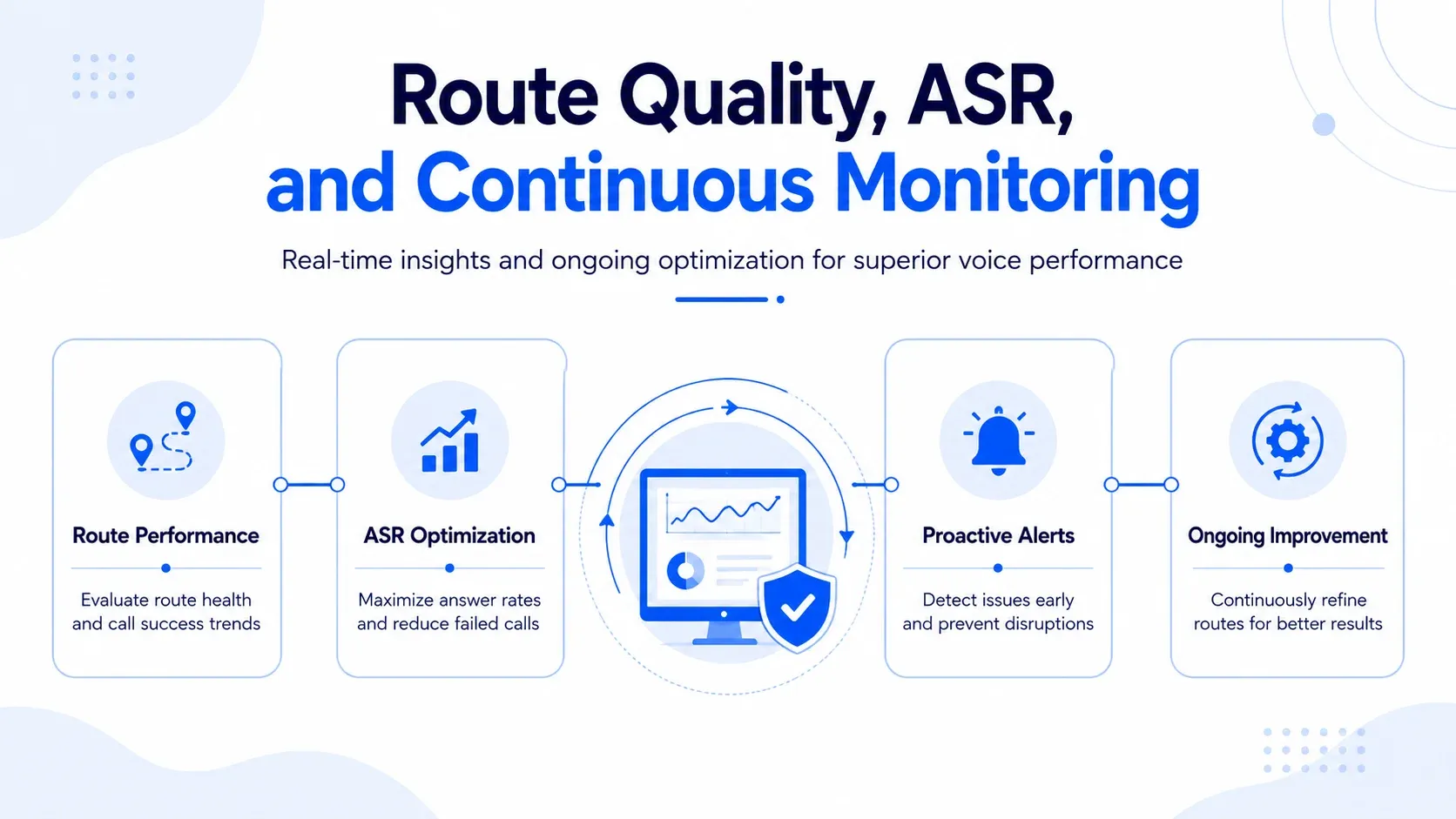
The customer dashboard surfaces per-destination quality numbers — anything less means the VoIP termination provider is doing the monitoring manually, with all the latency that implies.
Customers should expect API access to the same quality data the provider uses internally. CDR streaming, per-route ASR queries, and quality alerts piped into your own monitoring stack are now standard.
A VoIP termination provider locking quality data behind a static PDF is hiding what their network actually delivers.
Understanding Wholesale VoIP Rates and Billing
Further reading: Wholesale VoIP platform
Wholesale VoIP rates from a VoIP termination provider are quoted per destination on a published rate deck, billed per second under a stated increment.
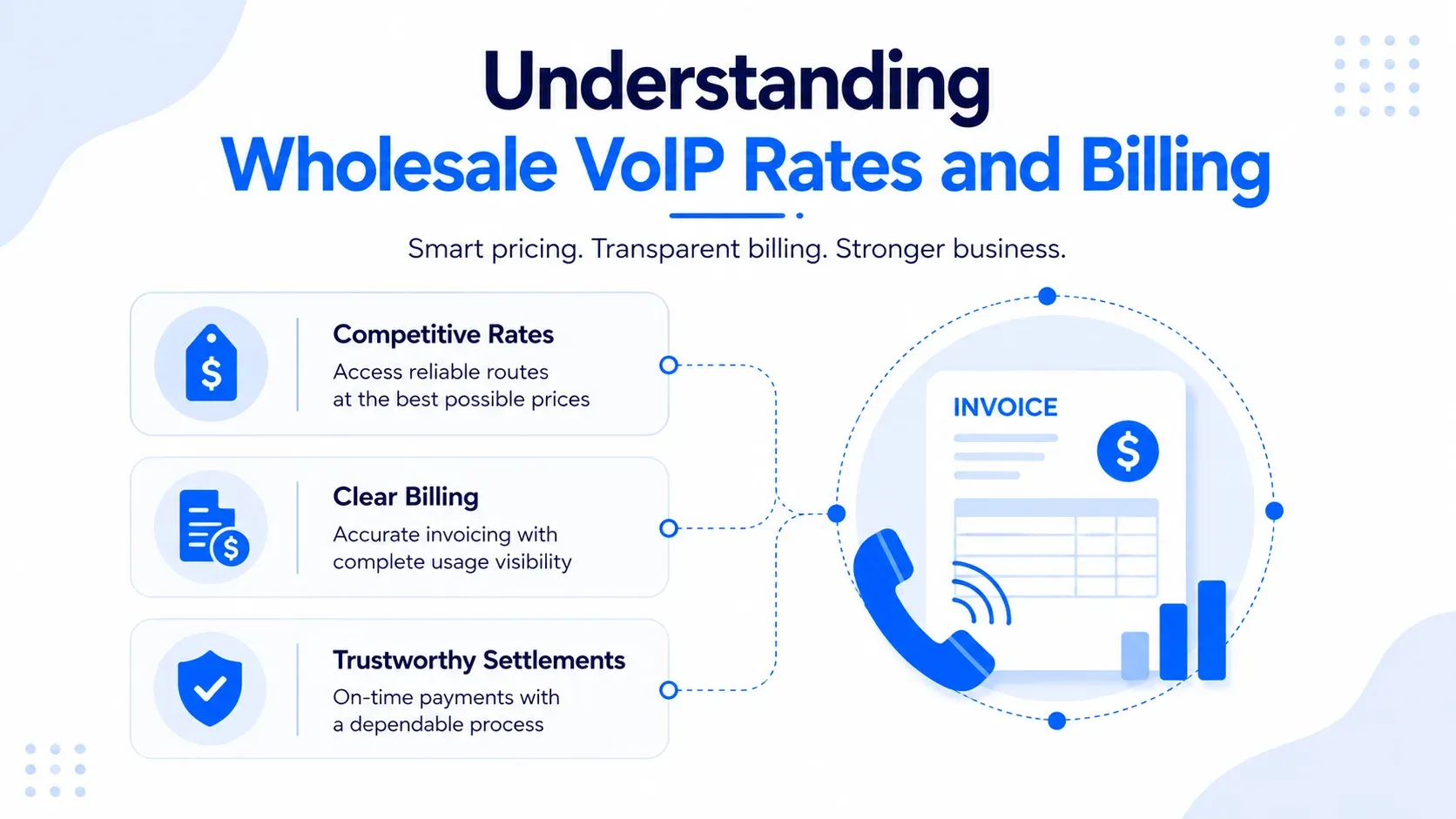
The rate deck is the single most important commercial artifact in the relationship. It covers outbound termination across every country code with the per-minute price, billing increment, currency, and effective date for each row.
Billing increments matter as much as the headline rate; 6-second increments are friendlier than 30/6 on short-duration traffic.
A credible VoIP termination provider publishes the full rate deck transparently so customers can model accurate outbound termination margins before signing.
Real-time CDR access is now table stakes. Monthly invoices should arrive with itemised destination breakdowns, and disputes should run through a documented resolution process with defined credit timelines.
A VoIP termination provider that batches CDRs weekly or quietly inflates increments at quarter-end is one to avoid — the math eventually catches up at audit.
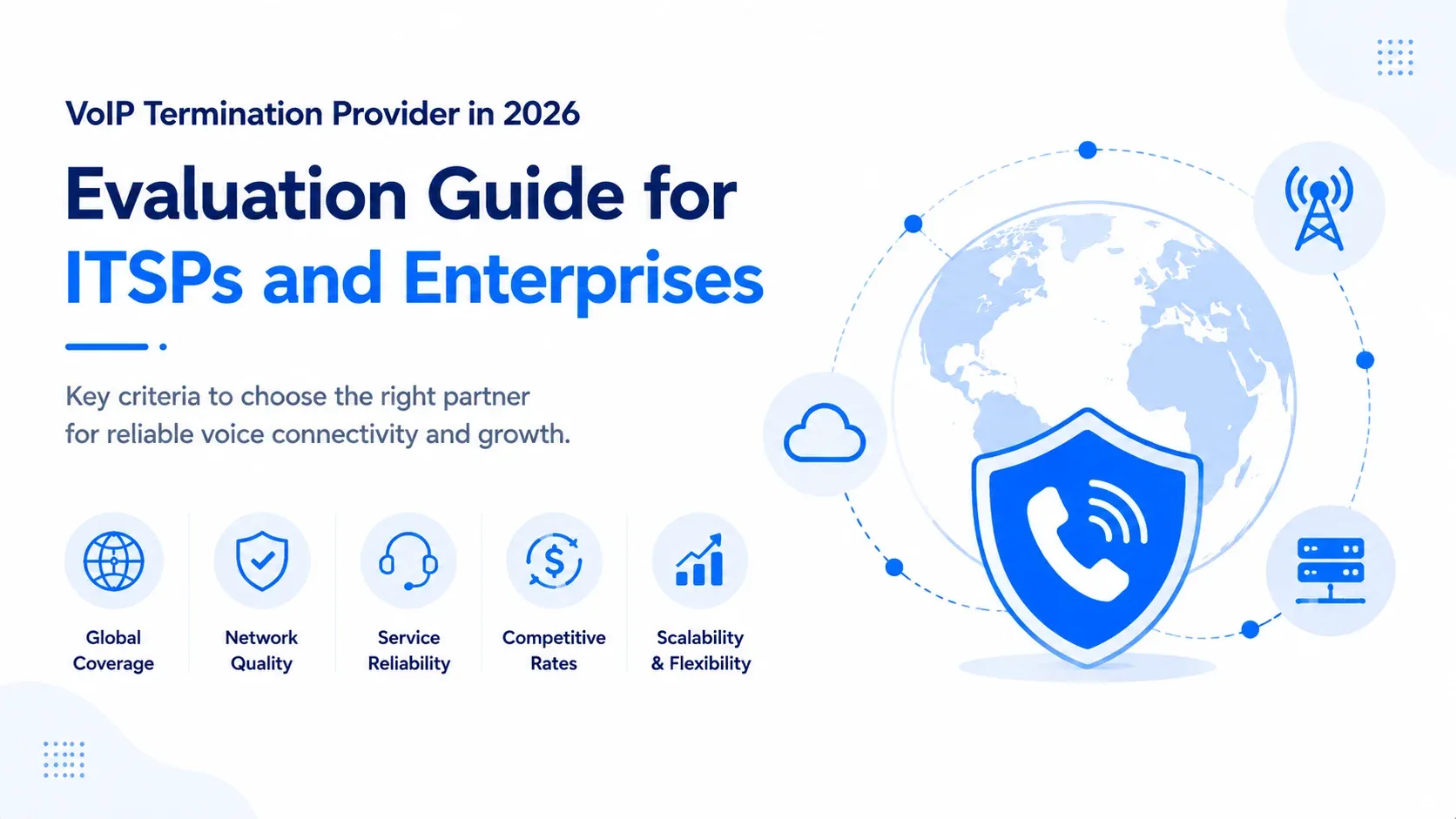
How to Choose a VoIP Termination Provider
Weight the first three items heavily — interconnects, published rates, and live quality data are the ones a provider cannot fake with a good sales deck, and they predict the rest of the relationship far better than a demo call does.
- 01Owned carrier interconnects in your top destinations, not transit-only paths
- 02Wholesale VoIP rates published per destination with billing increments and effective dates
- 03Live ASR, ACD, PDD, and MOS per destination, accessible via API
- 04STIR/SHAKEN attestation on US-bound traffic, surfaced in CDRs
- 0599.9% uptime SLA with ASR floors and financial credits for breaches
- 06Real-time fraud controls — spend caps, IRSF detection, blocked-prefix lists
- 0724/7 NOC with 15-minute critical-incident response and named escalation contacts
The last three items — SLA terms, fraud controls, and NOC response — matter less on day one and more the first time something actually breaks, which is exactly when a thin provider's gaps become expensive.
STIR/SHAKEN and Why It Matters for a VoIP Termination Provider
STIR/SHAKEN is the caller ID verification framework required for US telephone calls in 2026. A compliant VoIP termination provider signs every outbound US-bound call with the appropriate attestation level (A, B, or C) based on the customer's KYC posture.
A-attested calls get higher downstream ASR and fewer spam labels; unsigned calls are increasingly filtered by terminating carriers.
Using a non-compliant VoIP termination provider for US-bound traffic is a slow-motion ASR collapse. Connection rates drop, answer rates erode, and downstream-carrier reputation suffers across every customer of that provider.
STIR/SHAKEN attestation must be embedded in the call path, not bolted on as an external integration.
Fraud Protection at a Carrier-Grade VoIP Termination Provider
Further reading: Wikipedia: VoIP overview
IRSF (International Revenue Share Fraud) is the existential risk inside any VoIP termination provider relationship. A compromised customer trunk can rack up six-figure exposure overnight if controls are not real-time.
Effective VoIP termination provider platforms monitor spending velocity and apply hard per-account spend caps. They maintain blocked-prefix lists and pause traffic on suspicious patterns inside the same call window, not after the daily report runs.
Customers should expect spend caps, destination whitelists, and real-time alerts as default features in any VoIP termination provider dashboard. Anything weaker turns the customer's trunk into the provider's fraud problem — and that is the contract to walk away from, not sign.
Failover Planning When Your VoIP Termination Provider Has an Outage
Every VoIP termination provider has outages. The variable is whether your platform survives one.
The right approach is a secondary VoIP termination provider pre-configured for immediate failover. The LCR engine on your softswitch should be ready to redirect traffic in under 5 minutes. Test the failover quarterly so the procedure works when you actually need it.
Twiching's customers typically run a primary + secondary VoIP termination provider relationship for exactly this reason. The cost overhead is small, the operational insurance is significant, and the test cadence keeps the runbook fresh.
A VoIP termination provider whose marketing argues you do not need failover is a VoIP termination provider you should not bet your business on.
Before committing to a VoIP termination provider, test their support responsiveness as rigorously as their technical capabilities. Submit a test support ticket describing a simulated route quality issue and measure response time, technical depth, and resolution speed.
Providers who respond within 15 minutes with technically substantive answers demonstrate the operational maturity you need when real incidents occur. Night and weekend support coverage is essential if your customers operate outside business hours.
Failover planning with your VoIP termination provider should be documented before you need it. Define the failover trigger — the ASR or uptime threshold at which traffic automatically redirects to a secondary carrier.
Configure secondary routes in your routing engine and test failover monthly with a controlled traffic sample. Many operators discover failover failures during actual incidents rather than planned tests, which is too late.
Quarterly failover drills, where you intentionally redirect all traffic to your backup provider for 30 minutes, validate the configuration and train operations staff on the emergency procedure.
Contract terms with VoIP termination providers deserve as much scrutiny as technical capabilities. Review traffic clawback clauses, which allow carriers to retroactively reclassify and reprice traffic types.
Ensure the agreement defines allowable traffic types explicitly and prohibits unilateral rate changes without 30-day notice.
SLA credits for downtime and quality failures should be automatic. Requiring you to file a ticket to claim credits creates a friction barrier that providers rely on to avoid paying. A well-drafted termination agreement protects you contractually and sets clear expectations for both parties.
Reference architecture for VoIP termination provider integration typically follows a hub-and-spoke model. Your SBCs act as the hub, connecting to multiple termination providers (spokes) with weighted routing that distributes traffic based on cost and quality.
Each SBC peer relationship should be documented with the carrier's IP addresses, codec preferences, DTMF relay method, and SIP profile version. This documentation enables rapid reconfiguration during incidents and simplifies onboarding when your engineering team changes.
Treat carrier interconnect configurations as infrastructure-as-code and version-control them accordingly.
Conclusion
A VoIP termination provider is the carrier underneath every outbound call your platform makes — and the variable that drives ASR, fraud exposure, and the wholesale VoIP rates flowing through your P&L. Direct carrier interconnects, transparent per-destination pricing with billing increments, real-time route quality data, STIR/SHAKEN attestation on US-bound traffic, and a 24/7 NOC with named escalation contacts are the carrier-grade non-negotiables.
Pair the primary VoIP termination provider with a pre-configured secondary for failover and test the runbook quarterly. Twiching delivers all of that on one platform, so partners launch on a carrier-grade VoIP termination provider from day one without operating the underlying carrier themselves.