Introduction
Wholesale VoIP voice is the carrier-tier service every modern voice product runs on top of. Telecom companies, ISPs, ITSPs, contact-centre platforms, and enterprises shipping outbound voice all buy it in bulk and apply their own retail layer on top.
This guide explains what wholesale VoIP voice actually delivers — SIP trunking, hosted PBX, termination, call routing, and analytics — plus the pricing structure and quality metrics that matter.
What Wholesale VoIP Voice Actually Is
Wholesale VoIP voice is the bulk provision of voice-over-IP services to other businesses. It is the carrier-tier layer that delivers SIP trunks, wholesale VoIP termination, DID numbers, hosted PBX, and call analytics.
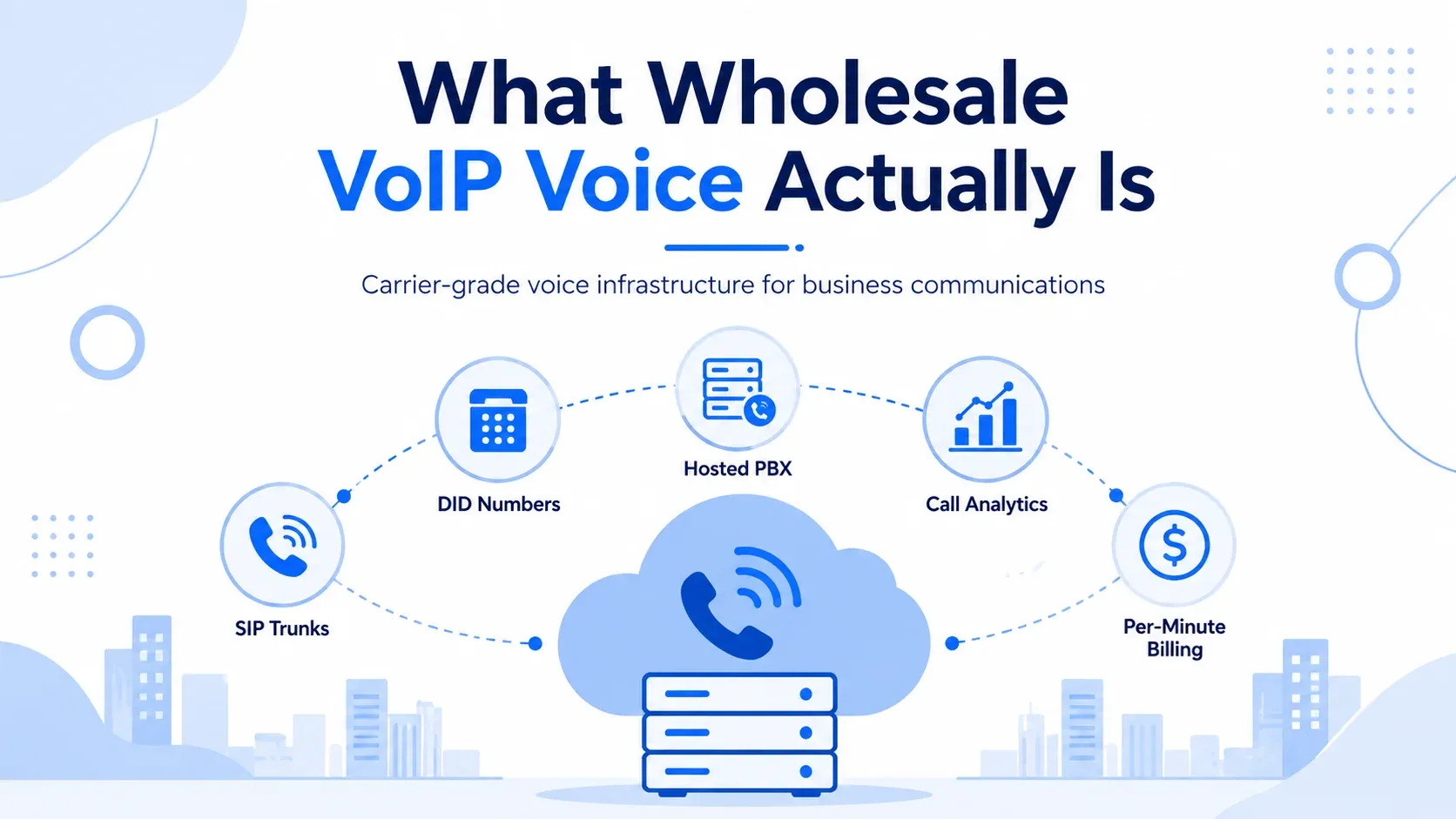
The wholesale VoIP voice provider holds the licences, runs the softswitches, signs carrier interconnects, and exposes the result as services other operators consume. The customer brings the application and the end-user relationship.
This is fundamentally different from retail VoIP, which packages handsets, voicemail, and consumer support into a per-seat plan. A wholesale VoIP voice provider strips that wrapper away and sells raw transport, billing per-minute on a published rate deck. Telecoms, ISPs, ITSPs, and contact-centre platforms all consume wholesale VoIP voice underneath their own products.
Wholesale VoIP Voice vs Wholesale Voice vs Wholesale SMS
The terms overlap. Wholesale voice is the broad category: carrier-to-carrier calling over any technology, including legacy TDM links. Wholesale VoIP voice is the IP-delivered part, reached over SIP, and it is where nearly all new traffic now runs.
Wholesale SMS is a separate product, with its own per-message pricing, routes, and compliance rules. Some providers sell both on one account, but judge each on its own quality data.
How Wholesale VoIP Voice Works
Further reading: Wholesale pricing & rate deck
Inside a wholesale VoIP voice platform, every outbound call follows the same pipeline. The customer's SIP trunk delivers an INVITE, and the Class 4 softswitch consults the rate deck across upstream carriers.
It applies LCR routing with quality floors, dispatches the call on the cheapest qualifying route, and generates a real-time CDR when the call completes. For US-bound traffic, STIR/SHAKEN attestation is signed inline, so the whole decision completes inside the normal call-setup window.
On the inbound side, wholesale VoIP voice covers DID origination: hosting your phone numbers and routing incoming PSTN calls to your SIP endpoint or UCaaS platform. Combining inbound and outbound on one provider simplifies operations and unlocks better unified pricing.
Core Services Inside Wholesale VoIP Voice
Further reading: Wholesale DID number buyer's guide
A credible wholesale VoIP voice provider bundles a tightly integrated stack on one billing account. Splitting these across vendors is technically possible but operationally painful — reconciliation, fraud controls, and quality scoring all break across mismatched stacks.
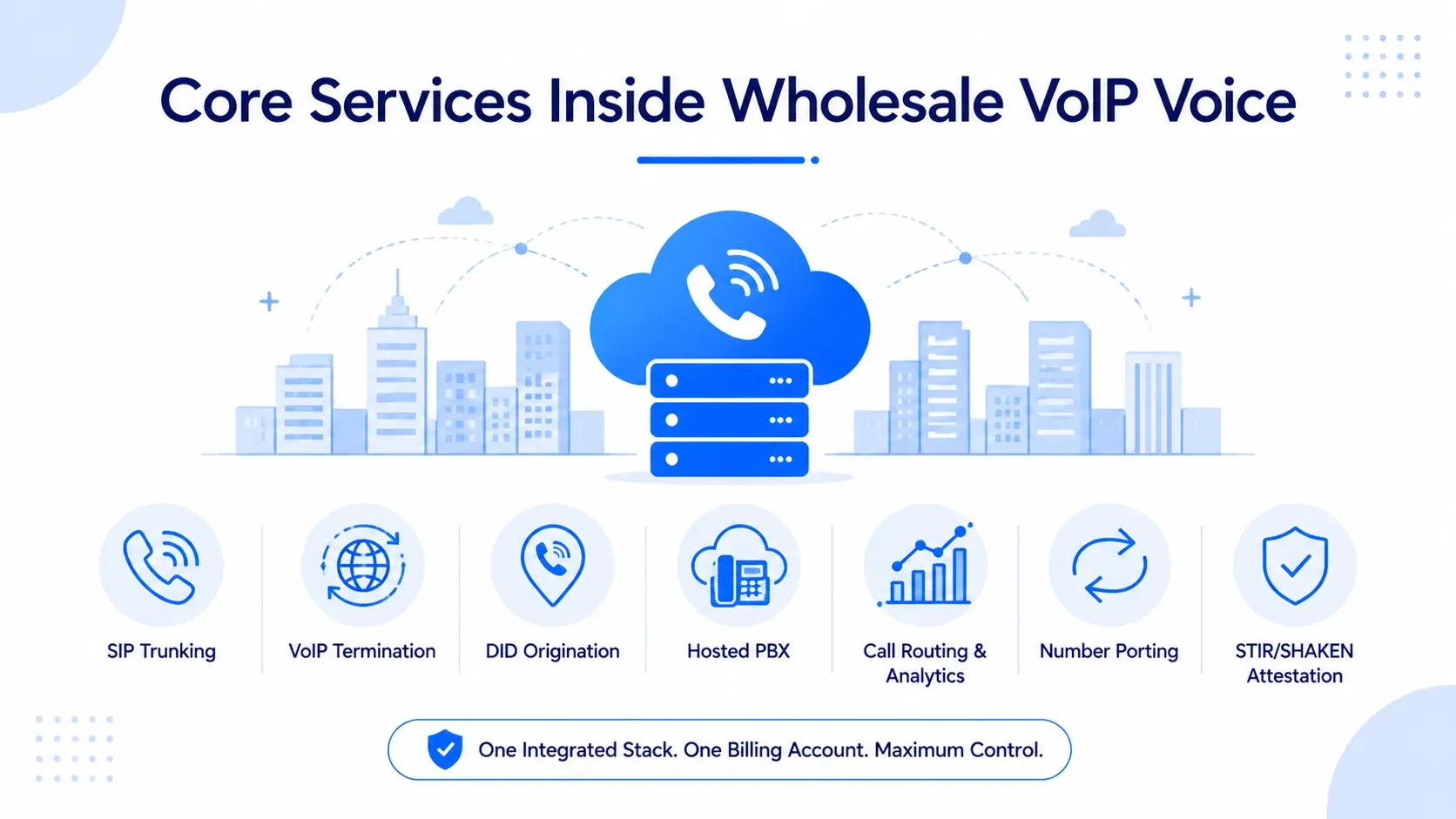
Buying SIP trunking and DIDs from two vendors means two billing systems and two support queues, which is exactly the overhead one contract removes.
- SIP trunking — direct PBX-to-carrier connectivity that replaces legacy PRI
- Wholesale VoIP termination — outbound A-Z minutes delivered via LCR routing
- DID origination — local, mobile, and toll-free numbers across 191 countries
- Hosted PBX — cloud-based phone system with voicemail, IVR, and call routing
- Call routing and analytics — programmable rules with real-time CDR streaming
- Number porting — clean transfer of existing DIDs from the incumbent provider
- STIR/SHAKEN attestation — embedded in the call path for US-bound traffic
Pricing Structure for Wholesale VoIP Voice
Further reading: Wholesale VoIP platform · Wholesale VoIP termination rates explained · Wholesale VoIP minutes: how to buy, bill and scale
Wholesale VoIP voice pricing blends three recurring models. Per-minute usage for outbound termination, monthly DID rental for inbound numbers, and per-channel SIP trunk fees for the underlying capacity.
Hosted PBX adds per-user seat charges, and CPaaS-style API features layer on per-API-call usage on top.
Volume commitments unlock tiered wholesale VoIP rates — typically 10 to 25 percent reductions across the curve. Billing increments (1/1 vs 6/6 vs 30/6) shift real cost on short-duration traffic by another 12 to 18 percent. Strong wholesale VoIP voice providers publish all of these inputs transparently per destination so customers can model total cost before signing — not after the first invoice.
Call Routing, Quality Metrics, and Analytics
Further reading: Wholesale VoIP routes: choose, test and manage
Routing inside a wholesale VoIP voice platform goes beyond simple LCR. Time-of-day, skill-based, geographic, and language-based rules, plus failover behaviour, are all configurable in the customer portal.
Analytics matter just as much. Real-time CDR dashboards expose volume, duration, cost, destination breakdown, ASR, ACD, PDD, and MOS per route.
API access to raw CDR data lets customers feed these metrics into their own BI stack. Anything weaker means manual monitoring and delay.
A Quality Scorecard for Wholesale VoIP Voice
Know what to ask for. These are typical targets for quality routes, not guarantees, and they vary by destination. Ask for live numbers on your own top destinations, not a network average.
- ASR (answer-seizure ratio) — the share of attempts that connect; mobile and tail-end routes run lower
- PDD (post-dial delay) — the wait before ringing; about three seconds or less is a common target
- NER (network effectiveness ratio) — counts network-side failures; quality routes sit in the mid-to-high 90s
- MOS (mean opinion score) — voice quality on a 1–5 scale; around 4.0 or higher is typical
Codec choice matters too. G.711 delivers toll-quality audio at about 64 kbps per call; G.729 uses roughly 8 kbps with a small quality loss. Each transcoding hop between carriers degrades audio, so ask for G.711 pass-through where quality matters.
STIR/SHAKEN, Security, and Compliance
Further reading: STIR/SHAKEN and robocall mitigation on wholesale VoIP
STIR/SHAKEN attestation is table stakes on any wholesale VoIP voice platform that carries US-bound traffic. A-attested calls complete more often and collect fewer spam labels, and Twiching signs all US outbound traffic at A-level. Full mechanics are in our STIR/SHAKEN guide.
Security inside wholesale VoIP voice spans several layers:
- TLS for SIP signalling
- SRTP for media encryption
- IP whitelisting for trunk authentication
- DDoS scrubbing
- IRSF detection on streaming CDRs
Fraud Protection on Wholesale VoIP Voice
Further reading: Protecting wholesale voice termination routes from fraud
IRSF (International Revenue Share Fraud) is the existential risk inside any wholesale VoIP voice relationship. A compromised customer trunk can rack up six-figure exposure overnight if controls are not real-time.
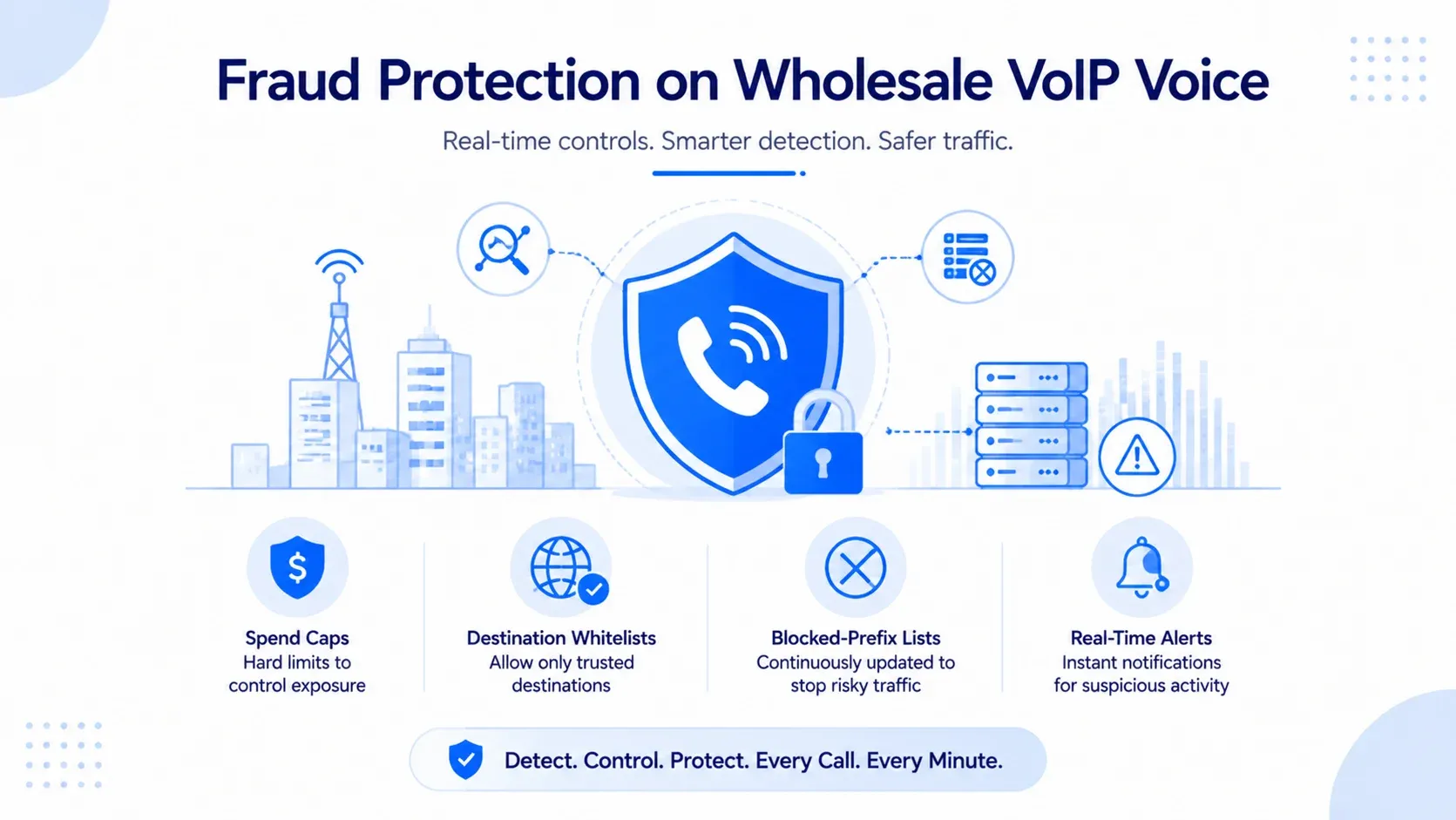
Effective wholesale VoIP voice platforms run anomaly detection on streaming CDRs and apply hard per-account spend caps. They maintain a blocked-prefix list refreshed continuously, and pause traffic on the destination side the moment a pattern looks off.
Expect spend caps, destination whitelists, and real-time alerts as defaults in any provider dashboard. How fraud targets termination routes, and how to block it, is covered in our guide to protecting wholesale voice termination routes.
Who Buys Wholesale VoIP Voice
Further reading: Wikipedia: VoIP overview
The right provider depends on who you are. Each type of buyer needs something different from the same carrier-tier service.
- Telecom operators and ISPs — new-market reach without building interconnects
- ITSPs and UCaaS platforms — SIP trunks, DIDs, and APIs to wrap in their own product
- Contact-centre platforms — outbound capacity with stable ASR and per-campaign data
- Resellers and startups — no minimums, a white-label option, and a markup-ready rate deck
- High-volume enterprises — one contract for termination and DIDs, with a clear SLA
Modern providers have largely dropped volume minimums, so small businesses and startups can buy the same carrier-tier rates as multinationals. Pay-as-you-go on a transparent rate deck is now the default.
Choosing a Wholesale VoIP Voice Provider
Buyers who already run inbound and outbound on separate vendors should weight service breadth heavily here — consolidating both onto one wholesale VoIP voice contract is usually where the biggest operational win in this whole evaluation actually sits.
- 01Service breadth — SIP trunking, termination, DID origination, hosted PBX, porting on one platform
- 02Rate transparency — wholesale VoIP rates published per destination with billing increments
- 03Route quality — live ASR, ACD, PDD, MOS per destination, accessible via API
- 04STIR/SHAKEN — full attestation on US-bound traffic, surfaced in CDRs
- 05SLA terms — 99.9% uptime, ASR floors, financial credits for breaches
- 06Fraud controls — real-time spend caps, IRSF detection, blocked-prefix lists
- 07APIs — programmable provisioning, CDR streaming, and rate-deck queries via REST
- 08Operations — 24/7 NOC with 15-minute critical-incident SLA
A provider that scores well on breadth but weak on APIs is still asking your team to do manual reconciliation across services, just under one invoice instead of several — check both before assuming consolidation alone solves the operational overhead.
Twiching as a Wholesale VoIP Voice Provider
Twiching is built specifically for telecoms, ISPs, ITSPs, contact-centre platforms, and enterprises that need carrier-grade wholesale VoIP voice without operating the carrier themselves. The platform combines SIP trunking, wholesale VoIP termination, DID origination, hosted PBX, number porting, and CPaaS-style APIs on a single billing account.
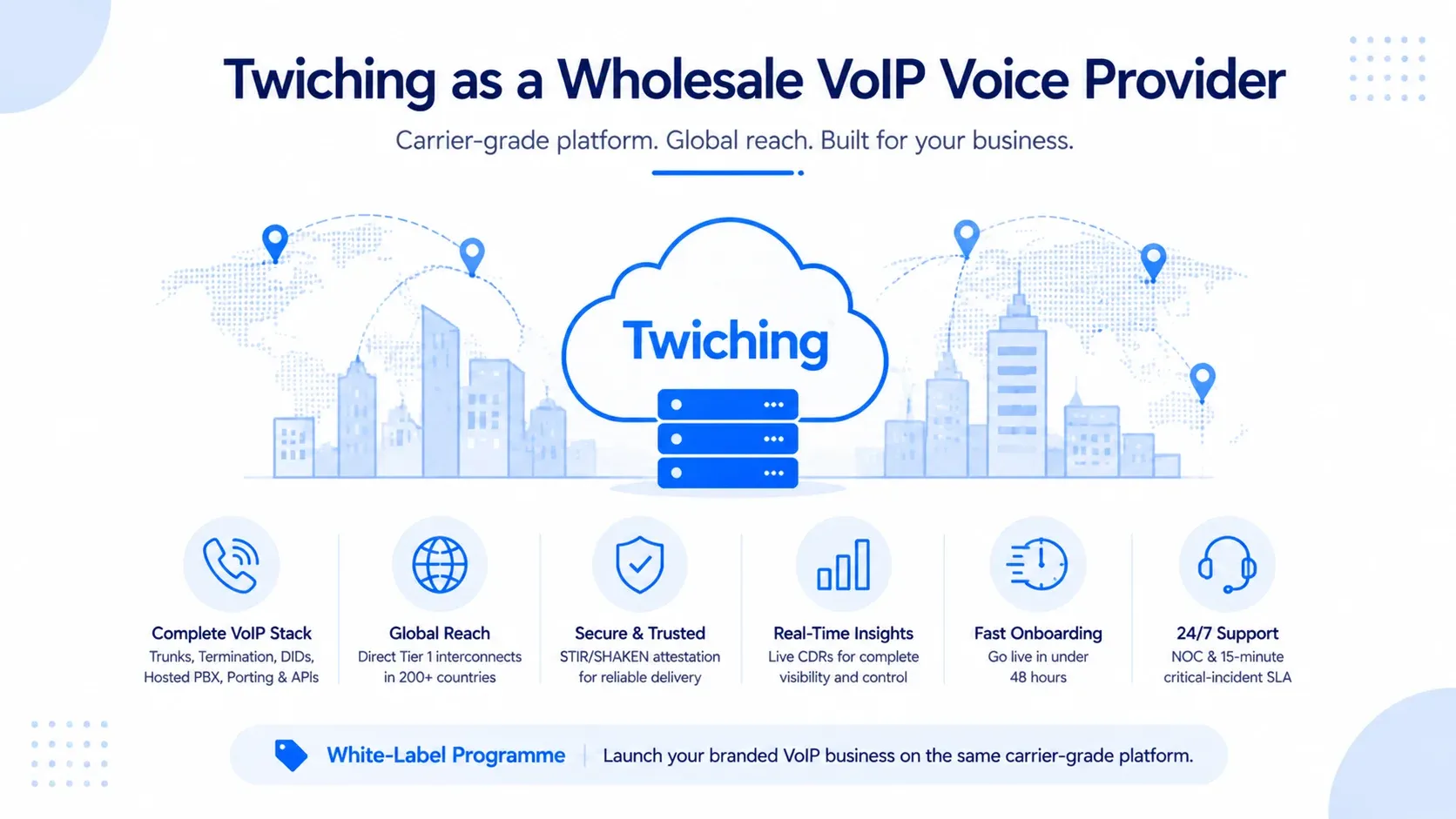
It runs on direct carrier peering across 191 countries, with A-level STIR/SHAKEN attestation on all US traffic, real-time CDRs, route failover in under two seconds, and a 24/7 follow-the-sun NOC.
Partner accounts are provisioned within 24 hours, and the rate deck publishes per-destination wholesale VoIP voice pricing with billing increments and effective dates visible on every row. Partners on the white-label reseller programme launch their own branded wholesale VoIP services business on the same carrier-grade infrastructure Twiching uses internally.
Conclusion
Wholesale VoIP voice is the carrier-tier service every modern voice product is built on top of. The provider underneath your service determines call quality, fraud exposure, the wholesale VoIP rates you pass on, and the speed at which you can ship new features.
Service breadth, rate transparency, route quality scoring, STIR/SHAKEN attestation, contractual SLAs, real-time fraud controls, and a 24/7 NOC are the carrier-grade non-negotiables. Twiching is built around that bar, so partners and enterprises launch on a carrier-grade wholesale VoIP voice platform from day one and scale on competitive per-minute pricing without operating the underlying carrier themselves.