Introduction
Wholesale voip carrier services are the hidden infrastructure behind millions of daily business calls, letting operators and enterprises move large volumes of voice traffic across global networks at costs retail telephony can't touch. This matters for any business with big outbound calling, international traffic, or reselling voice services.
Knowing what these services deliver, and how to pick the right provider, directly shapes cost, quality, and competitiveness.
What Are Wholesale VoIP Carrier Services?
Wholesale voip carrier services are high-volume voice transmission tools. Providers run global SIP interconnection networks and hold direct ties with local phone operators in each country.
They also run the switching infrastructure needed to deliver calls to any destination on the public switched telephone network.
Unlike retail VoIP products built for individual users or small businesses, wholesale voip carrier services are built for operators, resellers, contact centers, and enterprises. These customers usually process hundreds of thousands to hundreds of millions of monthly minutes.
The savings from wholesale access — per-minute rates 60 to 80 percent below retail — only kick in at these volumes. This is why wholesale and retail voice sit in separate market tiers.
Core Features of Wholesale VoIP Carrier Services
Further reading: Wholesale VoIP Termination Carriers
Professional wholesale voip carrier services combine several features that together decide the value passed on to operators.
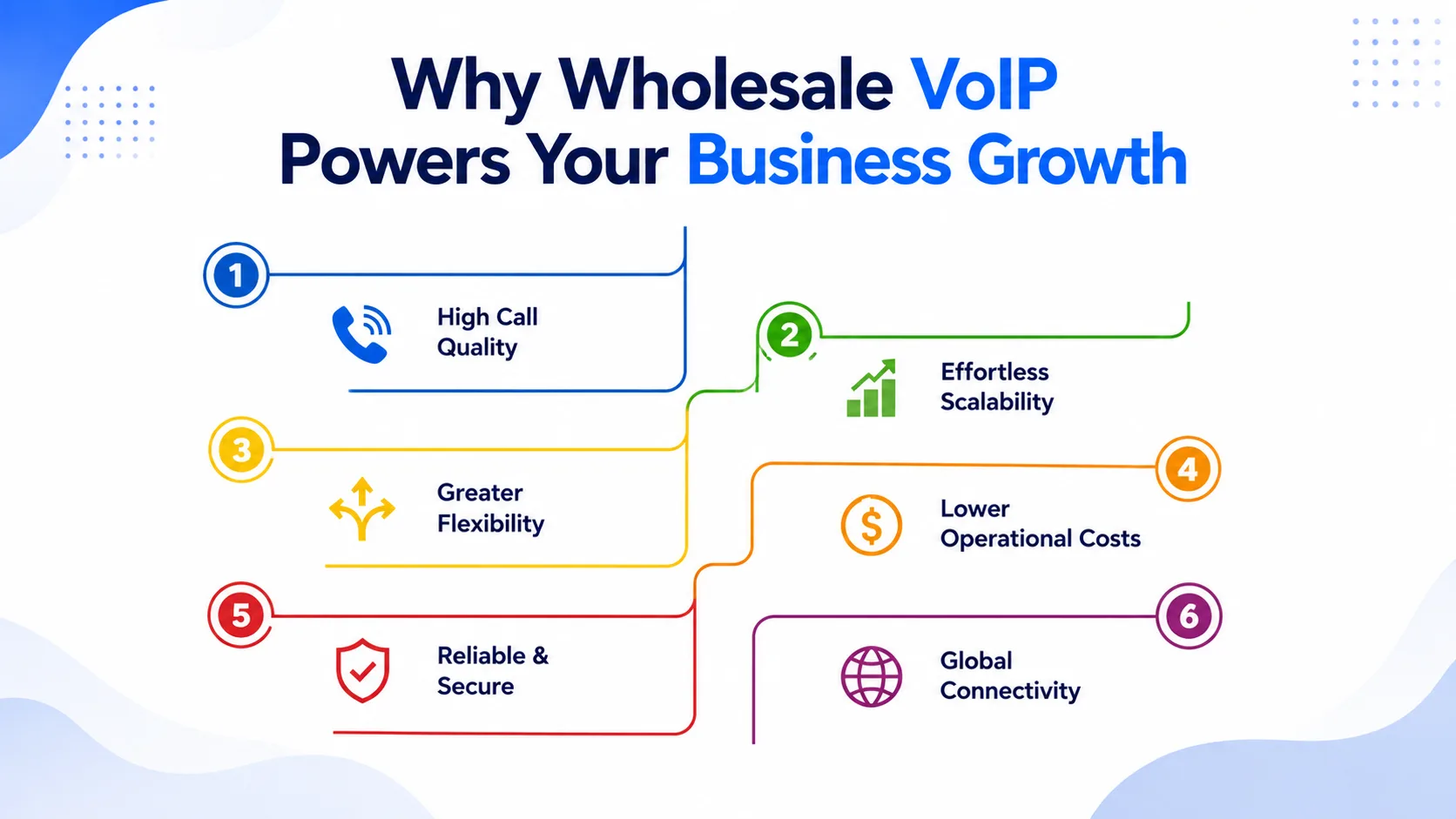
Least-cost routing engines constantly scan available carrier paths, apply quality filters, and pick the lowest-cost compliant route for every call — automatically, with no manual step.
Real-time quality checks across all active routes let operators catch problems before customers notice. Full CDR exports support billing checks and traffic analysis.
API-based setup lets new SIP trunks, DIDs, and routing configs go live without manual steps. Together, these features turn raw carrier capacity into a platform that scales well as traffic grows.
Global Network Coverage
How far a provider's wholesale voip carrier services reach is one of the first things to check for any operator with global traffic needs.
Coverage depth matters as much as breadth.
A provider listing 200 destinations may rely on resold routes for most of them. Another offering only 150 destinations might hold direct interconnections with local carriers in each market.
Direct interconnection always beats resold routing on the quality metrics that matter most: answer seizure ratio, post-dial delay, and mean opinion score.
Always ask exactly which destinations are served by owned direct interconnects versus third-party resold routes, before you commit traffic volumes to any provider.
SIP Trunking and Interconnection Standards
SIP trunking is the technical link through which wholesale voip carrier services reach your network.
It carries both signaling and media traffic using Session Initiation Protocol over IP connections.
Session border controllers at network edges handle security, protocol setup, codec matching, and quality checks across all active trunk connections.
The SIP setup of modern wholesale platforms cuts out the hardware buying cycles and physical limits of legacy TDM infrastructure. Adding capacity takes minutes, matching the fast scaling that a growing voice business needs.
Codec choice is an often-overlooked part of wholesale voip carrier services that directly affects both call quality and bandwidth use.
The G.711 codec gives the best voice quality and is the standard for PSTN-grade audio. But it uses about 64 kbps per call channel.
G.729 compresses audio to around 8 kbps per channel with decent quality for most voice uses. This makes it the practical pick for operators with tight bandwidth or high concurrent call volumes.
Wideband codecs such as G.722 and Opus give HD audio quality for internal and on-net calls between modern endpoints.
Check that your carrier's session border controllers support the codecs your platform and customers need. Also check for transcoding, so calls still work when endpoints use different compression standards.
Pricing and Rate Structures for Wholesale VoIP Carrier Services
Wholesale voip carrier services are priced per minute, with billing increments that vary by provider. Most use six-second increments after a short initial minimum.
Some providers offer one-second billing instead, which helps high-volume short calls like automated dialers.
Rate decks sort pricing by destination, splitting fixed-line, mobile, and special service number rates. These can differ a lot in markets where mobile termination fees are high.
Clear, full rate decks that split out number types are a good sign of provider quality. Unclear pricing that bundles mobile and fixed rates hides the true cost and makes it hard to plan costs accurately.
Understanding the full cost of wholesale voip carrier services means looking past per-minute rates to the total cost across all fees.
Several fees combine to form the real cost of a carrier relationship.
- Monthly recurring charges for SIP trunk capacity
- DID rental fees per number
- Number porting charges
- Setup fees on new routes or account tiers
- Any minimum spend commitments
Ask for a fully itemised fee list during evaluation, instead of looking only at termination rates.
Operators who check total cost, not just headline per-minute pricing, always make better decisions. This helps them avoid billing surprises that cancel out the appeal of a low starting rate.
Volume Tiers and Commitment Pricing
Most providers of wholesale voip carrier services offer tiered pricing that cuts per-minute rates at higher committed monthly traffic. These commitments can bring real savings on high-volume destination groups. But they carry risk if your traffic falls below what you committed to.
Build commitment proposals using cautious traffic estimates based on real past data, not growth guesses.
The rate gain must beat the expected cost of any shortfall for commitment tiers to make sense. Work this out directly, rather than assuming the headline rate gain justifies any commitment level.
How to Evaluate Wholesale VoIP Carrier Services Providers
Further reading: Wholesale VoIP platform
Checking providers of wholesale voip carrier services takes a clear method covering network quality, pricing clarity, platform features, support speed, and security.
Start with a technical check. Ask for rate decks for your priority destinations and gather quality stats, including ASR and ACD, for major routes. Also ask about the provider's owned versus resold network infrastructure.
Technical skill must come with commercial openness. Providers who share detailed quality data on their own, and talk openly about network incidents, show the kind of culture that builds reliable long-term partnerships.
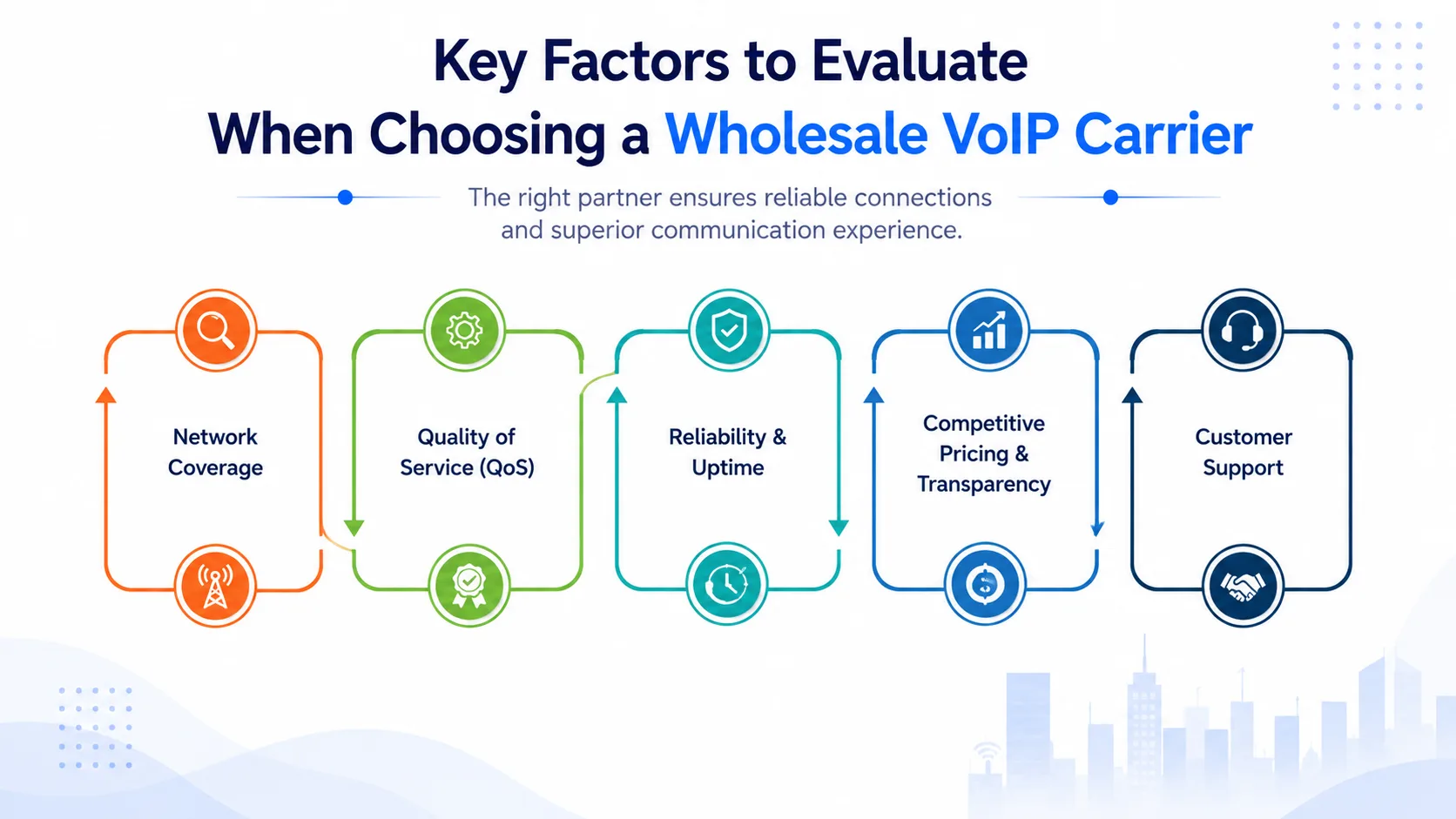
Structured trial periods with real traffic volumes are a key part of checking wholesale voip carrier services before you commit real business.
Ask for a trial allocation of at least five thousand minutes across your priority destinations. Measure ASR, ACD, and post-dial delay on live traffic, not just provider-supplied numbers.
A provider sure of their network quality will support structured trials happily and give detailed quality reports for the trial period.
Providers who resist live traffic testing, set unusually short trial windows, or won't share detailed quality data during evaluation are sending a signal. Their real performance may not match their marketing claims.
That's a risk far cheaper to spot in a trial than after you've committed your customer traffic.
Redundancy and Failover Architecture
Backup infrastructure is a must when checking wholesale voip carrier services for business-critical use.
Look for providers running several switching centers spread across regions, with automatic failover between sites. That way, an incident at one site can't disrupt your whole customer base.
Backup internet transit from different upstream providers protects against network-level outages.
Ask for past uptime data and look closely at the actual backup setup at the infrastructure level. Don't accept vague claims about "high availability" without proof.
Fraud Prevention and Security
Fraud is a real, ongoing risk in voice carrier markets. IRSF attacks can rack up tens of thousands in unwanted charges within hours by using your SIP infrastructure to route calls to premium-rate international numbers.
Quality carrier platform providers use AI-powered real-time fraud detection with automated traffic suspension that spots odd patterns and stops bad flows within seconds.
Add per-account spending limits and geographic blocking for destinations your traffic should never reach. Add speed alerts that trigger a check right away when odd patterns show up in your real-time CDR stream.
Building a Multi-Carrier Strategy
Further reading: ITU Telecom Resources
Smart operators build their voice infrastructure around several carrier providers, rather than leaning on a single supplier.
A multi-carrier setup spreads traffic across providers based on real-time quality and rate competitiveness, with automatic failover when main routes degrade.
This approach protects uptime. It keeps pricing pressure on over time. It also gives you real leverage in talks, which single-supplier reliance takes away.
Review provider performance every quarter and shift traffic based on measured quality and cost, not just past relationships.
Quarterly reviews with each active carrier should check:
- Pricing competitiveness
- Technical support responsiveness
- Billing accuracy
- Proactive communication during network incidents
Carriers who show the kind of culture that builds reliable long-term partnerships usually:
- Notify customers ahead of planned maintenance
- Provide real-time status updates during unplanned outages
- Resolve billing disputes promptly
Write down these checks and use them to guide traffic decisions. Reward carriers who perform well with more volume, and cut back on those whose standards fall short.
Conclusion
Wholesale VoIP carrier infrastructure rewards operators who put real work into checking providers, tracking performance, and firm commercial talks. The gap between a passive approach — taking whatever rate and quality one provider gives — and an active multi-carrier strategy with regular checks and performance-based traffic allocation grows into big cost and quality gains over time.
Building this discipline is the base for a lasting, competitive voice business at any scale.