Introduction
Wholesale voip termination carriers are the network operators that route Voice over Internet Protocol calls from your SIP infrastructure to any phone number worldwide. Picking and managing these carriers well decides the quality, cost, and uptime of every outbound call your business places — one of the most important infrastructure choices in any voice-dependent operation.
What Wholesale VoIP Termination Carriers Do
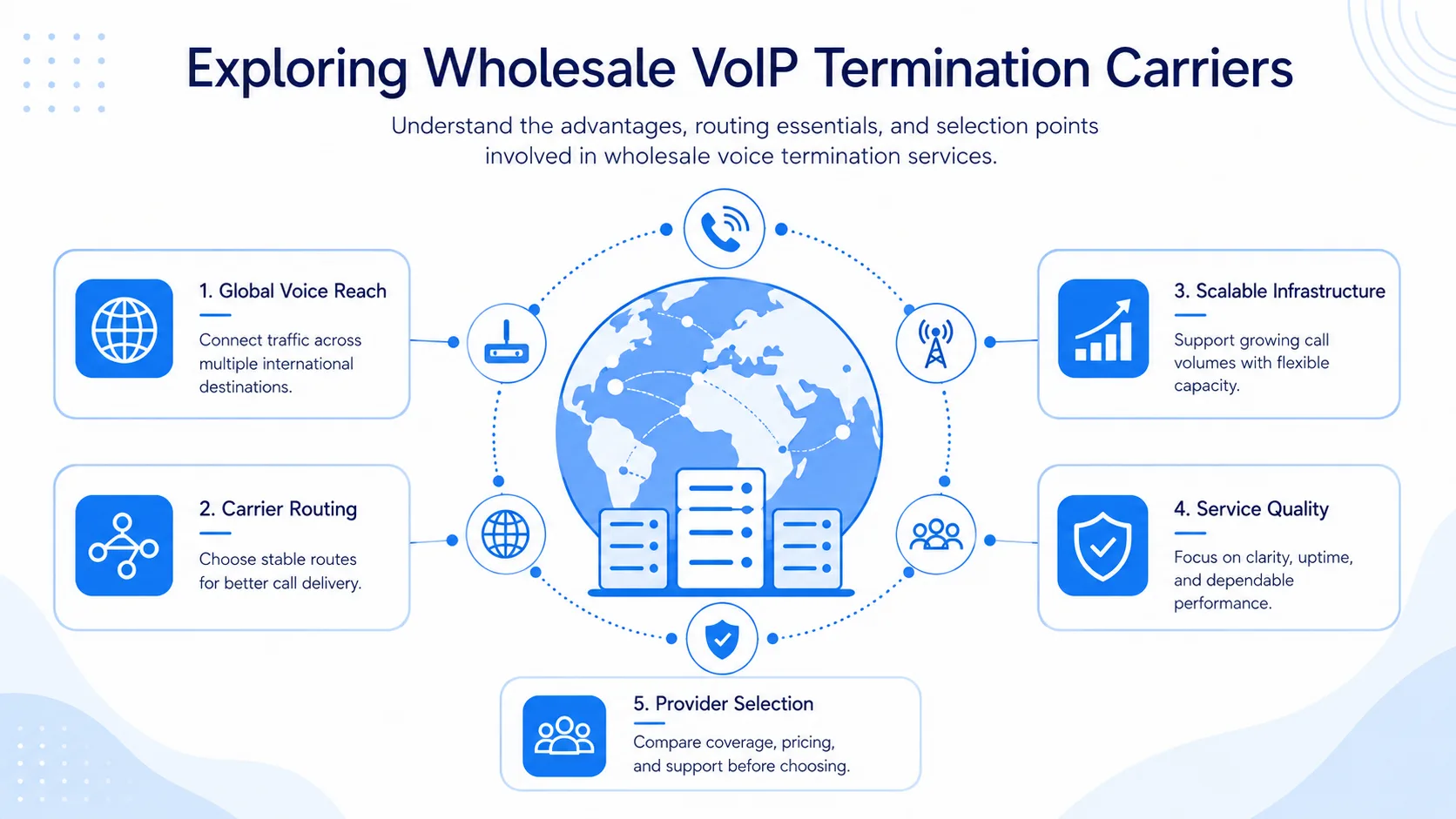
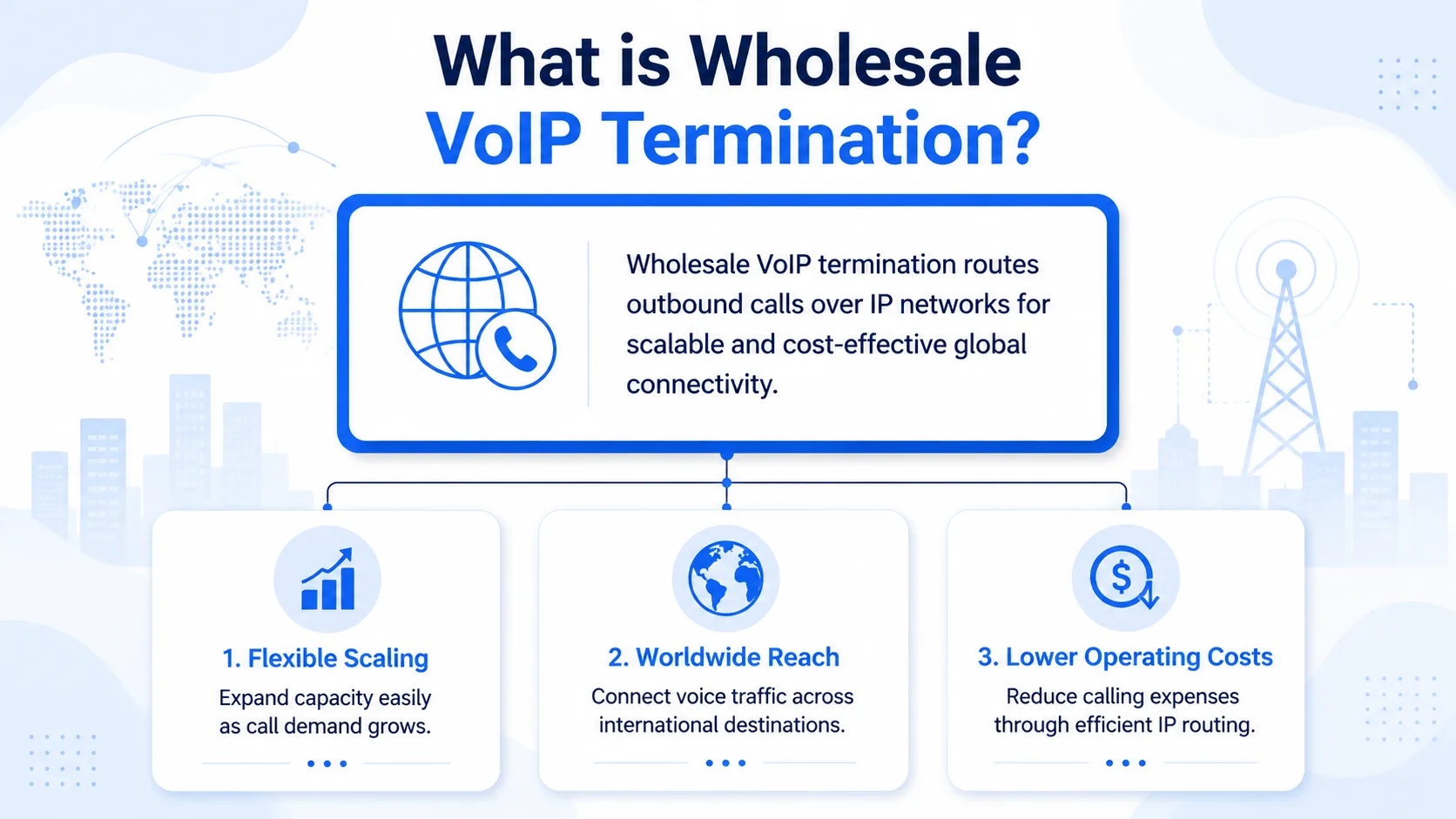
Wholesale voip termination carriers keep the carrier interconnection deals and switching infrastructure needed to deliver calls from your network to subscribers worldwide. This covers the PSTN and other VoIP networks in every country they serve.
At the technical level, they run Class 4 softswitches and session border controllers that route SIP-based traffic and track call state. These systems also deliver CDR data for billing and quality checks.
At the commercial level, they hold direct deals with local phone companies, mobile network operators, and other wholesale carriers in each market.
This lets calls reach both fixed-line and mobile subscribers at per-minute rates. Those rates reflect each carrier's costs and where they stand in the market.
How to Evaluate Wholesale VoIP Termination Carriers
Further reading: Wholesale Termination VoIP
A clear check of wholesale voip termination carriers starts with network coverage, using the rate decks each candidate provides.
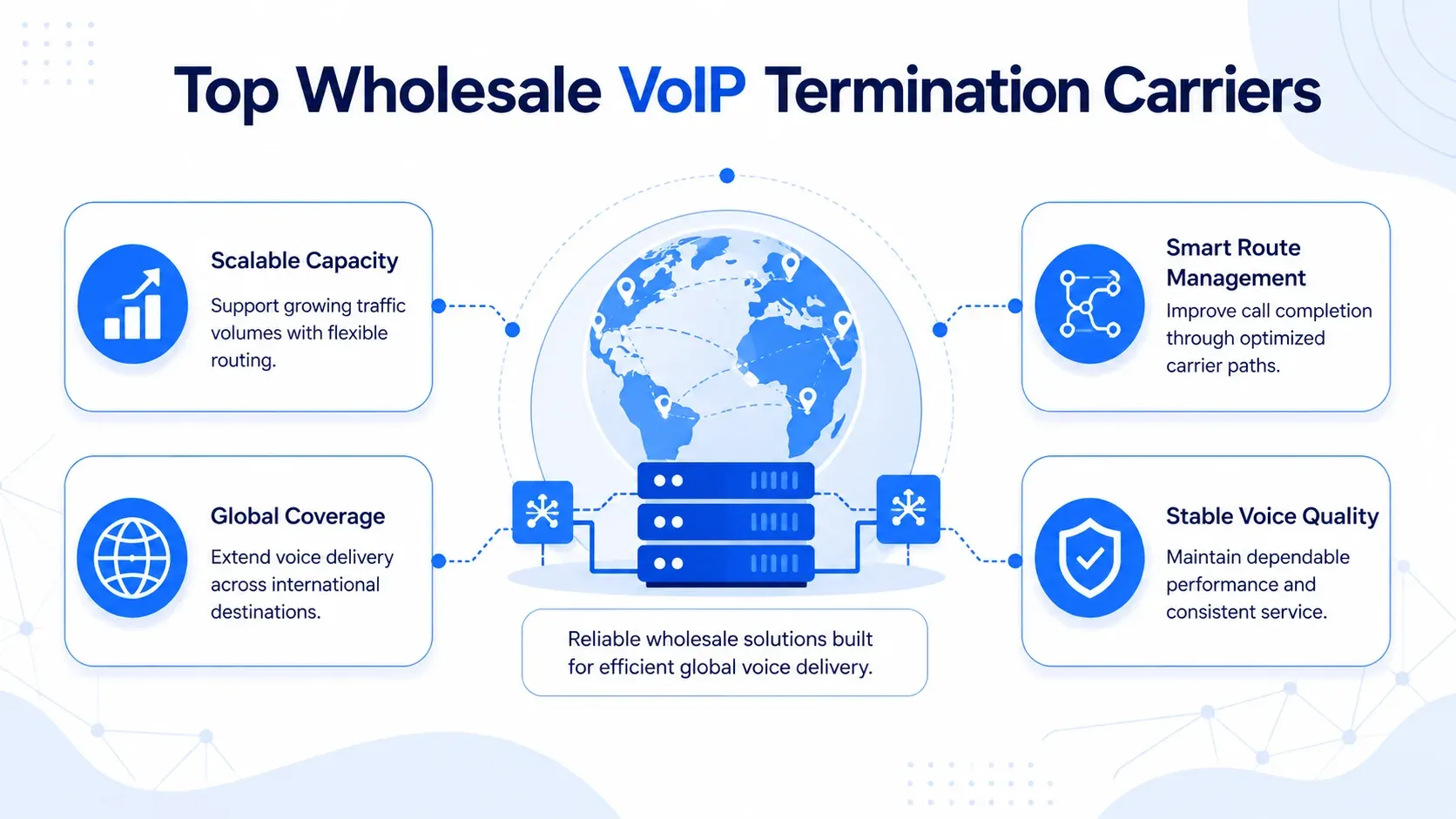
Compare rates on your most important destinations by volume. Check whether each provider has direct carrier ties in those countries or relies on resold routes from middlemen.
Direct interconnection always gives better quality than resold routes. Fewer network hops mean lower latency, less jitter, and higher call completion rates.
Ask for ASR and ACD data on your priority routes. Ask directly whether the rates on offer reflect direct or indirect carrier links, so you know what you're actually buying.
Network Infrastructure and Switching Architecture
The switching infrastructure run by wholesale voip termination carriers varies widely. This has a direct effect on the service quality your customers get.
Favor carriers running several switching centers spread across regions, with automatic failover between sites. That way, an incident at one site can't disrupt your whole customer base.
Ask about the softswitch platforms in use and how the network backup is laid out. Also ask about peering at major internet exchanges and past uptime stats on the routes that matter most to your business.
Carriers with their own infrastructure always offer steadier quality and pricing than those routing mainly through bought transit capacity.
Real-Time Quality Monitoring and Reporting
Professional carriers give full quality data through real-time web dashboards, API endpoints, and automated alerts.
Track answer seizure ratio, average call duration, and post-dial delay on all active routes at all times. Look into any metric that falls outside normal range before customers notice a problem.
Carriers who share performance data on their own and speak openly about network incidents show real maturity. That builds real trust and makes for strong long-term partnerships.
Avoid carriers who share quality data only when asked, or who are slow to admit network problems.
Pricing and Commercial Terms with Wholesale VoIP Termination Carriers
Top-tier wholesale voice carriers offer several pricing models suited to different traffic types and business needs.
Flat per-minute rates give steady costs for stable, high-volume traffic to set destination groups. Tiered volume pricing instead rewards traffic growth with better rates at higher commitment levels.
Knowing which pricing model fits your traffic best is key to getting the most value.
Businesses with unpredictable or mixed traffic often do better with flexible deals that carry no minimum commitments, even at slightly higher headline rates. Committed contracts expose them to shortfall penalties whenever traffic falls below plan.
Negotiating Rates with Carrier Partners
Good rate talks with carrier partners take prep work and market know-how. You also need to show your traffic is worth their business.
Your traffic volume data, destination mix, call quality, and payment record are your main bargaining chips.
Carriers always offer better terms to buyers with clean, high-quality traffic and steady monthly volumes. Uneven patterns or poor records get worse terms.
Always negotiate rate levels, minimum commitment terms, billing cycle timing, dispute steps, and quality fixes at the same time. Don't focus only on per-minute pricing.
Together, these terms decide the true value of the deal.
Volume Commitments and Rate Tiers
Volume commitment tiers from wholesale voip termination carriers usually bring real per-minute rate gains at set minimum monthly traffic levels.
This works in your favor when your traffic is truly steady. The rate gain across the committed volume usually beats the cost of any shortfall. This holds even in months when traffic falls a bit below target.
Build commitment plans around your real past traffic data, with a safe buffer. Don't rely on hopeful growth forecasts.
Overcommitting to volumes you can't reliably hit brings shortfall charges. Those charges wipe out the rate gains you were after and turn a good deal into a cost problem.
Building a Multi-Carrier Strategy
Further reading: Wholesale VoIP platform
Smart operators build routing infrastructure around several wholesale voip termination carriers. They avoid relying on just one supplier.
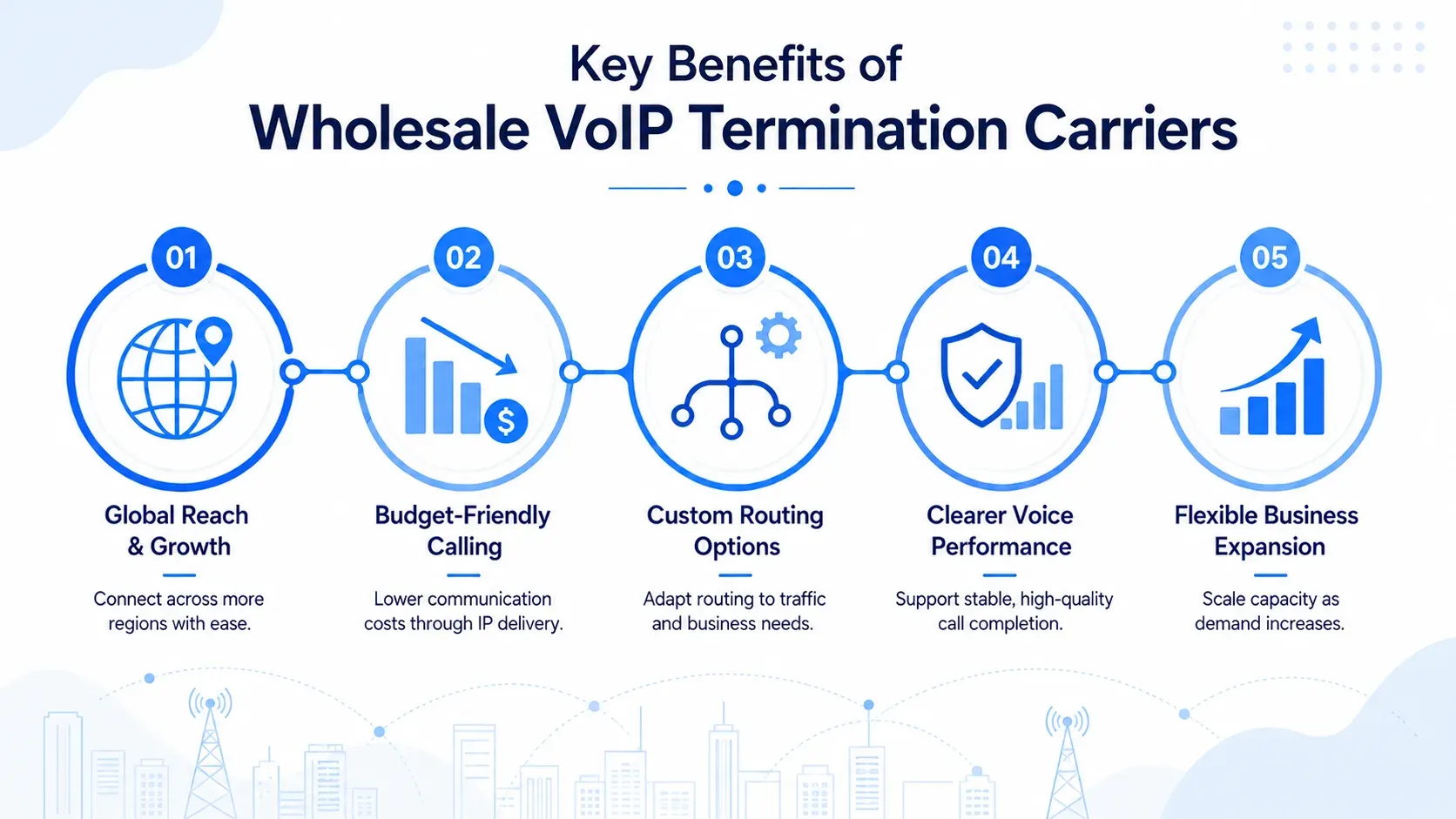
A well-built multi-carrier setup spreads traffic based on real-time quality, rate competitiveness, and the strength of each relationship. It also fails over automatically to backup carriers when main routes degrade.
Keeping at least two active wholesale voip termination carriers per major destination group gives routing backup. This protects uptime during outages. It also keeps pricing pressure on, which helps your costs over time.
Review carrier performance every quarter. Shift traffic to reward providers giving the best quality and value.
A useful way to think about multi-carrier design is in routing tiers, not simple carrier lists.
Tier A holds the main carrier for each destination, picked on a mix of price, ASR, ACD, and PDD over a rolling thirty-day window.
Tier B holds a backup carrier kept warm with at least five percent of live traffic. This keeps performance data fresh and pre-checks failover paths.
Tier C is a cold backup used only when both Tier A and Tier B trip a quality threshold at the same time.
The traffic-share split — usually 70/25/5 or 80/15/5 — is reviewed monthly. The tier structure itself changes only when a carrier is fully replaced.
This discipline stops a common problem: operators shifting traffic after every quality blip until nobody understands the routing table six months later.
Carrier diversity also has to look at the network behind the logos, not just the logos themselves.
Two seemingly different wholesale voip termination carriers can rely on the same upstream Tier 1 backbone. A single transit incident can then knock both of them out at once.
Your supposedly backed-up routing collapses to a single point of failure.
The fix is simple. Ask each carrier which upstream networks they rely on for your top destinations, then pick partners whose upstreams don't overlap.
Many operators find during this check that their three-carrier setup is really a single-carrier setup at the physical layer. A small reshuffle greatly improves real resilience without changing the cost.
Repeat this check every year, since upstream ties change quietly and often.
The final piece of a mature multi-carrier strategy is the playbook for what happens when something breaks.
Write down these parts of the playbook:
- The exact ASR, ACD, PDD, and packet-loss thresholds that trigger automated traffic shifts
- The human-in-the-loop escalation steps for events automation can't resolve
- The customer-communication template for partial-service degradations
- The postmortem cadence for any incident that produces a credit-eligible event
Carriers who see you run with this level of discipline will offer better terms. They see you as an easy, professional customer.
Carriers who run at the same level become your most valuable partners, since both sides can fix issues in hours, not days.
Multi-carrier strategies without a playbook end up as messy firefighting. The backup benefit disappears the first time a real incident hits.
Fraud Prevention with Carrier Partners
Further reading: GSMA — Wikipedia
Fraud prevention matters more and more when checking wholesale voip termination carriers. IRSF, wangiri, and interconnect fraud can cause big financial losses in wholesale voice.
The best wholesale voip termination carriers use real-time AI-powered fraud detection with automated traffic suspension. This spots odd patterns and stops bad flows within seconds of detection.
Ask prospective wholesale voip termination carriers detailed questions about their fraud detection methods and the usual time between an attack starting and suspension.
Also ask about the liability terms that apply when fraud losses go past set thresholds, even with automated controls active and set up right.
Compliance and Regulatory Standing
Regulatory compliance is a must when vetting wholesale voip termination carriers. Routing traffic through non-compliant carriers exposes your business to legal and financial risk.
These risks can be severe in places with active telecom enforcement.
Check that your carriers hold the right telecom licenses in the countries where they work. Also confirm they follow interconnection rules, numbering plan needs, and lawful intercept duties in each market.
Ask for compliance records as part of your formal check. Put regulatory promises directly into your commercial agreements with each carrier partner.
Conclusion
The market for wholesale voice termination rewards operators who put real work into carrier checks, active performance management, and firm commercial talks. Treating your carrier relationships as strategic assets, not simple commodity buys, brings better quality, pricing, and resilience than a passive approach.
Regular competitive checks, active quality monitoring, and clear contracts with each carrier partner will keep your termination strategy sharp as tech evolves, market pricing shifts, and customer quality expectations keep rising across global telecom markets.