Introduction
VoIP termination companies carry your outbound calls onto phone networks in every country you dial. They differ far more than their rate sheets suggest: in who owns the network, how quality is guaranteed and what happens when a route fails.
This guide sorts them by type, then gives you the checks and a 30-day test plan to compare them on evidence.
What Do VoIP Termination Companies Do?
A VoIP termination company takes outbound calls from your SIP platform and delivers them to a number on the phone network or a mobile network. It holds the interconnect agreements with carriers in each destination country, so you do not have to.
You pay per minute, but what separates providers is everything around that delivery: live route monitoring, automatic failover between carrier paths, fraud controls, caller ID attestation and billing records you can audit. A provider without these is reselling minutes, not running a network.
Further reading: What Is VoIP Termination
Further reading: ITU-T G.114: one-way transmission time
Four Types of VoIP Termination Companies
Companies in this market fall into four groups, each built around a different business model. Knowing which group a provider belongs to tells you more than its rate sheet does.
- Tier 1 carriers own network infrastructure and interconnect directly with other carriers. Quality and SLAs are the strongest, but volume commitments are large.
- Wholesale aggregators buy Tier 1 capacity and add routing, regional expertise and pricing. They suit most businesses, as long as their upstream carriers are named.
- API and CPaaS platforms bundle termination with developer tools and per-minute pricing. They are quick to start, but coverage and rates vary by destination.
- UCaaS-bundled providers include termination with a phone system. That is simple, but you rarely get route-level control or detailed CDRs.
For most businesses, an aggregator with confirmed Tier 1 upstream links gives the best balance of quality, price and flexibility. Ask any provider which carriers handle your top five destinations; a clear answer is a good sign.
How to Evaluate VoIP Termination Companies on Route Quality
Route quality matters most, and sales material rarely states it honestly. The only reliable check is to send live traffic through each shortlisted provider before you sign a volume deal.
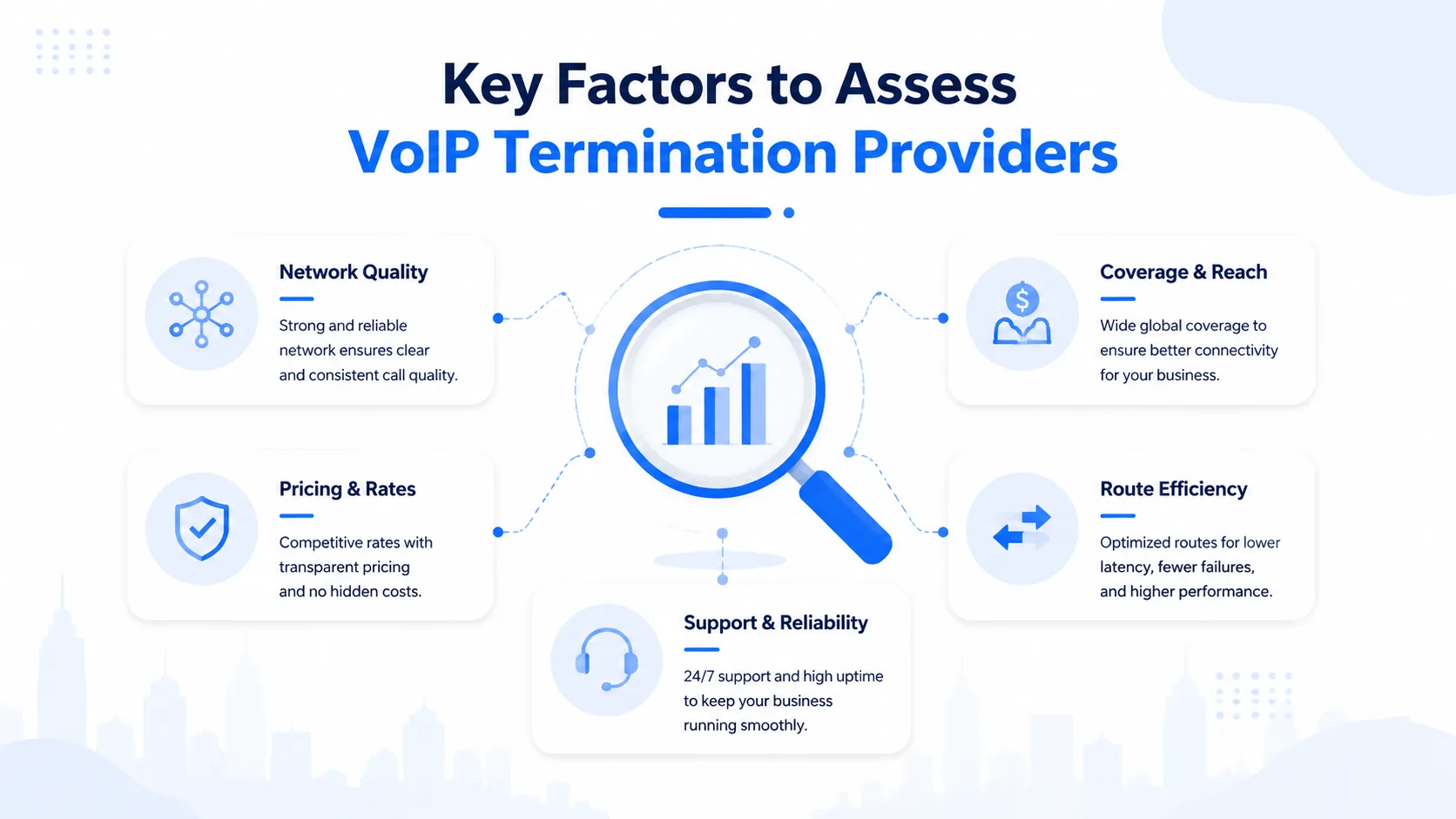
Ask for a test account and send 1,000 to 5,000 minutes across your key destinations. Record ASR, ACD, PDD and MOS for each route, and repeat the test at different times of day. Peak-hour results matter more than off-peak ones, because that is when your customers are calling.
ASR is the share of calls answered, ACD the average call length, PDD the delay before the first ring and MOS a score for voice quality. Tracking all four shows problems that any single number hides.
Pricing Comparison Across VoIP Termination Companies
A low headline rate can still produce a high invoice. Compare the terms that rate sheets hide before you compare per-minute prices.
- Billing increment — 6-second billing costs far less on short calls than 60-second billing at the same rate.
- Rate deck coverage — some providers price popular routes low and rare ones high. Check your full destination mix.
- Mobile versus landline — mobile termination often costs two to five times more, so the deck should show them separately.
- Volume tiers — committed monthly volume commonly earns a 15 to 35 percent discount. Model your traffic against each tier.
Add up your expected monthly minutes by destination and price them on every deck. The cheapest deck on paper is often not the cheapest bill.
Further reading: Wholesale VoIP termination
SLA Standards to Demand from VoIP Termination Companies
A service level agreement separates accountable providers from those offering best effort. Put the standards below in the contract, not in a sales email.
- Platform uptime of at least 99.9% a month, with 99.99% for business-critical traffic
- A minimum ASR per destination, often around 55% on domestic routes
- A cap on PDD, for example 5 seconds on standard routes and 3 on premium
- Automatic service credits for each breach, with no claim process
- Response times of about 15 minutes for critical outages and 4 hours for minor issues
A provider that refuses written commitments is telling you it cannot meet them. Walk away, whatever the price.
STIR/SHAKEN Compliance Among VoIP Termination Companies
In the US, STIR/SHAKEN is a baseline requirement for voice providers, and it affects whether your calls arrive labeled as spam. Ask every provider for its attestation level and its Robocall Mitigation Database filing.
Full A-level attestation means the provider has verified your right to use the calling number. B or C attestation gives carriers less to trust, so calls are more likely to be flagged or blocked. Make A-level the standard you hold every provider to.
Check each leg of your traffic too. A provider that signs US calls well but cannot say how international caller ID is handled leaves a gap.
Fraud Protection Capabilities
International revenue share fraud is the largest financial risk in termination. Criminals take over a SIP account and push traffic to premium-rate numbers, and the charges can reach hundreds of thousands of dollars within hours.
Ask what stops it: real-time spend alerts, per-account call rate limits, automatic blocking of known premium prefixes and fast account suspension when traffic looks wrong. A provider without these controls leaves the financial risk with you.
Set your own limits as well. Restrict every trunk to the countries you actually call.
Redundancy Architecture of VoIP Termination Companies
A provider's backup design decides whether a failure reaches your callers. Ask how many separate carrier paths serve each major destination, how its switching platform is spread across regions and how quickly failover triggers.
Then plan for the provider itself failing. Keep a second provider configured as a fallback route in your PBX or UCaaS platform, so traffic can move in minutes, not days. A failover that has never been tested is only a guess.
A 30-Day Test Plan Before You Commit
A structured trial turns opinions into data. Run the same four steps with every shortlisted provider so the results can be compared.
- 01Week 1 — open a test account and send 1,000 to 5,000 minutes across your top destinations.
- 02Week 2 — repeat during your busiest hours and compare ASR, ACD, PDD and MOS with week 1.
- 03Week 3 — export the CDRs and match them line by line against the invoice.
- 04Week 4 — simulate a failure by switching routes and time how long traffic takes to recover.
A good provider lets you see CDRs and quality dashboards during the trial. One that restricts access to them is hiding something you will want to see later.
Red Flags When Comparing VoIP Termination Companies
Some warning signs show up before any test traffic is sent. They are cheap to check and expensive to ignore.
- Rates quoted for popular destinations only
- No named upstream carriers
- Best-effort SLAs, or credits you must claim yourself
- No CDR export or sample invoice on request
- No stated attestation level for STIR/SHAKEN
- No test account without a volume commitment
Financial stability matters too. A provider short of cash may cut network spending, and quality then declines slowly. Ask for audited statements or a business credit report, and weigh how long the company has operated.
Where Twiching Fits Among VoIP Termination Companies
Twiching is a wholesale voice provider with termination to 191 countries, A-level STIR/SHAKEN attestation on US outbound traffic and billing in 6-second increments. Route failover takes under two seconds, and the platform carries a 99.99% uptime SLA.
There are no minimums to get started, with committed-minute pricing from 1M minutes a month. CDRs stream in real time over the API, interconnect takes under an hour and a network operations team watches the platform around the clock.
Run it through the 30-day plan above and compare the results with your current provider.
Conclusion
Choosing a termination provider takes more than a rate sheet. Sort your shortlist by type, test each one with live traffic, and check SLA terms, STIR/SHAKEN attestation, fraud controls and billing records before you commit to any volume.
Keep a second provider ready as a fallback and put every promise in writing, because contracts outlast sales conversations. You can test Twiching with the same 30-day plan you use for any other provider and compare the results side by side.