Introduction
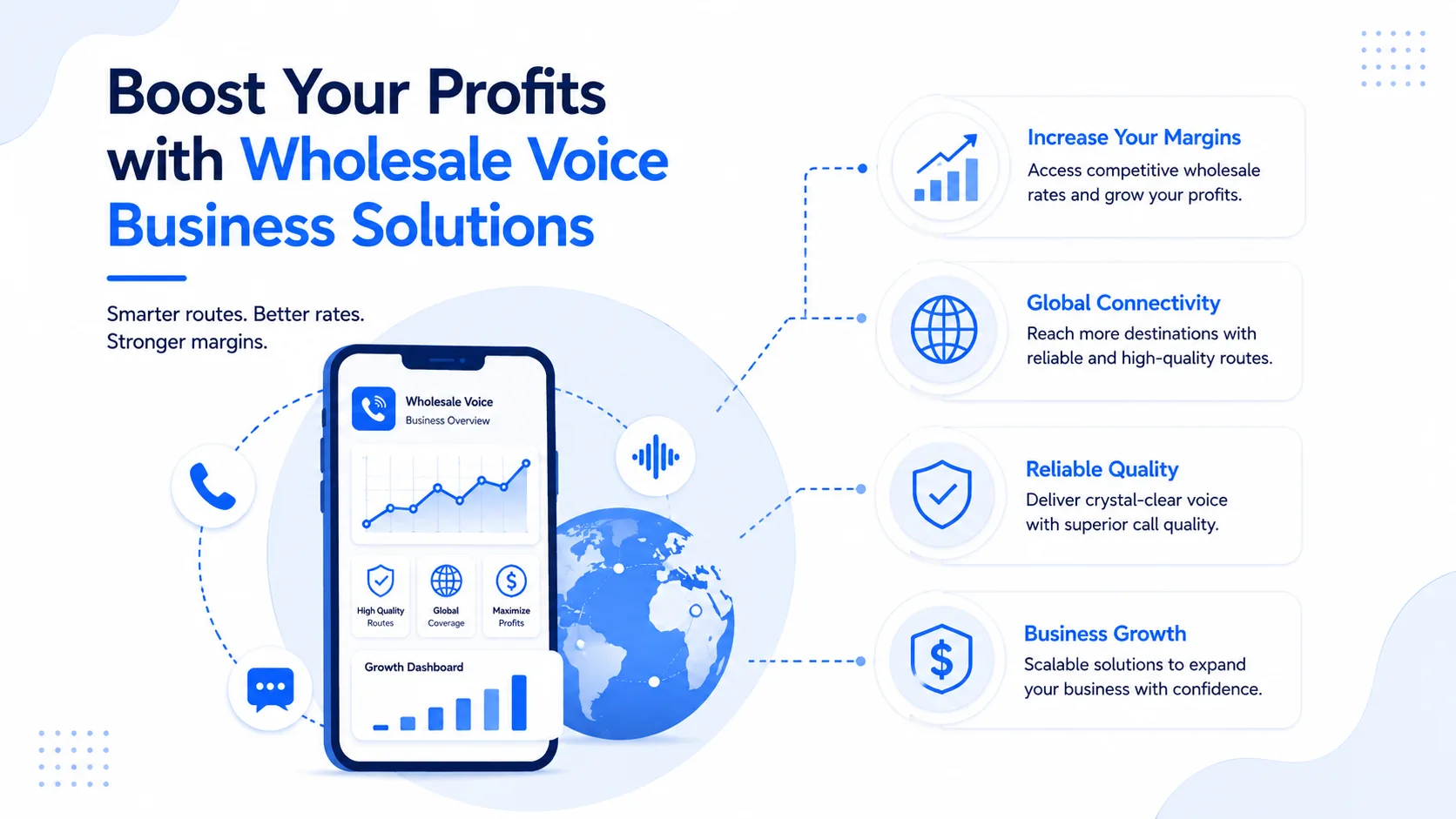
The wholesale voice business model is straightforward in theory and brutal in execution: buy bulk voice capacity from carriers at carrier-tier rates and resell it to operators, enterprises, and resellers. The margin lives in route quality, LCR routing intelligence, billing accuracy, and carrier relationships. This guide walks through how a real wholesale voice business operates in 2026, and how Twiching delivers carrier-grade solutions so partners can focus on growth.
What a Wholesale Voice Business Actually Does
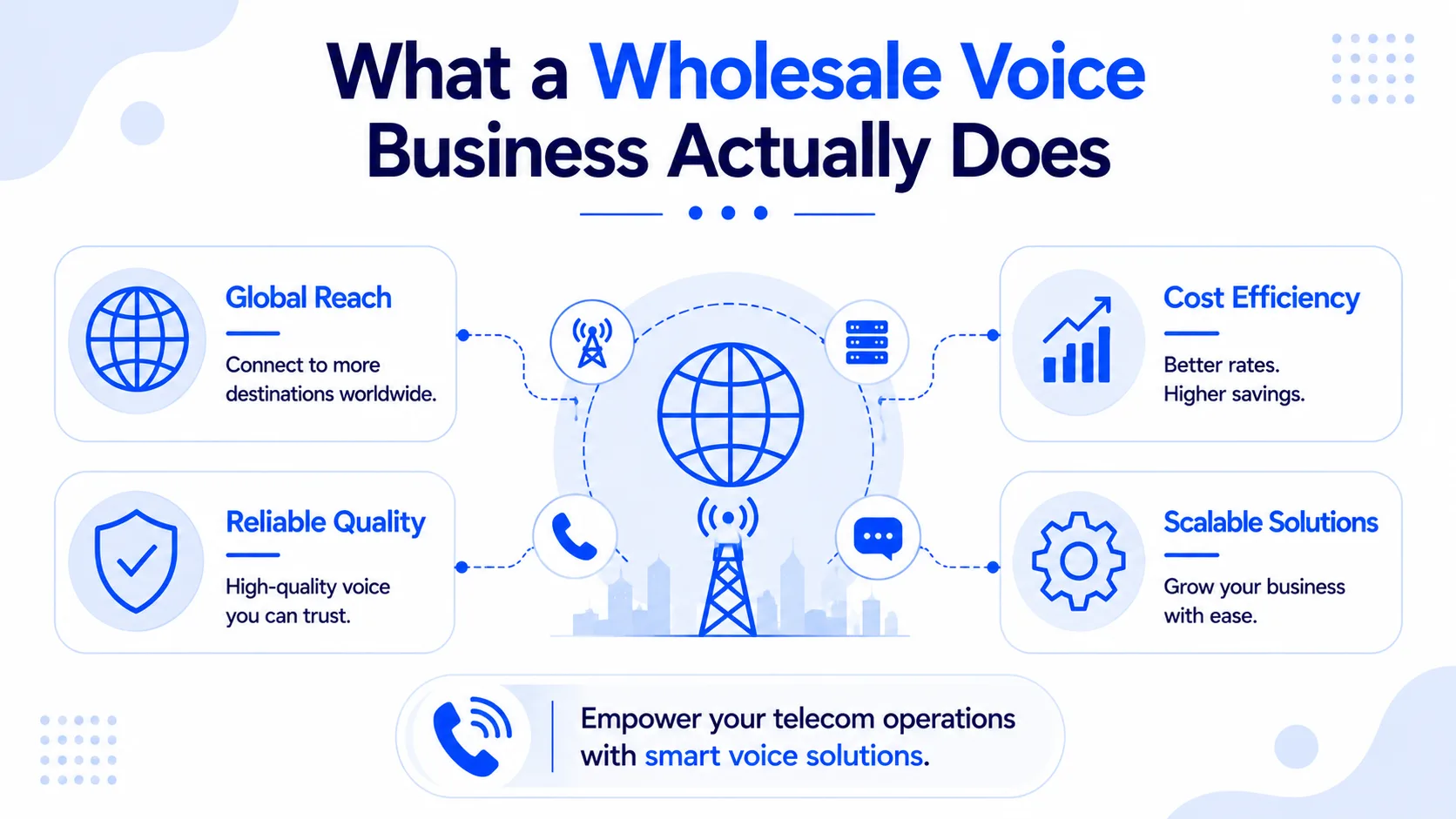
A wholesale voice business is the carrier-tier operator sitting between Tier 1 networks and the end-customer market. It purchases bulk capacity at carrier rates and runs LCR routing across multiple upstream paths.
It layers in fraud prevention and billing, then resells the resulting wholesale voice services to ITSPs, contact-centre platforms, and enterprises. The buyer never touches the underlying carrier; the wholesale voice business handles all of it.
The operational core is route management. A wholesale voice business that owns its routing intelligence — published wholesale VoIP rates, live ASR data, real-time quality scoring — can charge a premium that commodity resellers cannot match.
A wholesale voice business that simply re-prices someone else's routes is competing on price alone, and price-only competition is a slow path to no margin.
Revenue Streams Inside a Wholesale Voice Business
Further reading: Wholesale pricing & rate deck
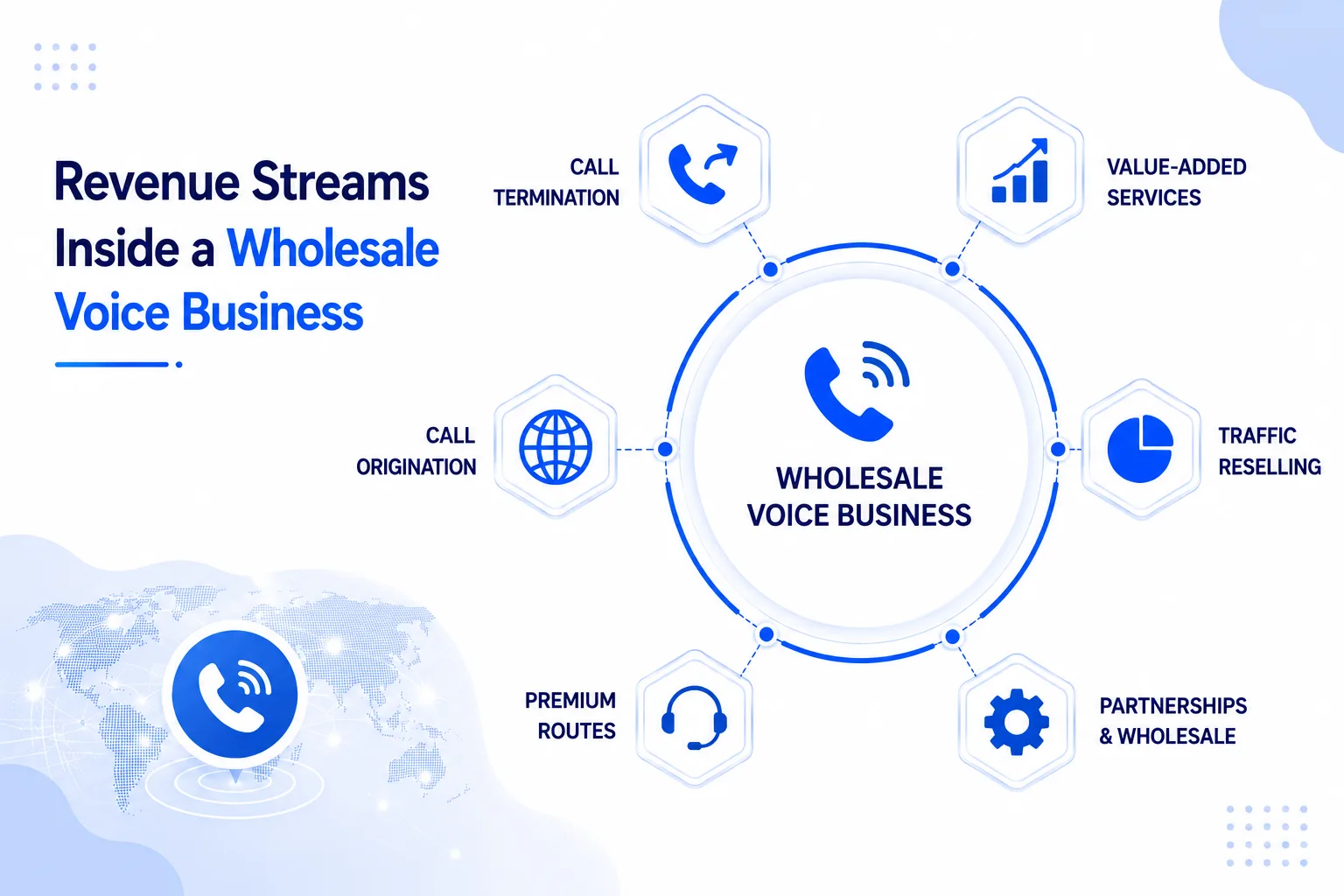
Core revenue inside a wholesale voice business comes from termination margins (per-minute spread between the buy and sell side), monthly SIP trunk fees, and DID number rental. None of these alone are usually enough to fund a serious operator. The strongest wholesale voice business models layer multiple revenue streams on top of the same infrastructure.
- Termination margin — the per-minute spread between purchased capacity and resale price.
- SIP trunking — monthly recurring fees on PBX-to-carrier trunks.
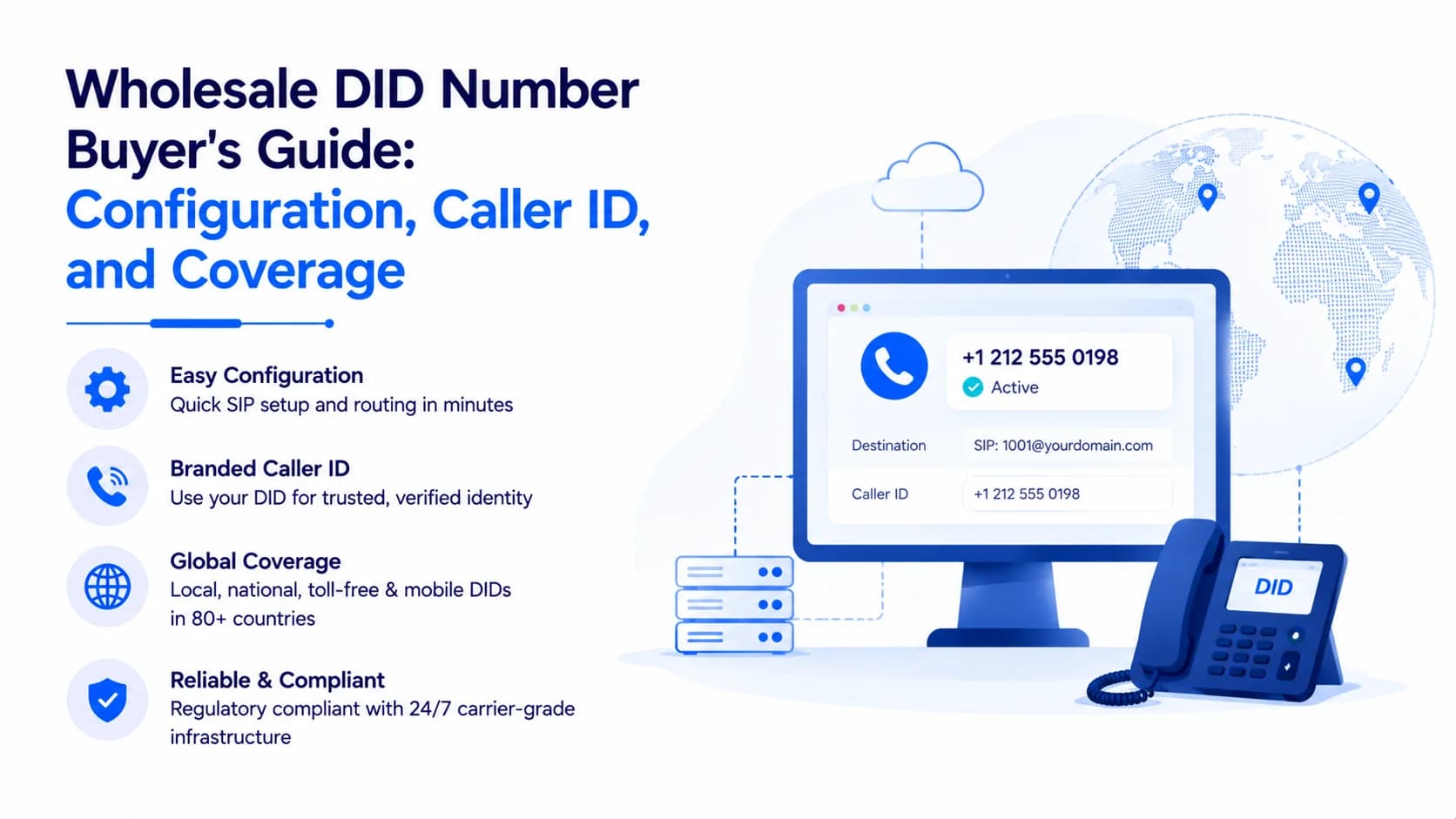
- DID rental — recurring monthly fees on local, mobile, and toll-free numbers.
- Call recording and analytics — subscription add-ons sold per seat or per minute.
- White-label reseller programme — revenue share with downstream partners.
- API access and CPaaS — usage-based fees on programmable voice and messaging.
- Transit fees — routing other carriers' traffic through the same wholesale voice carrier infrastructure.
Voice Traffic Management and LCR Routing
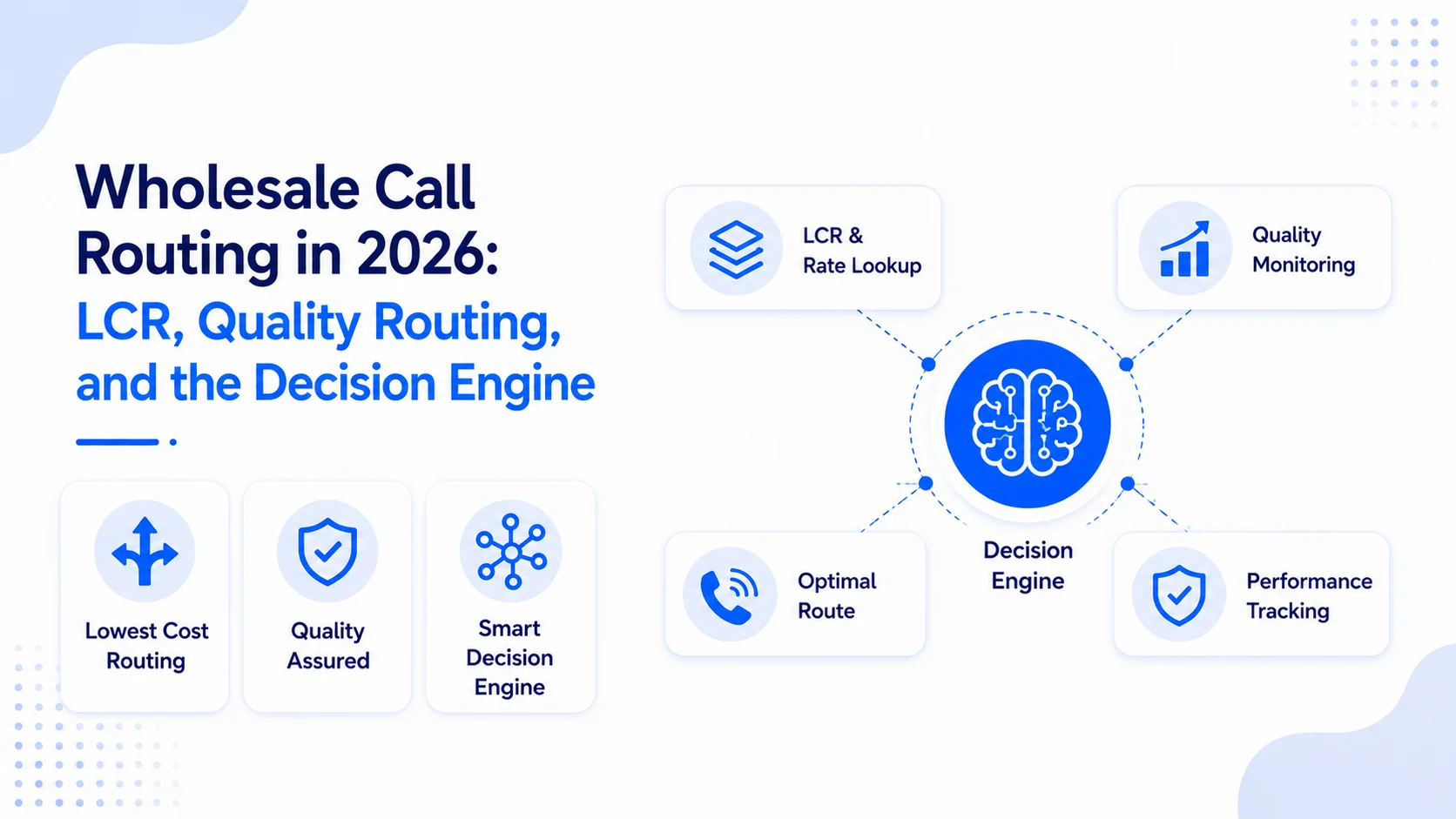
Voice traffic management is the discipline of getting every call onto the best available route at the lowest defensible cost. LCR (least-cost routing) is the algorithm that drives it.
The wholesale voice business consults its rate deck, applies quality floors (minimum ASR, maximum PDD), and picks the best path. Done right, LCR routing lifts gross margin by 200–400 basis points without raising customer-facing wholesale VoIP rates.
Modern voice traffic management is increasingly AI-assisted. Streaming CDRs feed quality scoring models that learn which carriers degrade at which times of day, and routing rebalances pre-emptively. For a wholesale voice business operating at scale, this is the difference between consistently delivering 96% ASR and chasing complaints at 92%.
Voice Reseller Programmes
Further reading: Wholesale voice solutions
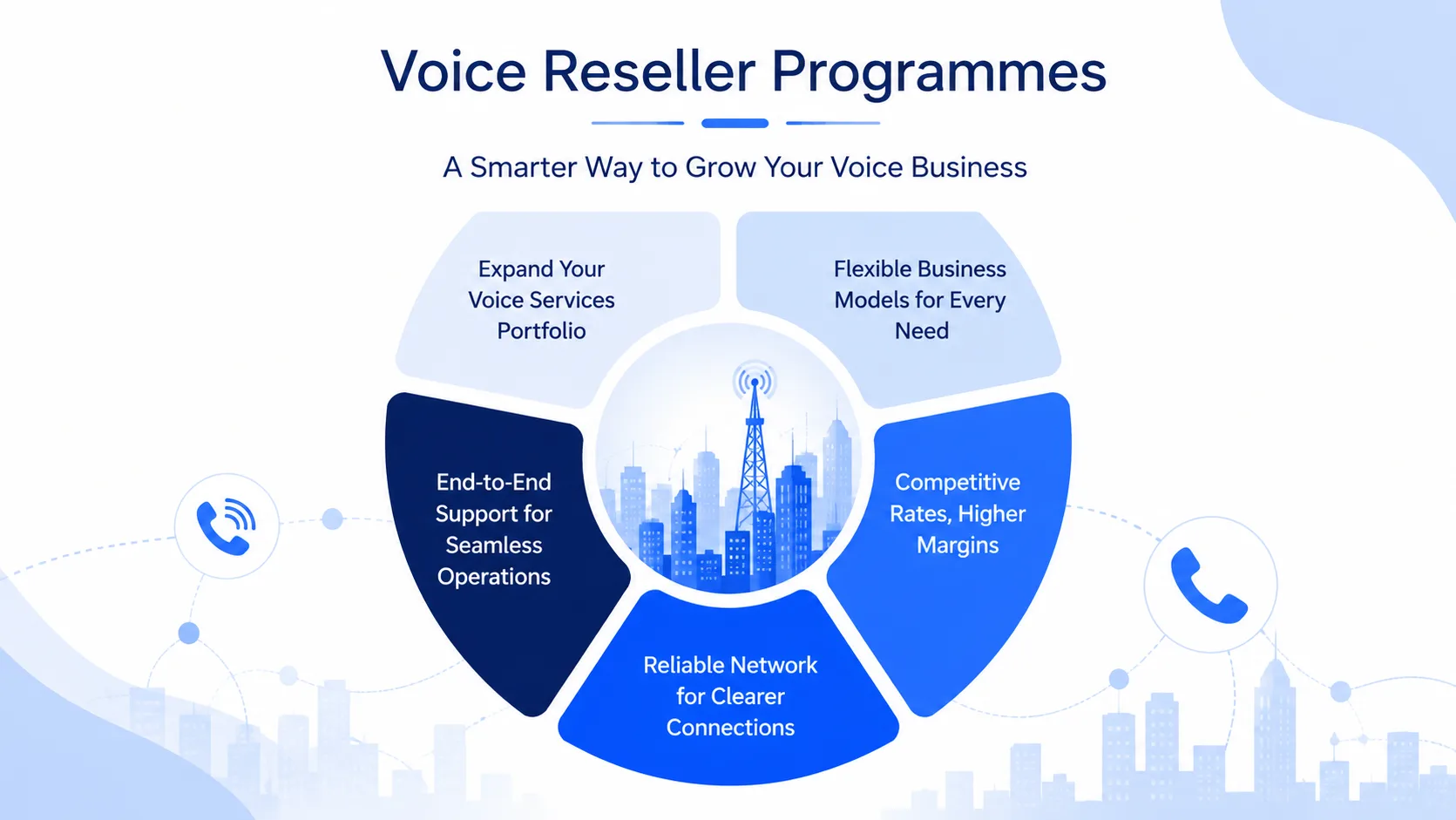
A voice reseller programme is the cleanest growth lever in any wholesale voice business. Resellers carry their own brand, set their own retail wholesale VoIP rates, and own the customer relationship.
The wholesale voice carrier handles softswitches, billing engines, and fraud controls behind the scenes. Distribution scales without proportional sales headcount.
Fair commissions paired with a fast onboarding ramp are the difference between a reseller programme that compounds and one that stalls. A wholesale voice business offering competitive rates, a branded portal, and KYC under 48 hours will outsell a slower competitor every time.
Technology Stack Behind a Wholesale Voice Business
At minimum, a wholesale voice business needs five pieces.
- A Class 4 softswitch.
- A real-time billing and CDR engine.
- A fraud detection layer.
- A self-service customer portal.
- Network monitoring.
Total monthly infrastructure cost for a cloud-native setup starts around USD 500–2,000 for a small operator and scales with concurrent call volume.
For most operators, building all of this from scratch is the wrong move. The capital, calendar time, and operational depth required to compete with established wholesale voice carriers is significant. The same outcome can be reached by signing with a credible wholesale voice carrier that already owns the carrier-grade VoIP infrastructure, NOC, and interconnects.
Fraud Prevention as a Business Function
IRSF (International Revenue Share Fraud) is the existential risk inside every wholesale voice business. A compromised customer trunk can rack up six-figure exposure overnight if controls are not real-time. Effective fraud prevention combines hard spend caps, destination whitelists, anomaly detection on streaming CDRs, and instant traffic pauses when patterns look off.
STIR/SHAKEN attestation adds another layer for US-bound traffic. Cryptographically signed caller ID raises ASR on US networks and protects the wholesale voice business reputation. A wholesale voice operator that has not implemented STIR/SHAKEN is leaving connection rates — and customer trust — on the table.
Competing in the Wholesale Voice Market
The wholesale voice market is highly competitive on commodity termination. Thin margins are the norm for undifferentiated operators, and price-only competition is a race to zero. The wholesale voice business operators that pull ahead compete on route quality, value-added services like analytics and recording, niche vertical focus, and responsive carrier-grade support.
Niche vertical focus matters disproportionately. A wholesale voice business optimised for healthcare, legal, or contact-centre verticals can defend higher wholesale VoIP rates. The customer is buying compliance, quality, and support — not just minutes.
Operators trying to be all things to everyone end up undercut by specialists in every segment.
How Twiching Supports a Wholesale Voice Business
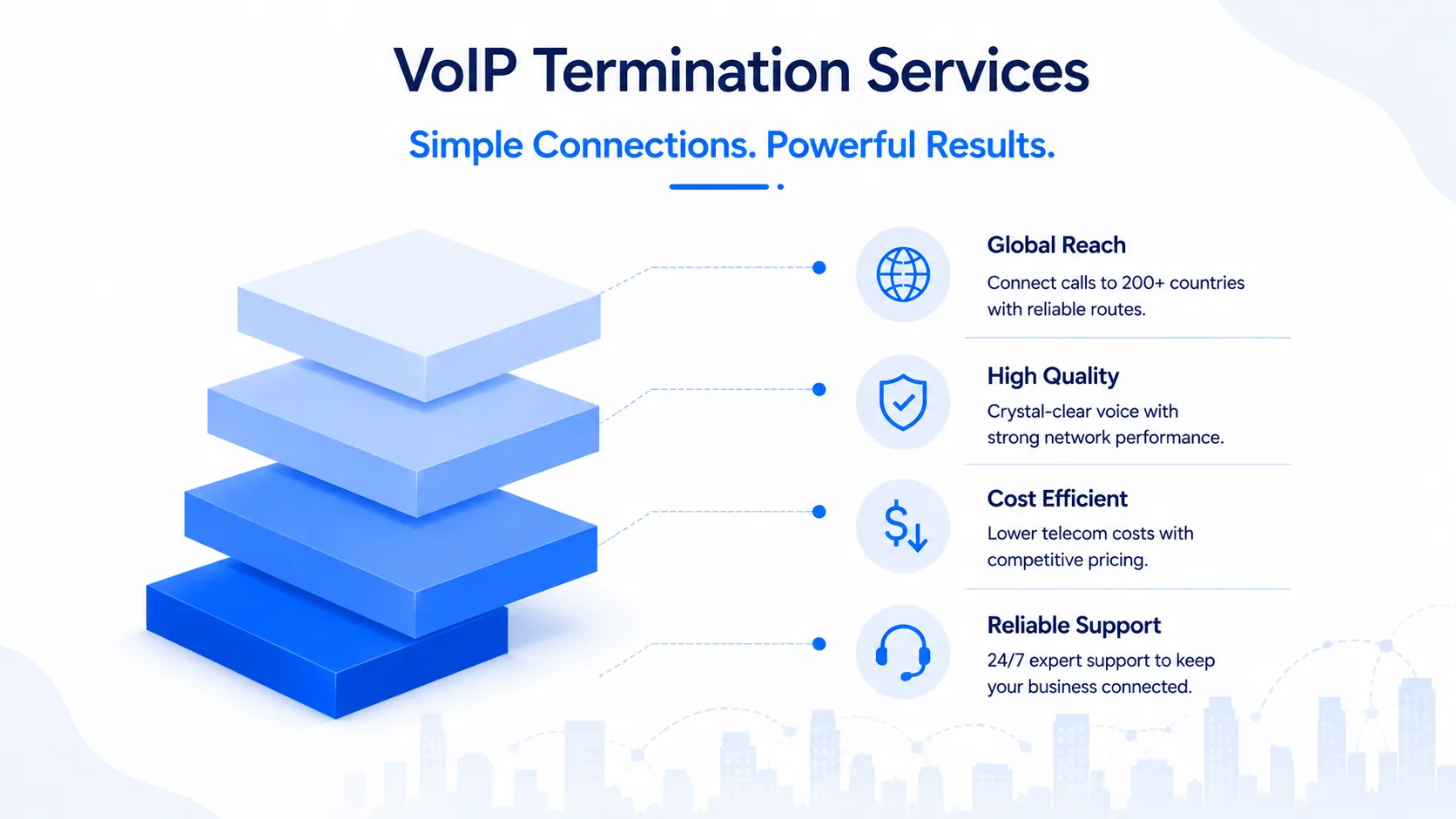
Twiching is purpose-built to run the carrier underneath every kind of wholesale voice business — ITSPs, resellers, contact-centre platforms, and enterprises with high-volume outbound. The platform combines a global softswitch fabric, direct Tier 1 interconnects across 200+ countries, full STIR/SHAKEN attestation, real-time CDRs, and a 24/7 NOC with 15-minute critical-incident SLA.
The same dashboard exposes per-destination route quality, configurable spend caps, and a white-label voice reseller programme — the operational primitives every wholesale voice business actually needs. Partners can launch their own branded wholesale voice carrier service in days on Twiching's wholesale voice solutions. Competitive wholesale voice rates and clean voice traffic management come already wired in.
The wholesale voice business operates on thin margins at high volume. Successful operators build cost advantages through long-term carrier relationships, automation of repetitive tasks, and specialisation in specific traffic types or geographic markets.
Generalist wholesale voice providers compete on price alone, which is a race to the bottom. Specialists who focus on, say, African termination or call centre traffic can command premium rates by offering superior route quality and market knowledge in their chosen niche.
Cash flow management is critical in the wholesale voice business. You typically pay carrier invoices monthly in arrears while collecting from customers weekly or biweekly. The timing mismatch requires working capital reserves of 1–2 months of carrier spend.
As you scale, negotiate extended payment terms (60–90 days net) with carriers while maintaining shorter collection cycles from customers. Factoring receivables is an option if capital is constrained during rapid growth phases.
Specialisation is a sustainable competitive strategy in the wholesale voice business. Generalist operators compete on price with hundreds of other wholesalers, which compresses margins to commodity levels.
Operators can specialise in specific geographic markets, say African termination or Latin American origination. Or they can specialise in specific traffic types, like premium call centre routes or high-volume SMS origination.
Either path builds route expertise and carrier relationships that create genuine competitive advantages. Customers with those specific needs will pay a modest premium for a provider who truly understands their requirements.
Technology investment priorities in a wholesale voice business should focus on automation first, differentiation second. Automate CDR processing, rate deck management, invoice reconciliation, and fraud detection before investing in features that differentiate your customer-facing offering. Automation reduces operational costs and errors, which improves margins immediately.
Differentiation features — better portal UX, richer analytics, tighter UC platform integrations — attract new customers and justify premium pricing. They only deliver value once your operational foundation is solid.
Review margin performance by route and by customer segment at least monthly. This ensures your pricing stays aligned with your cost structure as carrier rates and traffic volumes evolve.
Conclusion
A wholesale voice business is an infrastructure business with a software wrapper, not the other way round. Margin lives in route quality, LCR routing intelligence, voice traffic management discipline, real-time fraud prevention, and customer-grade support — not in the marketing copy on the homepage. Operators who treat the wholesale voice business as a carrier discipline (not a reseller hustle) compound margin year after year. Twiching runs the carrier-grade VoIP infrastructure underneath that discipline, so partners can launch a wholesale voice carrier business with competitive wholesale voice rates and credible wholesale voice solutions from day one.