Introduction
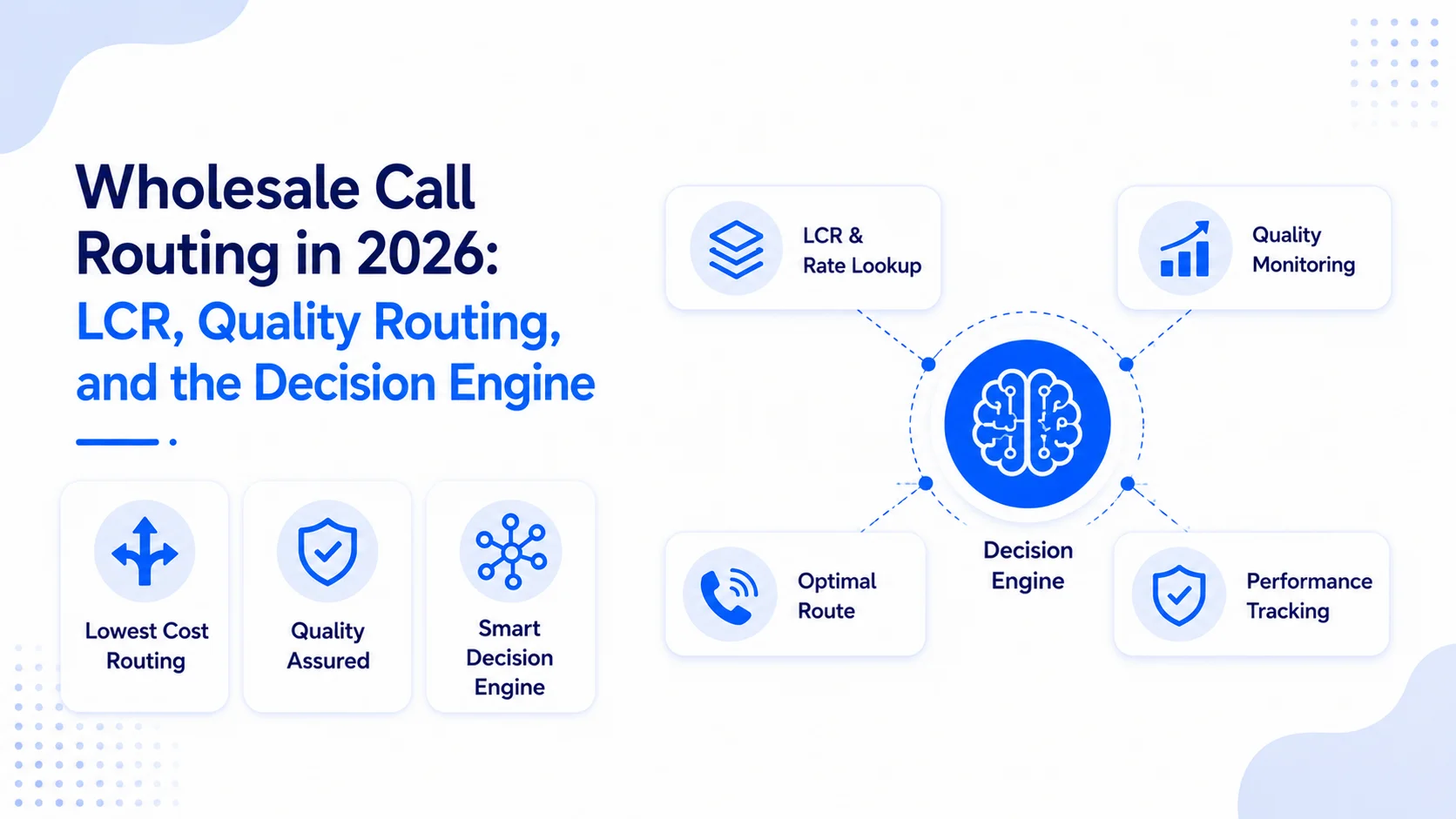
Wholesale call routing is the decision layer that picks which carrier carries each outbound call. The engine takes a destination number, consults rate decks from every active upstream carrier, applies cost and quality rules, and forwards the SIP INVITE to the chosen carrier. This guide walks through the routing strategies, data, and failover patterns that protect quality.
Done well, wholesale call routing delivers per-minute wholesale VoIP rates close to direct-interconnect economics, with quality close to a Tier 1 carrier.
Done badly, it sends premium customers over economy routes, leaks margin on misrouted traffic, and fails over slowly when carriers degrade.
This guide covers least-cost routing, quality-based routing, geographic affinity, weighted load balancing, and time-of-day routing. Twiching's wholesale call routing platform appears throughout as a worked example of a modern routing engine.
Key Takeaways
- Wholesale call routing is the decision layer that picks which upstream carrier carries each outbound call based on rate, quality, geography, and policy.
- Least-cost routing alone is not enough — quality filters and quality floors per traffic class are what stop LCR from sending premium traffic over degraded routes.
- Failover behaviour determines what happens when a carrier degrades — parallel failover minimises PDD on retries, sequential failover saves SIP capacity.
- The routing engine needs current rate decks, real-time ASR/PDD/MOS per route, and per-customer policy data to make decisions that hold up under campaign load.
- Twiching's wholesale call routing engine combines LCR, quality-based routing, geographic affinity, parallel failover, and real-time route demotion.
What Wholesale Call Routing Actually Is
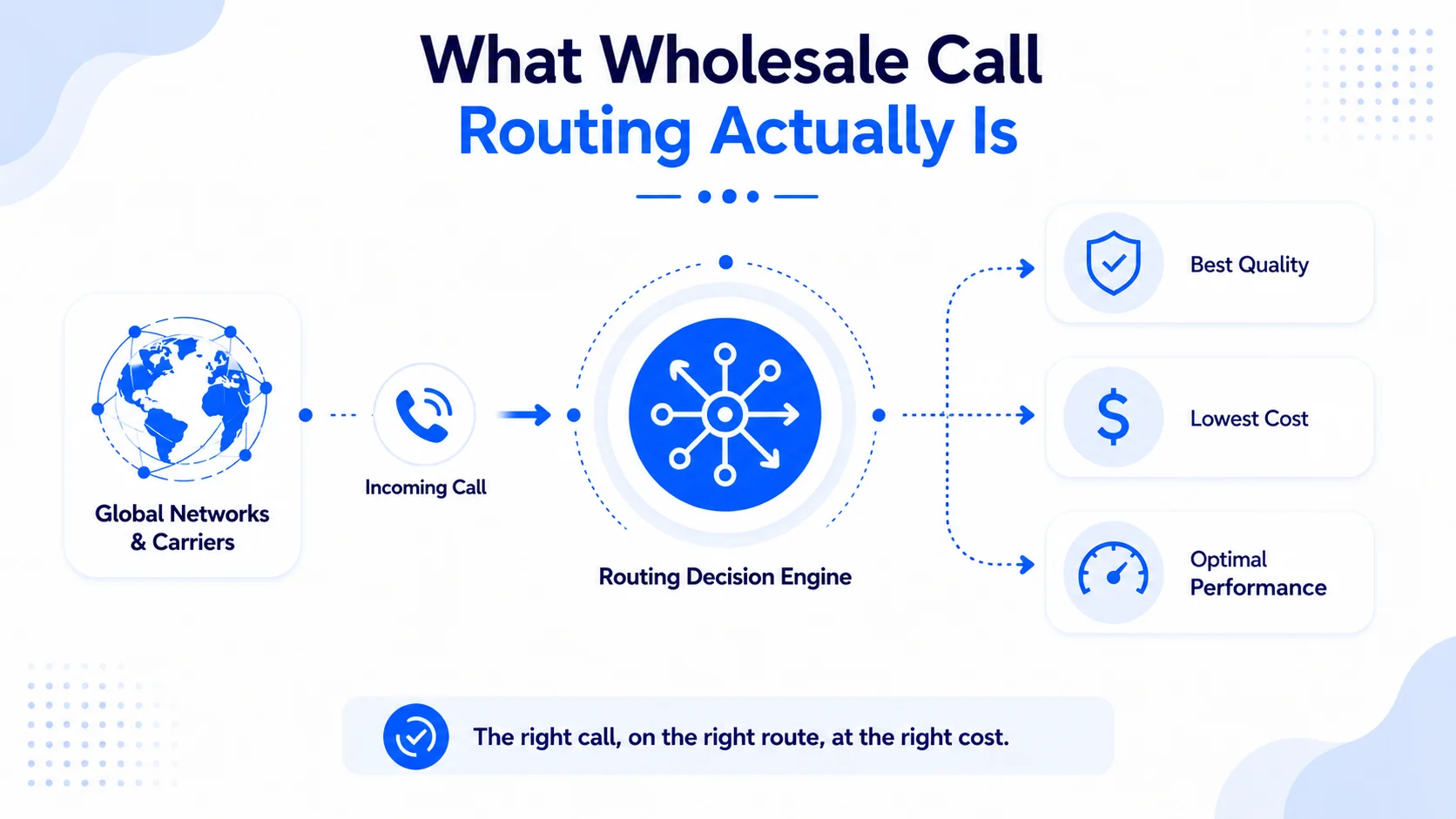
Wholesale call routing is the per-call decision the routing engine makes when an outbound INVITE arrives.
The engine looks at the destination prefix and queries the rate decks of every upstream carrier that has a route to that destination. It then applies the routing strategy (LCR, quality, geographic, weighted, or some combination).
It then checks customer-specific overrides and traffic-class quality floors.
It then forwards the call to the selected carrier. This happens in single-digit milliseconds and runs for every call the platform handles.
Bad routing decisions cost the wholesale VoIP business margin on every outbound call.
Routing decisions also have to respect carrier capacity. The engine knows the committed channel capacity it has against each carrier, the current real-time use, and the ceiling beyond which the carrier degrades.
Wholesale call routing engines that ignore capacity send too much traffic to the cheapest carrier and watch ASR collapse.
Least-Cost Routing — LCR
Further reading: Wholesale pricing & rate deck
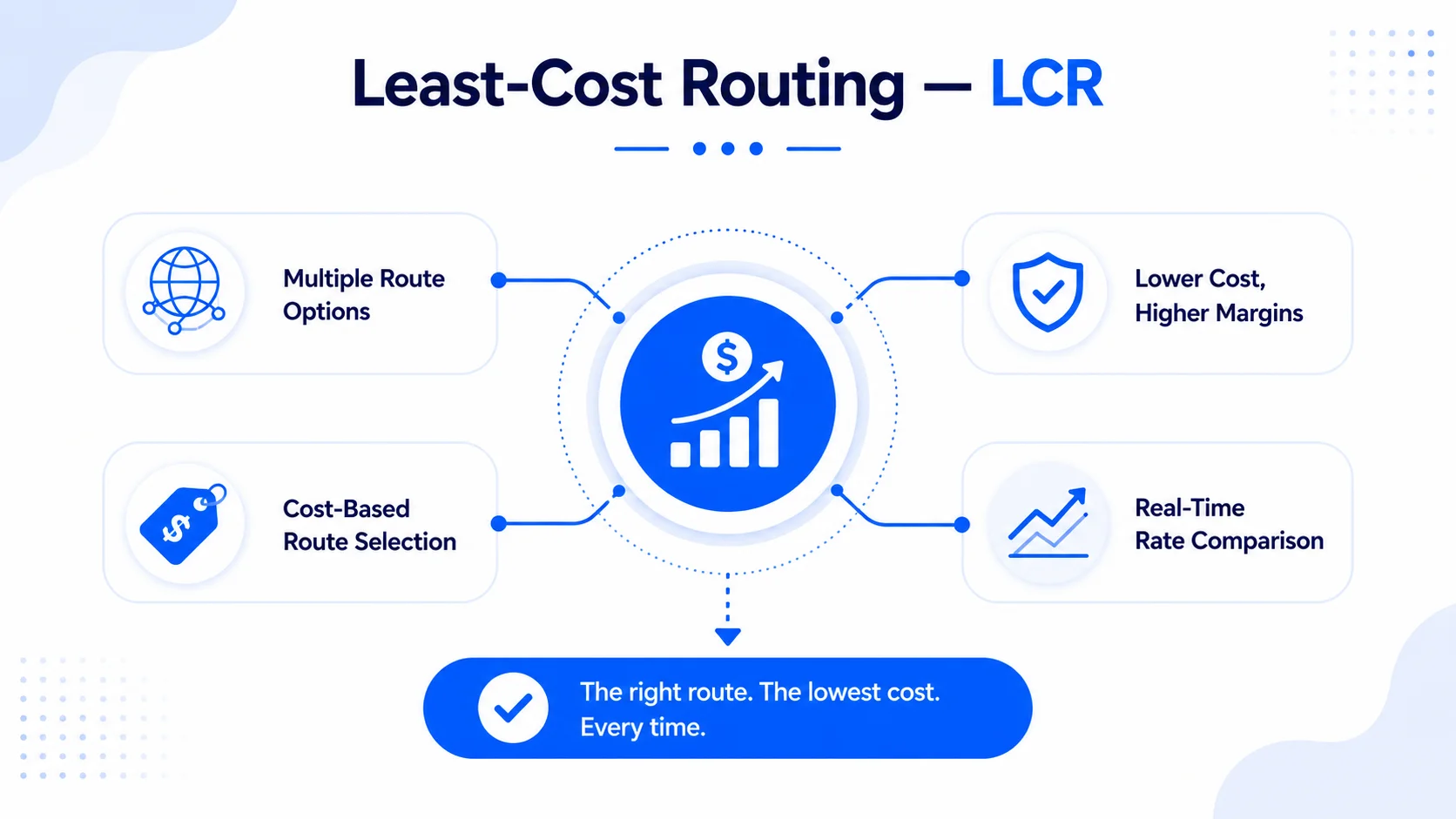
LCR is the default wholesale call routing strategy. For each destination prefix, it finds the carrier with the cheapest per-minute rate that meets the configured quality floor, and routes the call there.
The naive implementation sorts carriers by rate and picks the cheapest. The realistic implementation layers quality floors, customer overrides, and carrier capacity on top of the base sort.
LCR without quality floors sends premium customer traffic over economy carriers and produces the customer-quality complaints that drive churn.
Modern LCR engines support multi-tier routing — premium / standard / economy — so customers can pick the quality-vs-cost trade-off per destination class.
Premium routes use the most expensive, highest-quality carrier per prefix; economy routes use the cheapest. Twiching exposes the tier choice per destination prefix per customer in the portal.
Quality-Based Routing
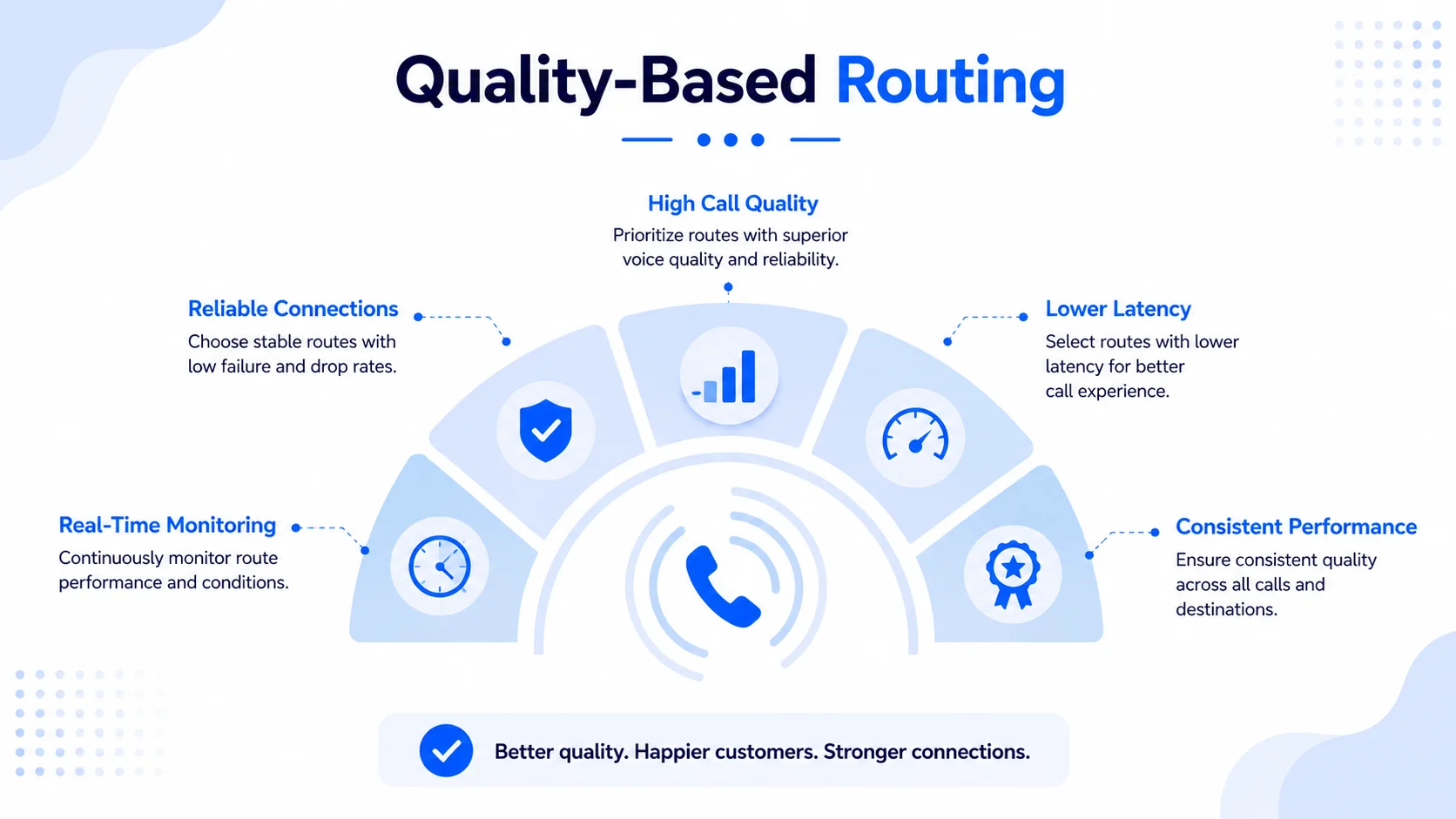
Quality-based routing picks the carrier with the best real-time quality metrics regardless of cost, within a set premium budget.
The engine consults the live ASR (Answer Seizure Ratio), PDD (Post-Dial Delay), and MOS (Mean Opinion Score) for each candidate route. It then forwards the call to the highest-scoring one.
This is the right strategy for contact-centre outbound traffic where every percentage point of ASR matters.
Quality data has to be current. A routing engine using yesterday's quality numbers will keep sending traffic to a route that degraded overnight.
Modern wholesale call routing platforms refresh quality metrics every 60 seconds and demote degrading routes within minutes, not hours. Twiching's engine updates per-prefix quality every minute and rebalances traffic away from degrading routes automatically.
Geographic Affinity and PoP-Aware Routing
Further reading: Wholesale voice solutions
Geographic routing matches the call's destination to the carrier with the most direct network path.
A UK-destined call routed through a carrier with a London PoP has lower latency and fewer hops. It also delivers better media quality than the same call routed through a US-only carrier.
Geographic routing matters more for media quality than for cost — the cheapest carrier on paper can be unusable if its network path adds 200ms of latency.
PoP-aware wholesale call routing also handles regulatory routing. EU-internal calls increasingly need to stay inside the EU for GDPR-of-call-content reasons. Calls into countries with specific national-routing rules need to enter via authorised carriers.
The routing engine encodes these regulatory constraints as routing policies, not as exceptions handled by support tickets.
Weighted Load Balancing
Weighted load balancing distributes traffic across multiple carriers at configured percentages. A wholesale call routing engine balancing 60/30/10 across three carriers sends 60% of qualifying traffic to the primary, 30% to the secondary, and 10% to the tertiary.
This pattern is useful for three reasons:
- Hitting committed-traffic-volume thresholds with each carrier, which trigger volume-rate discounts.
- Maintaining liveness on backup carriers.
- De-risking single-carrier outages.
Weighted routing also handles capacity ceilings. Once the primary carrier hits its committed channel limit, the engine shifts overflow to the secondary automatically — without operator help.
This is what lets a wholesale call routing platform absorb traffic spikes without degrading any single carrier.
Failover Patterns — Sequential vs Parallel
Failover is what happens when the selected route fails.
Sequential failover tries one route at a time. The engine sends the INVITE to the primary, waits for a SIP 4xx/5xx or timeout, then re-sends to the secondary.
Sequential failover is simple and saves SIP capacity, but it adds PDD on retries. By the time the call connects on the third attempt, the caller may have hung up.
Parallel failover sends the INVITE to multiple candidate routes simultaneously and connects the first one that answers, cancelling the others. Parallel failover minimises PDD but uses more carrier-side SIP capacity per call.
Modern wholesale call routing engines pick the pattern per traffic class — sequential for low-volume background traffic, parallel for contact-centre predictive dialler traffic where PDD matters.
What the Routing Engine Needs
Wholesale call routing engines need accurate, current data to make good decisions. The minimum data set is current rate decks from every active carrier with effective dates and notice periods.
It also includes real-time ASR, PDD, and MOS per route, updated at least every minute.
It also needs committed channel capacity and current real-time use per carrier. Per-customer routing policies, traffic-class quality floors, and per-prefix regulatory routing constraints round out the data set. Any of these going stale degrades routing quality.
The engine also needs feedback. When a call fails or completes, the CDR feeds back into the quality dataset.
A wholesale call routing platform that doesn't update its quality model from its own CDR feed flies blind. Twiching's engine ingests CDRs into the quality model in real time so the next call to the same destination uses the latest data.
Time-of-Day and Day-of-Week Routing
Some destinations behave differently by time of day.
A route that hits 65% ASR during European business hours can collapse to 35% in the early morning UTC. This happens because the destination carrier's overnight switch is congested or the destination network rate-limits.
Time-of-day routing rules tell the engine to use a different route between specified hours, restoring ASR without operator help.
Day-of-week patterns matter for weekend campaigns and for destinations where regulatory routing rules differ on weekends.
A wholesale call routing engine that doesn't support time-and-day routing forces operators to flip routes manually around the clock, which is not sustainable long-term.
Wholesale Call Routing Checklist
- 01Multi-tier LCR — premium, standard, economy routing per destination prefix with quality floors
- 02Real-time quality data — ASR, PDD, MOS refreshed at least every 60 seconds with automatic route demotion
- 03Geographic and PoP-aware routing — destination affinity rules that respect regulatory routing constraints
- 04Weighted load balancing — percentage distribution across multiple carriers with overflow handling
- 05Failover pattern selectable per traffic class — sequential for background, parallel for dialler-grade traffic
- 06Capacity-aware decisions — engine knows committed channels and current utilisation per carrier
- 07Customer-specific overrides — per-customer routing policies that override defaults without forking config
- 08Time-of-day and day-of-week rules — automatic route switching by clock without operator intervention
- 09Feedback loop from CDRs — call outcomes feed back into the quality model in real time
- 10Rate-deck lifecycle — automatic ingestion, validation, distribution with effective dates and notice periods
Twiching's Wholesale Call Routing Engine
Twiching operates a wholesale call routing engine that implements every item on the checklist above.
Multi-tier LCR runs per destination prefix with configurable quality floors, and real-time ASR/PDD/MOS refresh every 60 seconds per route with automatic demotion of degrading carriers.
Geographic routing respects PoP affinity and regulatory routing constraints. Weighted load balancing absorbs traffic spikes without overflowing any single carrier.
Failover behaviour is set per traffic class, and CDR feedback loops the quality model in real time.
Per-destination wholesale VoIP rates and routing policies are visible to customers through the portal and API.
Contact-centre customers running predictive dialler traffic get parallel failover with sub-3-second PDD, while background reseller traffic uses sequential failover to conserve SIP capacity.
Customers see effective routing tier per destination on every CDR. The data they need to audit routing decisions is in the same row as the rate they paid.
Conclusion
Twiching's wholesale call routing engine implements the full checklist above and exposes routing tier and effective rate on every CDR so customers can audit decisions, not guess at them. Walk through a destination-level routing review against Twiching's published wholesale VoIP rates to benchmark whether the engine carrying your outbound traffic is making the decisions you want.