Introduction
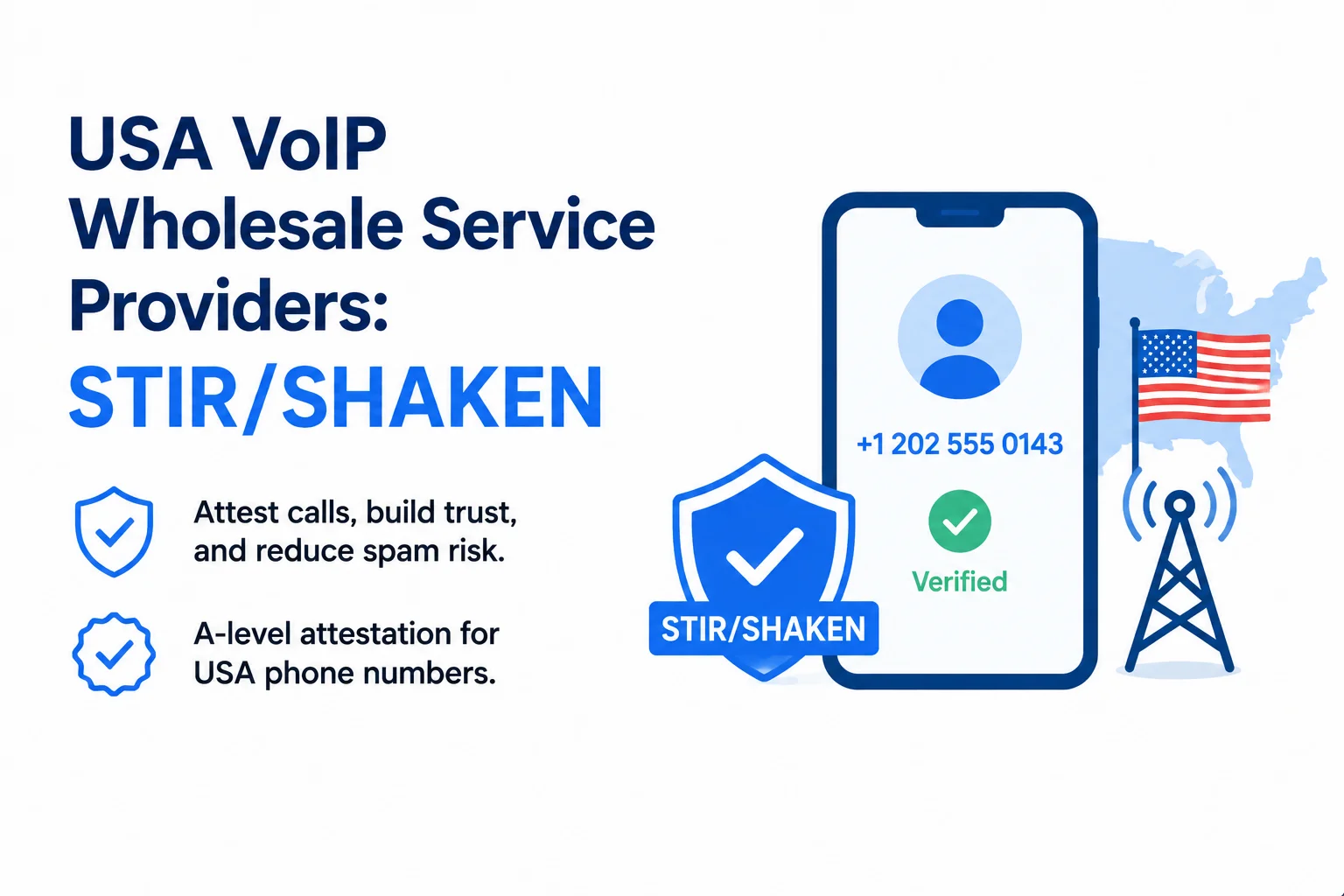
USA-based buyers of VoIP wholesale service providers face a compliance stack no other market enforces with the same teeth: mandatory STIR/SHAKEN attestation, Robocall Mitigation Database registration, FCC Form 499-A filings, and TRACED Act enforcement. This guide covers what every domestic buyer must verify — A-attestation evidence, RMD certificate validity, 499-A filings on record, and the contractual liability language that protects you when the carrier above slips.
Key Takeaways
- VoIP wholesale service providers bundle SIP trunking, A-Z termination, DID origination, toll-free hosting, porting, and SMS at per-minute wholesale VoIP rates.
- Redundancy architecture — geographically distributed softswitch clusters, multi-carrier upstream diversity, automatic failover — determines whether the platform survives under load.
- Support tier matters as much as the rate deck — a named technical contact with 15-minute critical-incident SLA at 3am is what protects revenue.
- STIR/SHAKEN attestation, GDPR-compliant CDR handling, and emergency-services compliance are 2026 baselines, not differentiators.
- Total cost = blended per-minute termination + monthly DID fees + SIP trunk fees + value-added features + lifecycle fees — model it across the actual estate before signing.
What VoIP Wholesale Service Providers Actually Do
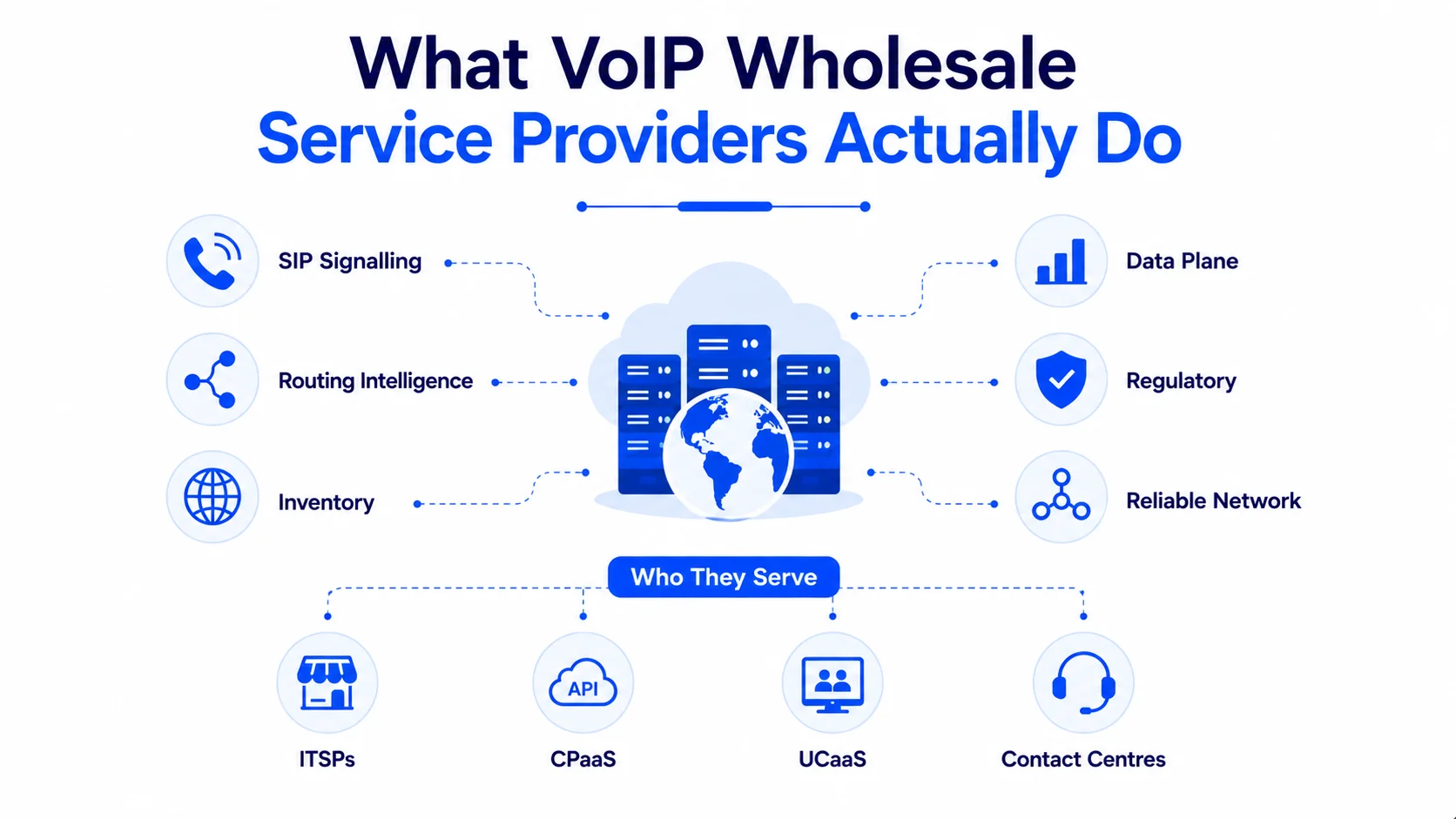
A VoIP wholesale service provider operates as the carrier-tier supplier behind other businesses.
The customer side is never an end consumer.
- An ITSP reselling minutes and numbers to small businesses.
- A CPaaS layer building voice into an app.
- A UCaaS platform handing out seats.
- A contact centre running campaigns.
- Another wholesale operator aggregating downstream demand.
The supplier-side stack covers the SIP signalling layer (Class 4 softswitch) and routing intelligence (multi-tier LCR with quality-aware demotion).
It also covers inventory (DIDs across countries plus toll-free) and the data plane (real-time CDRs, webhook events).
The regulatory layer rounds it out: STIR/SHAKEN attestation, E.911 registration, address-of-record, and CALEA lawful intercept.
VoIP wholesale service providers compete on the bundle, not just the rate. A cheap rate deck is meaningless if the SIP trunk drops 5% of INVITEs.
It's also meaningless if porting takes 30 days when 5 was promised, or if STIR/SHAKEN attestation is only B-level when US carrier spam analytics demand A.
The evaluation question is the whole bundle and the whole operations layer.
What VoIP Wholesale Service Providers Bundle
Further reading: Wholesale pricing & rate deck
The core bundle every credible VoIP wholesale service provider exposes starts with SIP trunking (committed concurrent channels plus elastic burst). It adds outbound A-Z termination at per-minute wholesale VoIP rates across 200+ countries via multi-tier LCR.
It also includes several additional services.
- Inbound DID origination in 80+ countries with REST API provisioning.
- US toll-free hosting via the Toll-Free Number Database.
- Number porting with stage-by-stage status visibility.
- Outbound SMS where the buyer's product needs it.
Anything less and you're talking to a niche specialist, not a general-purpose VoIP wholesale service provider.
Advanced bundles layer on top.
- Call recording with retention controls.
- Real-time analytics dashboards.
- IRSF fraud detection with hard spend caps.
- REST APIs covering every routine operation (search, provision, configure routing, query CDRs, submit ports).
Webhook delivery for call events and white-label reseller infrastructure round out the advanced tier. These features are useful for customers who want to launch their own wholesale VoIP business on the supplier's platform.
Redundancy Architecture That Holds Under Load
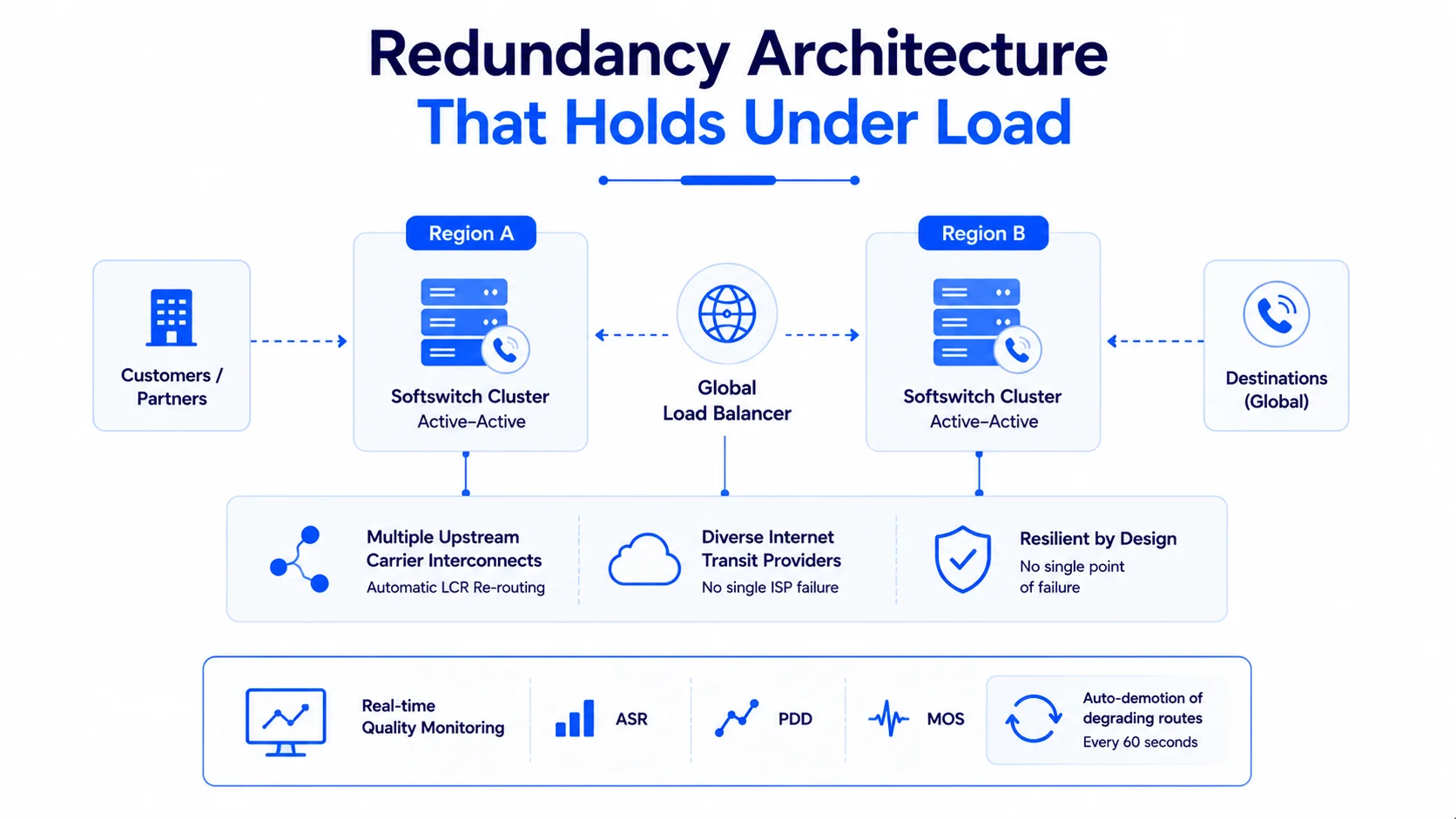
Redundancy is what separates VoIP wholesale service providers that survive a Friday-afternoon traffic spike from those that don't.
The architecture that holds: geographically distributed softswitch clusters running active-active across multiple regions.
It also means multiple upstream carrier interconnects per major destination prefix, so any single carrier outage triggers automatic LCR re-routing within minutes.
Diverse internet transit providers ensure a single ISP failure doesn't take the platform out.
Real-time per-destination quality monitoring demotes degrading routes automatically, rather than waiting for a human to spot the problem.
VoIP wholesale service providers that run a single softswitch in a single data centre are single points of failure. Ask for the architecture diagram and the 12-month uptime history before signing.
Twiching runs multi-region active-active with 99.99% platform uptime, real-time ASR/PDD/MOS monitoring per destination refreshed every 60 seconds, and auto-demotion of degrading carriers without operator intervention.
Support Tiers — What 3am Actually Looks Like
Further reading: Wholesale VoIP platform
Support tier varies dramatically across VoIP wholesale service providers. The minimum-viable tier is a self-service portal plus an email queue with a 24-hour response SLA. That's fine for routine provisioning, but useless when production traffic is degrading at 3am.
The enterprise tier is a named technical account manager and a 24/7 NOC with a 15-minute critical-incident SLA. It also includes proactive outreach when the provider's monitoring detects issues affecting the customer's traffic before the customer notices.
The right tier depends on what's running on the trunk. Contact-centre and ITSP customers running mission-critical voice need the enterprise tier — anything less and a Friday outage means missed customer calls until Monday.
Twiching's enterprise tier ships with named escalation contacts updated in the customer portal. It also includes 24/7 NOC response on critical incidents within 15 minutes, and proactive notification on detected route degradation.
Compliance Posture in 2026
Compliance is no longer optional for VoIP wholesale service providers. A-level STIR/SHAKEN attestation on US-bound outbound traffic is the gatekeeper — anything less triggers Spam Likely labelling that collapses answered-rate.
GDPR-compliant CDR handling matters for any traffic touching EU jurisdictions. Call recording with retention controls and lawful intercept (CALEA in the US, equivalent rules elsewhere) is required for regulated industries — financial services, healthcare, government.
E.911 registration in the US ties every DID to a physical address for emergency dispatch.
Ask each VoIP wholesale service provider on the shortlist for documented FCC interstate-carrier authorisation and state PUC registrations for intrastate services. Also ask for equivalent national regulatory authorisation in every market they sell into.
Providers that ask buyers to take compliance on trust without paper are a red flag.
Twiching publishes its US and EU regulatory authorisation per market and provides A-level STIR/SHAKEN attestation by default on outbound traffic presenting hosted DIDs.
The Total-Cost Model
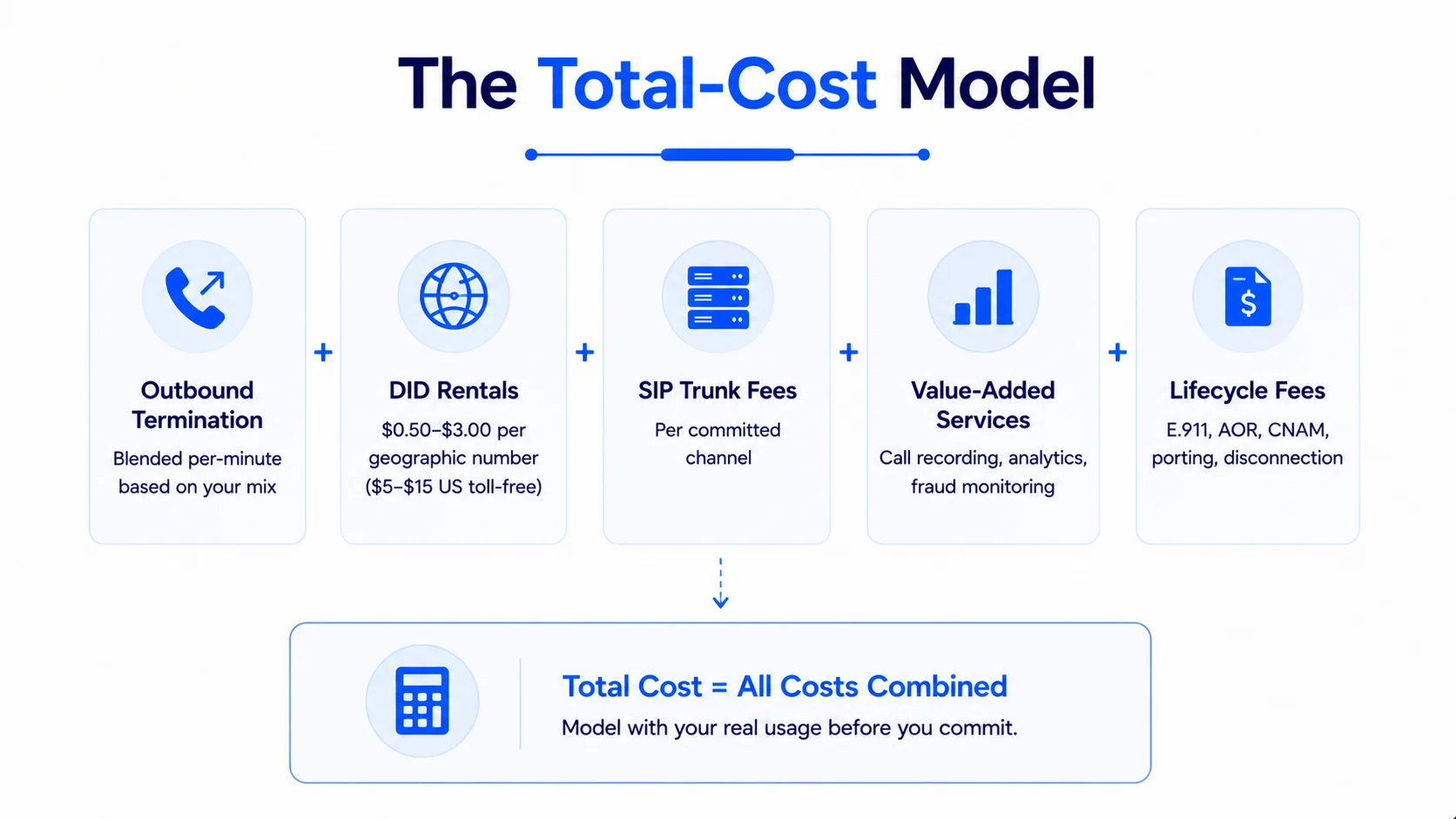
Headline per-minute rates lie. The total cost of running on a VoIP wholesale service provider is the sum of several pieces.
It starts with blended per-minute outbound termination, weighted by your actual destination mix and volume. Add to that monthly DID rentals at $0.50–$3.00 per geographic number and $5–$15 for US toll-free.
SIP trunk fees per committed channel and subscription fees on value-added services (call recording, analytics, fraud monitoring) add to that. Lifecycle fees on E.911 registration, address-of-record changes, CNAM updates, porting, and disconnection also factor into total cost.
Build the model against your real estate before signing. Take the last three months of CDRs and blend the new provider's rate deck across your actual destination mix.
Then add the per-number rentals for your actual DID count, layer on the value-added subscriptions you'll use, and add the lifecycle fees at your realistic operating frequency.
The provider that wins on headline rate often loses on total cost once the hidden fees compound at scale.
VoIP Wholesale Service Provider Evaluation Checklist
- 01Bundle completeness — SIP trunking, A-Z termination, DID origination, toll-free, porting, SMS, plus the value-added layers
- 02Per-destination wholesale VoIP rate deck published with billing increments, currency, and effective dates
- 03Multi-tier LCR with real-time per-destination ASR/PDD/MOS dashboards refreshed every 60 seconds
- 04Multi-region active-active platform architecture with documented 12-month uptime history above 99.99%
- 05A-level STIR/SHAKEN attestation inline on US-bound outbound traffic, CLI compliance on UK/EU outbound
- 06Documented FCC and equivalent EU regulatory authorisation per market, GDPR-compliant CDR handling
- 07REST API surface — search, provision, routing config, CDR retrieval, porting, webhook delivery
- 08IRSF fraud protection with hard spend caps and default-deny premium-rate posture, customer-configurable
- 09Enterprise support tier with named technical contact and 15-minute critical-incident SLA at 3am
- 10Total-cost model showing realistic costs across termination + DIDs + trunks + value-added + lifecycle fees
Twiching as a VoIP Wholesale Service Provider
Twiching operates as a technology-led VoIP wholesale service provider with several core capabilities.
- Direct SIP interconnects across 200+ countries.
- DID inventory in 80+ countries via REST API.
- Cloud-native Class 4 softswitch in multi-region active-active configuration.
- Multi-tier LCR with auto-demotion on degrading routes.
The platform also runs several additional layers.
- Real-time CDR streaming via webhook and Kafka.
- A-level STIR/SHAKEN attestation on US-bound outbound.
- IRSF protection by default with customer-configurable spend caps.
- Documented FCC plus equivalent EU regulatory authorisation per market.
The enterprise support tier ships with several elements.
- A named technical account manager.
- 24/7 NOC response on critical incidents within 15 minutes.
- Named escalation contacts updated in the portal.
- Proactive outreach when monitoring detects route degradation.
Per-destination wholesale VoIP rates publish with billing increments and effective dates visible on every row. There are no large volume minimums on standard business accounts, and onboarding completes in under 48 hours from KYC submission to production SIP trunks.
Conclusion
Evaluating VoIP wholesale service providers is a structured exercise — bundle completeness, redundancy architecture, support tier, compliance posture, REST API surface, and the total-cost model that exposes lifecycle fees. Headline per-minute rates are necessary but not sufficient; the whole bundle and the whole operations layer determine whether the provider holds quality under campaign load and survives at 3am when something breaks. Twiching ships the full stack — direct interconnects across 200+ countries, multi-region active-active platform, A-level STIR/SHAKEN attestation, IRSF protection by default, REST API across the lifecycle, named technical contacts, 15-minute critical-incident SLA — and publishes per-destination wholesale VoIP rates with billing increments and effective dates on every row. Run the evaluation checklist above against your current VoIP wholesale service provider, then model total cost against Twiching's published terms to benchmark whether your current supplier is still the right one.