Introduction
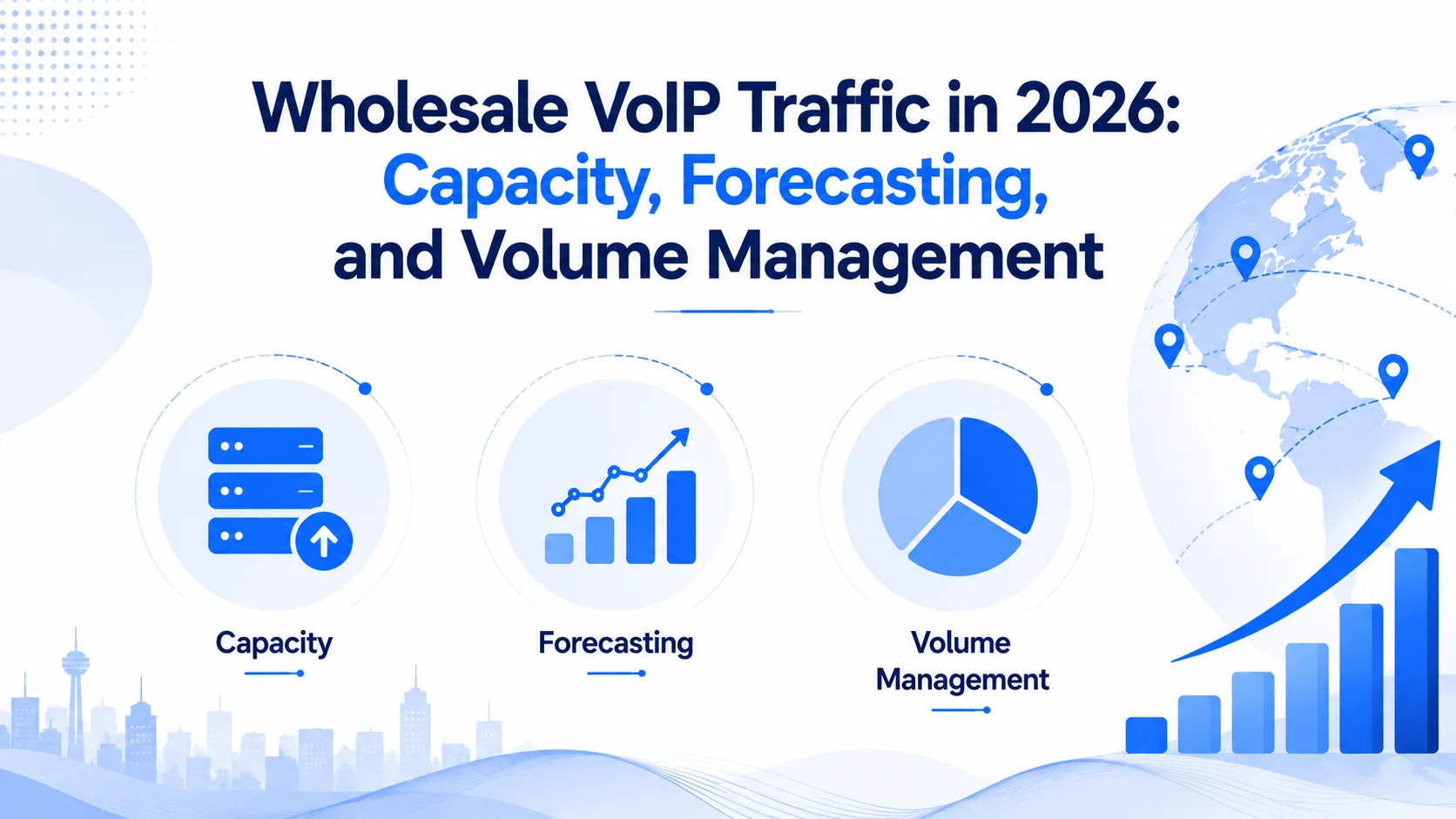
Wholesale VoIP traffic is the aggregate voice load flowing through a carrier's network, measured in minutes per month, peak concurrent calls, and destination mix. Managing it well separates a carrier that holds up under campaign launches from one that drops calls during peaks. This guide explains how traffic is measured and managed.
How Wholesale VoIP Traffic Is Measured
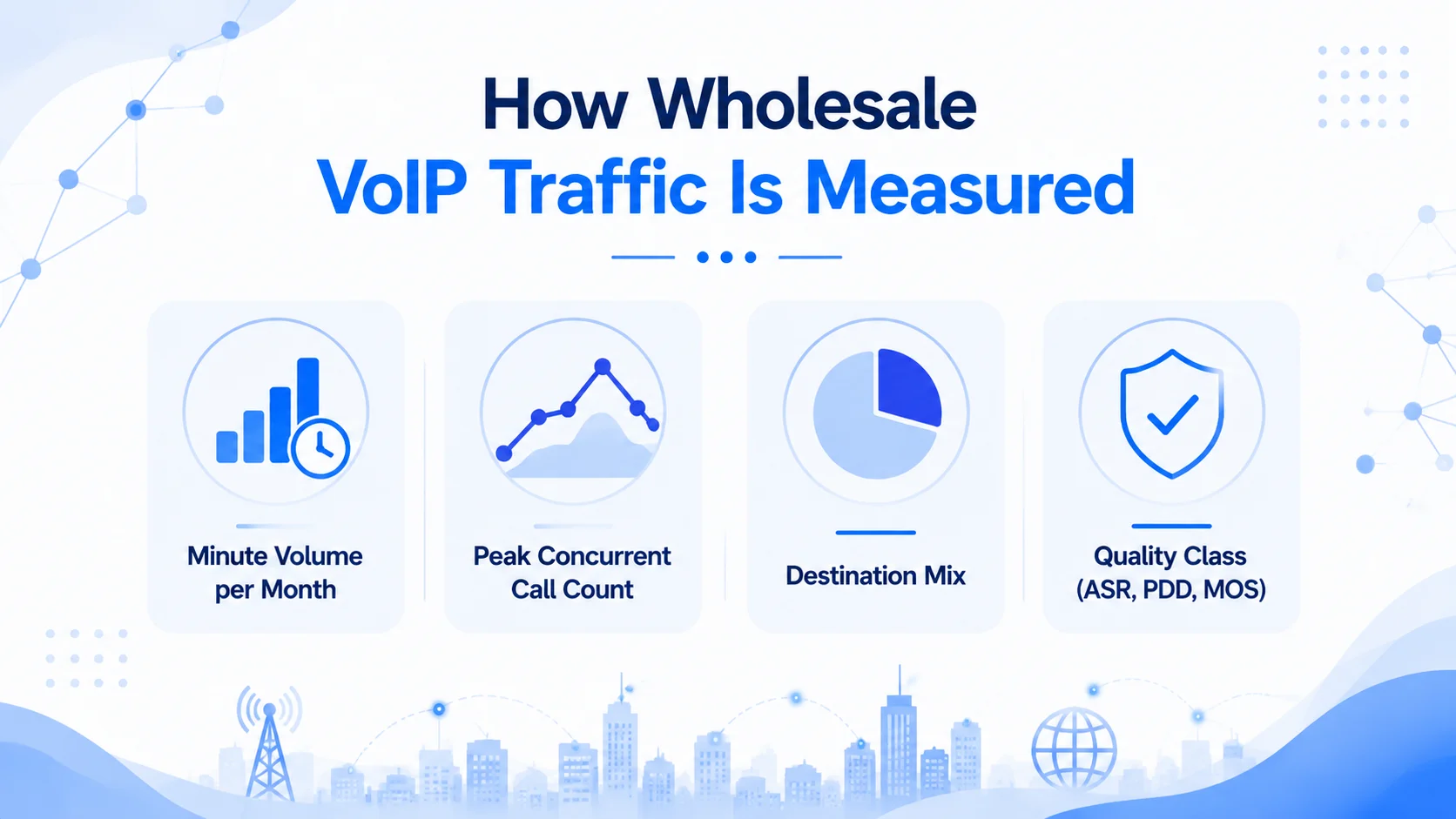
Wholesale VoIP traffic is measured along four axes that together describe the load a carrier is carrying. Minute volume per month is the headline number — total billable minutes that flow through the SIP trunks.
Peak concurrent call count is the operational ceiling — the maximum number of simultaneous calls the network has to support without dropping any. Destination mix tells you where the traffic is going, and quality class tells you what ASR, PDD, and MOS targets each route has to hit.
A wholesale VoIP carrier that measures only minute volume is missing the operational dimension. Two customers shipping 5,000,000 minutes per month with the same destination mix can behave completely differently.
One has smooth diurnal traffic at 200 concurrent calls peak. The other has bursty contact-centre wholesale VoIP traffic spiking to 8,000 concurrent at campaign start. Capacity planning has to address both shapes, not just the monthly total.
Why Wholesale VoIP Traffic Patterns Matter
Wholesale VoIP traffic falls into broad patterns: steady-state business voice, bursty contact centre dialler load, A2P messaging-adjacent voice (verification callbacks, fraud alerts), and inbound queue traffic. Each pattern places different demands on the carrier's softswitch, SBC layer, and upstream interconnects.
Carriers tune capacity and fraud detection per traffic class. A single one-size-fits-all configuration will either over-provision for steady traffic or under-provision for bursty contact centre wholesale VoIP traffic.
Understanding which traffic class dominates your wholesale VoIP traffic mix is the first step in any capacity conversation with a carrier. It also drives commercial decisions — committed-volume contracts make sense on steady traffic and rarely make sense on highly bursty campaign-driven workloads.
Managing Peak Wholesale VoIP Traffic
Further reading: Wholesale pricing & rate deck
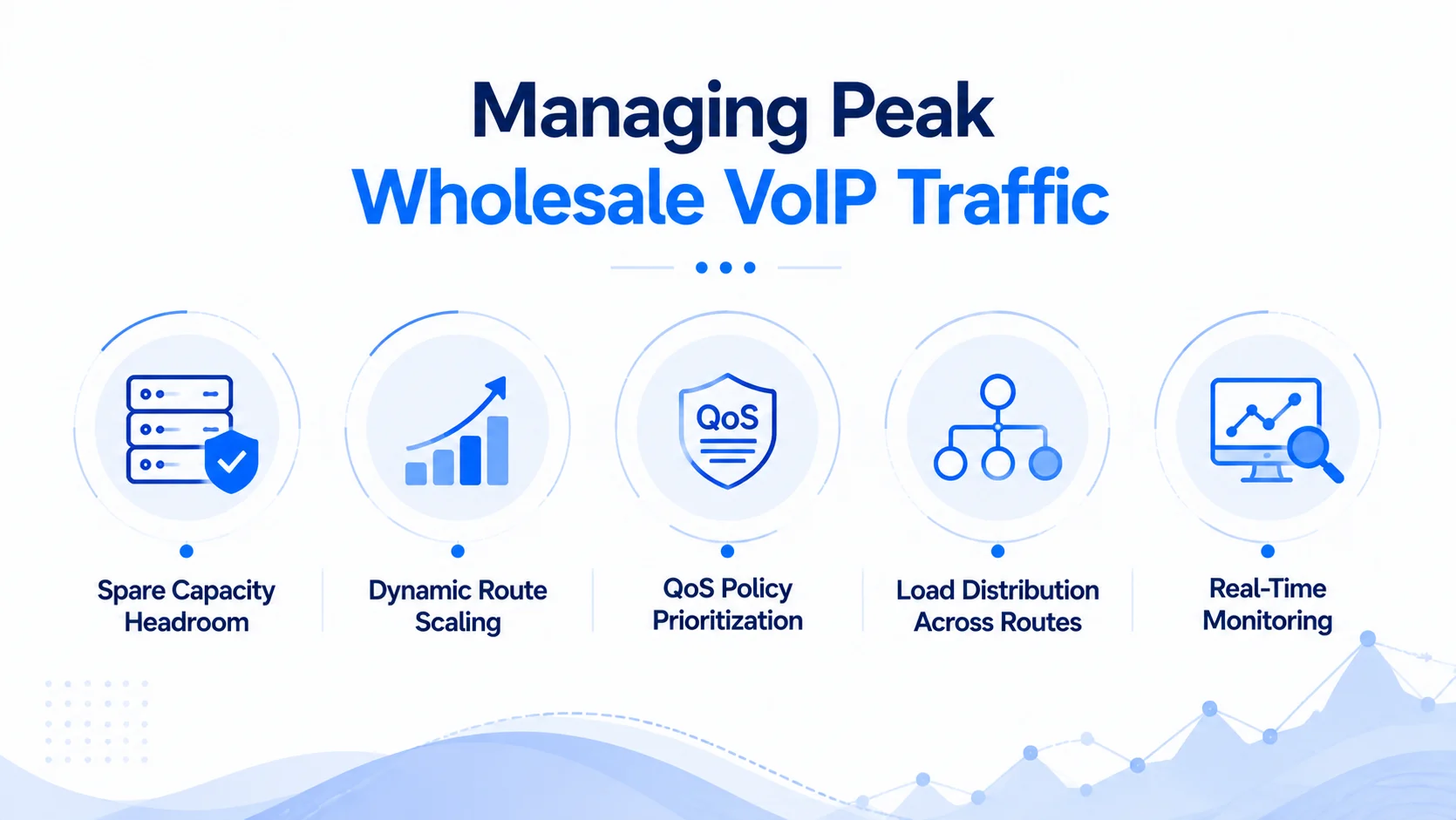
Peaks are where wholesale VoIP traffic management actually shows. Credible carriers pre-provision spare capacity above committed levels so unexpected bursts have headroom. Dynamic route scaling activates during detected peaks.
QoS policies prioritise critical traffic over best-effort calls. Load distribution across multiple upstream carrier paths spreads the peak rather than slamming one interconnect.
Real-time monitoring is the linchpin. A carrier that watches concurrent call counts, ASR per route, and PDD per destination in real time can trigger automatic responses.
These include failover, reroute, and channel scaling before quality degrades for end users. Wholesale VoIP traffic managed by daily-batch dashboards is wholesale VoIP traffic where customers experience the problem before the carrier sees it.
Forecasting Wholesale VoIP Traffic Accurately
Forecasting wholesale VoIP traffic well is the single highest-leverage activity in carrier capacity planning. The basic discipline is straightforward: pull 6 to 12 months of historical CDR data, and decompose it into trend, seasonal, and cyclical components.
Factor in planned business growth and new campaigns, and project forward at the destination-mix level rather than the aggregate level.
The forecast feeds three downstream decisions: commercial commitments — how much volume to commit at a discounted blended rate; capacity provisioning — how many concurrent channels to size for; and carrier diversification — when to spin up a secondary carrier to absorb peak overflow.
Skipping any of these decisions until traffic actually grows is how operators end up paying surge pricing on unplanned wholesale VoIP traffic.
Volume Tiers and Wholesale VoIP Traffic Pricing
Further reading: Wholesale VoIP platform
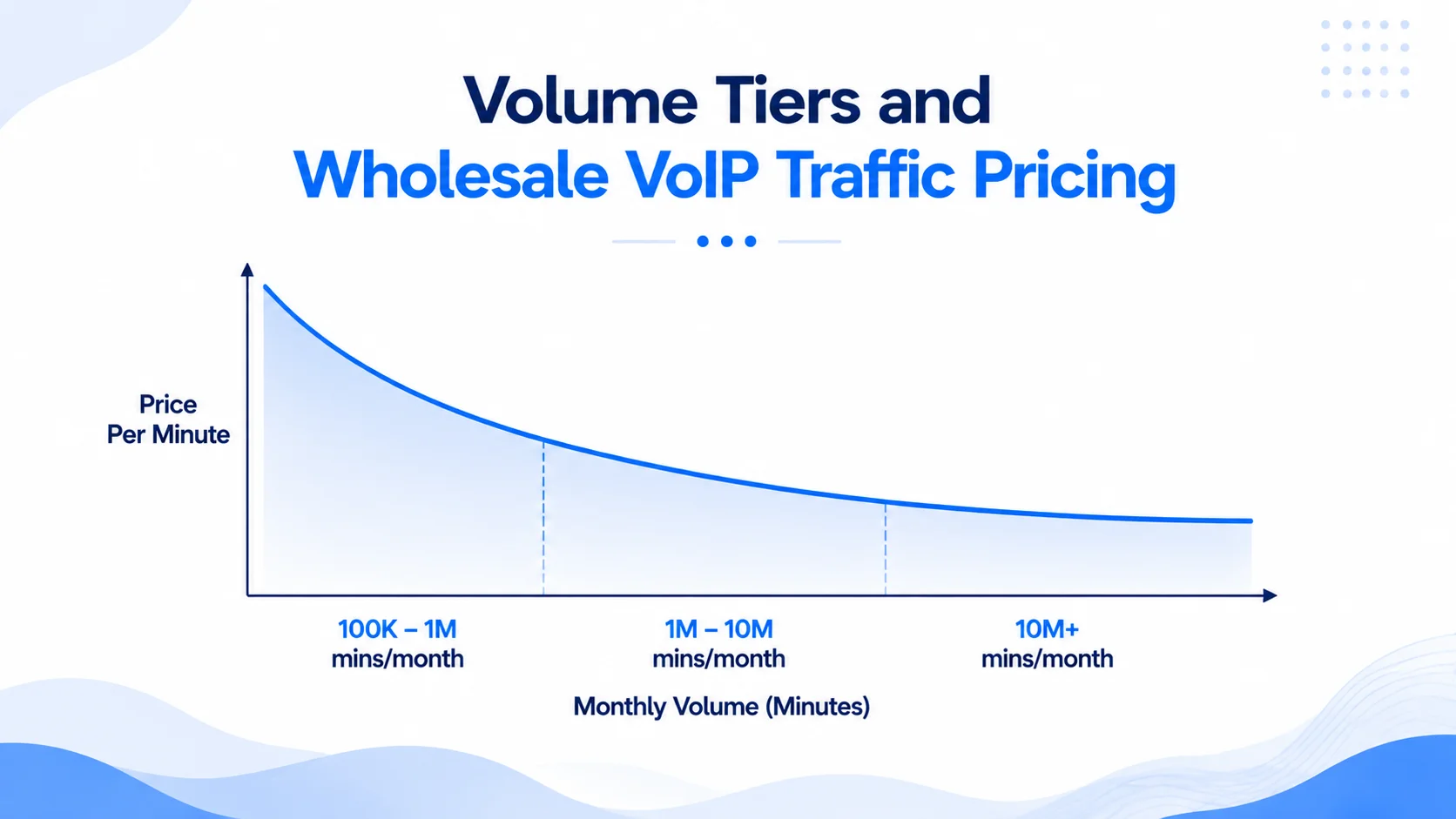
Higher wholesale VoIP traffic volumes unlock lower per-minute rates through tiered pricing. Carriers reduce rates for volume because larger traffic improves network utilisation and reduces per-call infrastructure cost.
Committed-volume contracts formalise this in exchange for rate guarantees. The customer commits to a monthly floor, the carrier locks in a discounted rate, and both sides plan against the same baseline.
The pricing curve is non-linear. Stepping from 100,000 to 1,000,000 minutes per month typically unlocks 15 to 25 percent rate reduction. Stepping from 1,000,000 to 10,000,000 might unlock another 10 to 15 percent.
Past a certain volume, the marginal discount flattens — the carrier's own upstream costs become the floor. Knowing where your wholesale VoIP traffic sits on that curve is what lets a negotiation be a conversation rather than an acceptance of the rate card.
QoS and Wholesale VoIP Traffic Prioritisation
QoS (Quality of Service) policies inside the carrier network prioritise wholesale VoIP traffic against other IP traffic and against itself. DSCP marking tags voice packets so routers and SBCs along the path treat them as latency-sensitive. Within a customer's account, QoS can prioritise specific destinations or specific time windows — useful when one campaign needs guaranteed latency while another can absorb best-effort treatment.
QoS only works end-to-end when every hop honours the markings. A carrier that markets QoS but does not control all the upstream paths is offering QoS within its own network only.
Real wholesale VoIP traffic QoS requires the carrier to either own the path or have peering agreements that preserve markings. That is again why direct Tier 1 interconnects beat transit-only relationships.
STIR/SHAKEN and Wholesale VoIP Traffic Flow
STIR/SHAKEN attestation is now applied inline as wholesale VoIP traffic flows through the carrier. A-attested traffic gets prioritised routing and better downstream acceptance; unattested traffic is increasingly filtered before it ever reaches the destination network. For carriers, this means STIR/SHAKEN posture is now a quality dimension on every wholesale VoIP traffic flow, not just a regulatory checkbox at signup.
Customers should expect their wholesale VoIP traffic to be A-attested on US-bound flows by default, with the attestation level visible in every CDR row. A carrier that handles attestation as a manual configuration per customer or omits it entirely is silently degrading the answer rate on every flow it carries.
IRSF Protection on Wholesale VoIP Traffic
IRSF (International Revenue Share Fraud) detection lives inside the wholesale VoIP traffic management layer. The detection engine watches spend velocity, flags premium-rate prefixes, applies per-account caps, and pauses traffic on suspicious patterns inside seconds.
A carrier that lets compromised customer trunks rack up six-figure exposure overnight is one that does not really manage wholesale VoIP traffic at all — it lets the traffic flow and bills the consequences.
Effective wholesale VoIP traffic IRSF protection means hard spend caps, destination whitelists, blocked-prefix lists refreshed continuously, and real-time alerts surfaced in the customer dashboard. Customers should be able to see exactly what controls are protecting their wholesale VoIP traffic rather than trusting marketing copy.
Real-Time Wholesale VoIP Traffic Analytics
A serious wholesale VoIP carrier exposes real-time traffic dashboards showing concurrent call counts, minute volume by destination, cost accumulation, quality metrics per route, and historical trend analysis. CDR data streams via API for integration with custom BI tools and reporting systems. The analytics drive everything downstream — capacity planning, commercial negotiation, quality troubleshooting, fraud response.
Twiching provides real-time wholesale VoIP traffic analytics with per-destination breakdowns, concurrent call visualisation, per-trunk activity, and configurable spend alerts. Customers see the same operational data the NOC team uses internally — no opaque monthly reports, no end-of-month surprises on the invoice.
Choosing a Carrier for Wholesale VoIP Traffic at Scale
- 01Direct Tier 1 interconnects in destinations relevant to your traffic mix — not transit-only paths
- 02Per-destination wholesale VoIP rates published with billing increments and effective dates
- 03Elastic channel scaling without pre-commitment to absorb bursty wholesale VoIP traffic
- 04Live ASR, ACD, PDD, MOS per destination, accessible via API
- 05STIR/SHAKEN A-level attestation on US-bound wholesale VoIP traffic
- 06Real-time IRSF detection with hard spend caps and blocked-prefix lists
- 07QoS policies preserved across direct upstream interconnects
- 0824/7 NOC with 15-minute critical-incident SLA — especially during traffic peaks
Twiching's Wholesale VoIP Traffic Platform
Twiching manages wholesale VoIP traffic across 200+ countries on direct Tier 1 interconnects, with elastic channel scaling that absorbs bursty contact-centre and campaign-driven traffic without pre-commitment. STIR/SHAKEN attestation runs inline on every US-bound flow, and IRSF detection on streaming CDRs pauses suspicious traffic in seconds. A 24/7 NOC monitors the global wholesale VoIP traffic footprint with a 15-minute critical-incident SLA.
Real-time analytics expose per-destination minute volume, concurrent call counts, cost accumulation, and quality metrics — accessible via dashboard and API. Per-destination wholesale VoIP rates publish with billing increments and effective dates visible on every row. Committed-volume contracts unlock tiered rate reductions for predictable wholesale VoIP traffic flows.
Conclusion
Wholesale VoIP traffic management is what separates a carrier that ships minutes from one that runs a network. Measuring concurrent peaks alongside monthly volume, forecasting accurately enough to commit, applying QoS that survives upstream paths, signing STIR/SHAKEN attestation inline, pausing IRSF-shaped traffic in seconds, and exposing live analytics that match what the NOC sees — these are the carrier-grade primitives that define wholesale VoIP traffic done well. Twiching is built around exactly that profile, so customers running campaign-driven, contact-centre, or steady business traffic on the same carrier inherit a wholesale VoIP traffic platform that holds up under load — without operating the underlying carrier themselves.