Introduction
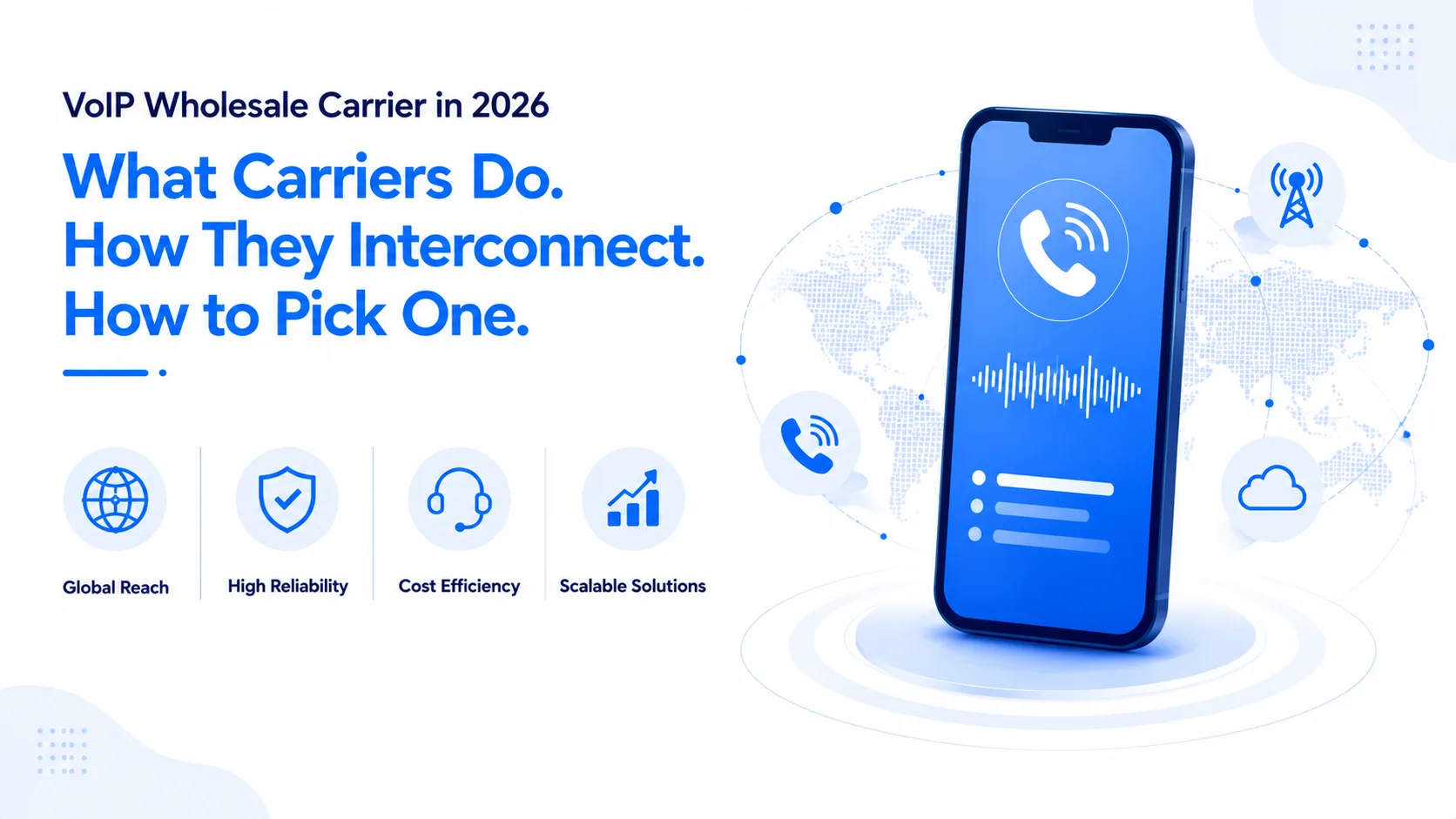
A VoIP wholesale carrier is a licensed telecommunications operator that sells bulk voice capacity to other carriers, resellers, and enterprises. It brings the licences, interconnects, softswitches, and 24/7 operations, while the customer brings the application and end-user relationship. This guide walks through what a VoIP wholesale carrier actually does and how to evaluate one against a structured checklist.
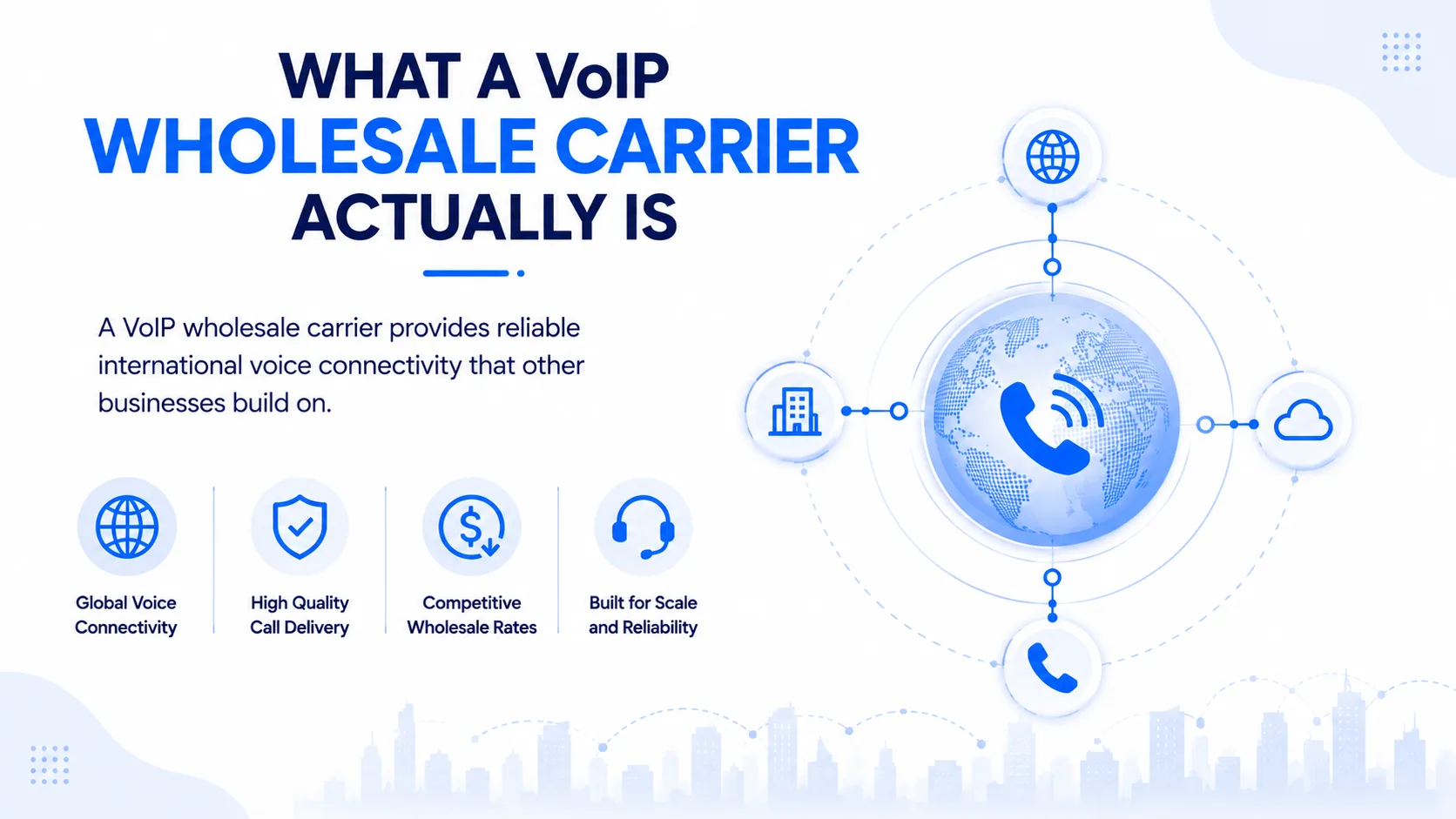
What a VoIP Wholesale Carrier Actually Is
A VoIP wholesale carrier is a licensed telecommunications operator. It sells voice termination, origination, and SIP trunking in bulk to other businesses — never to retail end users.
The carrier holds the FCC or national regulatory licences, owns the Class 4 softswitches, signs bilateral interconnects with Tier 1 partners, and runs the 24/7 NOC. Customers consume the service through SIP trunks and pay per-minute against a published rate deck.
This is fundamentally different from a retail VoIP provider, which packages handsets, voicemail, and consumer support. A VoIP wholesale carrier operates at the carrier layer with infrastructure-level SLAs and technical SIP integration.
The wholesale tier sells higher volume at lower per-unit cost, and the buyer absorbs the responsibility for the application and the end-customer relationship.
Core Services a VoIP Wholesale Carrier Offers
Further reading: Wholesale pricing & rate deck
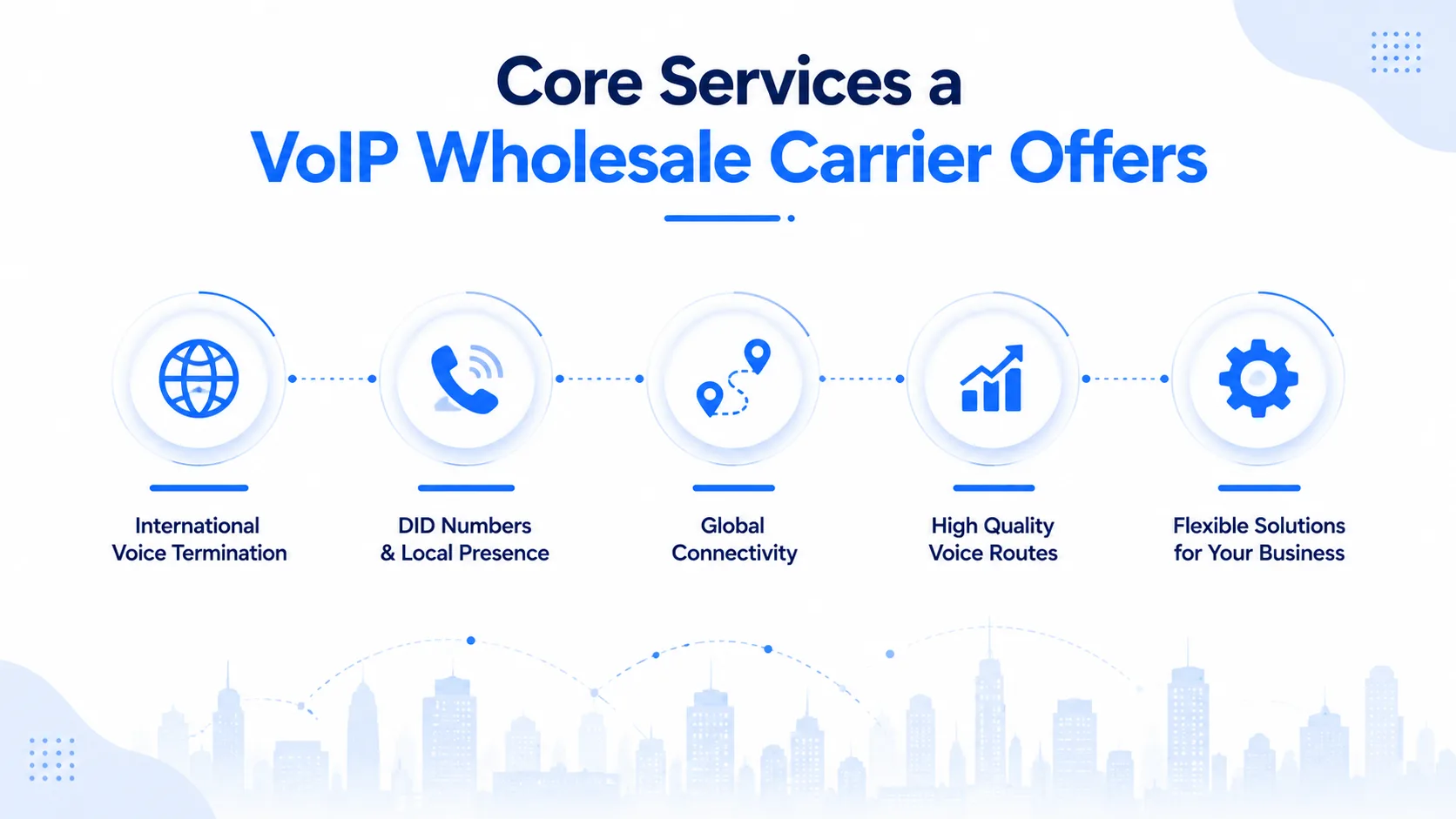
A serious VoIP wholesale carrier ships a tightly integrated set of carrier-grade services. Buying them separately from different vendors is technically possible but operationally painful — reconciliation, fraud controls, and quality scoring all break down across mismatched stacks.
- Outbound termination — A-Z international voice minutes delivered via LCR routing
- Inbound origination — local, mobile, and toll-free DIDs across 100+ countries
- SIP trunking — direct PBX-to-carrier connectivity replacing legacy PRI
- Number porting — moving existing numbers from other carriers without service disruption
- STIR/SHAKEN attestation — cryptographic caller ID signing for US-bound traffic
- Real-time CDRs — streaming call records for billing, analytics, and fraud detection
- Programmable APIs — provisioning, rate-deck queries, and CDR access via REST
Licensing and Regulatory Posture
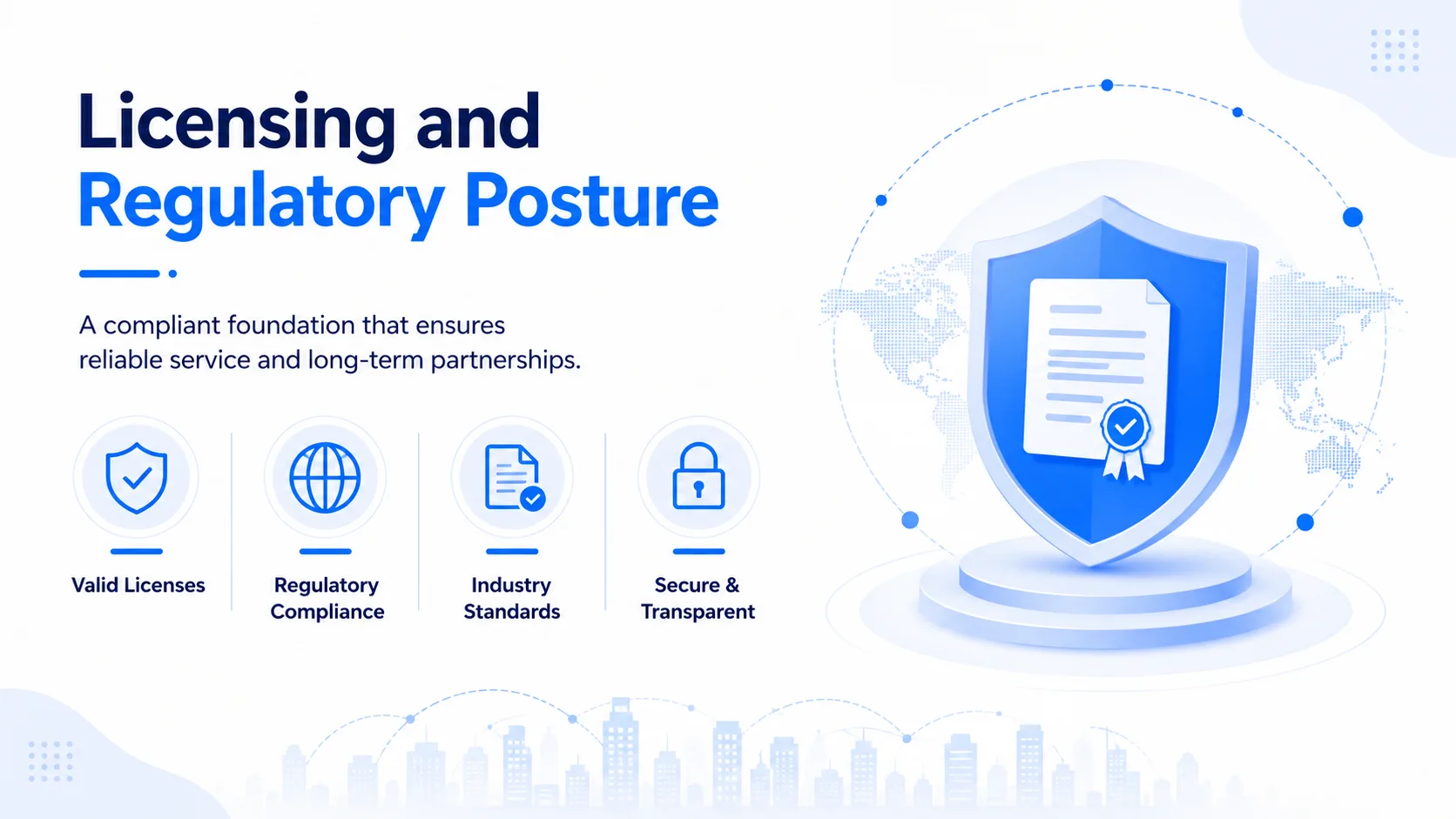
A real VoIP wholesale carrier carries real regulatory weight. In the US, that means FCC authorisation as an interstate carrier and state PUC registrations for intrastate services. It also means STIR/SHAKEN attestation agreements, number portability database access, and emergency-services routing where applicable.
In the EU, that means national regulatory authorisation in each member state under the European Electronic Communications Code.
Per-market licensing extends across emerging markets too. A credible VoIP wholesale carrier tracks all of it centrally, so customers inherit compliance rather than rebuild it per country.
Anyone marketing themselves as a VoIP wholesale carrier without naming their licences is almost certainly a reseller riding on someone else's regulatory posture.
Interconnect Options: SIP, MPLS, TDM
Further reading: Wholesale VoIP platform
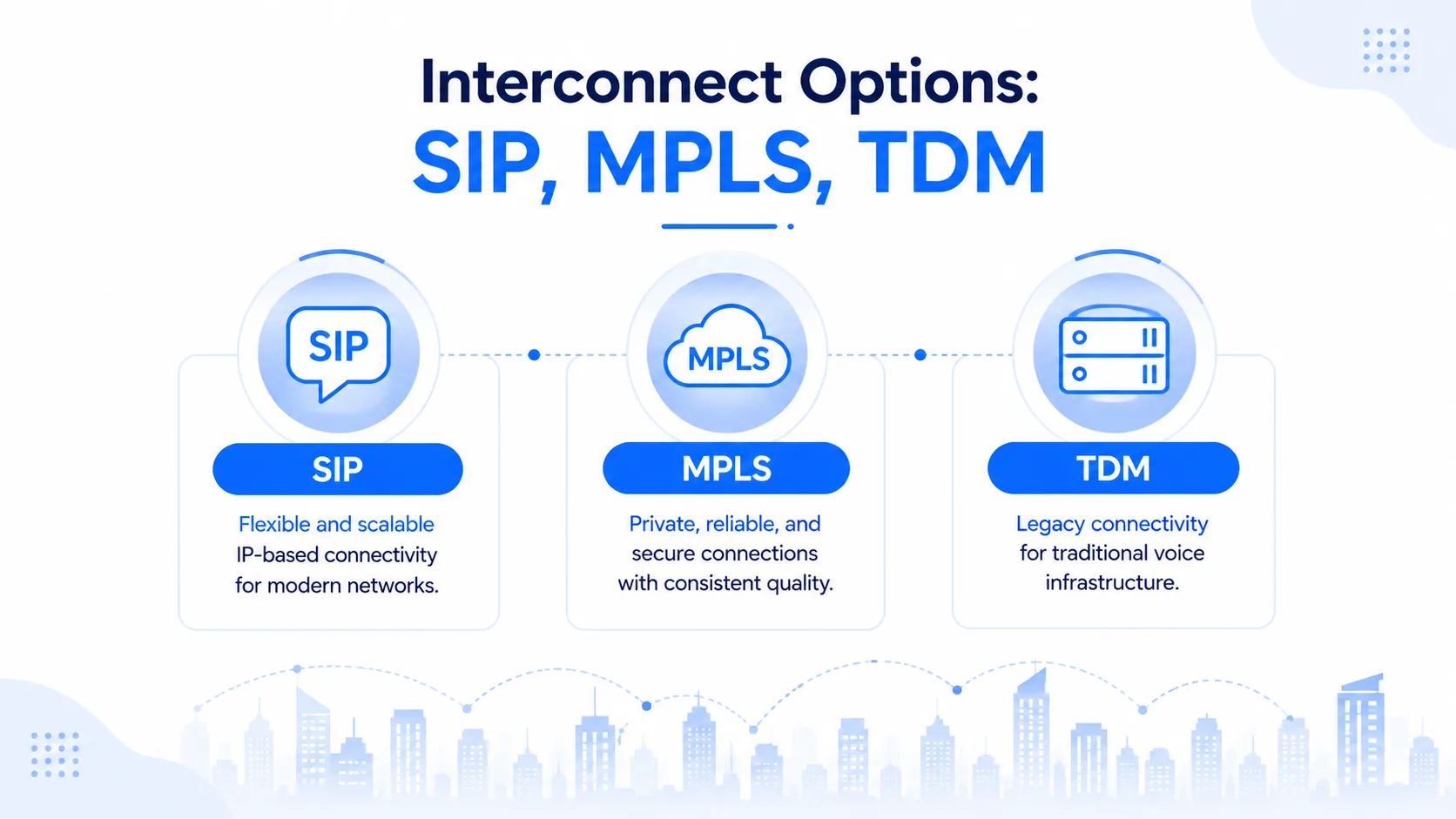
Modern VoIP wholesale carriers support three interconnect models. SIP over the public internet with TLS for signalling and SRTP for media is the default — fast to deploy, well-suited to most workloads.
SIP over MPLS private circuits adds higher reliability for mission-critical voice, common in contact-centre deployments. Legacy TDM/ISDN interconnect is still offered by some carriers for compatibility with older infrastructure.
For new deployments, internet-based SIP trunks are the standard. They onboard fast, scale elastically, and run on the same backbone the customer already pays for.
A VoIP wholesale carrier worth signing exposes all three options and lets the customer choose based on workload, not on what the carrier finds easiest to sell.
STIR/SHAKEN and Security
Security in any VoIP wholesale carrier deployment runs across multiple layers. TLS encrypts SIP signalling, SRTP encrypts media, IP whitelisting authenticates trunks, DDoS scrubbing protects upstream interconnects, and real-time anomaly detection catches IRSF before it generates exposure.
STIR/SHAKEN implementation has become a hard requirement for US-bound traffic — without it, downstream carriers filter calls aggressively and ASR collapses.
Regulators in most major markets now mandate specific security standards, and a credible VoIP wholesale carrier reflects those in the technical baseline rather than the marketing copy. Customers should expect TLS, SRTP, STIR/SHAKEN, and IRSF controls to be default — not paid add-ons negotiated separately.
Customer Portal Expectations
The customer portal is where the operational quality of a VoIP wholesale carrier shows up most directly. A useful portal exposes:
- Real-time CDR access
- Live traffic dashboards
- Per-route quality metrics
- Balance and usage monitoring
- DID management (adding and removing numbers)
- Rate-deck downloads
- Billing history
Self-service capabilities cut dependency on support for routine work.
Programmable APIs sitting alongside the dashboard are now table stakes. CDR streaming, rate-deck queries, DID provisioning, and trunk configuration should all be accessible via REST.
A VoIP wholesale carrier shipping only a web UI in 2026 is asking customers to do operational work that should be automated end-to-end.
SLA Terms That Matter
Further reading: Wikipedia: VoIP overview
Strong VoIP wholesale carrier SLAs commit to specific outcomes, not vague aspirations. Expect minimum 99.9% uptime, ASR floors on major destinations, maximum PDD commitments, and financial credits for breaches.
The credit structure matters as much as the headline number. A 100% credit on one hour of downtime is meaningless if real customer impact dwarfs the interconnect outage.
Read the support SLA alongside the network SLA. A 15-minute critical-incident response from a real NOC, with named escalation contacts, is the standard to expect. That is what separates a serious VoIP wholesale carrier from a software vendor reselling someone else's voice product.
Email-only support is a clear tell of a thinner operation.
Choosing a VoIP Wholesale Carrier
- 01Licences — FCC/national authorisations and STIR/SHAKEN agreements named publicly
- 02Owned routes — direct Tier 1 interconnects in top destinations, not transit-only paths
- 03Interconnect options — SIP over internet, MPLS, and TDM where customers genuinely need them
- 04Portal — real-time CDRs, route quality data, self-service DID and trunk management
- 05APIs — programmable provisioning and CDR streaming via REST
- 06SLAs — 99.9% uptime, ASR floors, financial credits for breaches
- 07Fraud posture — IRSF detection, spend caps, blocked-prefix lists as default features
- 08Onboarding — KYC under 48 hours, production traffic within a week
Twiching as a VoIP Wholesale Carrier
Twiching operates as a carrier-grade VoIP wholesale carrier purpose-built for ITSPs, resellers, contact-centre platforms, and enterprises with high-volume voice.
The platform combines direct Tier 1 interconnects across 200+ countries, full STIR/SHAKEN attestation on US-bound traffic, and real-time CDRs. IRSF detection runs with hard spend caps, and a 24/7 NOC operates with a 15-minute critical-incident SLA.
Onboarding completes in under 48 hours. The rate deck publishes wholesale VoIP rates per destination with billing increments and effective dates visible on every row. The customer portal exposes the same data the engineering team uses internally.
Partners on the white-label reseller programme launch on the same VoIP wholesale carrier infrastructure under their own brand. Twiching operates as a true wholesale VoIP carrier underneath, not a reseller in carrier clothing.
A VoIP wholesale carrier relationship is a long-term commercial partnership. Beyond rate negotiation, invest time in understanding your carrier's network architecture, planned upgrades, and geographic expansion roadmap.
Carriers investing in new PoPs, expanding peering relationships, or deploying next-generation switching equipment are building quality improvements you will benefit from. Carriers that are static or contracting may be managing decline, which eventually affects route quality and platform investment.
Network topology transparency distinguishes quality VoIP wholesale carriers from commodity resellers. Ask carriers to provide a network diagram showing their PoP locations and the Tier 1 carriers they peer with directly. It should also show the transit paths for traffic to your key destinations.
Carriers with direct peering to national incumbents deliver lower latency and better call completion than those routing through two or three transit hops.
Requests for this documentation are reasonable; carriers who refuse to share it are typically aggregating routes from third parties and cannot guarantee the quality they claim.
Payment terms and financial management with VoIP wholesale carriers affect your working capital significantly. Most carriers invoice monthly with 30-day payment terms, meaning you could carry 60 days of traffic cost before the first payment is due.
As volume grows, negotiate extended payment terms — 45 or 60 days — to improve cash flow.
Some carriers offer prepaid arrangements with bonuses: paying three months in advance in exchange for additional rate discounts. Model the effective cost of capital against the rate discount to evaluate whether prepayment makes financial sense.
Conclusion
A VoIP wholesale carrier is an infrastructure company first and a software vendor second. Licences, owned routes, real interconnect options, customer portals worth using, and SLAs that cost the carrier money when they miss — these are what separate a serious VoIP wholesale carrier from a thin reseller. STIR/SHAKEN attestation, real-time fraud controls, and 24/7 NOC depth sit alongside as the non-negotiables. Twiching is built around that bar, so partners launch on a carrier-grade VoIP wholesale carrier from day one and scale on competitive per-minute pricing without operating the underlying infrastructure themselves.