Introduction
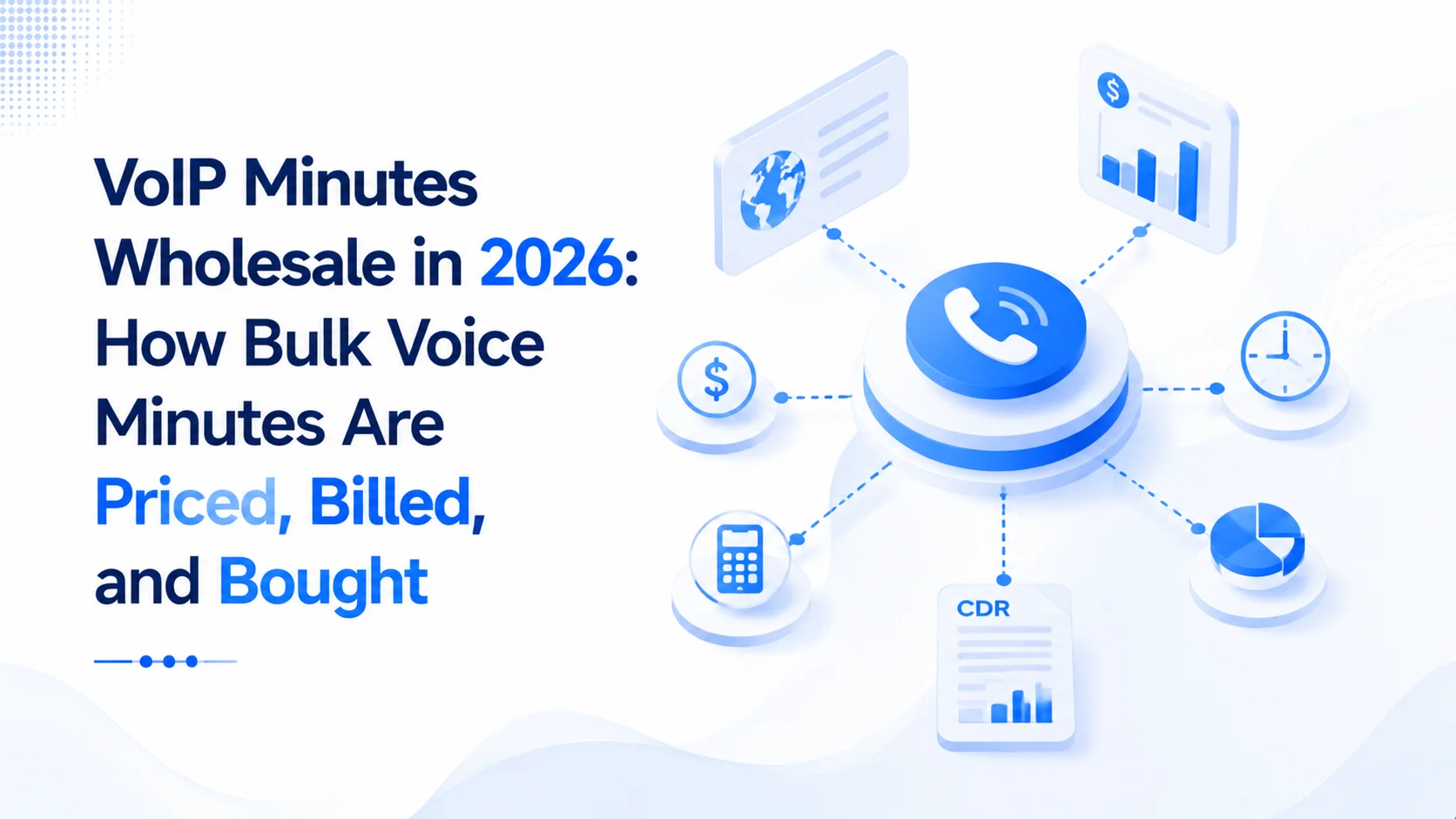
VoIP minutes wholesale pricing is rarely a single number — it's a choice between flat A-Z per-minute, destination-tiered decks, and blended bucket pricing that perform differently by traffic mix. Billing increments matter too: 1-second versus 60-second rounding can swing invoices 12 percent. This guide does the math on each model.
What VoIP Minutes Wholesale Actually Is
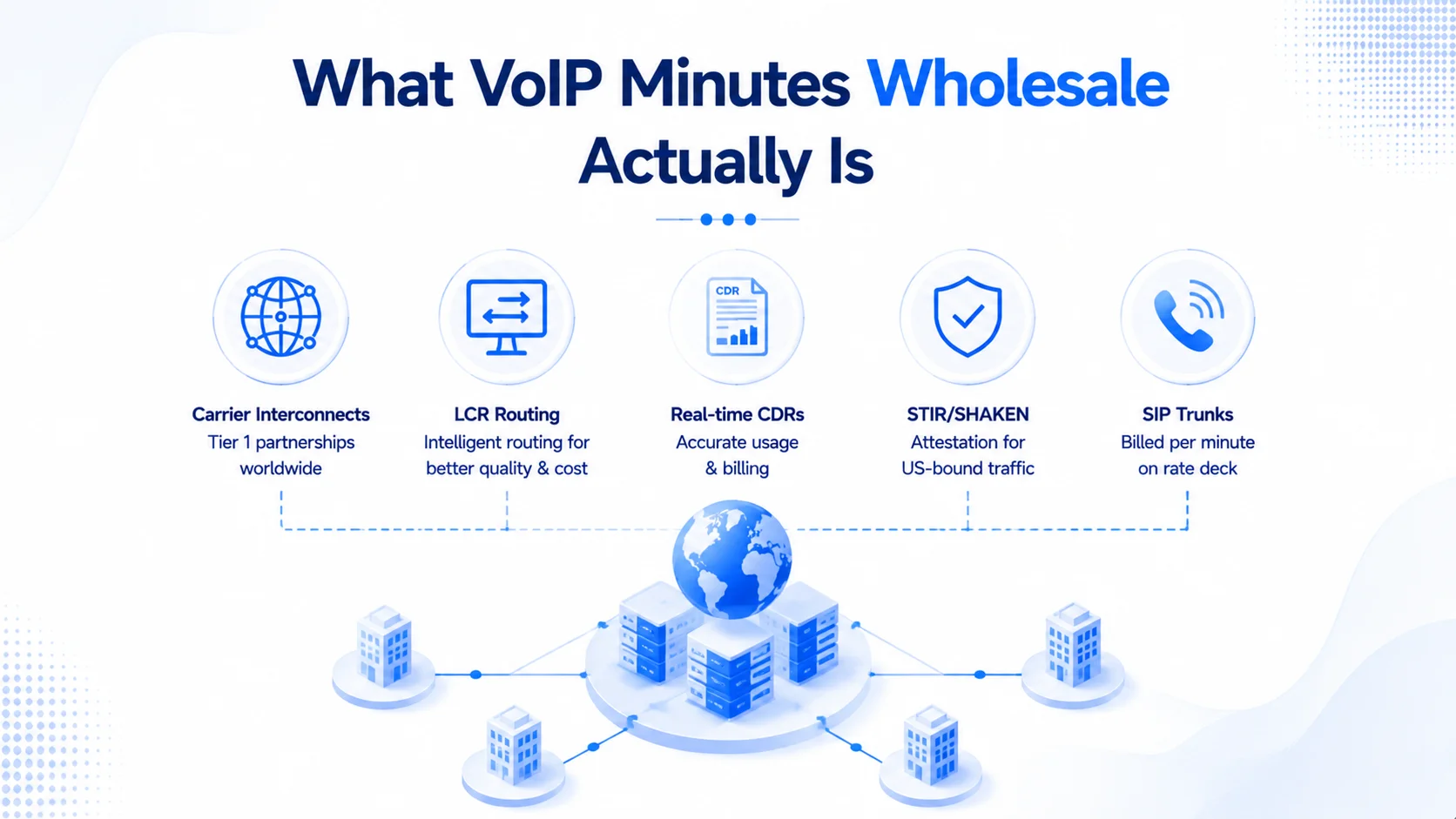
VoIP minutes wholesale is the carrier-tier sale of bulk voice call capacity at per-minute rates. A VoIP minutes wholesale provider holds carrier interconnects with Tier 1 partners and runs LCR routing across upstream carriers.
It generates real-time CDRs for billing and signs STIR/SHAKEN attestation for US-bound traffic. Customers consume the result as SIP trunks billed per minute against a published rate deck — no handsets, no per-seat plans, no consumer wrapper.
The economics work because the VoIP minutes wholesale provider aggregates traffic across hundreds of customers and negotiates bulk capacity at every destination. It passes the scale back as per-minute pricing the buyer could never achieve alone. For ITSPs, contact centres, and platform companies, VoIP minutes wholesale is what makes the unit economics of the retail product line work.
How VoIP Minutes Wholesale Is Priced
Further reading: Wholesale pricing & rate deck
VoIP minutes wholesale is sold through three core models. Pay-as-you-go on a rate deck suits volatile or unpredictable traffic with no commitment.
Committed volume contracts — guaranteed monthly minimum minutes — unlock tiered discounts of 10 to 25 percent across the rate curve. Prepaid bundles deliver a fixed number of minutes at a fixed price, typically with a 30-day expiry window.
The rate deck is the single most important commercial artifact in any VoIP minutes wholesale relationship. It lists per-destination per-minute pricing alongside the billing increment, currency, effective date, and (on credible providers) the quality class. A VoIP minutes wholesale provider that hides any of those columns is hoping you do not check, and the math eventually catches up at audit.
Billing Increments Matter as Much as the Rate
Billing increments are how short-duration VoIP minutes wholesale traffic actually gets billed. 1/1 (1-second initial, 1-second steps) is the buyer-friendly default. 6/6 adds a small uplift on very short calls.
30/6 inflates real cost on short-duration traffic by 12 to 18 percent. On extremely short calls, a 6-second billing increment costs roughly 10x less than a 60-second increment for the same actual call.
For any contact-centre VoIP minutes wholesale contract, always negotiate 6-second increments at minimum. The headline rate looks identical on the cover page, but the increment shifts the blended cost meaningfully once a few million short calls run through the trunk. The same destination quoted at the same price under different increments is genuinely different pricing.
International VoIP Minutes Wholesale Rates
Further reading: Wholesale VoIP platform
Per-minute rates on VoIP minutes wholesale vary enormously by destination. US domestic typically runs USD 0.002 to 0.007 per minute. Major Western markets sit under USD 0.01, while some remote or regulated destinations exceed USD 0.40 per minute.
Your blended VoIP minutes wholesale cost depends entirely on the destination mix in your real CDR profile. There is no useful single average across the rate deck.
Mobile termination consistently costs more than landline on the same VoIP minutes wholesale rate deck because mobile network operators charge higher interconnect fees. Toll-free origination inverts the model — the called party (you) pays the access charge, so toll-free wholesale minutes carry higher per-minute cost than standard inbound. Knowing your call mix is what makes any VoIP minutes wholesale provider comparison meaningful.
- US domestic — USD 0.002–0.007/min on competitive routes
- UK landline — USD 0.005–0.01/min depending on quality class
- Mexico mobile — USD 0.03–0.06/min with mobile-termination premium
- Remote markets — USD 0.20+/min for monopoly or regulated destinations
- Toll-free origination — higher per-minute than standard inbound DIDs
Volume Commitments and Tiered Pricing
Volume commitment is the single biggest lever on VoIP minutes wholesale pricing. A guaranteed monthly minimum gives the carrier predictable revenue, which they pass back as per-minute reductions.
Showing a clean CDR history — predictable ASR, ACD, and short-duration ratios — during negotiation typically extracts another 5 to 10 percent. The carrier can forecast their own upstream margin on your specific traffic.
Traditional VoIP minutes wholesale providers required USD 500 to 5,000 per month minimum spend. Modern aggregated platforms like Twiching have eliminated hard floors entirely. Small businesses now access the same carrier-tier VoIP minutes wholesale rates as multinationals, with volume discounts activating automatically as monthly usage grows.
STIR/SHAKEN on VoIP Minutes Wholesale
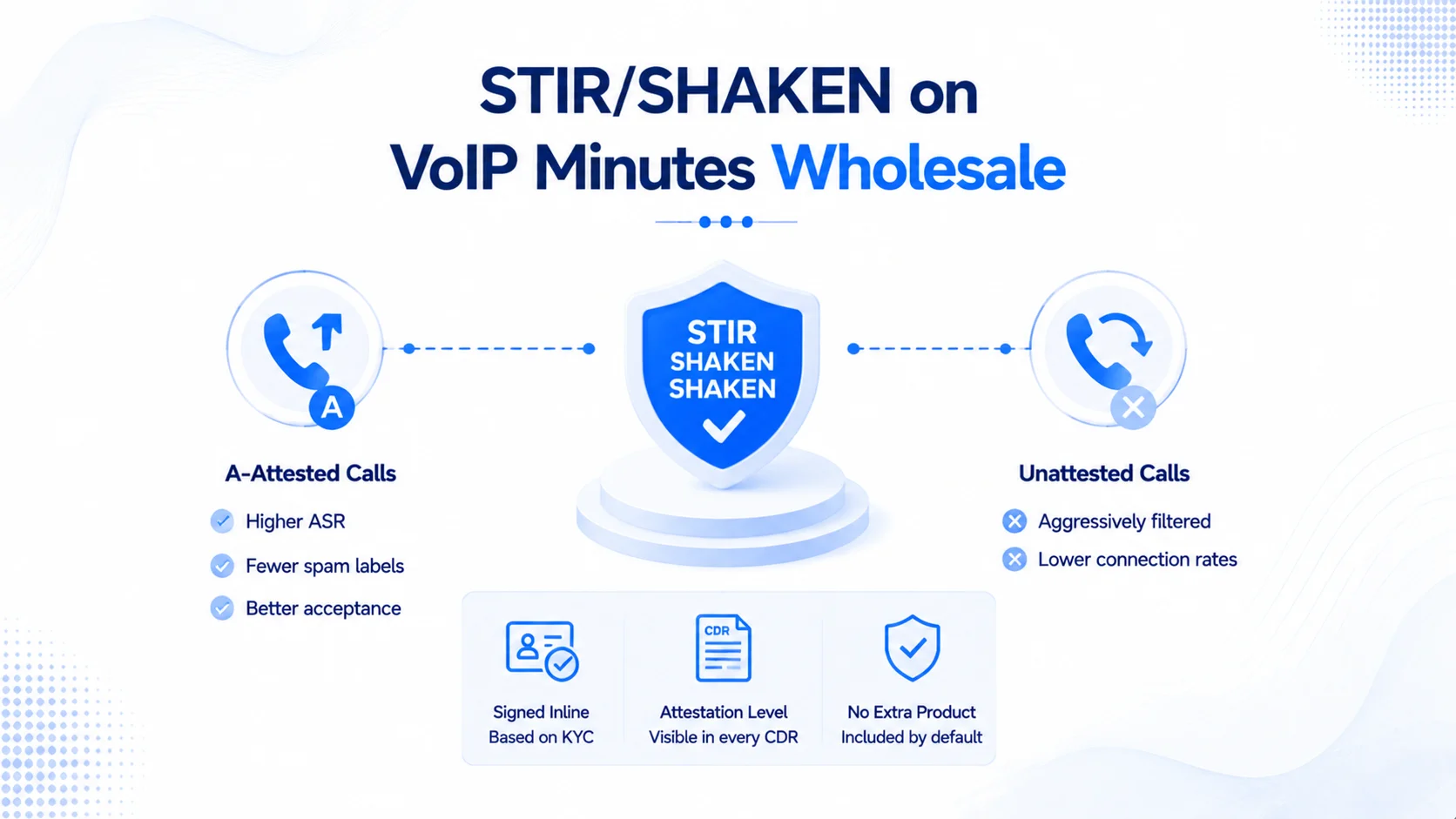
For US-bound VoIP minutes wholesale traffic, STIR/SHAKEN attestation has become a route-level attribute. A-attested calls get measurably higher downstream ASR, fewer spam labels, and better acceptance by terminating carriers. Unattested VoIP minutes wholesale traffic is aggressively filtered, dropping connection rates on US destinations by double-digit percentages over time.
A modern VoIP minutes wholesale provider signs every US-bound call inline based on the customer's KYC posture. Twiching does this by default.
There is no separate attestation product to buy, and the attestation level is visible in every CDR row. Customers can audit their own US compliance posture without raising a support ticket.
Fraud Protection on Bulk VoIP Minutes Wholesale
IRSF (International Revenue Share Fraud) is the existential risk inside any VoIP minutes wholesale contract. A compromised customer trunk can rack up six-figure exposure overnight if controls are not real-time.
Effective VoIP minutes wholesale providers monitor spending velocity and apply hard per-account spend caps. They maintain blocked-prefix lists refreshed continuously, and pause traffic the instant a pattern looks off, not after the daily report runs.
Customers should expect spend caps, destination whitelists, and real-time alerts as default features in any VoIP minutes wholesale provider dashboard. Anything weaker turns the customer's trunk into the carrier's fraud problem, and that is the contract worth declining rather than signing.
Tracking Usage and Real-Time CDRs
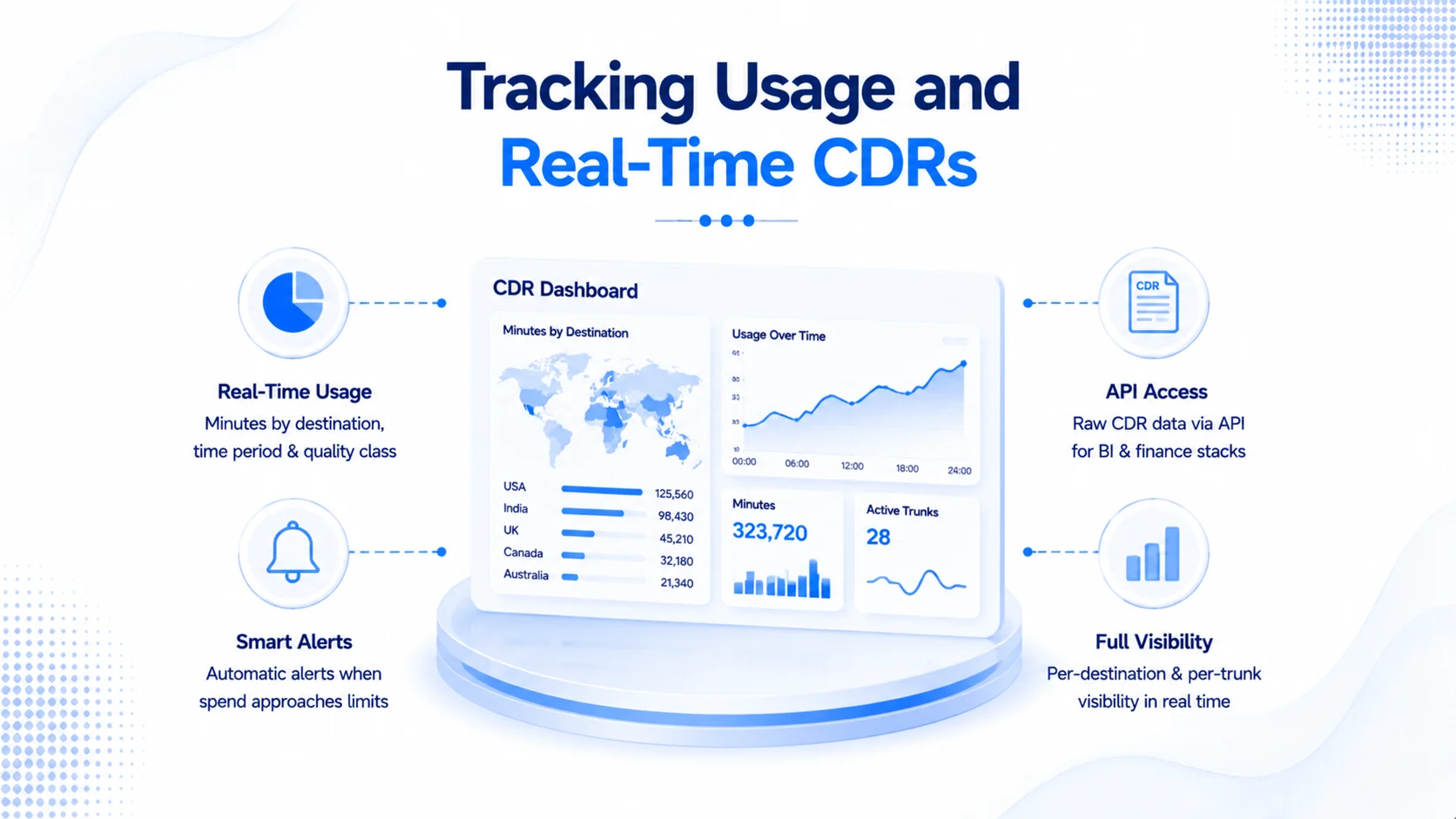
A serious VoIP minutes wholesale provider exposes real-time CDR dashboards showing minutes consumed by destination, time period, and quality class. Automatic alerts trigger when spend approaches predefined thresholds. API access to raw CDR data lets customers feed VoIP minutes wholesale usage into their own BI or finance stacks.
Twiching provides live usage tracking with per-destination breakdowns, per-trunk visibility, and configurable spend alert thresholds. Customers see the same data the NOC team uses internally — no monthly batch reports, no opaque adjustments at quarter-end.
How to Evaluate a VoIP Minutes Wholesale Provider
- 01Owned carrier interconnects in your top destinations, not transit-only paths
- 02Per-destination VoIP minutes wholesale rates published with billing increments and effective dates
- 03Live ASR, ACD, PDD, MOS per destination, accessible via API
- 04STIR/SHAKEN attestation on US-bound traffic, surfaced in CDRs
- 05Contractual SLAs — 99.9% uptime, ASR floors, financial credits for breaches
- 06Fraud controls — real-time spend caps, IRSF detection, blocked-prefix lists
- 07Onboarding speed — KYC under 48 hours, production traffic within a week
- 0824/7 NOC with 15-minute critical-incident SLA and named escalation contacts
Twiching as a VoIP Minutes Wholesale Provider
Twiching delivers VoIP minutes wholesale across 200+ countries on direct Tier 1 interconnects, with no hard minimum monthly commitment. Per-destination rates publish with billing increments and effective dates visible on every row. Small businesses access the same carrier-tier VoIP minutes wholesale pricing as large operators through traffic aggregation.
STIR/SHAKEN attestation runs inline on every US-bound call, and IRSF detection runs on streaming CDRs with hard spend caps. A 24/7 NOC monitors the global VoIP minutes wholesale footprint with a 15-minute critical-incident SLA.
The same platform supports a white-label reseller programme. Partners launch a branded VoIP minutes wholesale business on Twiching's carrier-grade infrastructure and pass through the same competitive wholesale VoIP rates Twiching uses internally.
Buying VoIP minutes wholesale requires understanding the difference between blended rates and destination-specific rates. Blended rates average pricing across all destinations, hiding the true cost of high-rate routes.
Destination-specific rates give you visibility into exactly what each country's traffic costs, enabling informed routing decisions. Always request a destination-level rate deck from prospective carriers rather than accepting a blended rate — it gives you the data needed to model true costs against your traffic mix.
Quality assurance for VoIP minutes purchased wholesale requires systematic testing before and after committing to volume. Use an automated call testing platform that makes real calls to sample numbers in your target destinations and measures objective quality metrics (ASR, MOS, PDD).
Test at different times of day, including peak hours when carrier networks are most congested, and run tests from your actual platform to measure end-to-end quality including your own infrastructure, not just the carrier's network.
This testing discipline takes 2–3 days per carrier evaluation but prevents costly migrations caused by quality problems discovered after volume commitment.
Conclusion
VoIP minutes wholesale looks like commodity pricing on the cover page and is actually an infrastructure business underneath. The per-minute rate is one input among many — billing increments, STIR/SHAKEN posture, IRSF controls, real-time CDR transparency, and contractual SLAs all bend real cost and real risk far more than the headline number. Pick a VoIP minutes wholesale provider on owned carrier interconnects, transparent rate decks, and operational depth — not on the cheapest minute. Twiching is built around that bar, so partners and enterprises buy VoIP minutes wholesale on carrier-grade infrastructure from day one without operating the underlying carrier themselves.