Introduction
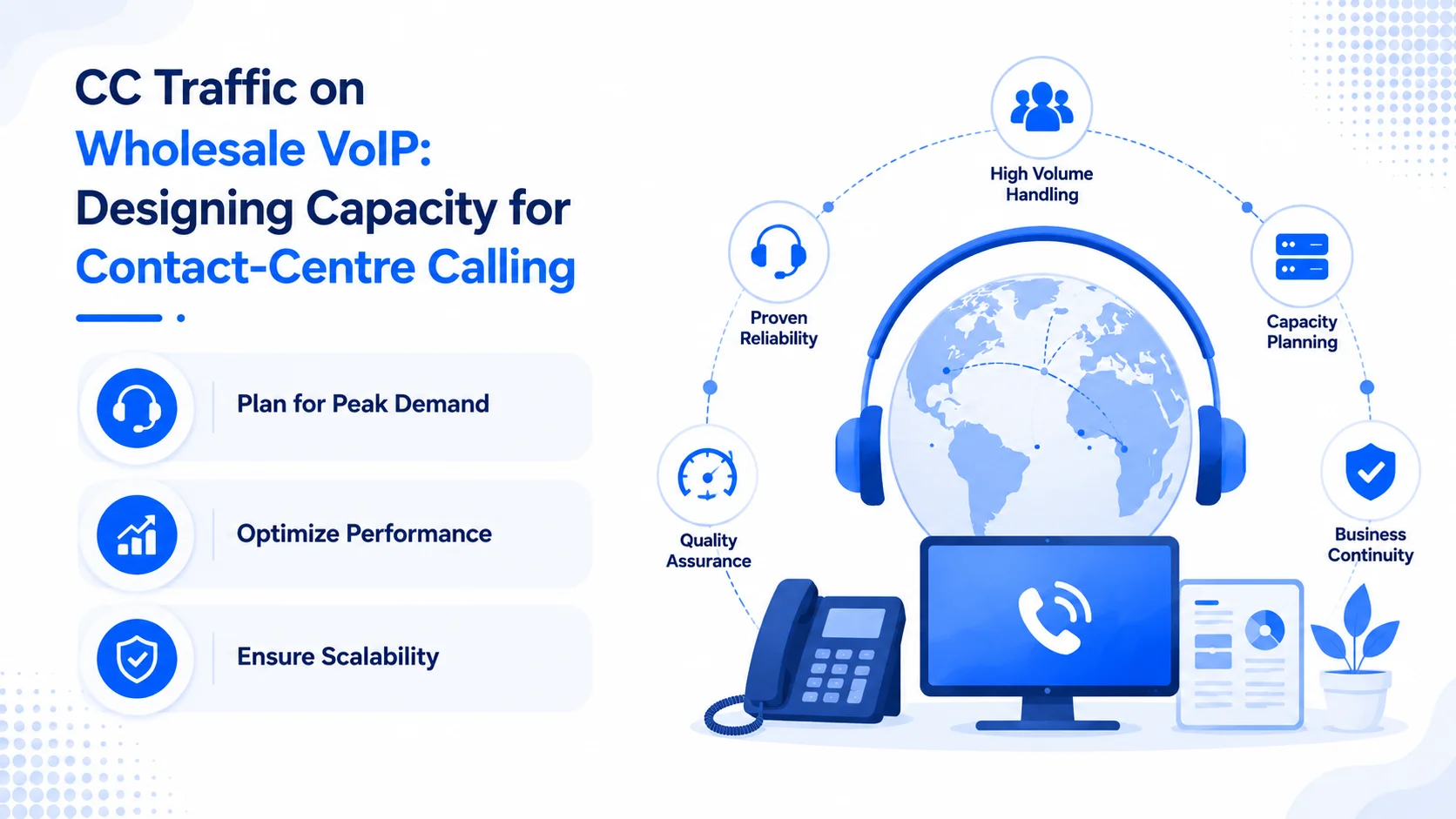
CC traffic — short for call centre traffic — is the high-density, bursty voice load generated by contact centre operations. Predictive diallers, inbound queues, and IVR interactions behave differently from standard business voice. This guide covers how CC traffic flows on a wholesale VoIP platform and how to scale for a campaign launch.
What CC Traffic Actually Means on a Wholesale VoIP Platform
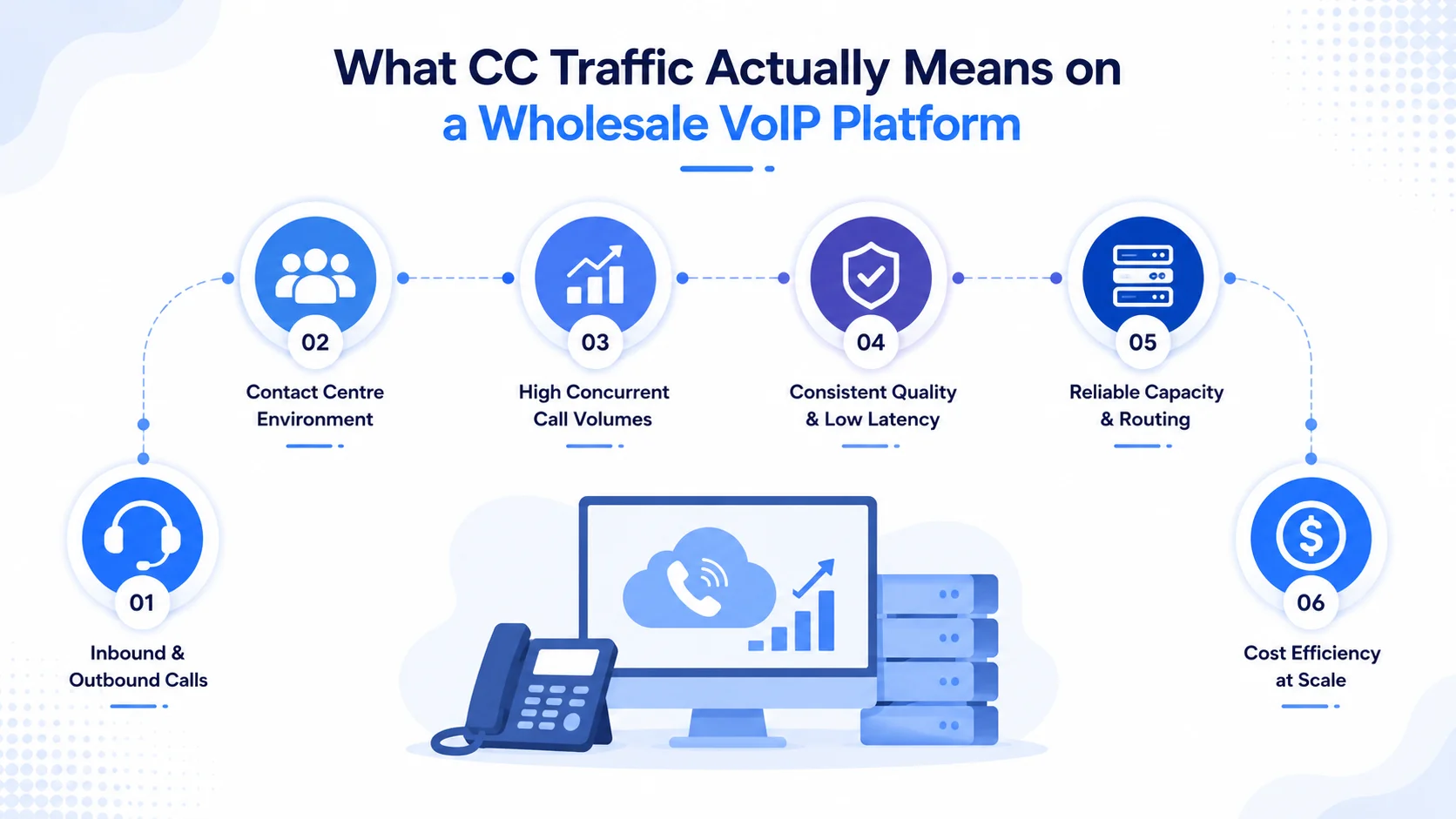
CC traffic — call centre traffic — is the high-density, customer-facing voice load generated by contact centre operations. It covers predictive dialler outbound campaigns, inbound queue overflow, blended-agent calling, and IVR-handled interactions.
It also covers the bursty pattern that shows up whenever a contact centre starts or pauses a campaign. CC traffic has very different characteristics from general business voice, and treating both the same way is how wholesale VoIP carriers quietly fail contact-centre customers.
For wholesale VoIP providers, recognising CC traffic on the SIP trunk is the first step in serving it well. High concurrent call density, short ACD, peaky outbound patterns, and strict customer-experience SLAs all show up in the CDR stream.
A wholesale VoIP platform that knows the SIP trunk is carrying CC traffic can apply the right settings without guessing — the right LCR weights, the right fraud thresholds, and the right STIR/SHAKEN attestation posture.
Why CC Traffic Behaves Differently from Business Traffic
CC traffic has four signatures that separate it from standard business voice. Concurrent call density per agent is much higher because predictive diallers pre-place several outbound calls per available agent. Average call duration is shorter because no-answers, voicemail, and brief screening calls drag the mean down.
Traffic patterns are bursty and tied to campaign schedules — a queue that runs at 5,000 simultaneous channels at 10:00 may drop to zero by 10:01. And the quality bar is strict because every call is customer-facing.
Standard business traffic looks the opposite: lower concurrent density, longer calls, smoother patterns, and lower per-call customer-experience stakes.
A wholesale VoIP carrier built only for business voice will hit limits on CC traffic, and a CC-tuned carrier will overpay on capacity for ordinary business calls. The right CC traffic provider knows which load it is carrying and tunes accordingly.
Capacity Planning: Channel-to-Agent Ratios for CC Traffic
Further reading: Wholesale pricing & rate deck
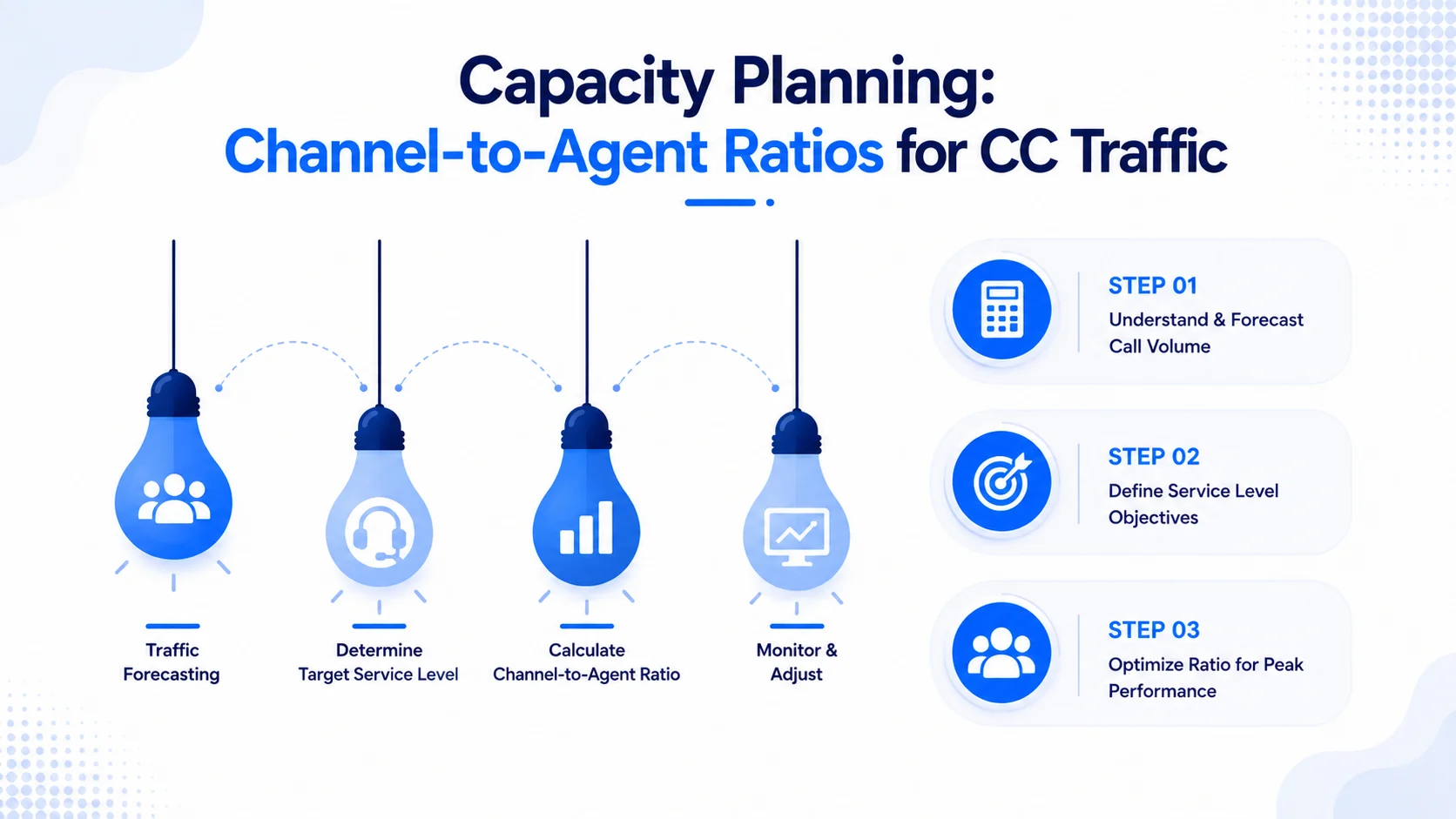
Capacity planning for CC traffic starts with the channel-to-agent ratio. Predictive dialler campaigns typically need 3 to 5 channel attempts per available agent to maintain target talk-time ratios. The dialler over-dials so that when no-answers and busy signals fail, an agent always has a fresh connection waiting.
Inbound-only contact centres need one channel per agent plus around 20 percent buffer for surge capacity. Blended centres need capacity that accounts for simultaneous inbound and outbound peaks rather than treating them as separate traffic types.
Wholesale VoIP capacity for CC traffic should also account for codec choice. G.711 burns roughly 87 kbps per channel including overhead; G.729 compresses to around 32 kbps but adds CPU cost on the SBC.
Most contact centres land on G.711 for quality and G.729 for low-bandwidth international agents. A serious CC traffic provider supports both transparently and lets the customer pick per route.
STIR/SHAKEN and CC Traffic Answer Rates
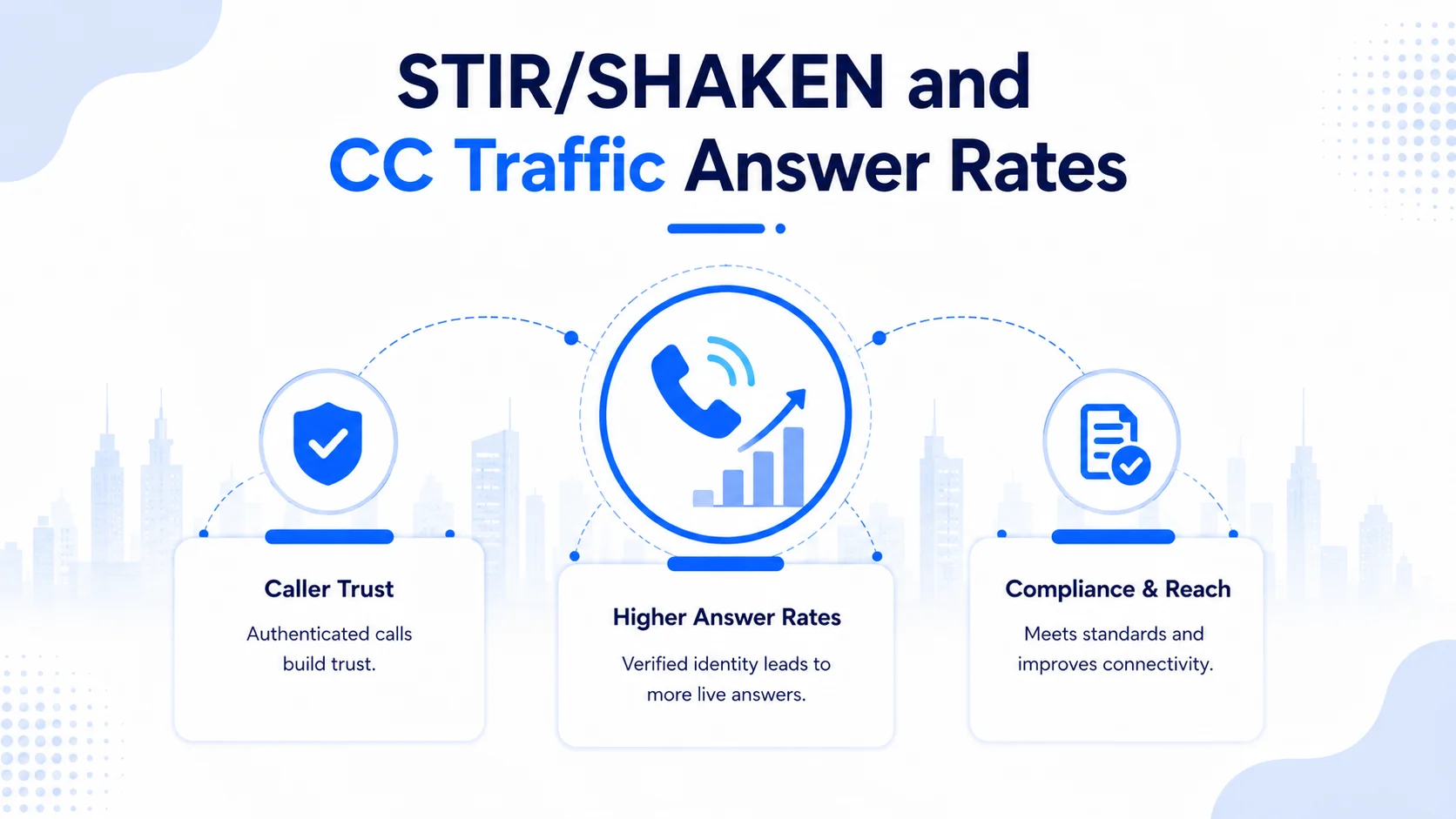
For US-bound CC traffic, STIR/SHAKEN attestation has become a competitive feature, not a compliance overhead. A-level attestation — fully verified caller ID — keeps outbound contact-centre calls out of the spam-label bucket on terminating carriers. Calls with full attestation routinely see answer rates 25 to 40 percent higher than unsigned or B/C-attested calls on the same campaigns.
For a contact centre running predictive dialler CC traffic at 100,000 dials per day, that delta matters a great deal. It is the difference between a campaign that pays for itself and one that does not.
A wholesale VoIP carrier serving CC traffic without inline STIR/SHAKEN attestation is silently costing every customer who routes US-bound traffic through them — that cost hits even before they look at the per-minute rate.
IRSF and Fraud Protection on High-Volume CC Traffic
Further reading: Wholesale voice solutions
CC traffic patterns make IRSF (International Revenue Share Fraud) detection harder. High concurrent counts and short ACDs look superficially similar to fraud signatures. Naive anomaly detection will either fail to catch real attacks or constantly false-positive on legitimate dialler campaigns.
A wholesale VoIP carrier that runs CC traffic at scale tunes the fraud engine to the known shape of contact-centre load. It pages a human before pausing a customer's live campaign.
Hard per-account spend caps remain non-negotiable. So do destination whitelists, blocked-prefix lists for known IRSF premium-rate ranges, and real-time alerts that surface in the customer dashboard. A wholesale VoIP carrier that carries CC traffic without these primitives is exposing both its margin and its customer's bottom line to a single compromised credential.
Bursty CC Traffic and Elastic Channel Scaling
CC traffic is bursty by design. A campaign that launches at 09:00 might ramp from zero to 8,000 concurrent channels inside 90 seconds. A wholesale VoIP carrier that requires customers to pre-commit capacity for those bursts is the wrong fit for a CC traffic workload.
Elastic channel scaling is how modern wholesale VoIP serves CC traffic without leaving channels idle. The SBC accepts whatever concurrent call count the dialler throws at it, up to a customer-defined ceiling.
Twiching supports elastic channel scaling on CC traffic with no pre-commitment required for burst capacity. Additional channels activate instantly when the dialler places more simultaneous calls.
The carrier-side capacity is provisioned, and the customer is billed per minute on the calls that actually complete. This is the right model for any contact centre that runs campaigns rather than steady-state traffic.
Quality Monitoring on CC Traffic
Quality monitoring for CC traffic is more aggressive than for general business voice. ASR per destination per campaign should be inspected live, not in a weekly report.
PDD over 5 seconds on outbound dialler campaigns wastes the dialler's predictive window. MOS scores below 4.0 on customer-facing calls hit campaign conversion rates within hours of starting.
A wholesale VoIP carrier serving CC traffic exposes per-route quality scoring with the same granularity the contact-centre operations team uses to tune the dialler. CDR streaming via API into the customer's own BI stack lets the operations team correlate quality metrics with conversion data. They can shut off routes that are quietly costing campaign performance.
Scaling CC Traffic for a Campaign Launch
Scaling CC traffic for a campaign launch comes down to three steps. Tell the wholesale VoIP carrier the planned start date and peak concurrent call estimate at least 48 hours in advance so the NOC can pre-stage capacity.
Run a quality test against the upstream routes you intend to use, at the time of day the campaign will actually fire. And keep a secondary carrier pre-configured for failover in case the primary route degrades under campaign load.
Twiching's customers running CC traffic typically run a primary + secondary carrier model for exactly this reason. The cost overhead is small, the operational insurance during campaign launches is significant, and the test cadence keeps the runbook fresh between campaigns.
Choosing a Wholesale VoIP Carrier for CC Traffic
- 01Direct Tier 1 interconnects in your target destination markets — not transit-only paths
- 02Full STIR/SHAKEN attestation on US-bound CC traffic, surfaced in CDRs
- 03Elastic channel scaling without pre-commitment for burst capacity
- 04Real-time CDR streaming via API for quality monitoring against your dialler stats
- 05Hard spend caps and IRSF detection tuned for high-density CC traffic patterns
- 06ASR floors and PDD commitments contractually defined per destination
- 07Onboarding speed measured in days, not weeks, for new campaigns
- 0824/7 NOC with 15-minute critical-incident SLA and named escalation contacts
Twiching for CC Traffic Workloads
Twiching is built to carry CC traffic across direct Tier 1 interconnects in 200+ countries. It applies full STIR/SHAKEN attestation on US-bound calls and elastic channel scaling without pre-commitment.
It also runs real-time CDR streaming via API, hard spend caps tuned for legitimate contact-centre patterns, and a 24/7 NOC with a 15-minute critical-incident SLA. Per-destination rates publish with billing increments visible on every row.
Partners on the white-label reseller programme inherit the same CC traffic infrastructure under their own brand. Contact-centre platform companies can run their own carrier under their own commercial terms without operating the underlying wholesale VoIP carrier themselves.
Conclusion
CC traffic on wholesale VoIP is a specialised workload, and a generic wholesale VoIP carrier serving it as if it were ordinary business voice will quietly cost the customer answer rates and the carrier its margin. Concurrent call density, channel-to-agent ratios, STIR/SHAKEN attestation, elastic burst capacity, and CC-tuned IRSF detection are the carrier-grade primitives every CC traffic provider has to get right. Pair that with transparent per-destination wholesale VoIP rates, real-time CDR streaming, and a 24/7 NOC that responds in minutes during campaign launches. Twiching is built around exactly that profile, so contact centres and platform companies running CC traffic launch on carrier-grade wholesale VoIP from day one without operating the underlying carrier themselves.