Introduction
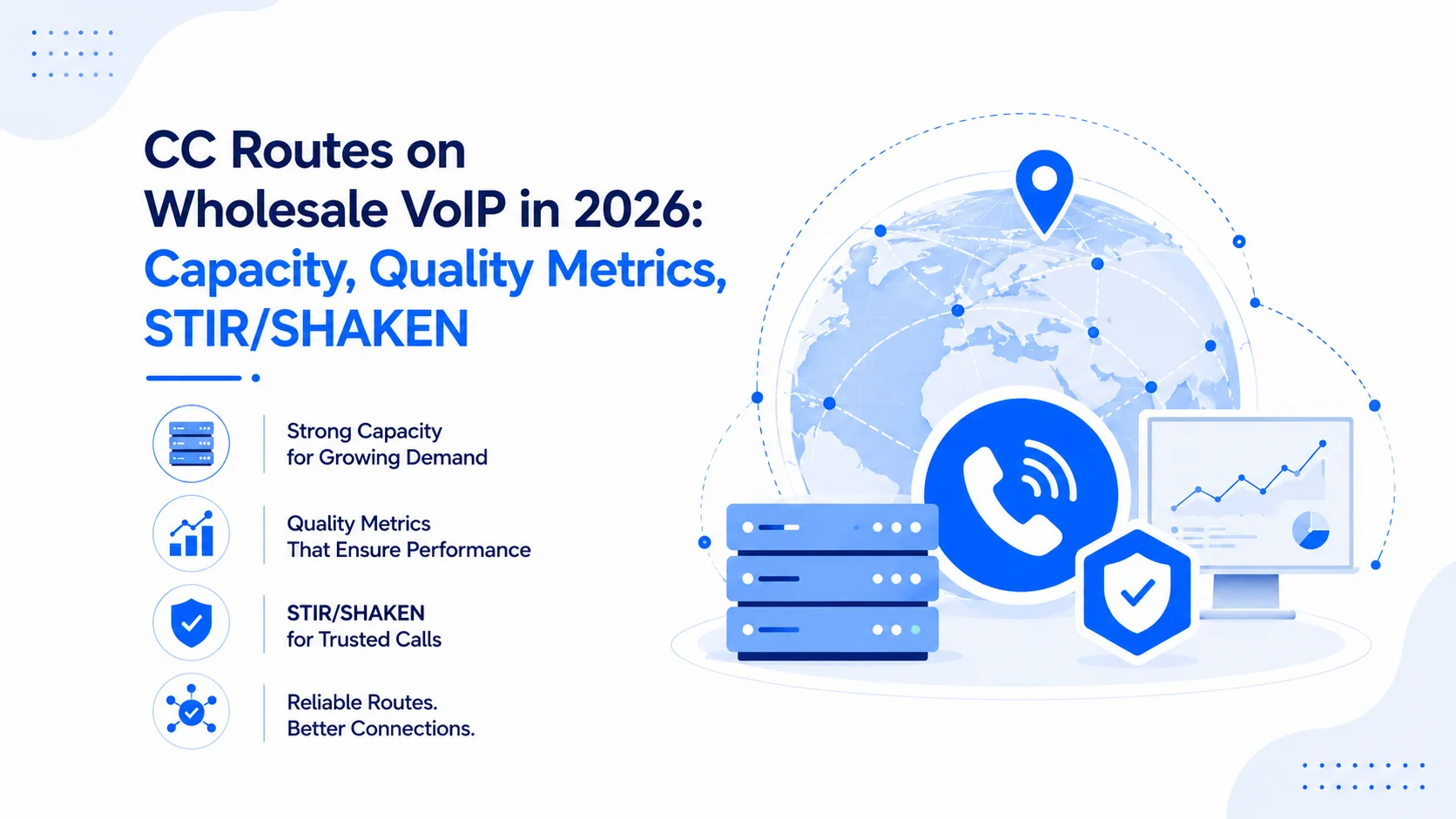
CC routes — call centre routes — are the carrier paths a wholesale VoIP provider provisions for high-volume outbound contact-centre traffic. Unlike a general business route, they carry higher concurrent capacity and tighter ASR/PDD targets that keep dialler campaigns out of the spam-label bucket. This guide explains how they work and how to evaluate them.
What CC Routes Actually Are
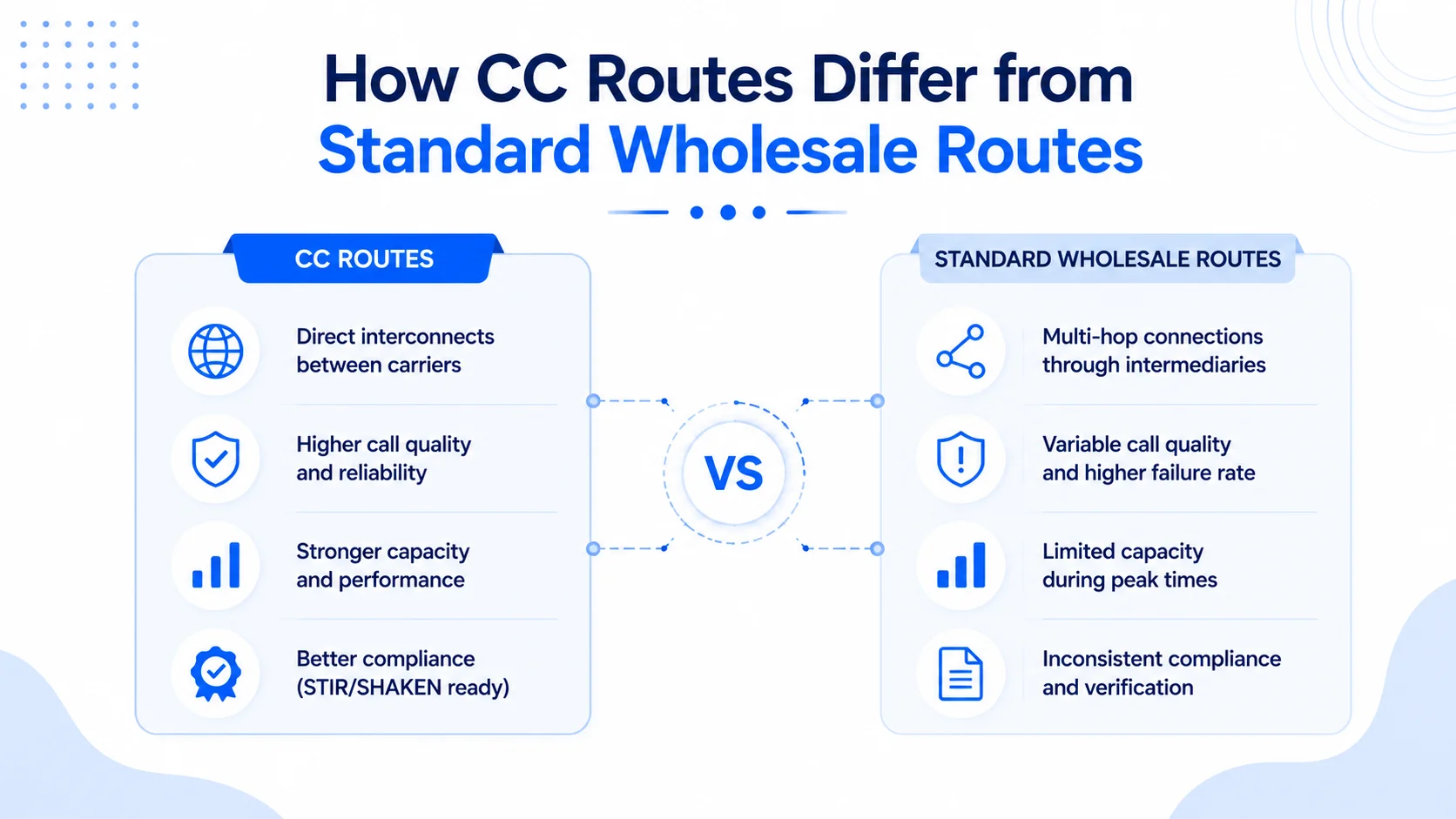
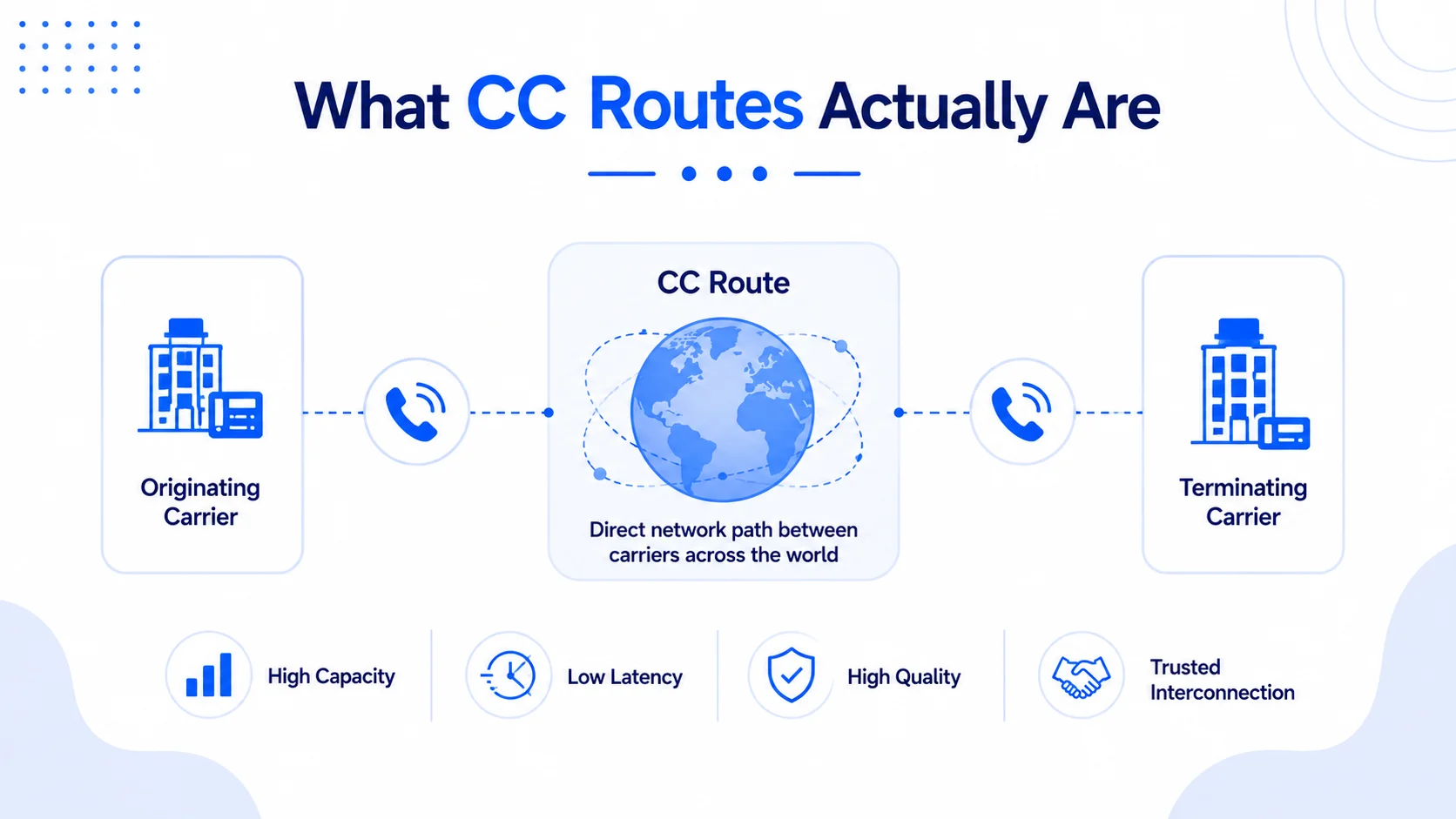
CC routes are dedicated carrier paths on a wholesale VoIP network provisioned and quality-assured for high-volume outbound contact-centre traffic. They terminate to the same SIP endpoints customers already use, but differ from standard wholesale VoIP routes in three structural ways.
They have higher concurrent call capacity to absorb dialler bursts, and tighter quality targets on ASR and PDD because every call is customer-facing. They also carry STIR/SHAKEN attestation handled inline so calls reach terminating carriers with verified caller ID rather than getting filtered as spam.
Calling them CC routes is more than a marketing label. A wholesale VoIP carrier that runs CC routes as a distinct product class tunes its softswitch, fraud engine, and LCR policies for contact-centre traffic patterns.
A carrier that treats CC traffic as ordinary outbound termination will fail differently — common failure modes are answer-rate collapses during campaign peaks, fraud false-positives on legitimate dialler bursts, or capacity exhaustion when the dialler scales up.
How CC Routes Differ from Standard Wholesale Routes
Further reading: Wholesale pricing & rate deck
Standard wholesale VoIP routes are sized and priced for the average business traffic pattern — moderate concurrent density, longer call durations, smooth diurnal patterns. CC routes invert all three signatures.
Concurrent density is high because predictive diallers pre-place several outbound attempts per agent. Average call duration is short because no-answers, voicemail drops, and brief screening calls drag the mean down. Patterns are bursty because campaigns ramp from zero to thousands of concurrent channels in seconds.
Standard routes also rate-limit aggressively to protect upstream carriers from anomalous traffic. CC routes have to accommodate exactly the patterns those rate limits would otherwise flag, while still catching real IRSF abuse hidden inside legitimate-looking dialler load.
A wholesale VoIP carrier that runs CC routes well has tuned its anomaly detection for this exact problem. The alternative is running a generic fraud model and ignoring the false positives.
Capacity Planning for CC Routes
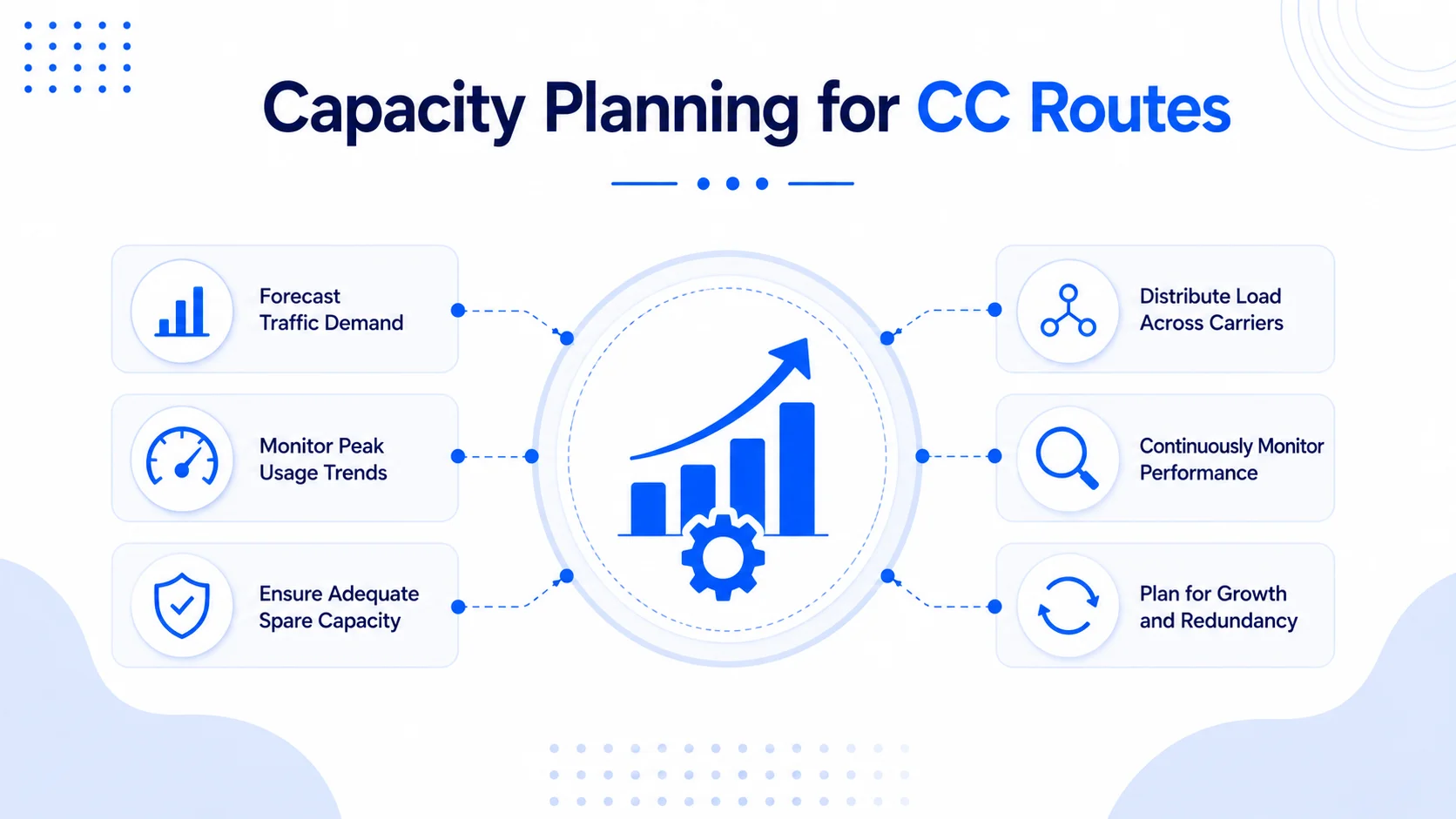
Capacity planning for CC routes starts with the channel-to-agent ratio. Predictive dialler campaigns typically need 3 to 5 channel attempts per available agent.
Inbound-only contact centres need one channel per agent plus around 20 percent burst buffer. Blended centres mix both and need capacity sized to simultaneous inbound and outbound peaks rather than treating them as separate workloads.
Elastic channel scaling on CC routes is what makes campaign launches work. Pre-commitment for burst capacity is the wrong economic model. A campaign that needs 5,000 concurrent channels for two hours next Tuesday should not require paying for 5,000 channels every day.
A wholesale VoIP carrier serving CC routes with elastic channel scaling lets the dialler place whatever concurrent count it needs. It bills per minute on the calls that actually complete.
Quality Metrics on CC Routes: ASR, PDD, MOS
Further reading: Wholesale voice solutions
Four metrics dominate CC route quality. ASR (Answer-Seizure Ratio) determines how many dial attempts are needed per connected call — every percentage point matters at scale. PDD (Post-Dial Delay) under 5 seconds keeps the dialler's predictive window accurate.
PDD over 5 seconds causes the dialler to misclassify calls and agents to sit idle. MOS (Mean Opinion Score) above 4.0 keeps the customer conversation healthy and conversion rates intact. Concurrent call capacity has to absorb peak dialler load without dropping calls.
A wholesale VoIP carrier serving CC routes exposes per-destination quality data live in the customer dashboard and via API. Contact-centre operations teams correlate quality metrics with conversion data to spot underperforming routes before they wreck a campaign. Anything weaker means the operations team is flying blind on the metric that drives commercial outcomes.
STIR/SHAKEN on CC Routes Is a Commercial Requirement
STIR/SHAKEN attestation on outbound CC routes is no longer just a regulatory checkbox. Calls with A-level attestation routinely see answer rates 25 to 40 percent higher than unsigned or weakly-attested calls on the same campaigns.
That happens because terminating carriers and call-screening apps trust verified caller ID and treat unverified calls as spam. For a contact centre running predictive-dialler CC routes at scale, that delta is the difference between a profitable campaign and one that does not pay for itself.
A wholesale VoIP carrier serving CC routes signs every US-bound call inline with the appropriate attestation level based on the customer's KYC posture. A CC route product without inline STIR/SHAKEN signing is silently costing every customer who routes US-bound traffic through it. That cost hits before they even look at the per-minute rate.
Automated Failover Between CC Routes
CC routes degrade. Upstream carriers go down, route quality drops at peak hours, and individual destinations hit congestion.
A wholesale VoIP carrier serving CC routes runs automated failover across multiple Tier 1 paths per destination. The LCR engine demotes degraded routes inside seconds and promotes alternative paths without any operator intervention required from the customer side.
For contact centres, this matters most during campaign launches. The first 30 minutes of a campaign reveal which routes are healthy under the specific load profile.
Manual route management on CC traffic during a campaign launch is operationally impossible at scale. A wholesale VoIP carrier that requires it is the wrong carrier for any contact-centre workload.
International CC Routes
Further reading: Wikipedia: VoIP overview
CC routes do not stop at US destinations. Outbound contact centres dialling international markets need country-specific CC routes with the right STIR/SHAKEN equivalent attestation (where it exists), local mobile-termination posture, and currency-normalised wholesale VoIP rates. A serious wholesale VoIP carrier provisions CC routes across 200+ countries with per-market quality scoring rather than treating international termination as a single bucket.
Compliance posture per market matters as much as quality. GDPR for European call data, EU mobile-termination caps, and country-specific KYC requirements all matter. Credible CC routes inherit compliance from the wholesale VoIP carrier rather than forcing the customer to rebuild it per market.
Choosing CC Routes on Wholesale VoIP
- 01Direct Tier 1 interconnects in destinations relevant to your campaign mix — not transit-only paths
- 02Elastic channel scaling without pre-commitment to absorb dialler burst patterns
- 03Full STIR/SHAKEN attestation on US-bound CC routes, surfaced in CDRs
- 04Live ASR, ACD, PDD, MOS per destination, accessible via API for ops correlation
- 05Hard spend caps and IRSF detection tuned for high-density CC traffic patterns
- 06Automated failover across multiple upstream routes per destination
- 07Contractual ASR floors and PDD commitments per route
- 0824/7 NOC with 15-minute critical-incident SLA — especially during campaign launches
Twiching's CC Routes for Contact Centres
Twiching provisions dedicated high-capacity CC routes across 200+ countries with elastic channel scaling and full STIR/SHAKEN A-level attestation on verified outbound caller IDs. It also runs real-time ASR and quality monitoring, automated failover between Tier 1 upstream paths, and per-campaign traffic analytics accessible via dashboard and API. Hard spend caps and IRSF detection are tuned for the specific patterns of contact-centre traffic rather than running a generic fraud model.
Per-destination wholesale VoIP rates on CC routes publish with billing increments and effective dates visible on every row. Onboarding completes in under 48 hours for standard business customers, and a 24/7 NOC responds to critical incidents during campaign launches inside 15 minutes.
CC (call centre) routes on wholesale VoIP must be provisioned to handle burst traffic patterns without call queuing or quality degradation. Predictive diallers generate sharp traffic spikes when a campaign launches — trunk capacity should be provisioned at 150% of average peak to absorb bursts.
Work with your wholesale provider to configure per-trunk burst allowances and establish a clear escalation process for capacity increases. Providers that require advance notice of more than 24 hours for capacity changes cannot support aggressive outbound dialling campaigns.
Conclusion
CC routes are a specialised wholesale VoIP product class, and serving them well requires the carrier to tune softswitch capacity, fraud detection, LCR policies, and STIR/SHAKEN attestation specifically for contact-centre traffic patterns. The non-negotiables are elastic channel scaling, A-level attestation on US-bound calls, live per-destination quality metrics, automated failover across multiple Tier 1 paths, and a 24/7 NOC that picks up the phone during campaign launches. Twiching is built around exactly that profile, so contact centres and platform companies running outbound campaigns launch on CC routes that hold up under campaign load — without operating the underlying wholesale VoIP carrier themselves.