Introduction
A wholesale voice carrier is a licensed telecommunications operator that routes large volumes of voice traffic between networks, holding direct interconnects with carriers, mobile operators, and international gateways. It sells access to that network as wholesale capacity, billed per minute, to ITSPs and UCaaS platforms.
This guide covers interconnect technology, route quality, and rate-deck mechanics.
Key Takeaways
- A wholesale voice carrier routes large volumes of carrier-to-carrier voice traffic over SIP-over-IP interconnects at per-minute wholesale VoIP rates.
- Modern interconnects are SIP over IP; legacy TDM/ISDN persists for compatibility but new arrangements default to IP.
- Route quality engineering — real-time ASR, ACD, PDD, MOS monitoring with automatic route demotion — is what separates serious wholesale voice carriers from weak ones.
- STIR/SHAKEN attestation, FCC/PUC licensing in the US, and national regulatory authorisation in each country a carrier operates in are baseline compliance.
- Twiching operates as a technology-led wholesale voice carrier with direct interconnects across 200+ countries, programmable APIs, and a 24/7 NOC.
What a Wholesale Voice Carrier Actually Does
Further reading: Wholesale DID number buyer's guide
A wholesale voice carrier sits at the infrastructure layer of the telephone network. The carrier holds licences in the jurisdictions it operates in.
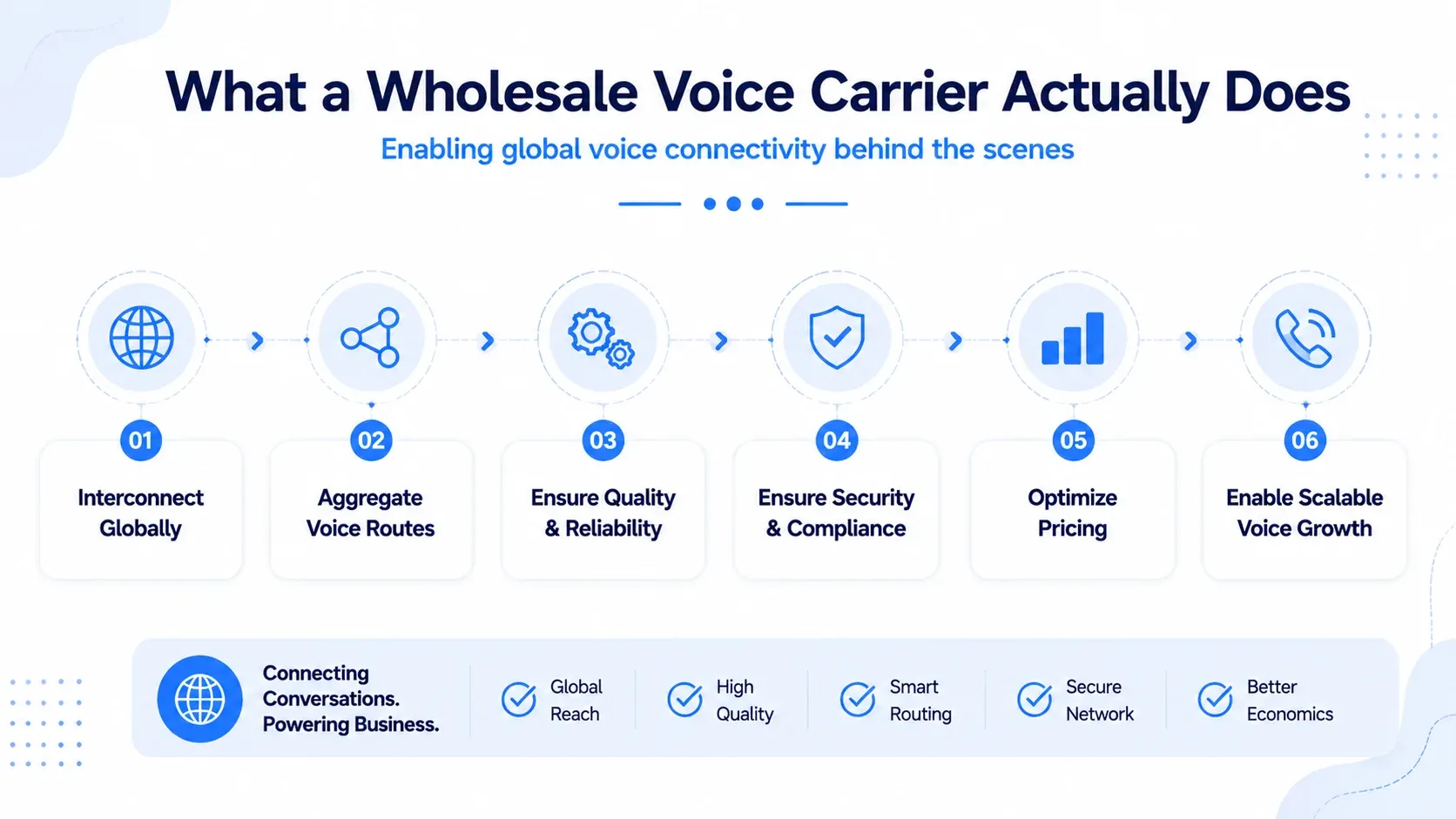
It also owns or leases capacity on direct SIP interconnects with other carriers.
It also runs a Class 4 softswitch that routes traffic across those interconnects, and maintains a 24/7 NOC. It bills customers per minute of completed traffic at carrier-tier wholesale VoIP rates.
Customers are other businesses — never end users — which is what distinguishes wholesale from retail in the telecoms sense.
The economics make sense because the carrier aggregates traffic from many buyers across its interconnect base. That scale lets it commit to volume thresholds with upstream carriers and unlock rate discounts no single buyer could earn alone. The carrier passes most of that discount through and keeps a margin.
Quality differentiation between wholesale voice carriers comes down to three things: interconnect depth, routing engineering, and operations.
Interconnect depth means more direct routes to more destinations. Routing engineering means better LCR and quality-aware demotion. Operations covers 24/7 NOC response, real-time CDR streaming, and fraud controls.
SIP Over IP — the Modern Wholesale Voice Carrier Interconnect
Further reading: Wholesale pricing & rate deck
New interconnects between wholesale voice carriers default to SIP over IP. The two carriers exchange signalling via SIP and media via RTP over private MPLS, IPsec VPN, or peering at an IX.
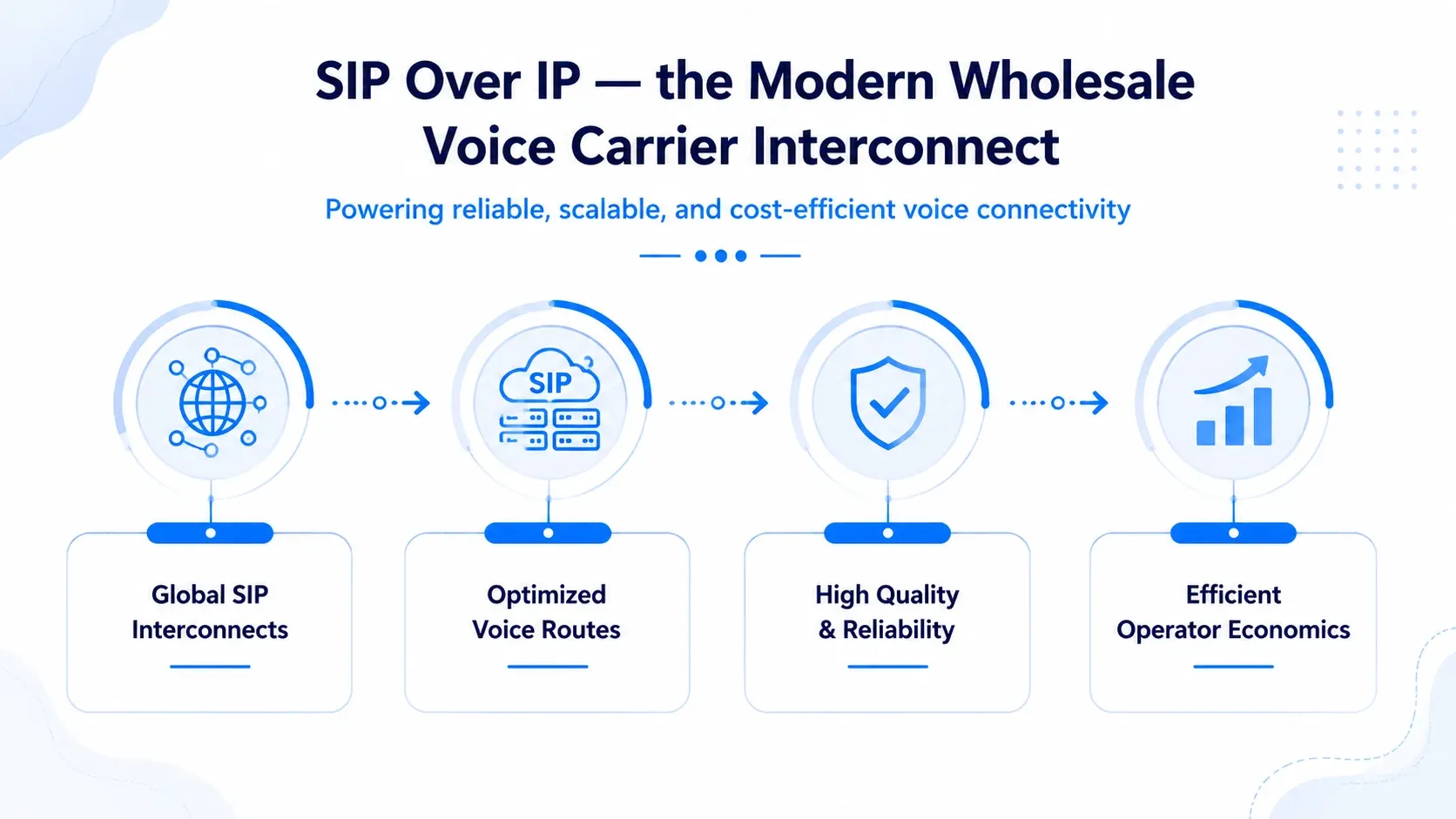
IP interconnects carry vastly more traffic per circuit at materially lower cost than the TDM/ISDN equivalent they replaced.
They also support codec flexibility — G.711, G.729, Opus, AMR-WB — negotiated per call.
The downside is integration complexity — IP interconnects need ongoing SIP normalisation, capacity monitoring, and security operations against SIP-layer fraud.
Legacy TDM/ISDN interconnects persist where the counterparty hasn't moved to IP. A serious wholesale voice carrier maintains both: IP for everything new, and TDM gateways for the long tail of legacy interconnects. Those older links still matter for completion against specific destinations.
The mix tilts heavily toward IP each year as legacy carriers complete their own migrations.
Route Quality Engineering at a Wholesale Voice Carrier
Route quality is the operational core of a wholesale voice carrier.
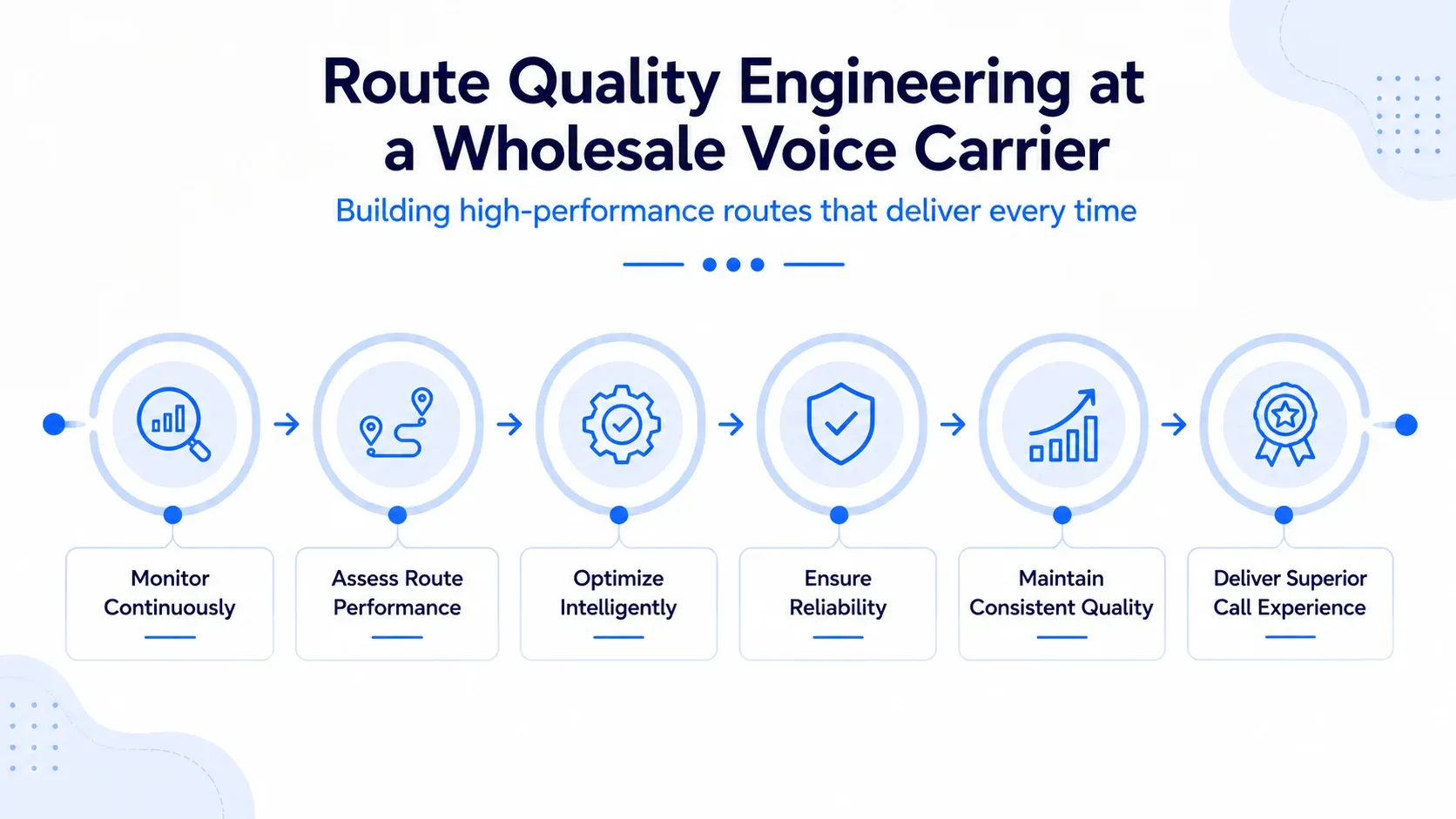
The carrier monitors ASR (Answer Seizure Ratio), ACD (Average Call Duration), PDD (Post-Dial Delay), and MOS (Mean Opinion Score). Tracking runs per destination prefix per upstream carrier in real time, typically refreshed every minute.
The routing engine demotes degrading routes automatically, so traffic shifts away from a degraded carrier within minutes, not hours. It then rebalances toward routes that meet the customer's quality floor at the lowest cost.
Behind the real-time engine, a NOC team handles the fault management. They investigate the underlying cause when a route degrades, escalate to upstream carriers, and push fixes back into the routing rules.
A wholesale voice carrier with no real-time quality data and an email-based NOC will lose customers to one with a real-time dashboard and 15-minute critical-incident SLAs. Twiching's NOC runs a 15-minute critical-incident SLA with named escalation contacts on every customer account.
Rate Decks and Per-Minute Billing
Further reading: Wholesale voice solutions
A wholesale voice carrier publishes a per-destination rate deck listing the wholesale VoIP rate per prefix, the billing increment, and the currency.
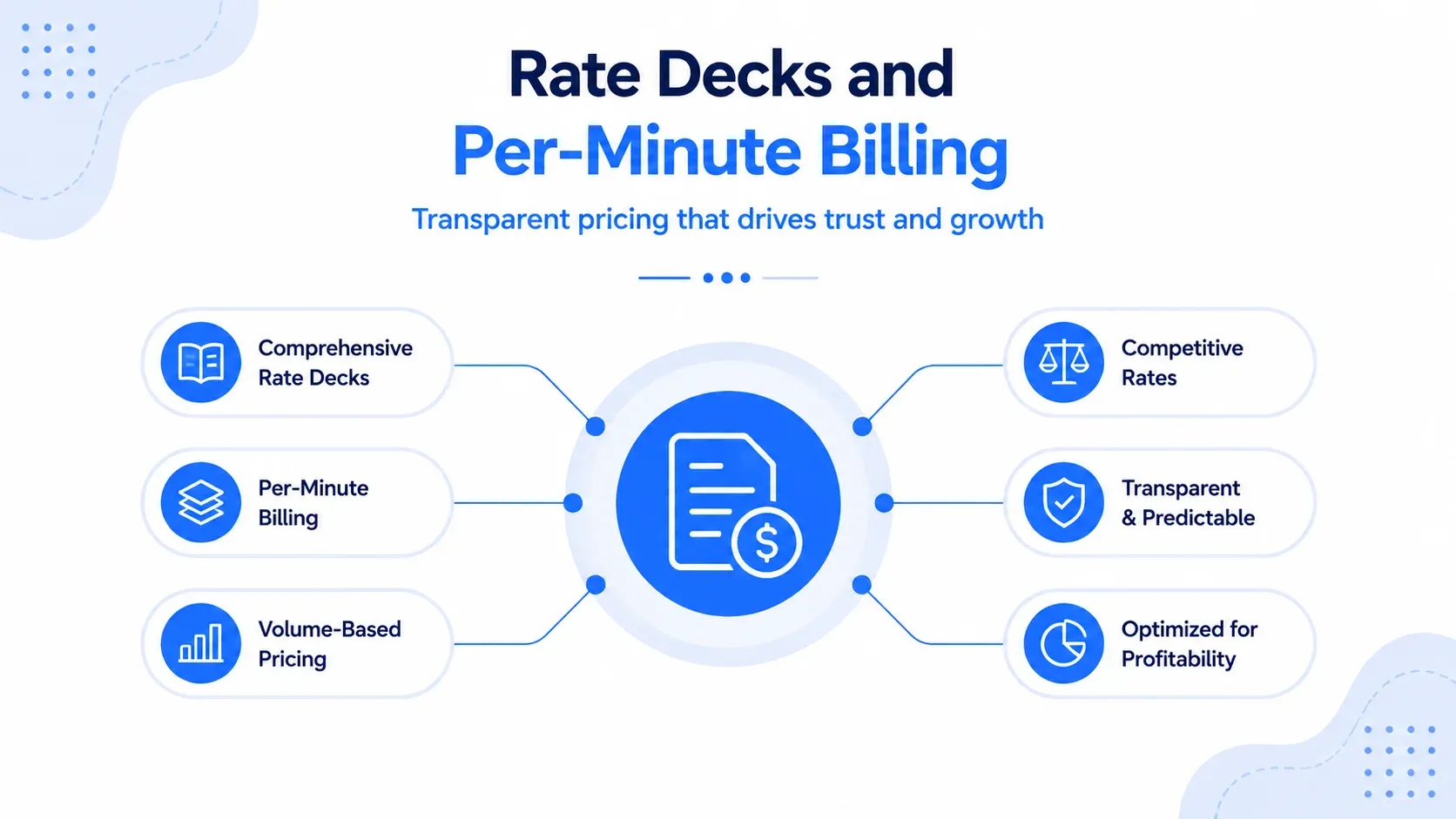
Modern decks typically bill in 1-second increments after a 6-second minimum. Each rate deck also lists an effective date, with a notice period before changes take effect.
Customers download the rate deck via portal or API and audit against their own CDRs. The CDR-rating engine inside the carrier processes each call in real time, debits prepaid balances or accumulates postpaid charges, and exposes live balance dashboards.
Margin economics inside a wholesale voice carrier come from spread. That is the rate the carrier pays an upstream provider for a destination, versus the rate it sells to its customers.
Volume-tier discounts with upstreams compound. A wholesale voice carrier serving 100 small ITSPs at aggregate 1B+ minutes/month qualifies for tier discounts no single ITSP could earn.
It then prices its customer-side rate deck above its own cost.
The narrower the spread, the more sensitive the carrier is to bad debt, fraud, and route degradation.
STIR/SHAKEN and the Regulatory Layer
STIR/SHAKEN attestation is mandatory for US-bound outbound traffic in 2026. A wholesale voice carrier signs each outbound INVITE with an attestation level — A (full), B (partial), or C (gateway).
The receiving carrier's spam analytics then use that attestation level to score caller reputation.
Customers terminating outbound through a wholesale voice carrier that signs only at C see their answered-rate collapse. US carriers flag low-attestation traffic as likely robocall and either label or block it.
Licensing sits on top of attestation. In the US, that means FCC authorisation as an interstate carrier plus state PUC registrations for intrastate services.
In the EU, it means national regulatory authorisation in each member state under the European Electronic Communications Code. Every other major market the carrier touches has its own equivalent rules.
CALEA in the US adds lawful intercept obligations. Any wholesale voice carrier asking customers to take licensing on trust without documentation is a red flag.
Fraud Controls — IRSF and Toll Fraud
International Revenue Share Fraud is the single biggest financial risk in the wholesale voice carrier business. Attackers compromise a customer's SIP credentials, then dial premium-rate international destinations until the customer's bill explodes.
Depending on contract terms, the customer-side carrier may be on the hook for the upstream charges.
Defensive controls inside the wholesale voice carrier include hard spend caps per customer trunk, a default-deny posture on premium-rate destinations, and blocked-prefix lists for high-risk geographies.
They also include real-time anomaly detection on destination/time/volume patterns, with automatic trunk suspension when thresholds are crossed.
What to Evaluate in a Wholesale Voice Carrier
Further reading: Wikipedia: VoIP overview
Score interconnect depth and route quality dashboards first — those two are the hardest for a thin reseller to fake, and they predict how the rest of the relationship will hold up under real traffic.
- 01Owned direct interconnects in your top destinations, not third-party reseller routing
- 02SIP-over-IP as the default; TDM gateways available where legacy counterparties require it
- 03Real-time per-destination ASR/PDD/MOS dashboards refreshed every 60 seconds with auto-demotion
- 04Multi-tier LCR — premium / standard / economy — selectable per destination
- 05Per-destination rate deck published with billing increments, currency, effective dates, and notice periods
- 06A-level STIR/SHAKEN attestation inline on US-bound outbound calls
- 07FCC and state PUC licensing documented; equivalent regulatory authorisation per market
- 08IRSF protection with hard spend caps, default-deny premium-rate posture, anomaly detection
- 09Real-time CDR streaming via webhook or Kafka for live customer-side analytics
- 1024/7 NOC with 15-minute critical-incident SLA and named escalation contacts
Licensing documentation is easy to overlook next to the technical items, but a carrier that cannot produce it on request is not a carrier worth building a business on top of, regardless of how the rest of the checklist scores.
Twiching as a Wholesale Voice Carrier
Twiching operates as a technology-led wholesale voice carrier, with direct SIP interconnects across 200+ countries and TDM gateways for legacy completion.
It runs on a cloud-native Class 4 softswitch with multi-region active-active failover, and multi-tier LCR routing per destination with auto-demotion on degrading routes.
The platform also runs real-time CDR streaming and A-level STIR/SHAKEN attestation on US-bound outbound calls.
IRSF protection is on by default, with customer-configurable spend caps. FCC and equivalent EU regulatory authorisation is documented per market.
Per-destination wholesale VoIP rates publish with billing increments and effective dates visible on every row. There's no per-seat licensing layered on top, and no large volume minimums on standard business accounts.
Twiching's 24/7 NOC runs a 15-minute critical-incident SLA with named escalation contacts on every account. Onboarding completes in under 48 hours for standard business customers.
White-label partners launch a branded wholesale voice carrier business on the same routing and operations infrastructure Twiching uses internally.
Conclusion
A wholesale voice carrier is judged on five things — interconnect depth, route quality engineering, rate-deck transparency, regulatory and STIR/SHAKEN compliance, and NOC response under campaign load — and everything else is positioning. Twiching operates as a technology-led wholesale voice carrier with direct SIP interconnects across 200+ countries, real-time per-destination ASR/PDD/MOS dashboards, multi-tier LCR, A-level STIR/SHAKEN attestation, documented FCC and EU regulatory authorisation, IRSF protection by default, and a 24/7 NOC with a 15-minute critical-incident SLA.
Per-destination wholesale VoIP rates publish with billing increments and effective dates visible on every row, with no large volume minimums on standard business accounts. Walk through a destination-level interconnect review against Twiching's published wholesale VoIP rates to benchmark whether the wholesale voice carrier carrying your traffic is still the right one.