Introduction
Every wholesale voice deal eventually comes down to one thing: the traffic itself — the actual stream of call minutes flowing between networks, and whether that stream holds up under real-world conditions. Two carriers can quote the same per-minute rate on paper and deliver wildly different outcomes once traffic starts flowing, because rate cards say nothing about how a call is routed, how its caller ID is handled, or how quickly a failing path gets pulled from rotation.
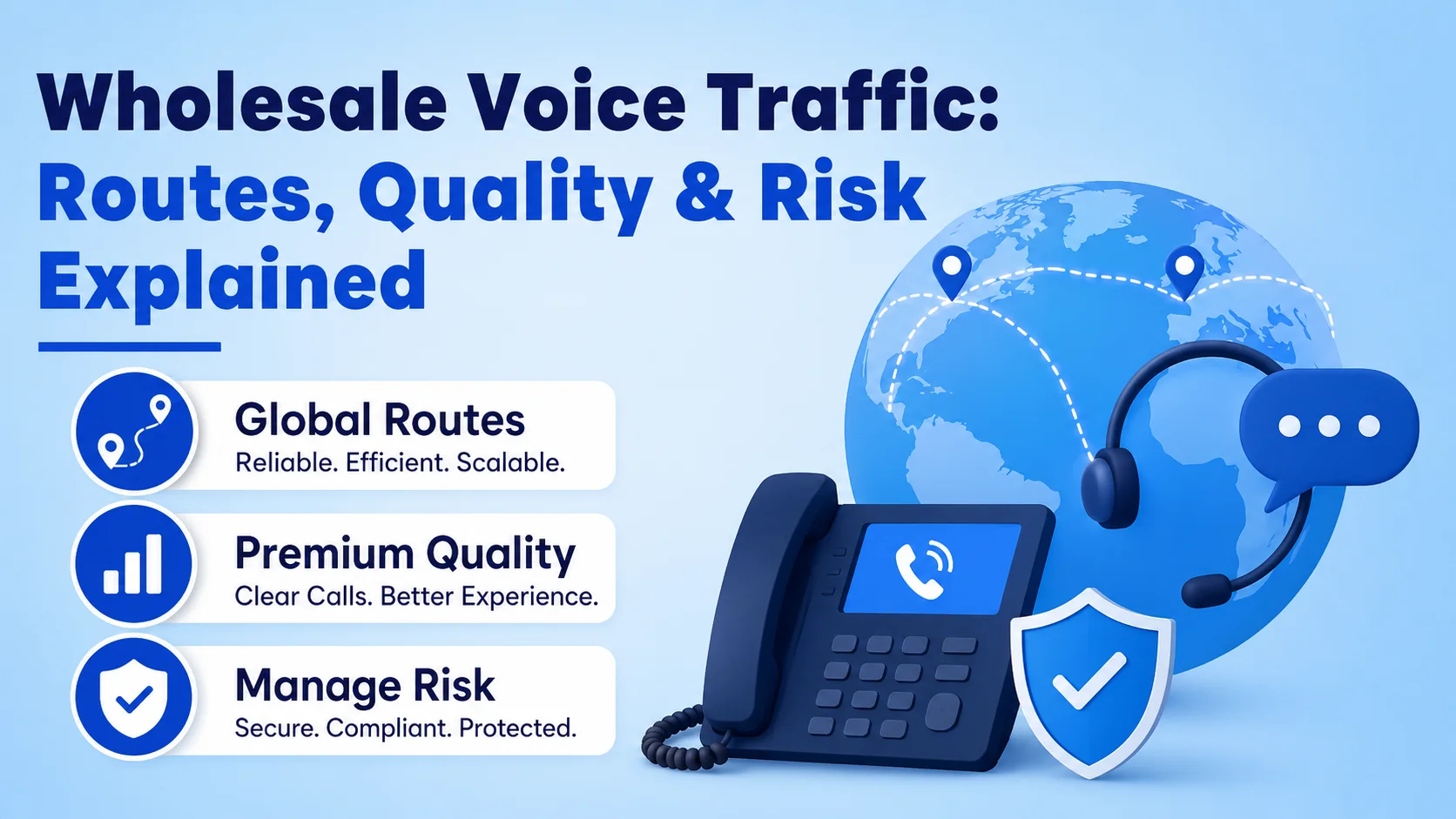
Understanding wholesale voice traffic means understanding what happens between dial and disconnect — the route classifications that determine call treatment, the quality metrics that reveal a route's real health, and the risks that live inside traffic that looks legitimate on the surface but isn't. This guide breaks down how wholesale voice traffic is classified, measured, monitored, and protected, so you can read a traffic report the way an operations team does.
What Counts as "Traffic" in Wholesale Voice
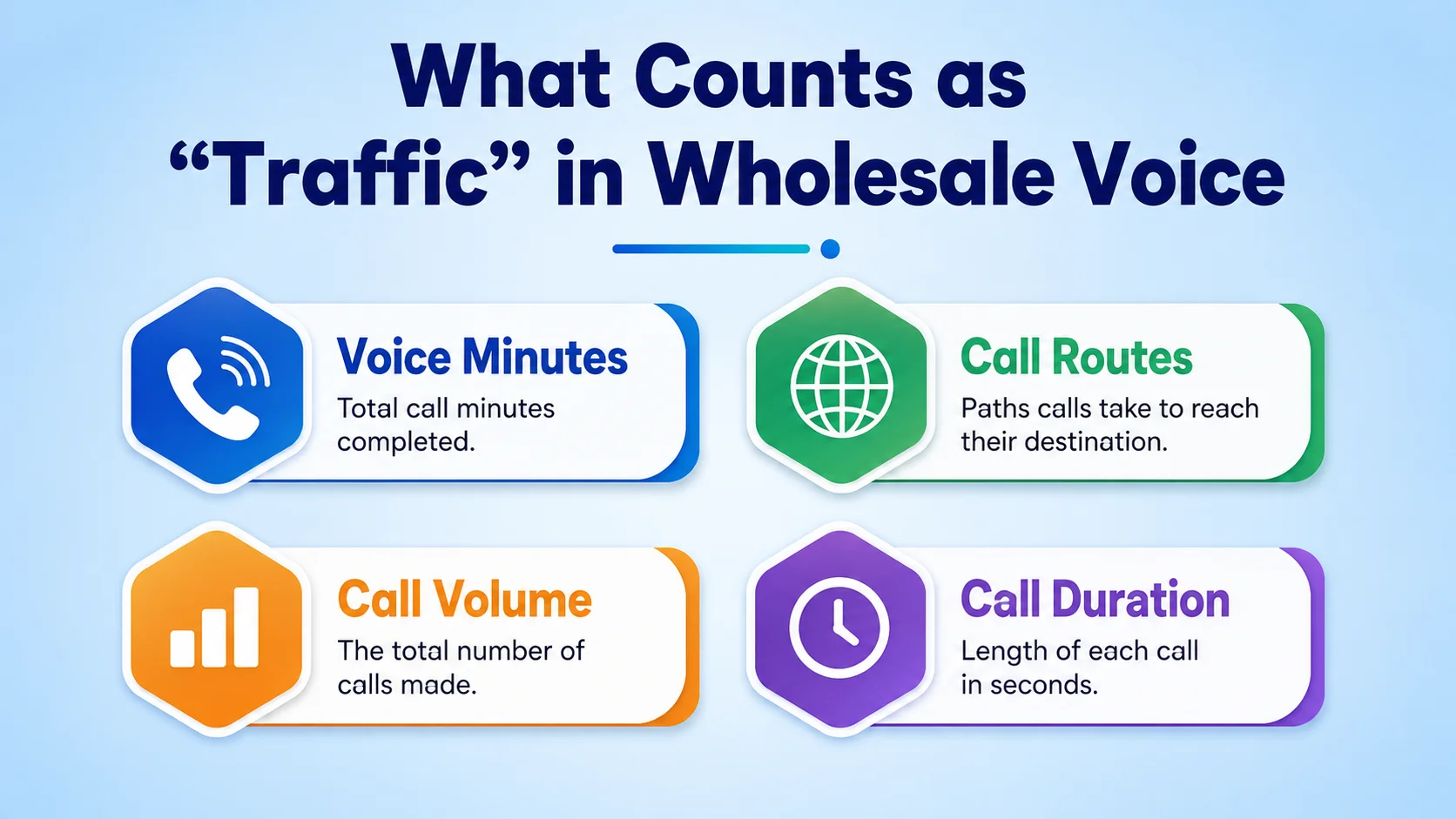
In wholesale voice, traffic refers to the aggregate flow of call attempts and completed minutes passing across an interconnect — not a single call, but the pattern of thousands or millions of them moving through a route over time. A carrier doesn't evaluate a route by listening to one call; it evaluates traffic by watching how an entire population of calls behaves: how many connect, how long they last, how fast they fail, and whether that pattern holds steady across the day.
This distinction matters because traffic-level thinking is what separates wholesale operations from retail. A retail customer cares whether their call went through. A wholesale buyer cares whether 100,000 calls an hour will go through at a predictable rate, on a predictable budget, without the route silently degrading halfway through a billing cycle.
Route Classifications That Shape How Traffic Behaves
Not all wholesale voice traffic is routed the same way, and the routing method directly shapes call outcomes. Four classifications come up constantly when carriers describe their traffic:
- CLI traffic — the caller's number passes through intact, letting the called party see a real, dialable number; this is required for sales, support, and any use case where trust in the caller ID matters
- Non-CLI traffic — the caller ID is stripped, altered, or replaced somewhere along the path; it's cheaper to terminate but shows as blank, invalid, or mismatched on the receiving end
- Premium and standard-tier traffic — carriers commonly grade capacity into tiers (sometimes labeled Standard, Premium, and Premium+) reflecting how direct the interconnect is and how tightly the carrier controls the path end to end
- Grey traffic — calls that appear to originate through a legitimate network but are actually diverted through unauthorized termination methods (most often SIM farms), bypassing the interconnection fees a legitimate route would incur
Grey traffic deserves a closer look, since it's the classification most likely to surprise a buyer after the fact — covered in its own section below.
Further reading: wholesale voice carrier route quality
Reading Traffic Quality: ASR, ACD, and PDD
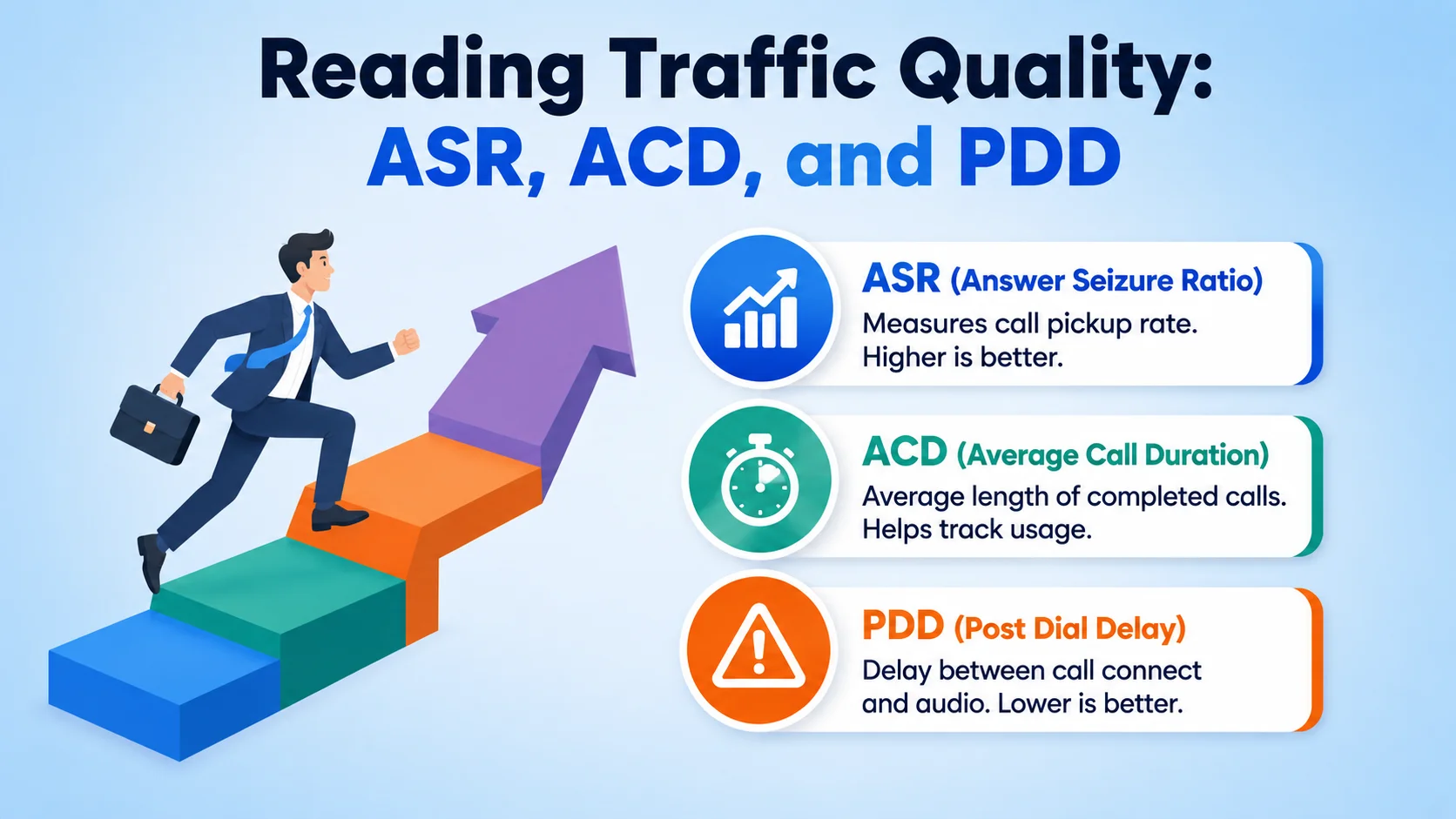
Three metrics tell you almost everything about how a stream of wholesale voice traffic is actually performing, and they're tracked per route, per destination, and per supplier — not just at the account level.
- Answer-Seizure Ratio (ASR) — the percentage of call attempts that get answered; wholesale traffic commonly runs lower than retail because it blends business, mobile, and automated dialing patterns, so a healthy wholesale ASR often sits in a wider band than consumer benchmarks suggest, and a sudden drop signals a routing or interconnect problem before customers start complaining
- Average Call Duration (ACD) — how long connected calls actually last; legitimate voice traffic tends to cluster in a multi-minute range that varies by traffic type, while unusually short average durations across a route often point to answering-machine detection issues, fraud probing, or a route that's technically connecting but failing to hold audio
- Post-Dial Delay (PDD) — the gap between dialing and hearing ringback; rising PDD on an otherwise stable route is frequently the earliest warning sign of upstream congestion, since it degrades before ASR does
Operations teams don't watch these numbers once a day — they watch them continuously, per route, and set automatic thresholds. When a route's ASR falls below its baseline for a sustained window, least-cost routing (LCR) engines deprioritize or pull it from rotation automatically, often before a human ever reviews a report.
Grey Routes and Traffic-Level Fraud
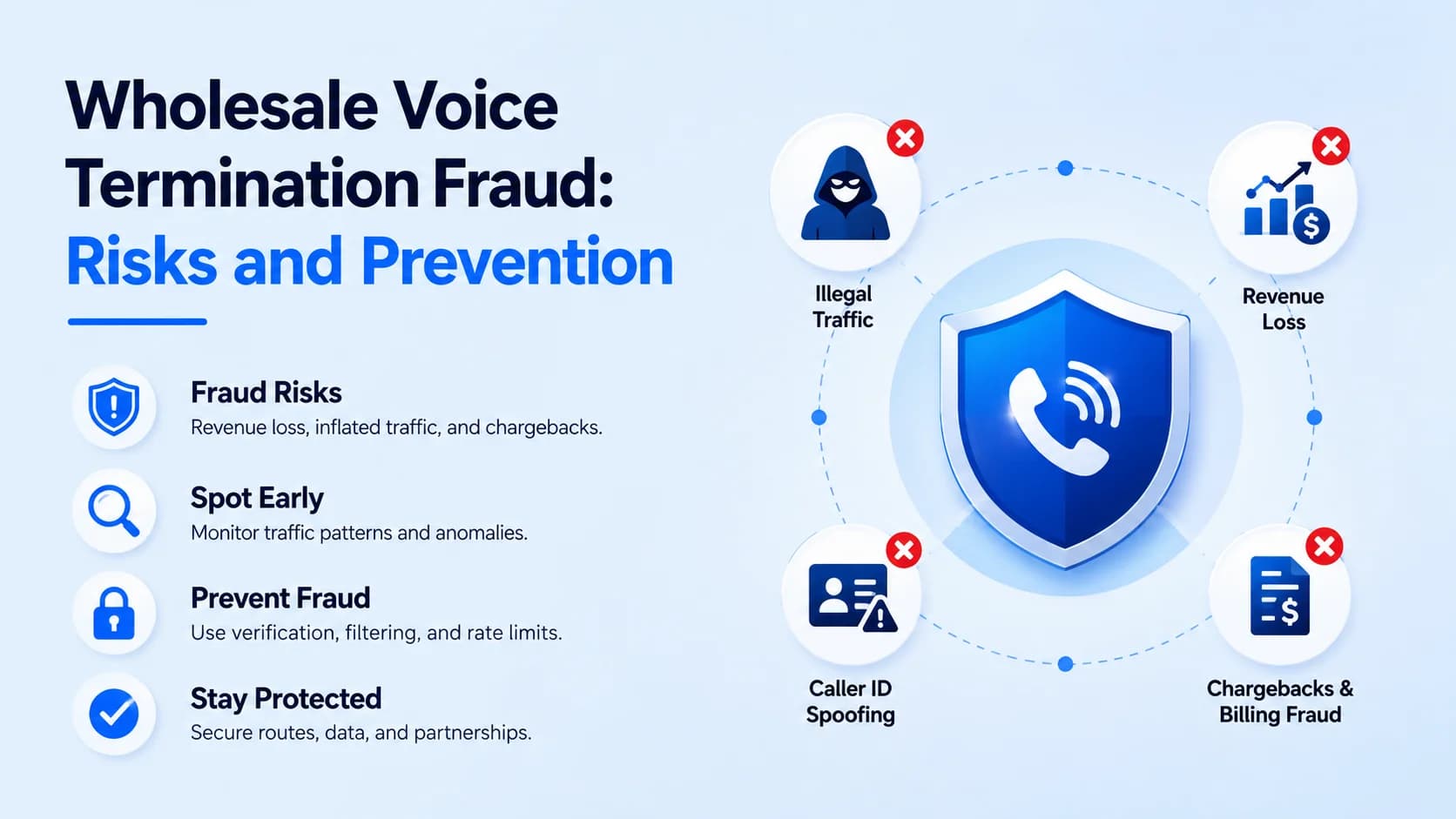
The most common fraud pattern hiding inside wholesale voice traffic is SIM-box bypass, sometimes called interconnect bypass fraud. Instead of terminating a call through the proper international gateway — where interconnection fees apply — the traffic is rerouted to a bank of SIM cards inside the destination country and terminated as if it were a local mobile call. The call still connects, and the person receiving it may not notice anything wrong, but the carrier that should have collected termination revenue never sees it.
This traffic is hard to spot from a single call detail record, but it leaves patterns across the aggregate: an unusually high concentration of calls landing on mobile numbers within one destination, ACD statistics that cluster suspiciously around typical grey-route durations, or a spike in traffic volume from a supplier whose contracted route type doesn't match what's actually being observed. Carriers that actively manage traffic quality run automated pattern detection against these signals rather than relying on manual spot checks, because by the time a manual review catches it, the exposure has usually run for weeks.
For buyers, the practical defense is contractual and observational: require route-type disclosure in writing, and independently verify that the traffic you're paying premium CLI rates for actually behaves like CLI traffic in your own monitoring — not just on the supplier's dashboard.
Further reading: GSMA: Interworking Security
How Traffic Moves Between Carriers: Interconnects and Exchanges
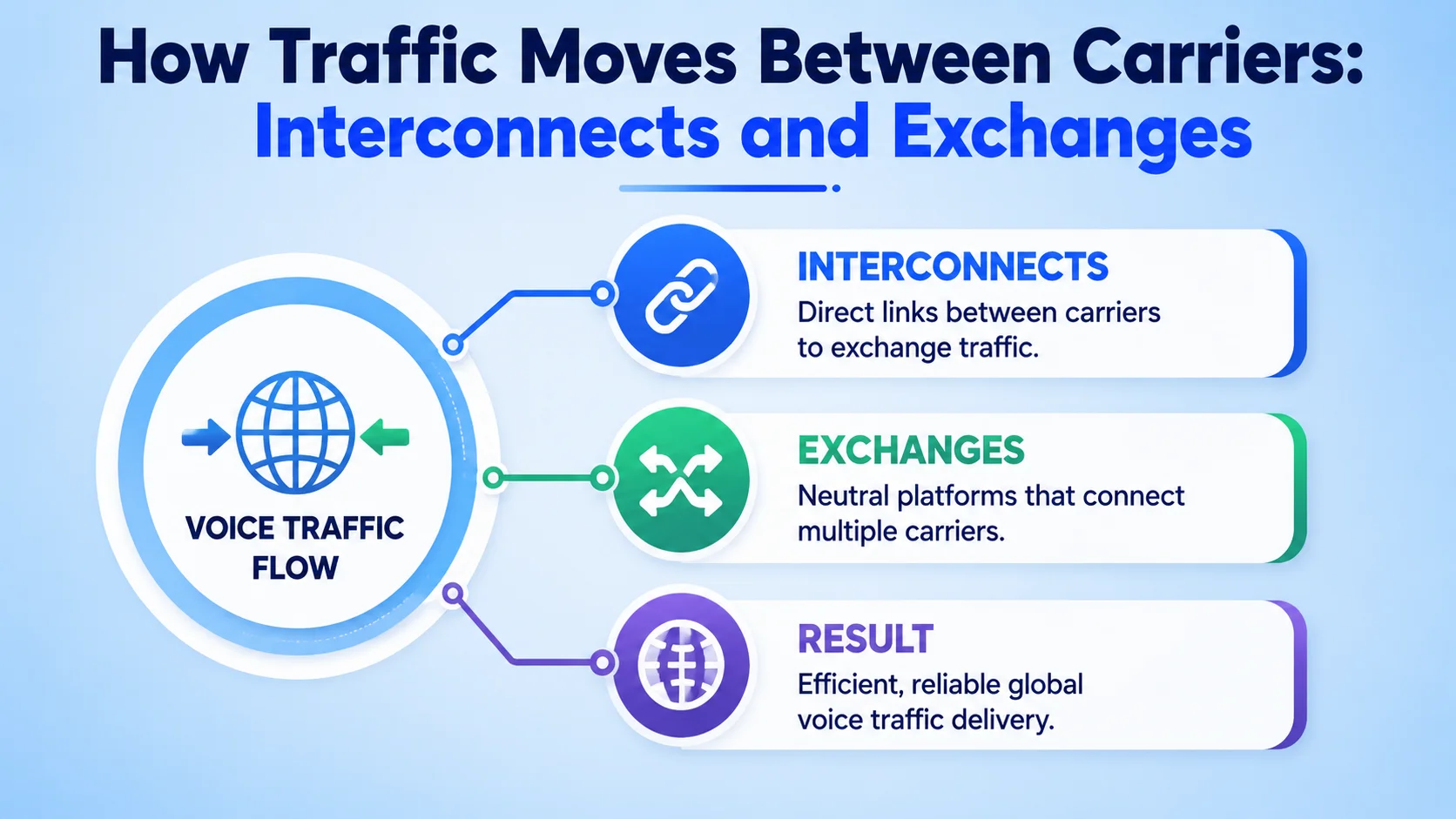
Wholesale voice traffic doesn't travel in a straight line from origin to destination — it crosses one or more interconnection points, and how those points are structured affects both cost and quality.
A direct interconnect links two carriers' networks point-to-point, giving both sides full visibility into the traffic and the shortest possible path. A voice traffic exchange (sometimes called an IX or hubbing platform) instead lets many carriers peer through a shared switching hub, trading traffic without negotiating a bilateral agreement with every single partner. Exchanges lower the barrier to reaching new destinations quickly, but they add a hop — and every additional hop is one more place where audio quality, latency, or CLI integrity can degrade before a call reaches its destination.
Larger wholesale operators typically run a hybrid model: direct interconnects for their highest-volume, quality-sensitive destinations, and exchange-based routes to fill in lower-volume or long-tail destinations where a dedicated interconnect wouldn't be cost-justified.
Monitoring Traffic in Real Time
Rate decks are static; traffic is not. A route that performed well on Monday can degrade by Wednesday if the upstream carrier reroutes capacity, a peering partner has an outage, or congestion builds during a regional peak period. Real-time monitoring is what catches this before it shows up as a customer complaint.
A working traffic-monitoring setup typically tracks live call volume against expected baselines, per-route ASR/ACD/PDD trending with automatic alerting on threshold breaches, SIP response code distribution (a spike in specific failure codes narrows down the fault to a specific layer of the call path), and CDR (call detail record) reconciliation against billing — catching cases where the volume you were billed for doesn't match the volume your own switch actually processed.
The dashboards matter less than the discipline behind them: any provider can show you a graph, but the useful question is whether a degrading route triggers an automatic action — deprioritization, rerouting, or an alert to a human — or whether someone has to notice the graph first.
Further reading: wholesale voice business model
Forecasting and Capacity Planning for Traffic Volume
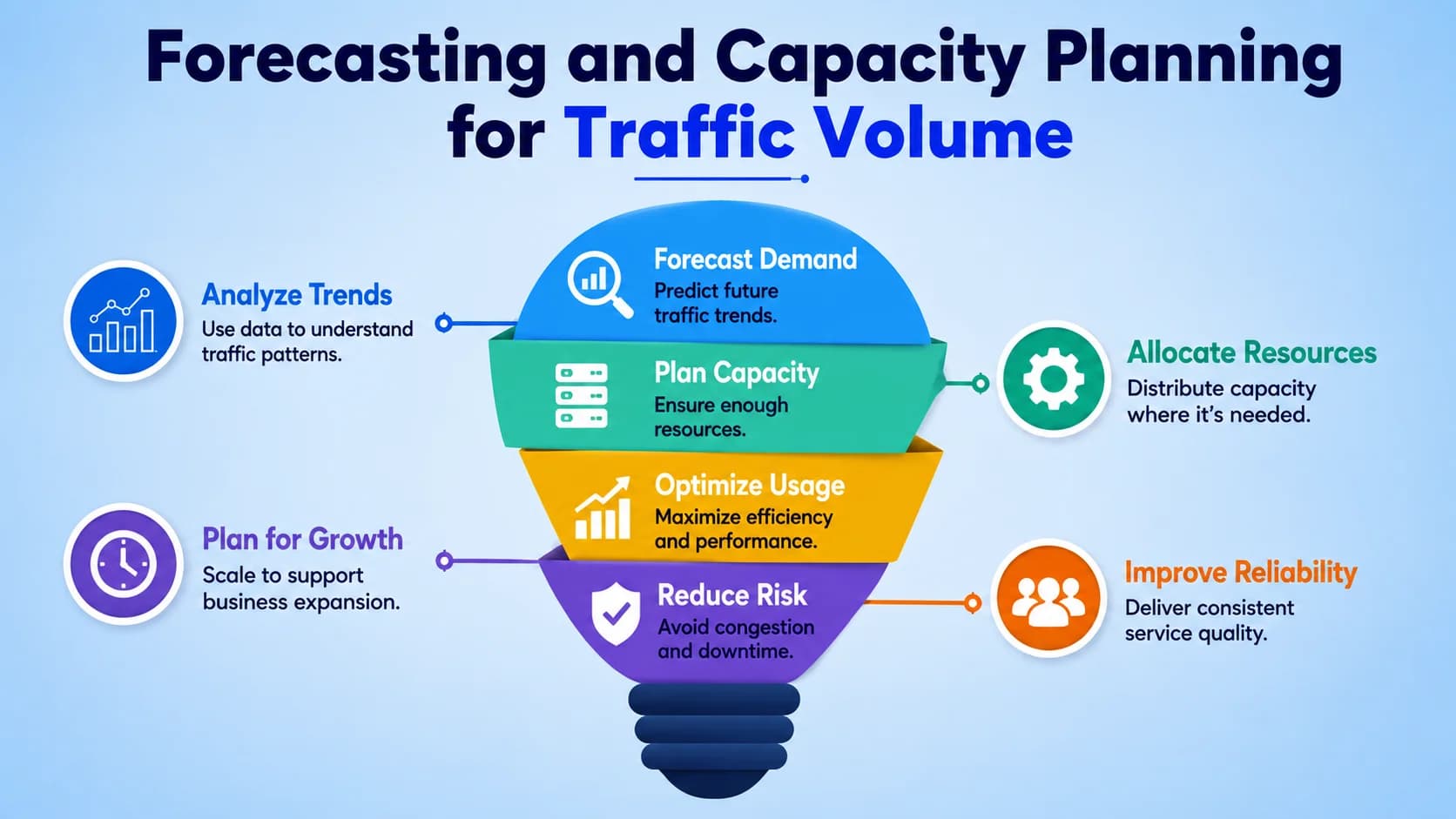
Wholesale voice traffic rarely arrives evenly. Contact centers spike around business hours in their target time zone, marketing campaigns generate short bursts of outbound volume, and international traffic shifts with regional calling patterns and holidays. A route or channel allocation sized for average volume will bottleneck during these peaks, generating busy signals or call failures precisely when traffic — and revenue — is highest.
Forecasting wholesale traffic well means modeling peak concurrent channel usage, not just monthly minute totals, and building in burst capacity that can absorb short spikes without a manual capacity request. Providers that support elastic, API-driven channel scaling let traffic-heavy operations — contact centers, AI voice platforms, and bulk notification systems — flex capacity up during a campaign and back down afterward, instead of paying for peak capacity year-round.
Conclusion
Wholesale voice traffic is never just a number on a rate card — it's a living stream of calls whose real value only shows up once you measure how it actually behaves: which routes hold up, which quietly degrade, and which were never what they claimed to be. Route classification tells you what kind of traffic you're buying, ASR/ACD/PDD tell you whether it's healthy, and traffic-level fraud monitoring tells you whether it's honest.
None of that is visible from a price sheet alone. The operators who get the most value from wholesale voice aren't the ones who found the lowest rate — they're the ones who built the monitoring discipline to know, in real time, whether the traffic they're paying for is the traffic they're actually getting.