Introduction
A wholesale VoIP minutes provider is the engine behind every call your product or platform delivers. When it runs poorly, every dropped call is a customer experience failure your product owns. This guide covers what to evaluate, what to demand, and how to verify before committing volume.
What a Wholesale VoIP Minutes Provider Actually Does
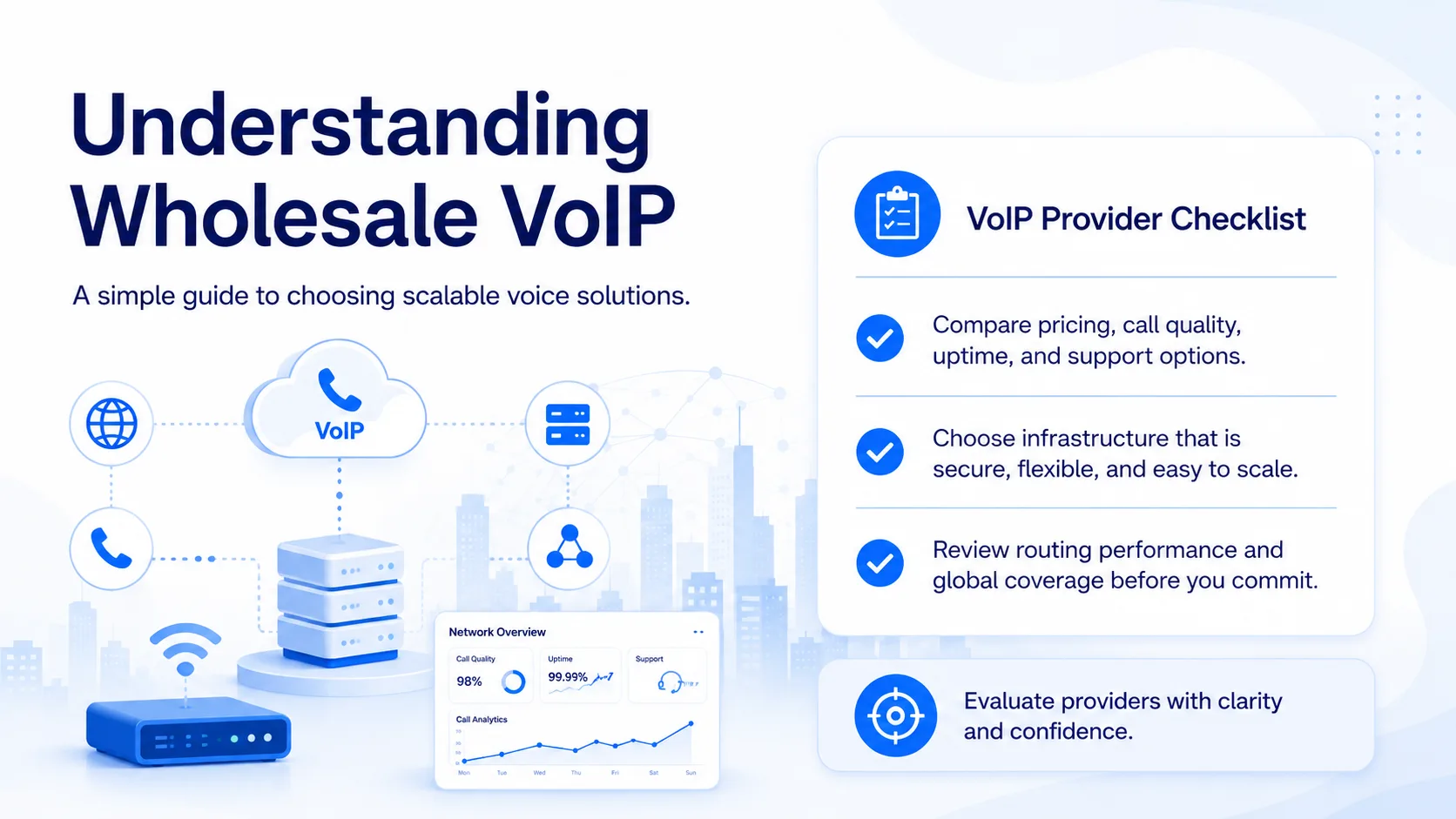
A wholesale VoIP minutes provider aggregates voice termination capacity from multiple carriers, or maintains its own direct carrier interconnections. It then resells that capacity in bulk to businesses, UCaaS platforms, contact centers, and resellers.
Your platform sends outbound calls to the provider's Session Border Controller (SBC) via SIP. The provider's routing engine selects the optimal path for each destination and hands the call to the appropriate terminating carrier. The provider handles all underlying carrier relationships, number portability lookups, and STIR/SHAKEN signing.
The provider's core value proposition is access:
- Access to Tier 1 carrier interconnects that would take years and significant capital to establish independently
- Access to global destinations through a single SIP connection
- Access to volume pricing that individual buyers cannot achieve at their own scale
The best providers add a second layer of value: routing intelligence that selects not just the cheapest path, but the highest-quality path for each call type.
The Three Tiers of Wholesale VoIP Minutes Providers
Further reading: Wholesale Voice Platform
Tier 1 direct providers own or have direct bilateral agreements with PSTN carriers in their coverage markets. They control quality end-to-end, can offer Level A STIR/SHAKEN attestation, and charge premium rates that reflect their infrastructure investment. For enterprise voice and contact center platforms where quality directly affects revenue, Tier 1 providers are almost always the right choice.
Tier 2 aggregators buy capacity from Tier 1 providers and resell with added routing intelligence. They offer competitive rates because they aggregate demand across many customers, and the best Tier 2 providers are transparent about their underlying carriers. For businesses with moderate quality requirements and price sensitivity, a reputable Tier 2 provider often strikes the best balance.
Commodity brokers buy and resell wholesale minutes with minimal quality infrastructure, often routing through gray or unregistered paths to maximize margin. They offer the lowest headline rates and the least predictable quality. For low-stakes, non-production traffic only — never for customer-facing calls.
Six Things to Evaluate Before Choosing a Provider
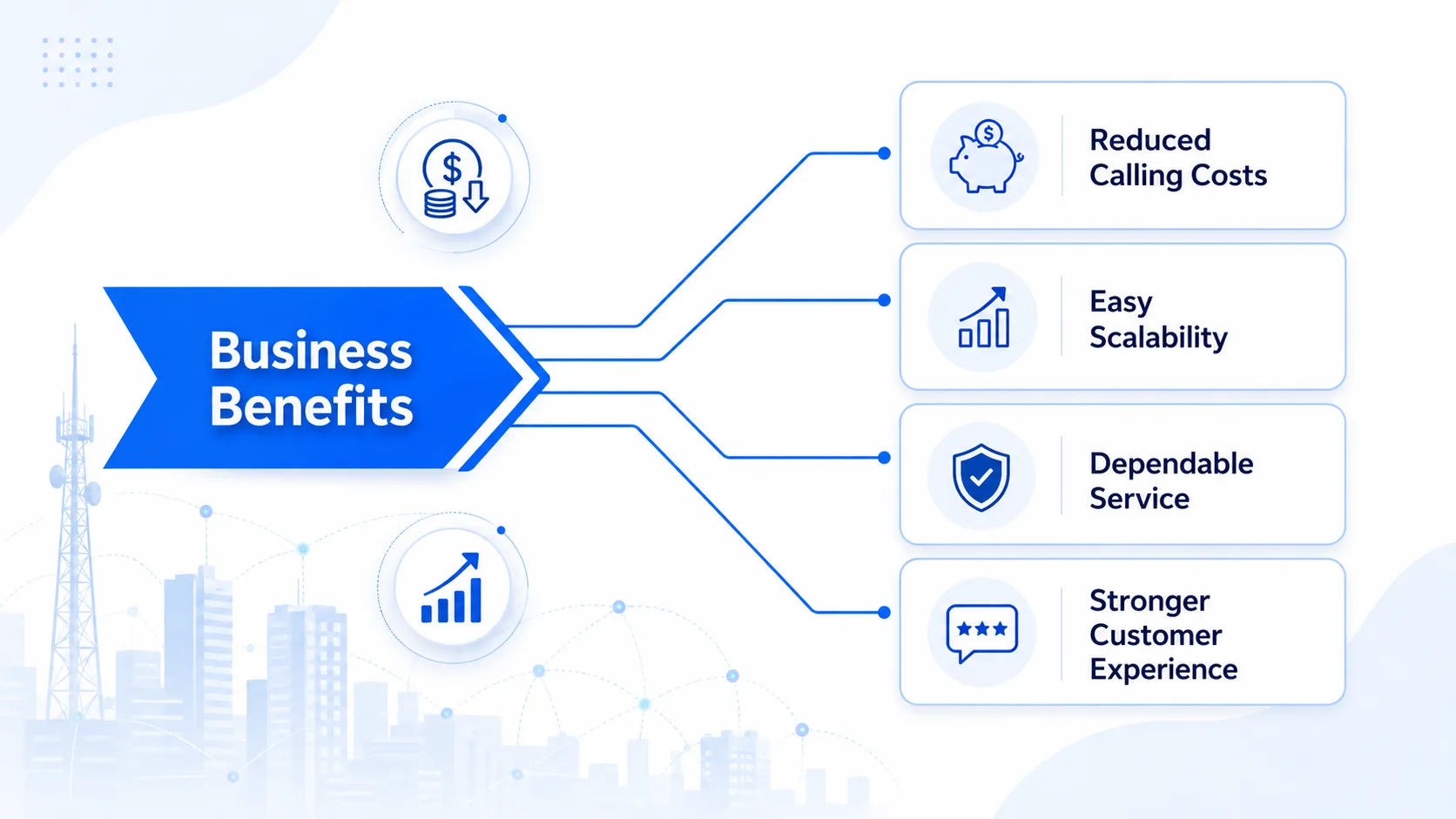
Route coverage mapped to your actual traffic is the first evaluation. Request the provider's rate deck and compare it to your top 20 destination countries by monthly minute volume.
Identify whether they have direct routes (Tier 1 or verified Tier 2) for each destination or whether they rely on cascading resellers for coverage. For destinations that represent over 10% of your monthly minutes, indirect routing is a risk worth pricing explicitly.
Quality metrics by destination are the second. ASR and PDD benchmarks should be available per destination class — not as global averages that hide poor performance on specific routes.
Ask for the last 90 days of ASR data for your top five destinations during the sales process. A provider who cannot produce destination-level quality data is a provider who is not measuring it.
Scalability architecture is the third. Ask about their maximum concurrent call capacity and how they handle traffic spikes. Contact centers and platforms that run outbound campaigns experience traffic spikes 5–10x baseline in short windows.
A provider whose SBC infrastructure cannot absorb a burst without degrading call setup times is a liability. Ask specifically: what is your peak concurrent call capacity, and how does your SBC cluster scale?
Billing transparency is the fourth. Itemized CDRs available within minutes of call completion, per-call cost data including applied rate and billing increment, and monthly reconciliation support are baseline requirements. Providers who offer only monthly aggregate invoices are providers who do not expect to be audited.
Support quality is the fifth. A wholesale provider is a technical partner, not just a vendor. P1 incidents need NOC-level responses within minutes, not hours.
Ask for their P1 response SLA in writing and ask for a reference customer you can call who has experienced a P1 incident with them. How a provider responds under stress is more revealing than how they perform in normal conditions.
Commercial terms are the sixth. Rate lock periods on committed volume, minimum commitment flexibility, exit rights tied to SLA performance, and clear rate update notification windows define the commercial relationship.
Some providers resist rate locks, require 12+ month minimums without quality-based exit rights, or bury surcharges in billing terms that differ from contract terms. That behavior communicates their priorities clearly.
How to Run a Provider Evaluation Trial
Further reading: Quality VoIP Minutes Wholesale
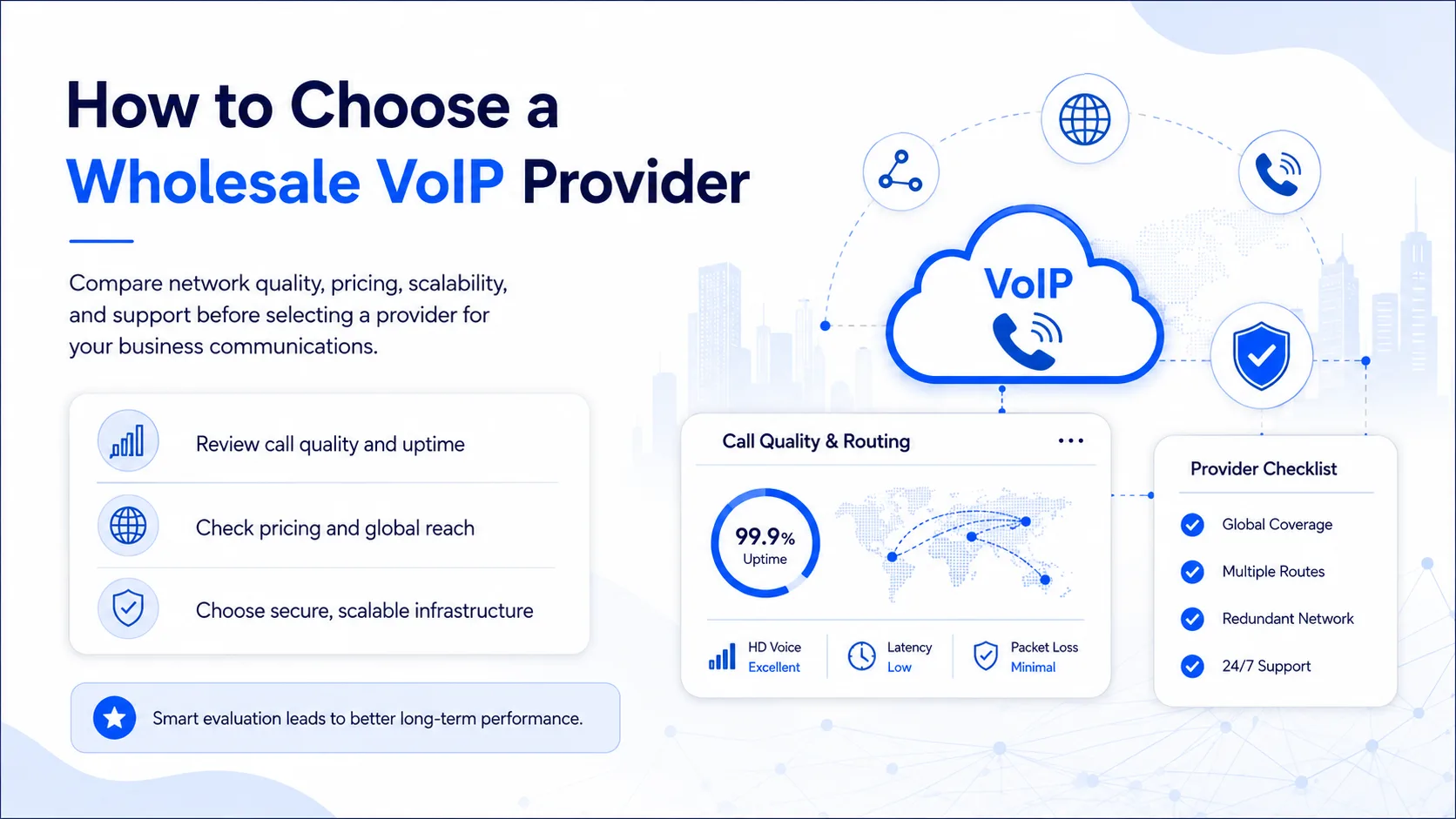
A proper evaluation trial runs for 30 days on live production traffic — not a synthetic test environment. Route 10–15% of actual outbound traffic to the candidate provider, selecting a representative sample of your destination mix. Compare ASR, average call duration, MOS scores (if your SBC supports RTCP-XR), and PDD against your existing provider on identical destination and call-type profiles.
Examine CDRs at the carrier level. Which underlying networks are carrying your calls? A Tier 2 provider who routes your US traffic through a Tier 1 carrier, but your international traffic through three unverified resellers, has a gap.
That's not the quality consistency their sales materials promised. CDR carrier transparency during the trial is as important as ASR numbers.
Stress-test their SBC during the trial. On a scheduled day, spike your traffic to 2–3x normal volume and monitor call setup latency, ASR change, and audio quality.
A provider whose quality degrades significantly under load has provisioned their infrastructure for average traffic, not peak traffic. That's a real problem for any business with variable call volume.
STIR/SHAKEN and Why It Narrows Your Provider Shortlist
ATIS STIR/SHAKEN Implementation
STIR/SHAKEN compliance is a meaningful filter when evaluating wholesale VoIP minutes providers. The FCC requires all US voice providers to register with ATIS and implement call signing.
Providers who achieve Level A attestation on US domestic traffic have verified caller identity — a meaningful operational commitment. Providers who can only achieve Level B or C either lack direct carrier relationships or route through intermediate carriers who cannot pass full attestation.
Beyond compliance, STIR/SHAKEN performance affects call delivery rates. Mobile carriers and downstream voice platforms increasingly use SHAKEN attestation level as a factor in call screening decisions.
Calls passing Level A attestation are less likely to be flagged or blocked by receiving carrier spam filters. For outbound contact centers and sales teams, this has a direct impact on answer rates.
Testing a wholesale VoIP minutes provider before committing requires a systematic approach. First, run traffic to your top 10 destinations and measure ASR and MOS over a 24-hour window that includes your peak business hours.
Then stress-test with concurrent call loads at 150% of your typical peak. Finally, test failover by asking the provider to simulate a route outage and confirm that backup routing activates within the agreed SLA window. Document all test results as they form the baseline for performance claims in your service agreement.
Transparent billing is a key differentiator among wholesale VoIP minutes providers. The best providers give you real-time CDR access so you can verify every call billed. Less transparent providers only provide monthly invoice summaries, which makes dispute resolution difficult when overcharges occur.
Before signing a volume contract, confirm that you will have access to raw CDRs with full call detail. That means destination number, call duration, carrier used, and rate applied for every call in your monthly invoice period.
Conclusion
The right wholesale VoIP minutes provider is not simply the cheapest option on the rate deck — it is the provider whose quality infrastructure, routing transparency, commercial terms, and support capability align with what your platform requires. Evaluate on all six dimensions in this guide before committing volume. Run a live traffic trial, examine CDRs at the carrier level, and verify STIR/SHAKEN registration. The provider who clears every bar in the evaluation is almost certainly the one who will perform when it matters.