Introduction
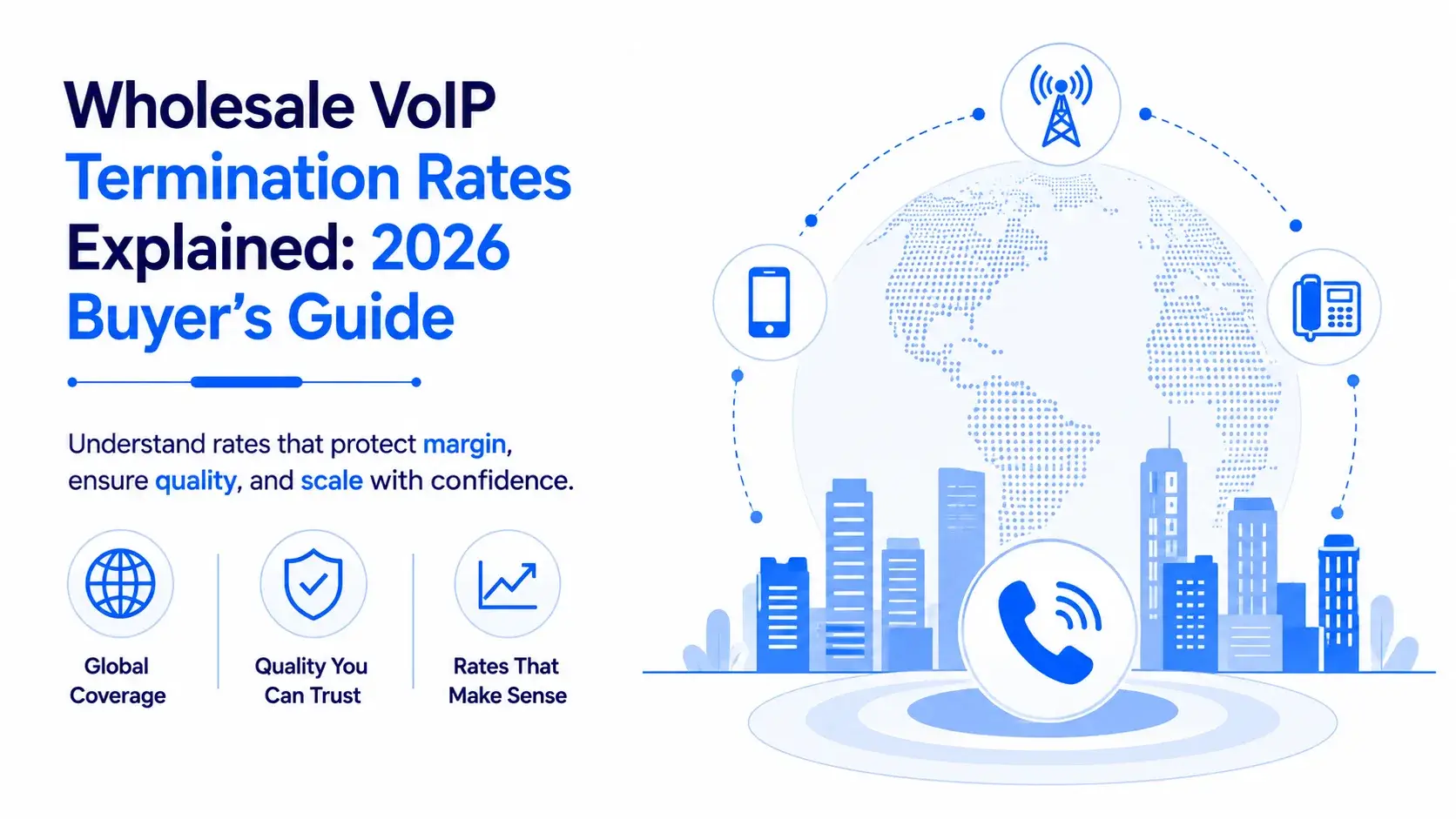
Wholesale VoIP termination rates are the per-minute prices a carrier quotes for delivering bulk voice traffic to a destination network. They are the single biggest cost line on any wholesale VoIP P&L, and how they're quoted and quality-banded varies wildly across providers.
This guide breaks down how those rates work in 2026 and how to compare quotes without hidden fees or grey routes.
What Wholesale VoIP Termination Rates Actually Are
Wholesale VoIP termination rates are the per-minute prices a wholesale voice termination carrier charges to deliver a call from your softswitch to the destination network. That destination might be the PSTN, a mobile operator, or a competing VoIP carrier.
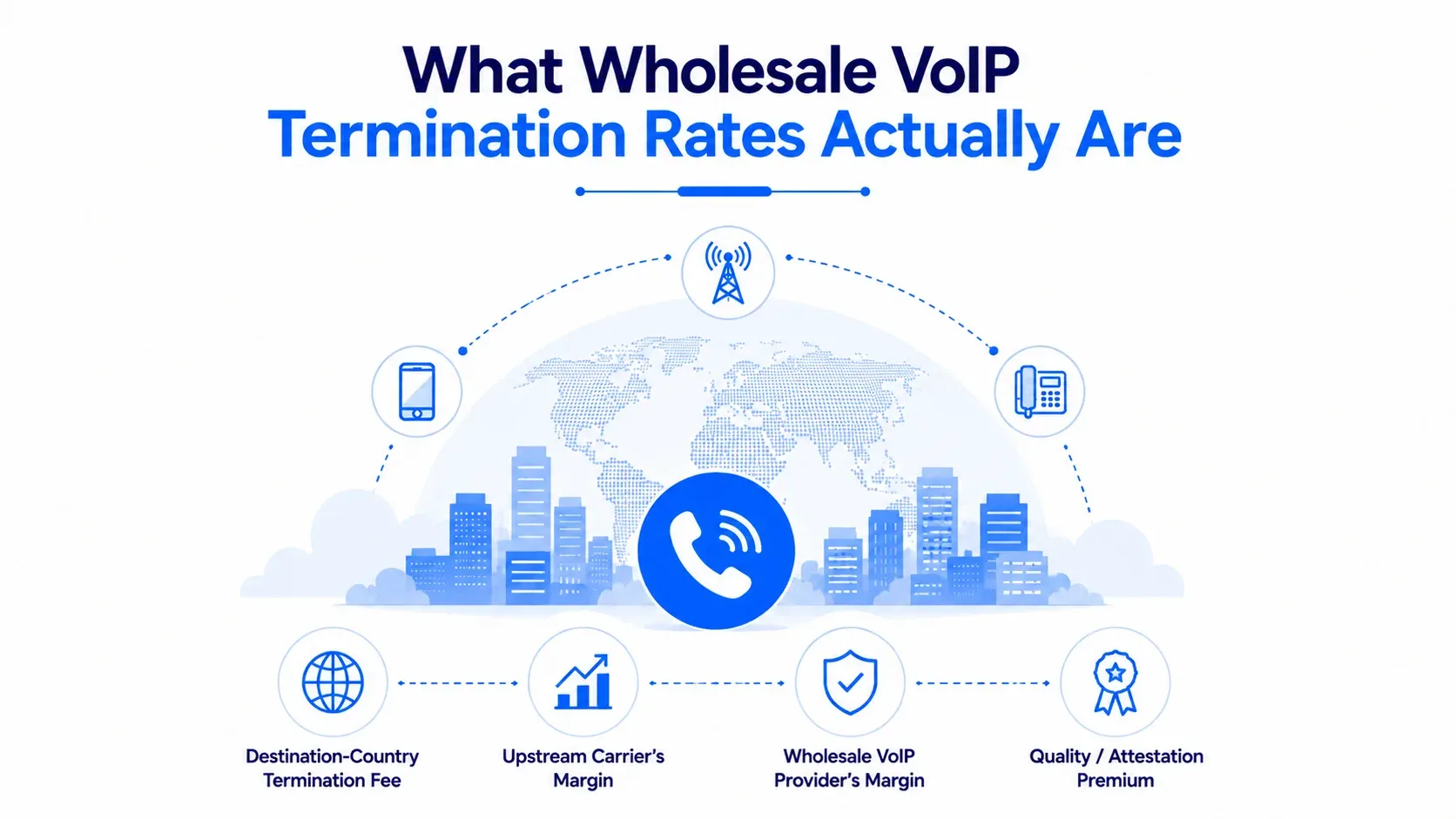
Unlike retail tariffs, these wholesale VoIP termination rates are quoted on a per-destination basis — one rate for US landline, another for UK mobile, another for Pakistan. Billing increments are measured in seconds.
Every wholesale VoIP termination rate ultimately reflects the destination-country in-country termination fee, the upstream carrier's margin, your wholesale VoIP provider's margin, and any quality or attestation premium. Understanding that stack is the difference between negotiating a real reduction and chasing a headline rate that loses you money on increments.
How Wholesale VoIP Termination Works
Further reading: Wholesale VoIP pricing
Wholesale VoIP termination works through carrier interconnects. Your softswitch sends a SIP INVITE to the wholesale VoIP termination provider, whose Class 4 softswitch applies LCR routing and hands the call off to the chosen Tier 1 carrier and from there to the destination network.
CDRs are generated in real time and rated against the published rate deck.
On A-Z international termination, the same SIP endpoint reaches every country in the world. The wholesale voice termination provider hides the complexity of dozens of underlying carriers behind a single rate deck and one set of trunks.
That abstraction is most of the value. It is also why route-quality transparency matters so much when comparing wholesale VoIP rates and termination quality across providers.
Why Wholesale VoIP Termination Rates Are Cheaper Than Retail
Three factors compound to make wholesale VoIP termination rates dramatically lower than any retail tariff. Aggregation lets a wholesale carrier buy bulk capacity across many customers. Direct interconnects remove reseller hops, and per-second billing means you pay only for the time you use.
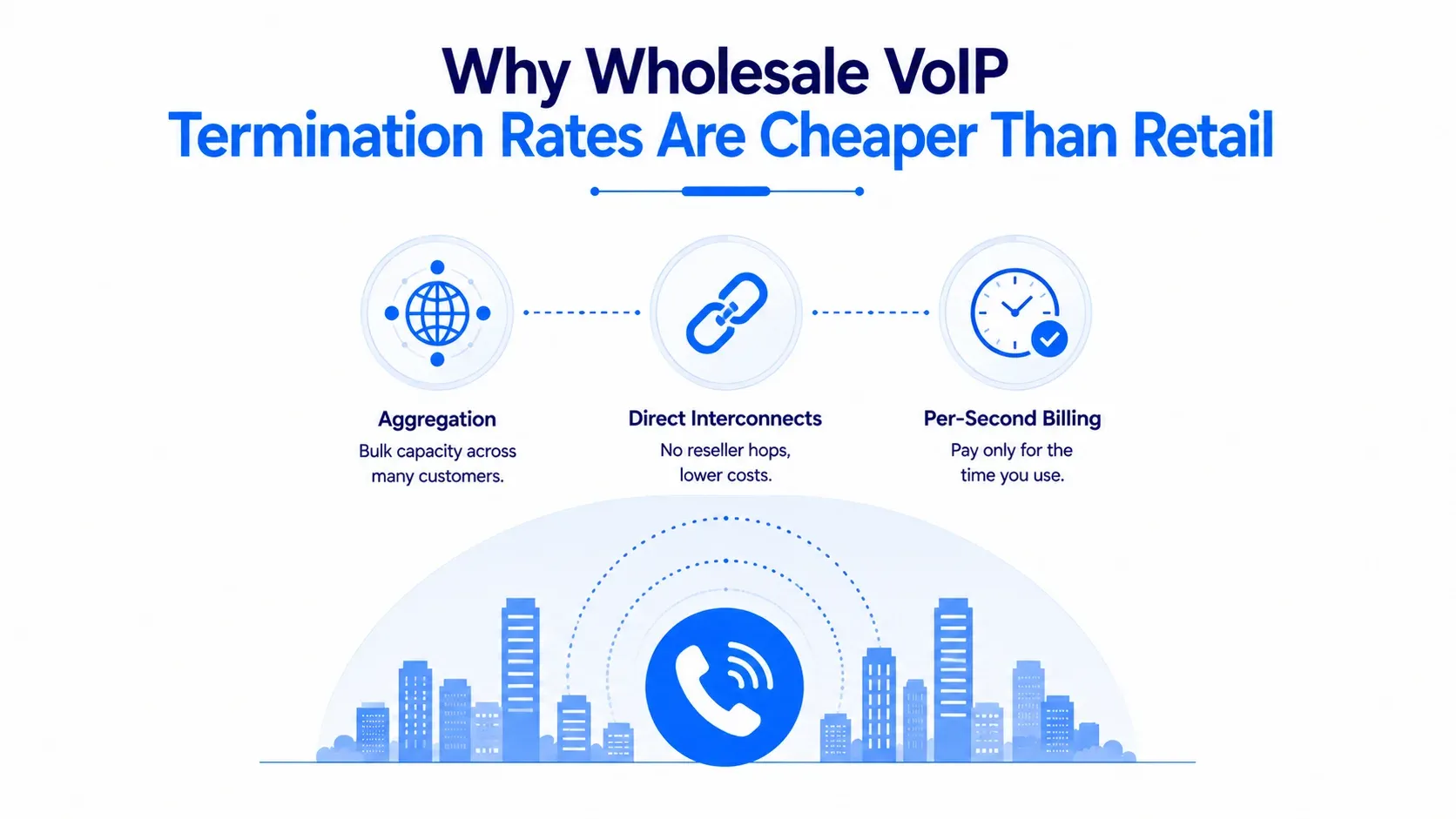
Retail providers also bundle UC features and customer support, which a pure wholesale VoIP termination service does not.
For ITSPs, resellers, and contact centres, this is exactly the point. Bulk voice traffic termination at competitive wholesale VoIP termination rates is what makes the application layer profitable. The carrier-grade VoIP termination underneath is sold as a commodity per-minute price, and the customer captures the margin between that and their retail tariff.
Per-Minute Pricing, Billing Increments, and Rounding
Further reading: Wholesale VoIP platform
Wholesale VoIP termination rates are quoted per minute, but billed per second under a chosen increment. Three increments are common:
The increment determines how much of each call gets rounded up in the carrier's favour, and it compounds fastest on short calls — IVR pings, failed attempts, and quick confirmations. A traffic mix heavy on short calls is far more sensitive to increment choice than one dominated by long conversational calls.
- 1/1 — first second, then 1-second steps.
- 6/6 — first 6 seconds minimum, then 6-second steps.
- 30/6 — first 30 seconds minimum, then 6-second steps.
Of these, a 1/1 increment on competitive wholesale voice termination is roughly 12–18 percent cheaper than 30/6 on the same nominal rate.
Read every quote carefully. A wholesale VoIP termination provider showing a beautiful headline rate at 30/6 may quietly cost more on real traffic, while a competitor at slightly higher rates on 1/1 can end up cheaper.
Twiching publishes the increment alongside every destination row, so partners can model wholesale VoIP termination rates against their actual call duration distribution.
Factors That Move Wholesale VoIP Termination Rates
No single input sets a wholesale VoIP termination rate — it is the combination of these factors, weighted differently per destination, that produces the number on the rate deck. Knowing which lever moved a quote helps a buyer tell a fair increase from a padded one.
- Destination — in-country termination fees vary 40x between competitive and monopoly markets.
- Mobile vs landline — mobile termination is consistently more expensive than fixed-line termination.
- Quality class — premium routes with higher ASR and STIR/SHAKEN attestation cost more than commodity routes.
- Volume commitment — committed monthly minutes unlock tiered wholesale VoIP termination rates.
- Currency — non-USD markets carry FX risk; some providers normalise, others pass it through.
- Regulatory environment — STIR/SHAKEN, Universal Service Fund, and EU rules all shape pricing.
When a rate quote moves, asking which of these six factors changed is usually more productive than simply pushing back on the number — a destination-driven increase and a margin-driven increase call for very different responses from the buyer.
QoS Bands and Premium Routes
Most wholesale voice termination providers expose at least two route classes per destination. A premium route offers high ASR, low PDD, and full STIR/SHAKEN attestation, while a commodity route is optimised for cost. The wholesale VoIP termination rates on each band differ — and the right choice depends on whether the traffic is business-quality dialling or low-value bulk.
QoS guarantees inside the wholesale VoIP termination contract should specify minimum ASR, maximum PDD, and remedies if the route falls below the floor. A carrier that quotes wholesale VoIP termination rates without committing to QoS is selling you cost, not quality — and the difference shows up in answer-seizure ratio.
Volume Commitments and Tiered Pricing
Volume commitments are the single biggest lever for reducing wholesale VoIP termination rates. A guaranteed monthly minimum gives the carrier predictable revenue, and the carrier passes that predictability back as a discount. Tiered pricing typically drops 10–25 percent across the curve, with the biggest savings on high-volume destinations.
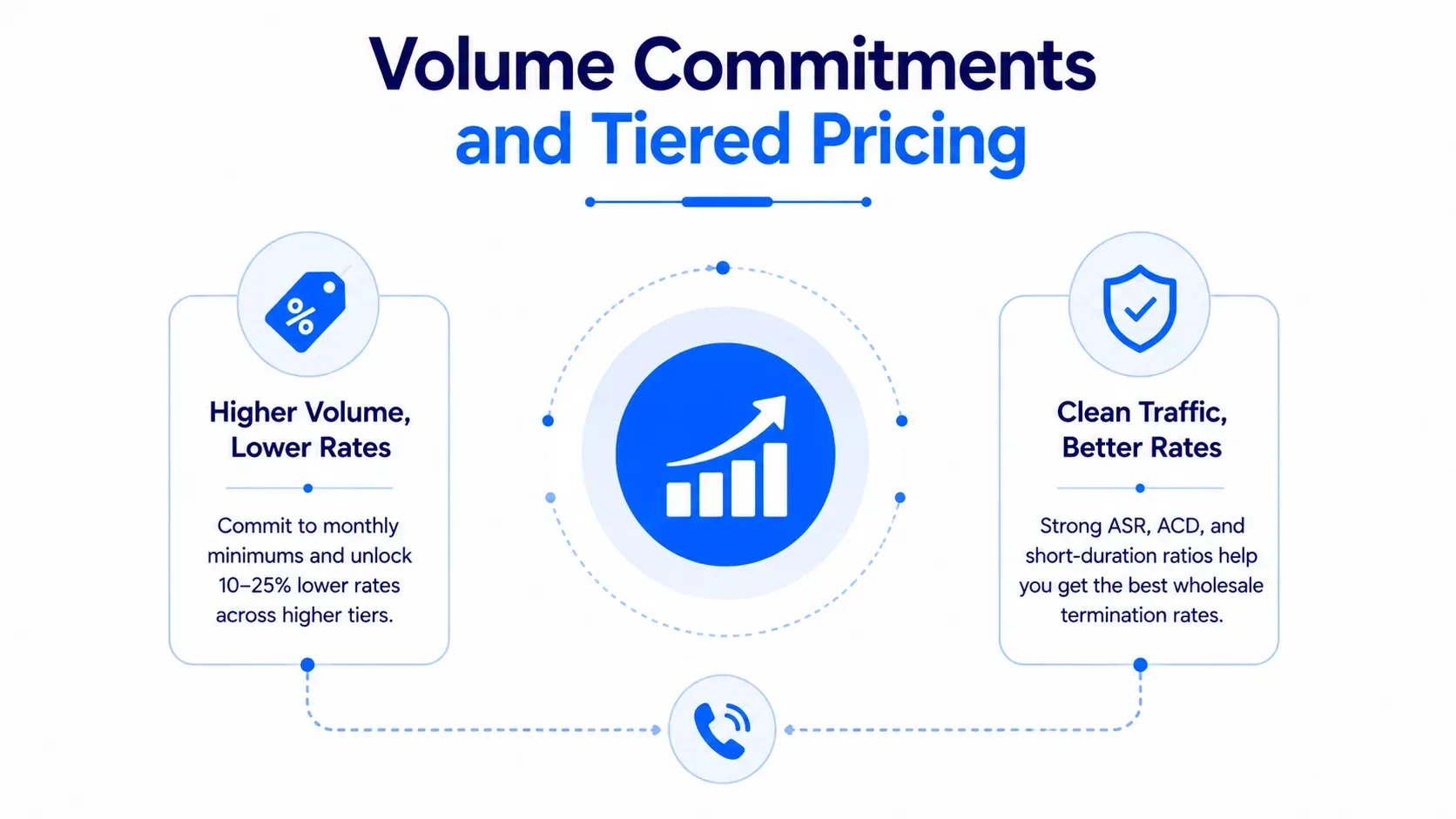
Clean traffic profiles help too. Carriers price wholesale voice termination based on ASR, ACD, and short-duration ratios. Showing a clean CDR history during negotiation lets the provider quote tighter wholesale VoIP termination rates because the route economics are predictable on your specific mix.
STIR/SHAKEN and Regulatory Impact on Rates
Further reading: FCC call authentication (STIR/SHAKEN)
STIR/SHAKEN attestation has crept into the wholesale VoIP termination rate stack. A-attested traffic carries a small premium because completion rates are measurably higher — fewer spam labels and better acceptance by downstream carriers. The premium is small (typically under 5 percent), and the improved ASR usually more than pays it back.
Outside the US, regulatory frameworks set rate floors and ceilings. The EU's European Electronic Communications Code caps mobile termination, while certain monopoly markets set rates by decree. A wholesale VoIP termination provider should track these per-market and reflect them in the rate deck as they change.
How to Choose a Wholesale VoIP Termination Provider
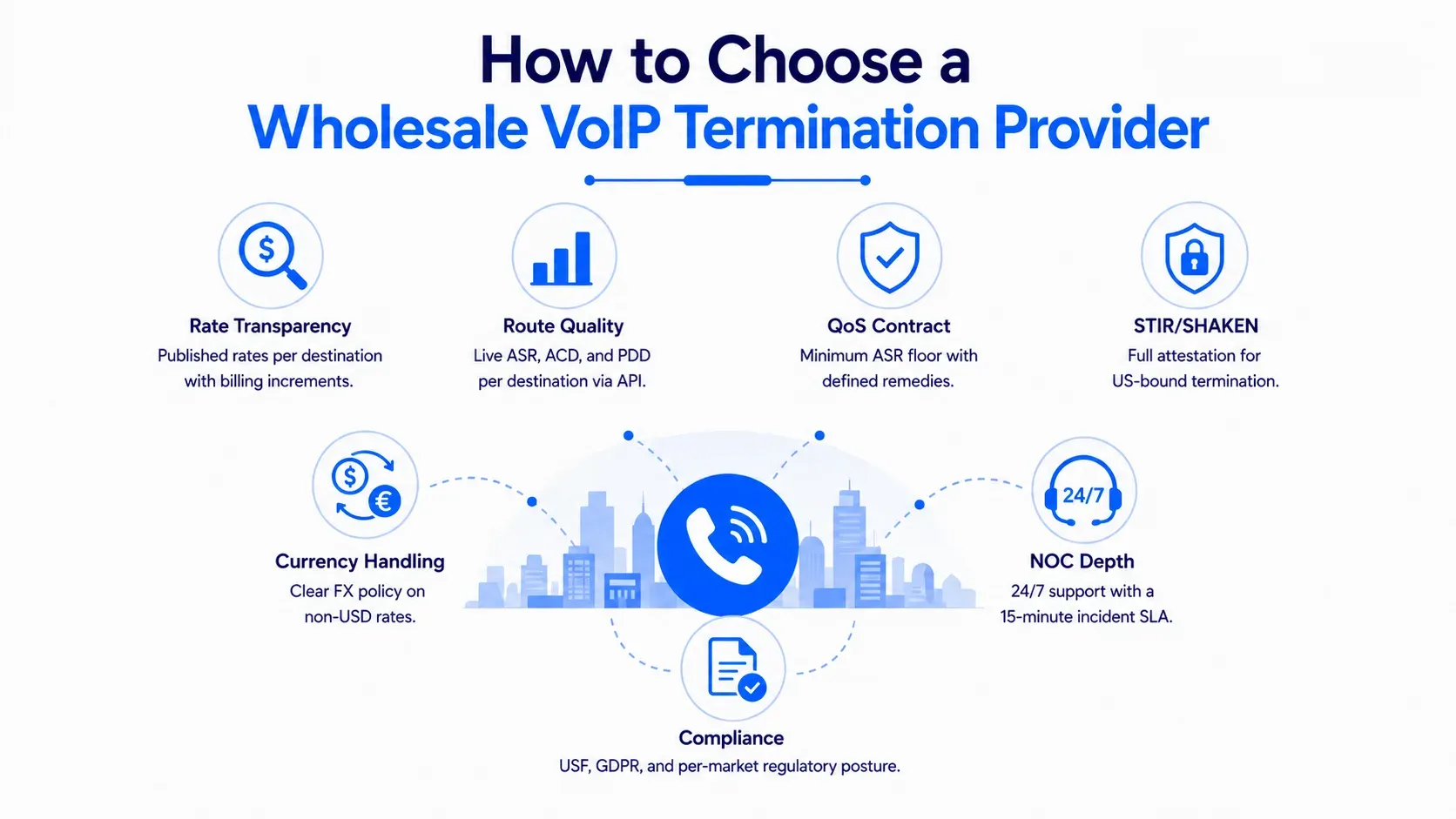
Run through this list against an actual rate deck and CDR sample rather than a sales deck — a provider's answers on paper and its answers under real traffic are not always the same thing.
- 01Rate transparency — published wholesale VoIP termination rates per destination with billing increments.
- 02Route quality — live ASR, ACD, and PDD per destination, ideally exposed via API.
- 03QoS contract — minimum ASR floor with defined remedies when breached.
- 04STIR/SHAKEN — full attestation for US-bound wholesale voice termination.
- 05Currency handling — clear FX policy on non-USD wholesale VoIP termination rates.
- 06NOC depth — 24/7 support with a 15-minute critical-incident SLA.
- 07Compliance — Universal Service Fund, GDPR, and per-market regulatory posture.
A provider that clears all seven points is rare enough that finding one is usually worth a small rate premium over a cheaper option that only clears four or five.
How Twiching Quotes Wholesale VoIP Termination Rates
Twiching publishes wholesale VoIP termination rates per destination with the billing increment, effective date, and quality class shown alongside every row. Customers can model real cost against their CDR profile before signing — no hidden setup fees, no opaque minimums. STIR/SHAKEN attestation is included on US-bound wholesale voice termination by default, and a 24/7 NOC handles route quality continuously.
Volume commitments unlock tiered pricing, and the same platform delivers SIP termination services, A-Z international termination, and inbound DIDs on a single billing account. That bundling is what makes Twiching's wholesale VoIP termination rates competitive on a total-cost basis, not just headline per-minute pricing.
Understanding the components of wholesale VoIP termination rates helps you negotiate more effectively. The base interconnect rate reflects the carrier's cost to deliver traffic to the terminating network. Above this, carriers add margin (typically 20–60%), SLA insurance (0.5–1%), fraud reserves (0.5–2%), and platform overhead.
When a carrier claims rates are 'at cost', ask them to break down these components. Legitimate operators can provide this analysis, which validates their pricing and opens the door to volume-based negotiation on the margin component.
Volume commitment negotiations for wholesale VoIP termination rates require careful modelling. Take-or-pay commitments — where you guarantee a minimum monthly spend in exchange for lower per-minute rates — transfer risk from the carrier to you. Model the break-even point: at what call volume does the lower committed rate save more than the penalty for falling short?
For routes where your traffic is predictable (established business calling patterns), commitments deliver clear savings. For new routes or traffic with high seasonality, maintain flexibility with uncommitted pricing even if the per-minute rate is slightly higher.
Conclusion
Wholesale VoIP termination rates are easy to compare badly and hard to compare well. The headline per-minute price is only one input — billing increments, QoS bands, STIR/SHAKEN posture, currency policy, and volume tiers all bend the real total cost.
A credible wholesale voice termination provider publishes every one of those inputs alongside the rate so customers can model real economics before signing. Twiching is built around that transparency: wholesale VoIP termination rates per destination, with increments and quality class on every row, plus carrier-grade VoIP termination and 24/7 NOC support underneath every minute billed.