Introduction
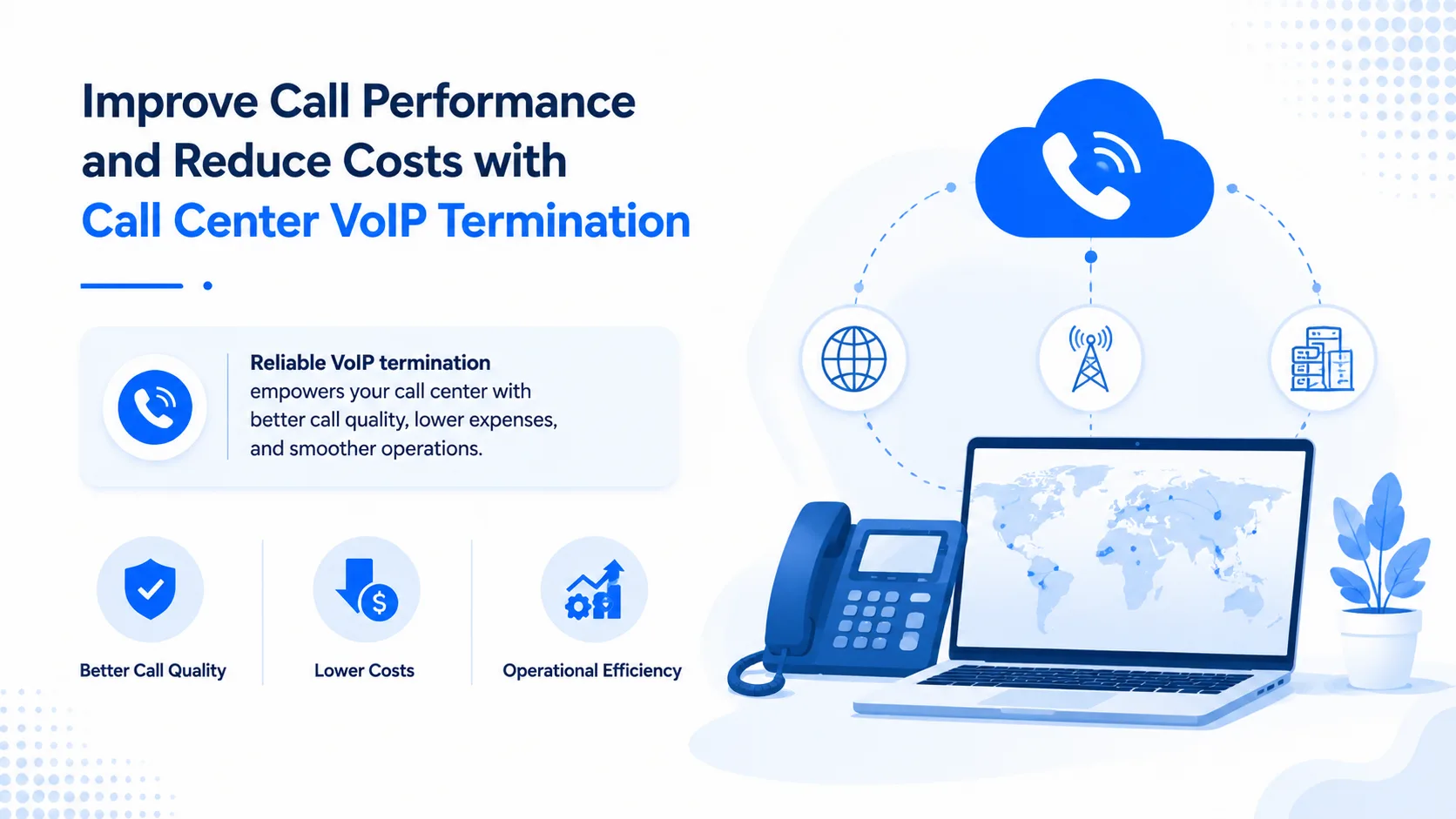
Call center VoIP termination is the carrier-layer service that delivers every outbound call from your contact centre platform to a customer's phone. Its quality, reliability, and cost directly determine campaign performance, customer satisfaction, and profitability, especially now that predictive diallers, AI auto-attendants, and omnichannel platforms all depend on carrier-grade voice infrastructure. This guide covers what contact centre operators need to know in 2026.
What Is Call Center VoIP Termination?
Call center VoIP termination is the wholesale carrier service that routes outbound voice calls from a contact centre's SIP-based platform. It reaches any telephone number on the PSTN or mobile networks.
When an agent clicks to dial, or a predictive dialler starts a call attempt, call center VoIP termination handles the handoff. It routes the call from the internet-based platform to the traditional telephone network and completes it at the far end.
Unlike standard business VoIP termination, call center VoIP termination must handle extreme concurrency: hundreds or thousands of simultaneous call attempts. It must do this with consistent quality, low post-dial delay, and high answer seizure ratios.
These demands make carrier selection critical for contact centre operators. Even a 5% improvement in ASR on an outbound campaign can generate a meaningful revenue lift.
How Call Center VoIP Termination Works
Further reading: Wholesale SIP Termination Providers
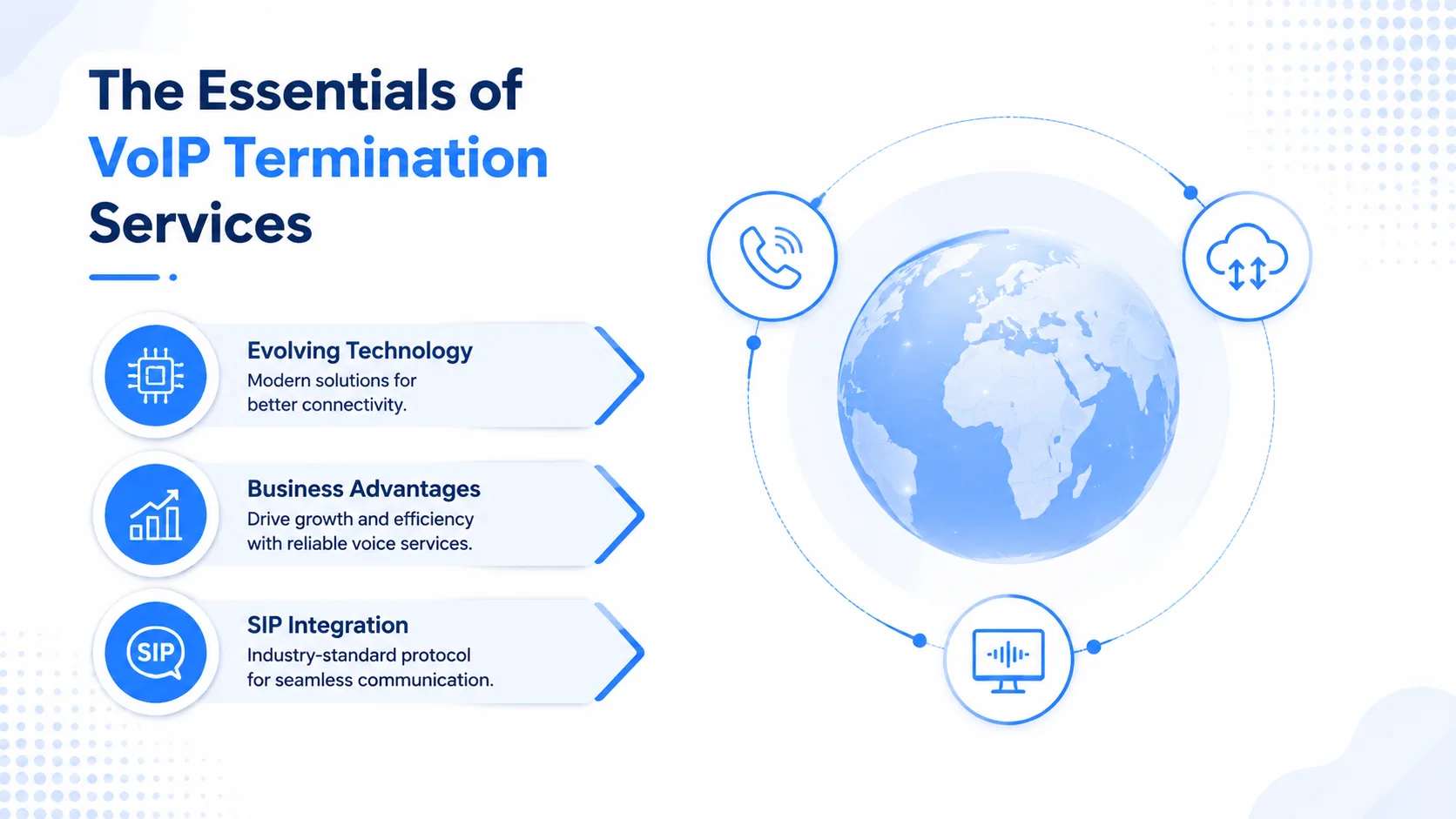
A contact centre's dialler or ACD platform connects to the carrier via a SIP trunk.
When a call is initiated, the platform sends a SIP INVITE to the carrier's softswitch. The softswitch applies routing logic, picks the best carrier path for the destination, and forwards the call.
The carrier's infrastructure handles number portability lookups and STIR/SHAKEN attestation. It also fails over to backup routes if the primary path degrades.
CDRs are generated for every call attempt, whether answered, unanswered, or failed. They capture duration, route, disposition, and quality metrics.
These CDRs feed your billing, quality monitoring, and campaign analytics.
Quality call center VoIP termination providers expose CDR data in real time via dashboard and API. This lets operations managers monitor campaign performance live.
Key Quality Metrics for Call Center VoIP Termination
Contact centre operators must monitor five quality metrics on their call center VoIP termination to maintain campaign efficiency and customer experience.
- ASR (Answer Seizure Ratio): The percentage of call attempts that successfully connect to a live party or answering machine. For outbound contact centres, ASR directly affects talk time per agent per hour. Target above 55% for domestic campaigns.
- ACD (Average Call Duration): Healthy ACD above 2 minutes indicates stable routes and genuine conversations. Very short ACD on outbound traffic can indicate route fraud or systematic call failures.
- PDD (Post-Dial Delay): The interval between dialling and the first ring tone. PDD above 5 seconds increases hang-ups before connection and wastes dialler capacity. Target under 3 seconds for premium call center VoIP termination routes.
- MOS (Mean Opinion Score): Audio quality rating from 1–5. Scores above 4.0 deliver toll-quality audio essential for agent-customer conversations. MOS below 3.5 generates complaints and reduces agent effectiveness.
- Concurrent channel capacity: The number of simultaneous call attempts your termination route can sustain without quality degradation. Predictive diallers generate 3–5 concurrent attempts per agent — capacity planning must account for this multiplier.
STIR/SHAKEN and Answer Rates for Contact Centres
Further reading: Wholesale VoIP platform
STIR/SHAKEN is the FCC-mandated caller ID verification framework. It cryptographically attests whether an outbound call's displayed number is legitimate.
For call center VoIP termination, STIR/SHAKEN compliance is now a commercial necessity, not just a regulatory requirement.
Contact centres using verified numbers with full A-level STIR/SHAKEN attestation see answer rates 25–40% higher than unattested calls.
That is because terminating carriers and smartphone call-screening apps — Hiya, First Orion, Google's Call Screen — actively label unattested calls as potential spam. This suppresses answer rates dramatically.
When evaluating call center VoIP termination providers in 2026, STIR/SHAKEN implementation is a non-negotiable requirement.
Capacity Planning for High-Volume Call Centers
Correctly sizing your call center VoIP termination capacity prevents both quality degradation during peak loads and wasted spend on over-provisioned channels. The core formula: concurrent channels needed = (agent seats x dialler ratio) + inbound overflow capacity + 15% burst buffer.
A 200-seat predictive dialler operation running a 4:1 dialler ratio needs roughly 800 concurrent outbound channels, plus buffer — around 920 channels total.
Twiching's elastic channel scaling means you do not need to pre-commit to peak capacity. Channels scale automatically with your dialler's demand, so you pay for what you use, not what you might need.
Billing Increments and Cost Management
Call center VoIP termination costs are significantly affected by billing increment: the minimum unit of time charged per call.
Contact centres with large volumes of short-duration calls — no-answers, voicemail detections, brief interactions — face dramatically different effective costs. It depends on whether they are billed in 6-second or 60-second increments.
A call that lasts 8 seconds costs 10x more under 60-second billing than under 6-second billing.
For a predictive dialler generating 50,000 short-duration call attempts per day, the difference between 6-second and 60-second billing adds up fast. It can mean thousands of dollars in monthly savings.
Always negotiate 6-second billing increments for call center VoIP termination. It is the single most impactful billing term for contact centre operations.
Redundancy and Failover for Contact Centres
Further reading: Session Initiation Protocol — Wikipedia
An outage in your call center VoIP termination during a live campaign is extremely costly. Every minute of downtime means idle agents, missed customer contacts, and campaign SLA failures.
Robust redundancy architecture is essential.
Quality call center VoIP termination providers maintain at least two independent carrier paths per major destination. Automatic failover triggers from real-time quality monitoring.
When the primary route degrades, the failover activates in seconds, without any human intervention.
Contact centre operators should also keep a secondary termination provider pre-configured for manual failover within 5 minutes. This covers the case where the primary provider suffers a platform-level outage.
CRM and Dialler Integration
Modern call center VoIP termination platforms integrate with leading CRM and dialler systems to deliver screen-pops, automatic call logging, and real-time agent performance dashboards.
Twiching's SIP trunking is compatible with Salesforce, HubSpot, Five9, Genesys, NICE inContact, and all major contact centre platforms. This enables deep integration without custom development.
API access to CDR data, real-time call events via webhooks, and programmable routing rules let contact centres build custom workflows.
Examples include routing VIP customers to specific agent groups, triggering CRM updates on call disposition, and automatically feeding call quality data into performance management platforms.
Choosing a Call Center VoIP Termination Provider
When selecting a call center VoIP termination provider, evaluate criteria in order of business impact. Start with STIR/SHAKEN compliance, since it affects every call you make.
Then assess route quality and ASR for your target geographies, tested with live traffic rather than rate sheets. Confirm the billing increment — 6-second is essential.
Also weigh concurrent channel capacity and elastic scaling, SLA terms with financial remedies, and 24/7 technical support with defined escalation paths.
Twiching provides call center VoIP termination with full STIR/SHAKEN A-level attestation and elastic channel scaling with no pre-commitment. It also includes 6-second billing, real-time CDR dashboards, and a 99.99% uptime SLA. Our platform handles contact centre traffic from 10-seat operations to enterprise call centres processing millions of minutes monthly.
Call centre VoIP termination has unique quality requirements compared to general wholesale traffic. Predictive diallers generate call bursts that can saturate trunks without warning.
Work with your termination provider to provision trunk capacity at 120% of your peak concurrent call estimate. Configure burst-allowance thresholds in your contract.
Post-dial delay is especially critical in outbound contact centre deployments. Delays above 2 seconds cause agents to miss the moment a customer answers, which reduces connection rates.
STIR/SHAKEN attestation directly affects contact centre call answer rates in North American markets. Outbound calls from contact centres need A-level attestation to avoid spam labelling.
To achieve A-level attestation, your originating carrier must verify both the caller's identity and their authorisation to use the presented CLI.
For contact centres using multiple outbound numbers across different carriers, make sure each carrier-number combination is correctly registered in the STIR/SHAKEN certificate chain.
Mismatches cause B or C attestation. This dramatically reduces answer rates on modern smartphones with spam screening enabled.
Conclusion
Call center VoIP termination is one of the highest-impact technology decisions a contact centre operator makes. The right provider — with STIR/SHAKEN compliance, 6-second billing, elastic channel scaling, and carrier-grade quality SLAs — directly improves campaign answer rates, reduces per-minute costs, and eliminates the operational risk of carrier outages during live campaigns. Twiching delivers all of this with same-day onboarding and no volume minimums, making enterprise-grade call center VoIP termination accessible to contact centres of every size.