Introduction
Choosing among wholesale VoIP termination providers is one of the highest-leverage decisions any ITSP, reseller, or contact-centre platform makes. The wholesale VoIP termination provider underneath your service shapes margin, ASR, fraud exposure, and how confidently you can scale into new markets. This guide breaks down what serious wholesale VoIP termination providers actually do, the technology stack they run, the SLA terms to demand, and how to evaluate them against a structured checklist instead of marketing copy.
What Wholesale VoIP Termination Providers Do
Wholesale VoIP termination providers operate the carrier layer that delivers your outbound minutes onto the PSTN, mobile networks, or other VoIP carriers worldwide.
They aggregate Tier 1 capacity, run LCR routing across upstream interconnects, generate CDRs for billing, and handle STIR/SHAKEN attestation — all behind a single SIP endpoint exposed to the customer.
The buyer brings the application and the customer; the wholesale VoIP termination provider supplies the carrier underneath.
This abstraction is what makes the wholesale VoIP termination provider model so attractive. Direct bilateral interconnects with every destination network would take an ITSP years to negotiate.
A credible wholesale VoIP termination provider already owns that footprint and prices it on a per-minute basis with transparent wholesale VoIP termination rates per destination.
Technology Stack Behind Wholesale VoIP Termination Providers
Further reading: Wholesale pricing & rate deck
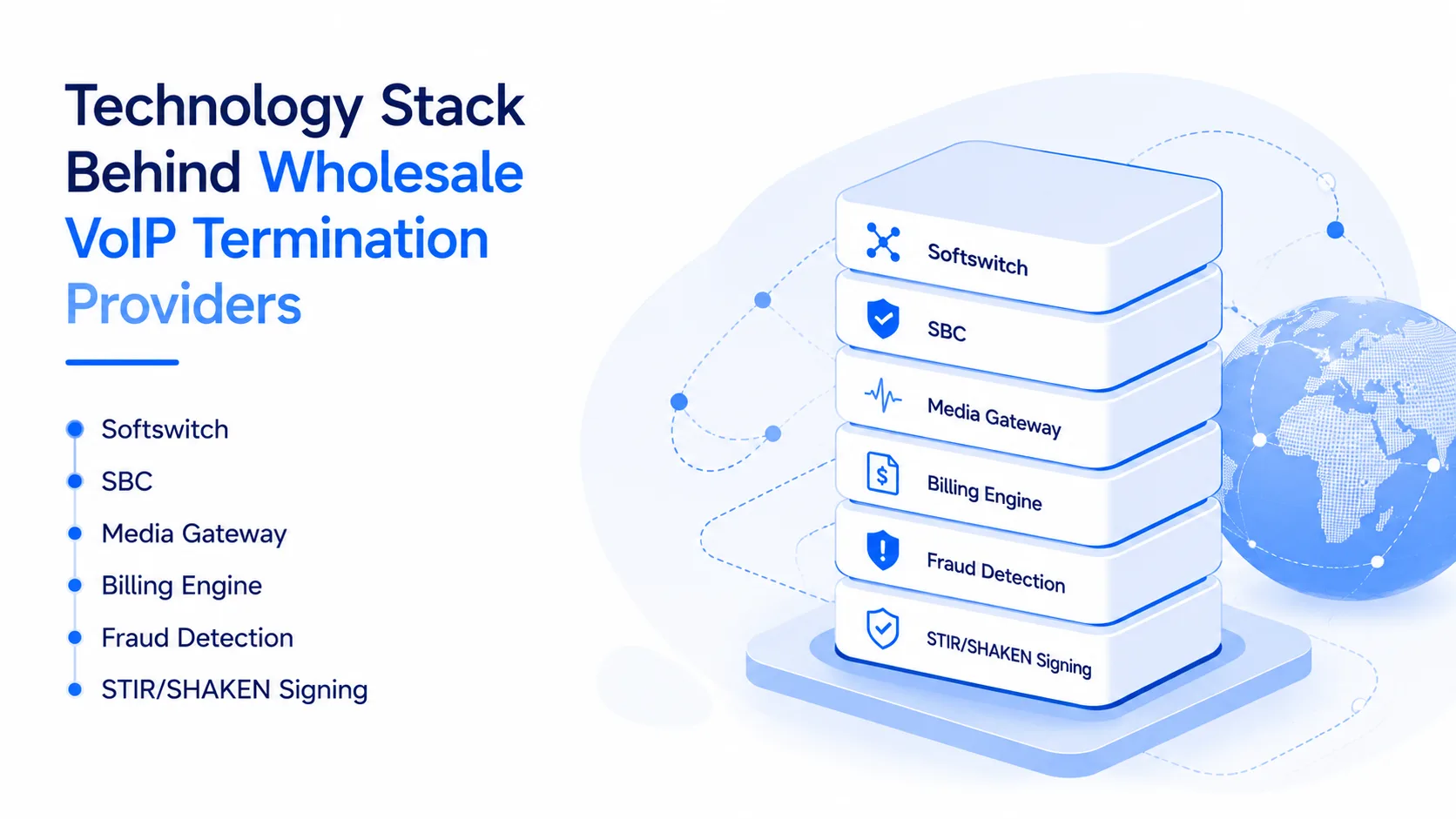
Three core components sit at the heart of every serious wholesale VoIP termination provider: the Class 4 softswitch, the session border controller (SBC), and the media gateway. Each plays a distinct role, and weakness in any of them shows up immediately in call quality and security posture.
- Softswitch — Class 4 routing engine handling LCR, CDR generation, and failover across upstream carriers
- Session border controller — secures the SIP signalling boundary, enforces topology hiding, and applies anti-fraud rules
- Media gateway — bridges between VoIP networks and legacy PSTN at SS7 interconnect points
- Billing engine — real-time CDR rating against per-destination rate decks
- Fraud detection — IRSF anomaly detection on streaming CDRs with hard spend caps
- STIR/SHAKEN signing — embedded in the call path for US-bound traffic
Network Coverage and Direct Routes
The single best filter for wholesale VoIP termination providers is whether they own their routes or buy them from someone else. Direct interconnects with Tier 1 carriers and in-country operators deliver tighter ASR, lower PDD, and stronger STIR/SHAKEN posture.
Reseller routes add hops, latency, and a layered margin you pay for without seeing in the dashboard.
Reputable wholesale VoIP termination providers publish their direct route footprint per destination and expose the carrier handling each call in the CDR.
Anything less is opaque routing — and opaque routing is where margin and quality both bleed silently across a wholesale VoIP termination contract.
Route Quality Scoring and Continuous Monitoring
Further reading: Wholesale VoIP platform
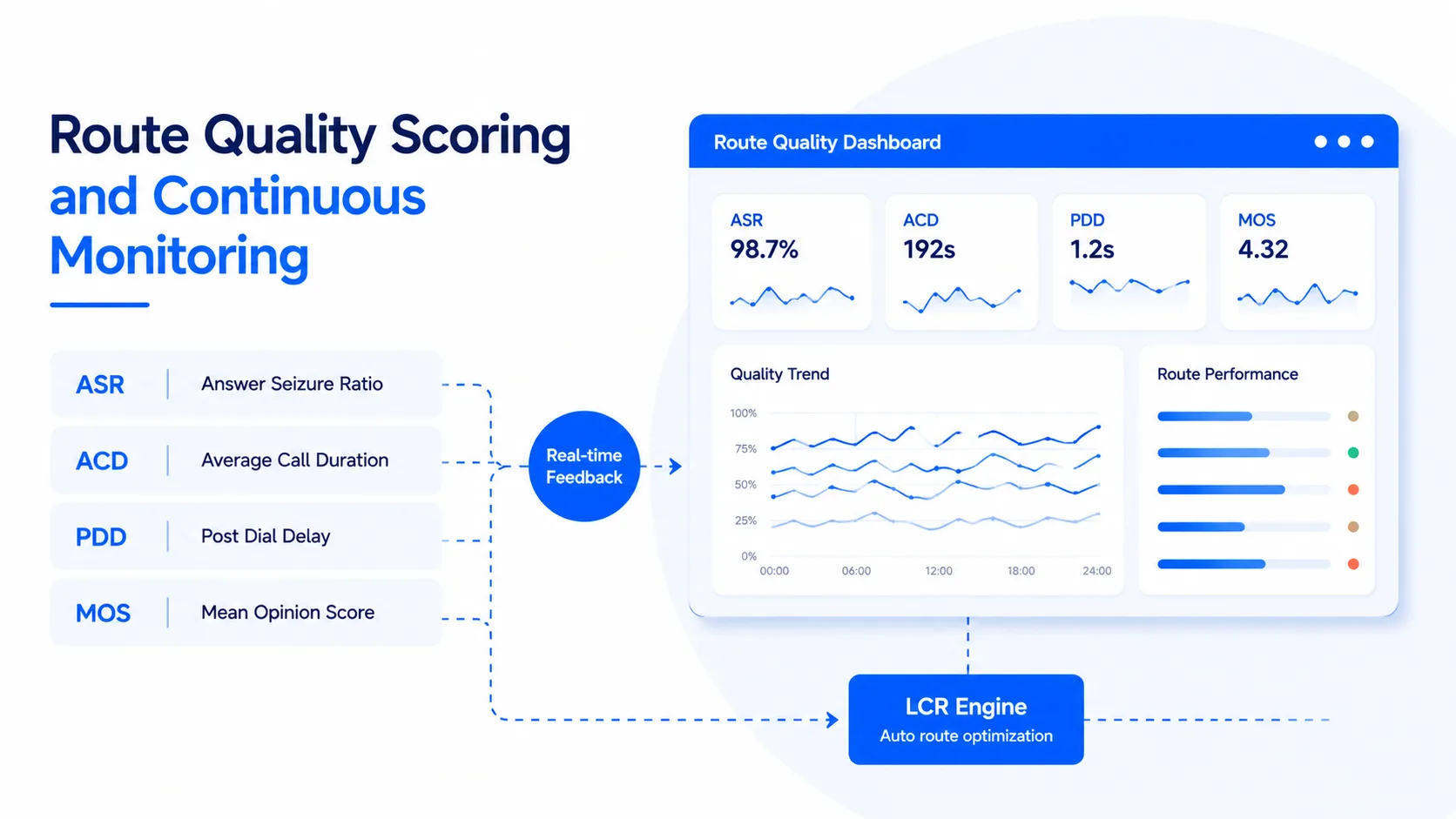
Top wholesale VoIP termination providers score route quality continuously, not in monthly batch reports. ASR, ACD, PDD, and MOS feed back into the LCR engine as calls complete.
Underperforming routes drop out of rotation automatically until upstream carriers remediate. The NOC sees alerts in minutes, not days.
Customers should expect dashboard exposure of per-destination quality data with API access for ingest into their own monitoring stacks.
A wholesale VoIP termination provider unwilling to share live ASR data is selling cost, not quality — and quality is what retail customers actually experience.
SLA Terms That Matter
SLA terms separate serious wholesale VoIP termination providers from optimistic resellers. Expect a minimum 99.9% uptime SLA with defined response and resolution times. Also expect ASR floors for your major destinations, maximum PDD commitments, and financial credits for breaches.
Providers without contractual quality SLAs are offering implied quality only — which is commercially unenforceable.
Read the credit structure carefully. A 100% credit on one hour of downtime means little when the real customer cost is far greater. Strong wholesale VoIP termination providers tie credits to measured business impact, not nominal interconnect downtime.
STIR/SHAKEN and Regulatory Compliance
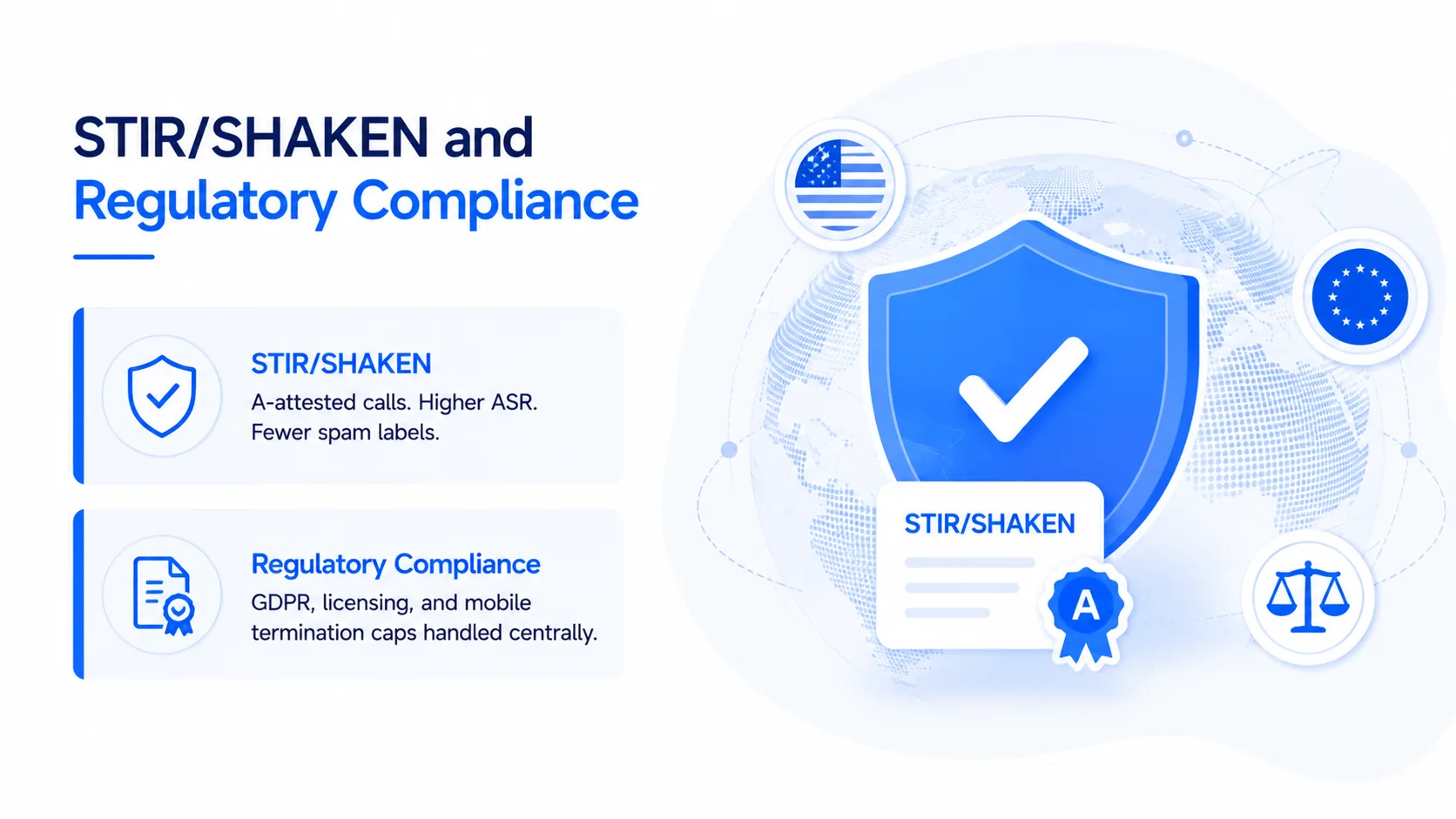
For US-bound traffic, STIR/SHAKEN attestation is now table stakes for any wholesale VoIP termination provider. A-attested calls get higher downstream ASR, fewer spam labels, and better acceptance by terminating carriers.
Providers without full attestation are quietly costing customers connection rates and brand reputation.
Outside the US, the regulatory floor varies — GDPR for European call data, country-specific licensing in many markets, EU mobile termination caps.
Reputable wholesale VoIP termination providers track these centrally and reflect them in the rate deck and signalling without forcing customers to rebuild compliance per market.
Pricing, Volume, and Onboarding
Traditional wholesale VoIP termination providers required USD 500–5,000 per month minimum spend. Modern platforms have largely eliminated those minimums by aggregating traffic across smaller customers, so single-location ITSPs now access the same carrier-tier wholesale VoIP termination rates as large operators.
Larger volume commitments still unlock better tiers, but they are no longer a barrier to entry.
Onboarding speed is a real differentiator. KYC under 48 hours, SIP trunk provisioning within a day, and real production traffic inside a week — these are the benchmarks for any serious wholesale VoIP termination provider in 2026.
Anything slower usually signals a manual operations team behind the marketing copy.
Fraud Prevention
IRSF (International Revenue Share Fraud) is the existential risk inside every wholesale VoIP termination relationship. A compromised customer trunk can generate six-figure exposure overnight if controls are not real-time.
Effective wholesale VoIP termination providers run anomaly detection on streaming CDRs, enforce hard spend caps that pause traffic instantly, and maintain a blocked-prefix list refreshed continuously.
Customers should expect spend cap controls, destination whitelists, and real-time alerts to be table-stakes features in any wholesale VoIP termination provider dashboard. Anything weaker turns the customer's network into the carrier's fraud problem — and that is a contract worth declining.
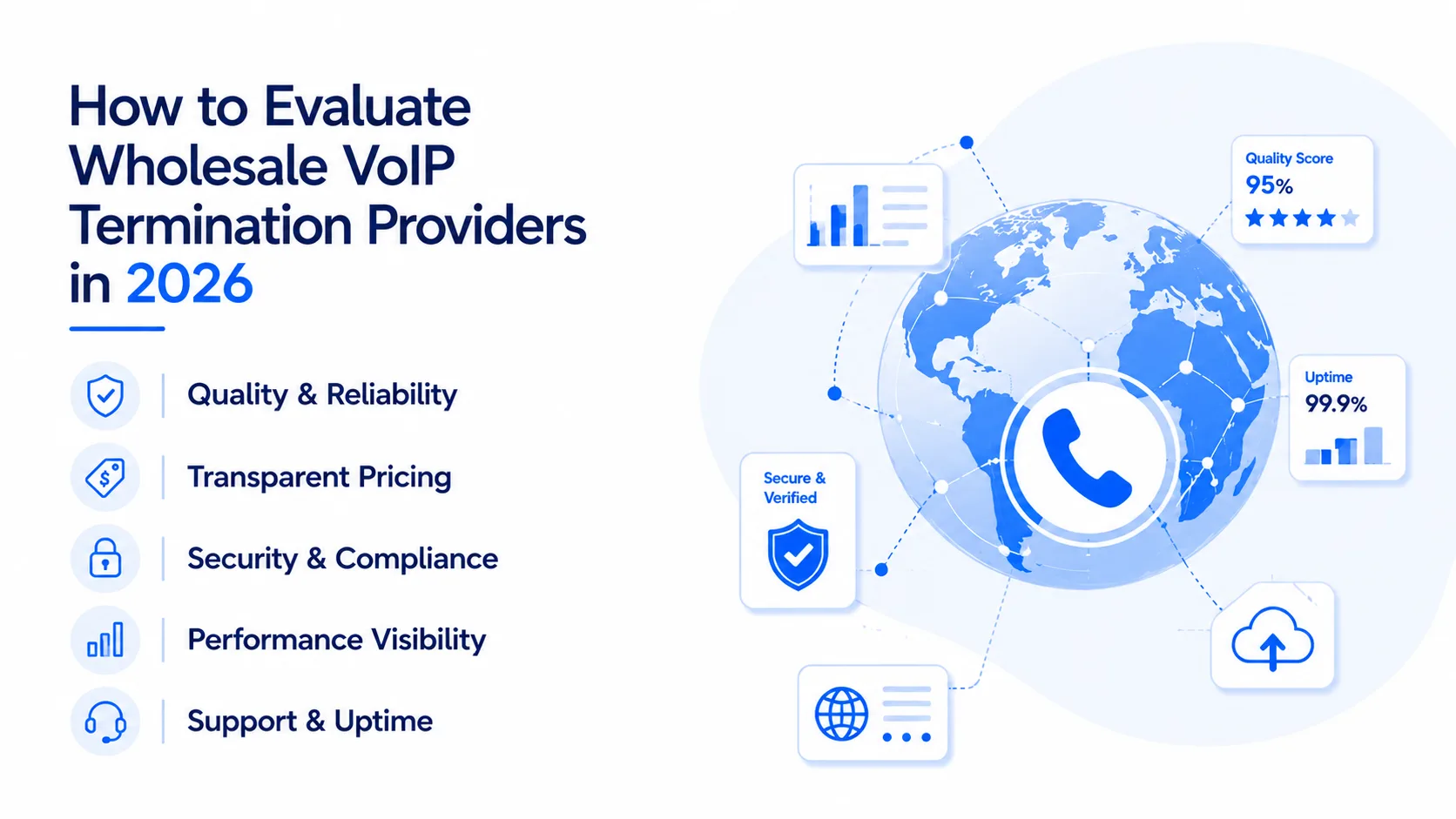
Evaluation Checklist for Wholesale VoIP Termination Providers
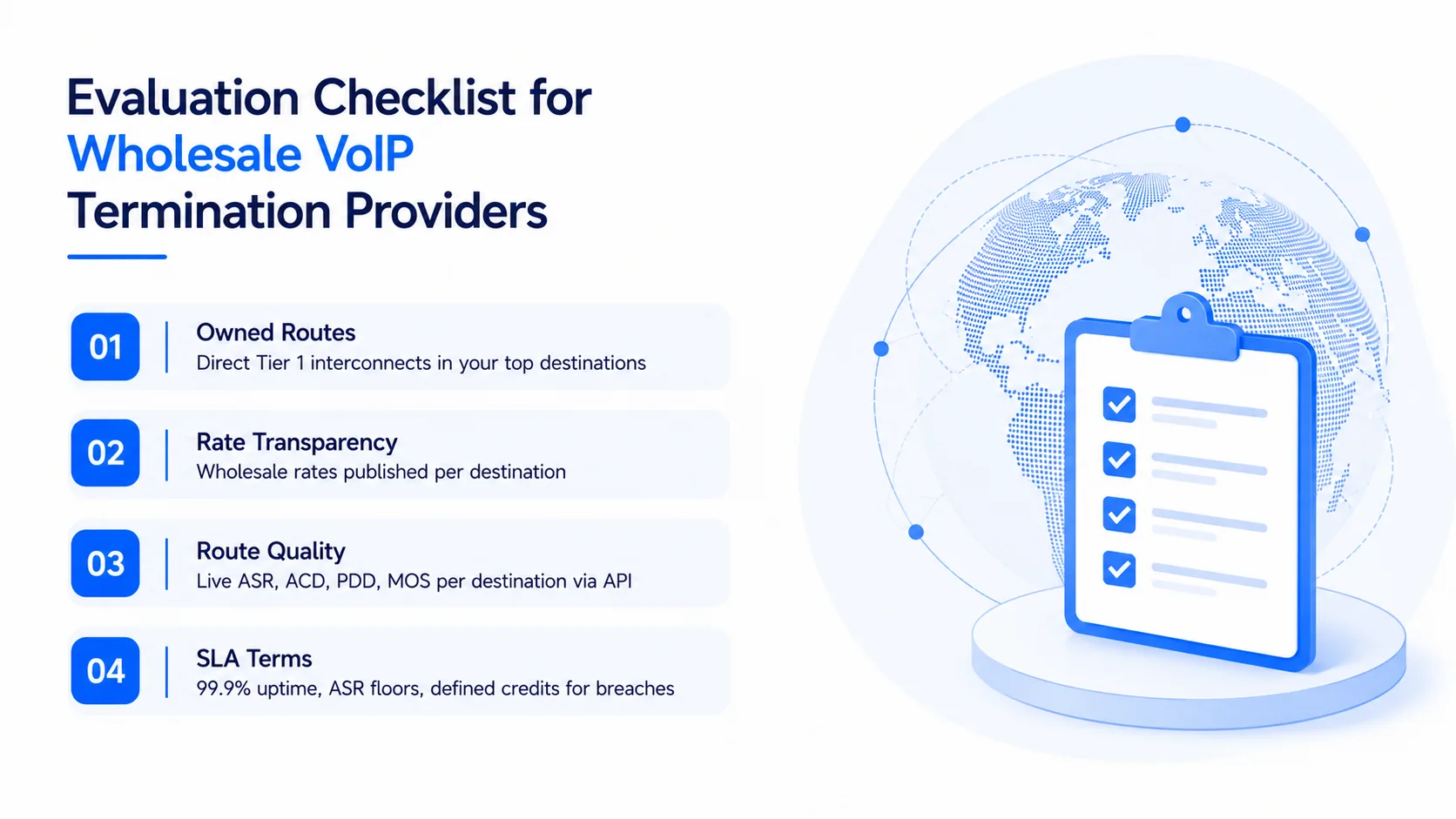
- 01Owned routes — direct Tier 1 interconnects in your top destinations, not reseller paths
- 02Rate transparency — wholesale VoIP termination rates published per destination with increments
- 03Route quality — live ASR, ACD, PDD, MOS per destination, accessible via API
- 04STIR/SHAKEN — full attestation on US-bound traffic, visible in CDRs
- 05SLA terms — 99.9% uptime, ASR floors, defined credits for breaches
- 06Fraud controls — real-time spend caps, IRSF detection, blocked-prefix lists
- 07Onboarding — KYC under 48 hours, production traffic within a week
- 08Operations — 24/7 NOC with 15-minute critical-incident SLA
Twiching as a Wholesale VoIP Termination Provider
Twiching is built specifically for ITSPs, resellers, contact-centre platforms, and enterprises evaluating wholesale VoIP termination providers.
The platform combines direct Tier 1 interconnects across 200+ countries, full STIR/SHAKEN attestation on US-bound traffic, real-time CDRs, IRSF anomaly detection with hard spend caps, and a 24/7 NOC with 15-minute critical-incident SLA.
Onboarding completes in under 48 hours, and the rate deck publishes wholesale VoIP rates per destination with billing increments and effective dates visible on every row.
The same wholesale VoIP termination platform supports a white-label reseller programme. Partners launch on carrier-grade infrastructure that already clears the bar this guide describes.
Evaluating wholesale VoIP termination providers requires a structured scorecard approach. Grade each prospective provider on route quality (ASR, MOS, PDD on your traffic mix) and pricing competitiveness (per-minute rate plus surcharges).
Also weigh platform capability — API access, CDR reporting, and real-time monitoring. Consider contractual terms too, such as notice periods, SLA credits, and traffic clawback clauses.
Financial stability matters as well: years in business, references, and regulatory filings all count. Weight these criteria according to your business priorities before making a selection.
The onboarding process with wholesale VoIP termination providers reveals their operational maturity. Look for streamlined onboarding: clear KYC requirements, standardised interconnect documentation, automated SIP credential provisioning, and a structured test call process.
Providers with all four are easier to work with long-term.
Poorly documented onboarding, slow responses, and manual configuration workflows signal operational immaturity. That immaturity will affect incident response and account management quality throughout the relationship.
Platform reliability beyond SLA commitments requires investigating a provider's infrastructure architecture. Ask about their redundancy model: do they operate active-active PoPs or active-passive failover?
Active-active designs distribute traffic across multiple sites simultaneously, so an outage at one site stays invisible to customers.
Active-passive designs route all traffic to a primary site, with automatic failover to a secondary. Failover takes seconds, but customers may experience brief disruption.
For business-critical termination, require active-active architecture and verify it with references from customers who have experienced PoP-level outages.
Conclusion
Choosing among wholesale VoIP termination providers is an infrastructure decision dressed up as a procurement decision. Owned routes, transparent rate decks, real-time route-quality scoring, contractual SLAs with measurable credits, STIR/SHAKEN attestation, and real-time fraud controls are the non-negotiables. A wholesale VoIP termination provider that exposes all of those publicly is one worth shortlisting; anyone who hides them is hoping you do not look. Twiching is built around that bar, so partners launch on carrier-grade wholesale VoIP termination from day one — without negotiating a single upstream interconnect themselves.