Introduction
A wholesale VoIP provider is the carrier-tier counterpart to retail business telephony, selling SIP trunking, DID origination, outbound termination, hosted PBX, and contact-centre voice infrastructure billed at per-minute rates. The market splits into Tier 1 infrastructure owners, Tier 2 regional aggregators, technology-led platforms like Twiching, and niche specialists. This guide compares them on quality, transparency, redundancy, and SLA terms, and covers the safe migration pattern between providers.
Key Takeaways
- Wholesale VoIP providers split into Tier 1 owners-of-infrastructure, Tier 2 regional aggregators, technology-led UCaaS platforms with wholesale layers, and niche specialists — pick by your traffic profile, not by brand recognition.
- Core services delivered: SIP trunking (concurrent channels for inbound/outbound), DID origination, outbound termination at per-minute wholesale VoIP rates, hosted PBX, contact-centre voice infrastructure.
- Evaluation criteria that actually matter: route quality with real-time ASR/PDD/MOS data, billing increments and rate-deck transparency, redundancy architecture, A-level STIR/SHAKEN attestation, REST API surface, SLA terms.
- Safe migration pattern: configure the new wholesale VoIP provider as secondary route, send 10–20% of test traffic, measure quality for 1–2 weeks, gradually shift share, keep the previous provider active for 30 days as failback.
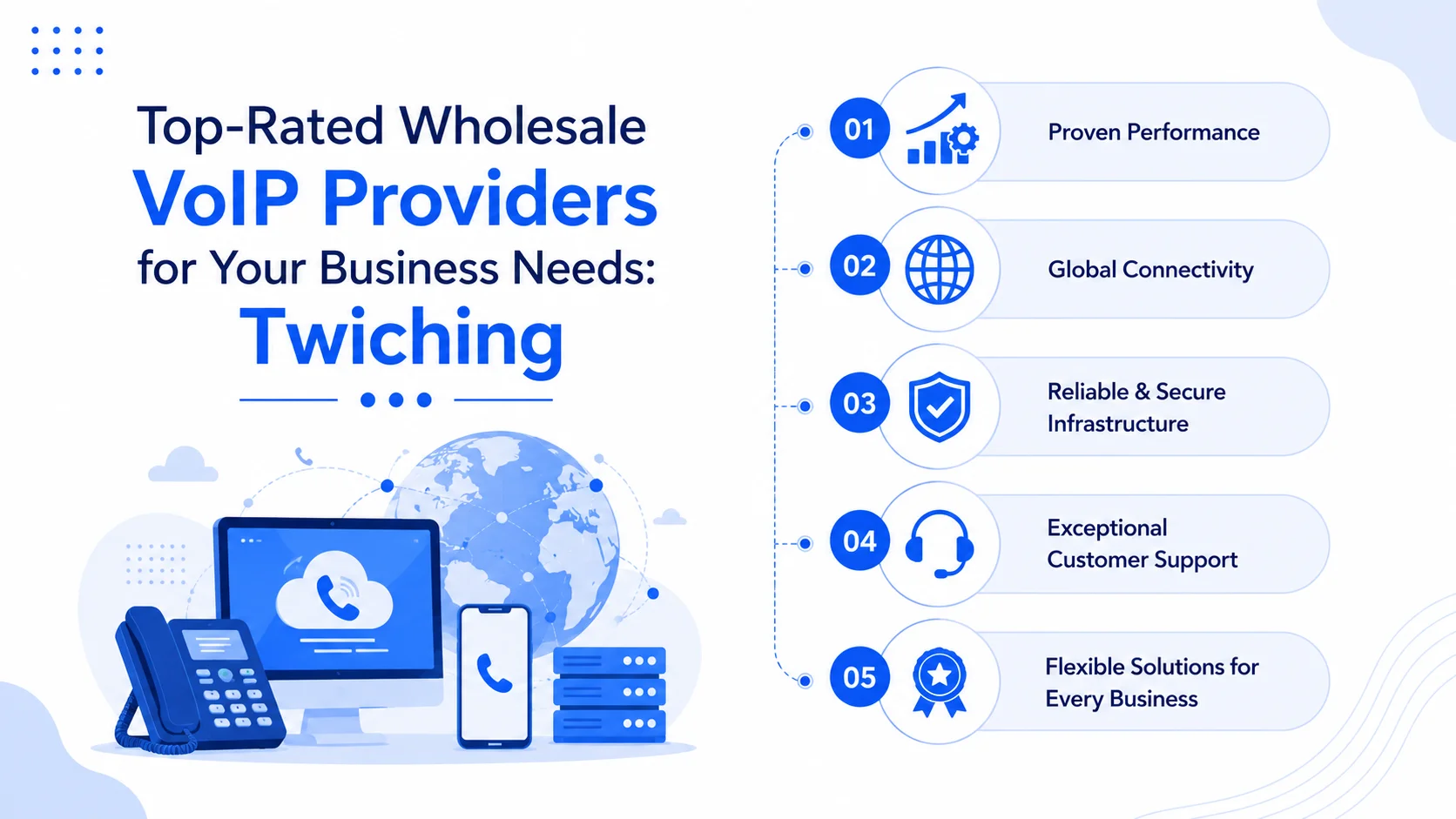
- Twiching operates as a technology-led wholesale VoIP provider with direct interconnects across 200+ countries, REST APIs, real-time CDR streaming, and a 24/7 NOC.
What a Wholesale VoIP Provider Actually Does
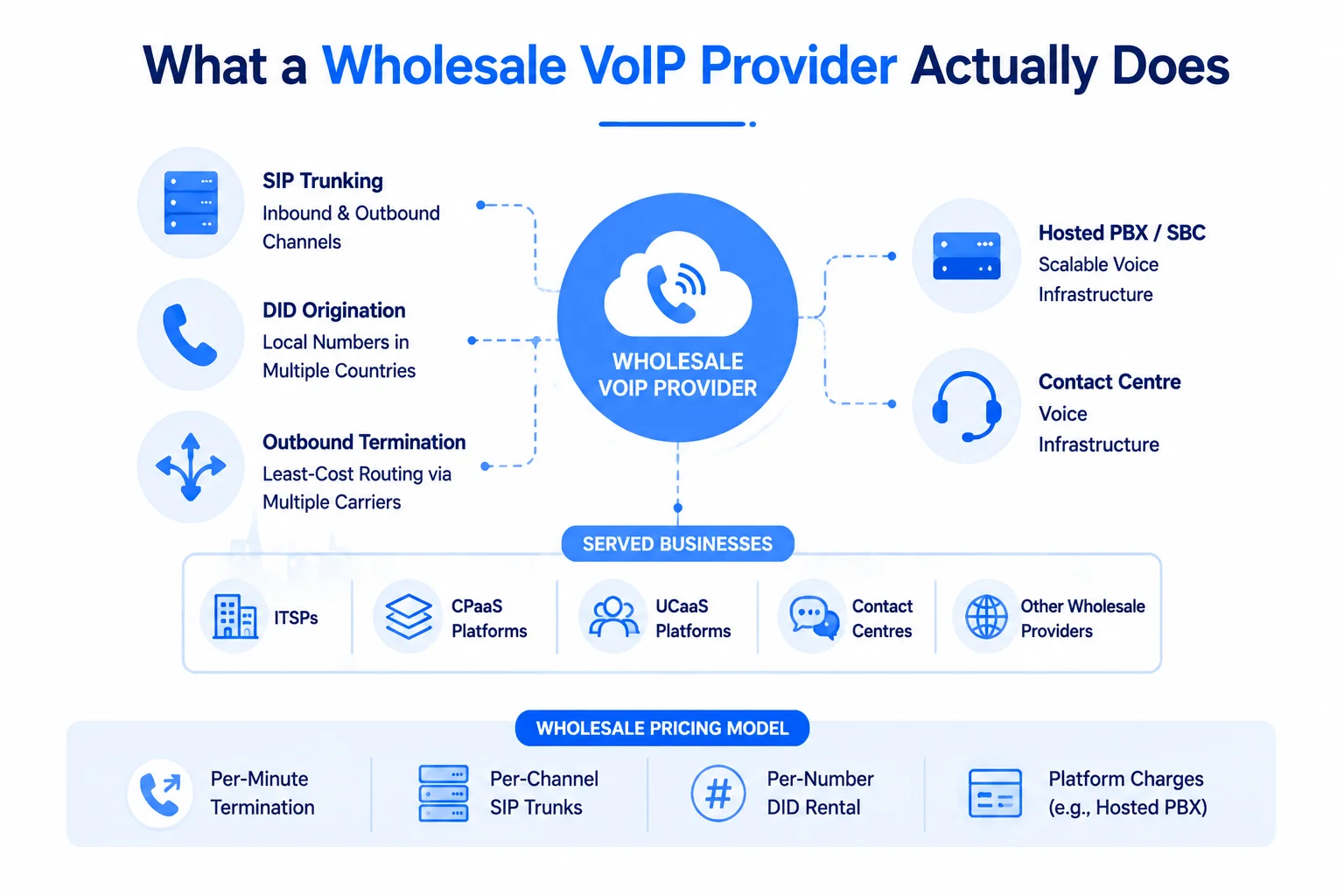
A wholesale VoIP provider sells voice infrastructure as a service to other businesses.
The product stack covers SIP trunking (concurrent channels for inbound and outbound traffic) and DID origination (numbers in each country the buyer needs). It also includes outbound termination via least-cost routing across multiple carrier interconnects, plus hosted PBX or SBC services and contact-centre voice infrastructure.
The buyer pays per-minute wholesale VoIP rates for outbound termination and per-channel committed capacity for SIP trunks. They also pay per-number monthly rentals for DIDs, and platform charges for higher-level services like hosted PBX.
The customer side is always another business.
- ITSPs reselling to end customers.
- CPaaS layers building apps.
- UCaaS platforms running seats.
- Contact centres running campaigns.
- Other wholesale VoIP providers aggregating downstream.
The Wholesale VoIP Provider Landscape
Further reading: Wholesale pricing & rate deck
Tier 1 wholesale VoIP providers own backbone infrastructure across multiple countries — AT&T Business, Verizon Wholesale, Lumen, BT Wholesale, Deutsche Telekom International. They offer the deepest direct interconnects, strong regulatory positioning, and large-customer SLAs.
The trade-off is slower onboarding and more complex contracts. Pricing also tends to favour large, committed-volume customers over smaller buyers.
Tier 2 regional aggregators specialise geographically — strong in one region (Europe, LATAM, APAC) with reseller arrangements elsewhere.
Technology-led wholesale VoIP providers, Twiching among them, combine carrier-grade routing with programmable APIs, real-time CDR streaming, instant provisioning, and accessibility to smaller customers.
Niche specialists focus on specific verticals — Tier 1 toll-free, mobile DID, SMS-capable numbers, specific countries — and complement broader providers.
Core Service — SIP Trunking
SIP trunking is the foundational service most wholesale VoIP provider customers consume. It delivers concurrent SIP channels over IP that connect the customer's PBX or UCaaS platform to the PSTN.
The provider supplies the channel commitment (committed concurrent channels plus elastic burst) and the SIP signalling. It also handles the outbound termination at per-minute wholesale VoIP rates, and the inbound DID hosting.
Modern wholesale VoIP providers also expose programmable SIP-trunk configuration via API so the customer can add channels, change routing, and configure failover without involving carrier support.
Core Service — DID Origination and Outbound Termination
Further reading: Wholesale VoIP platform
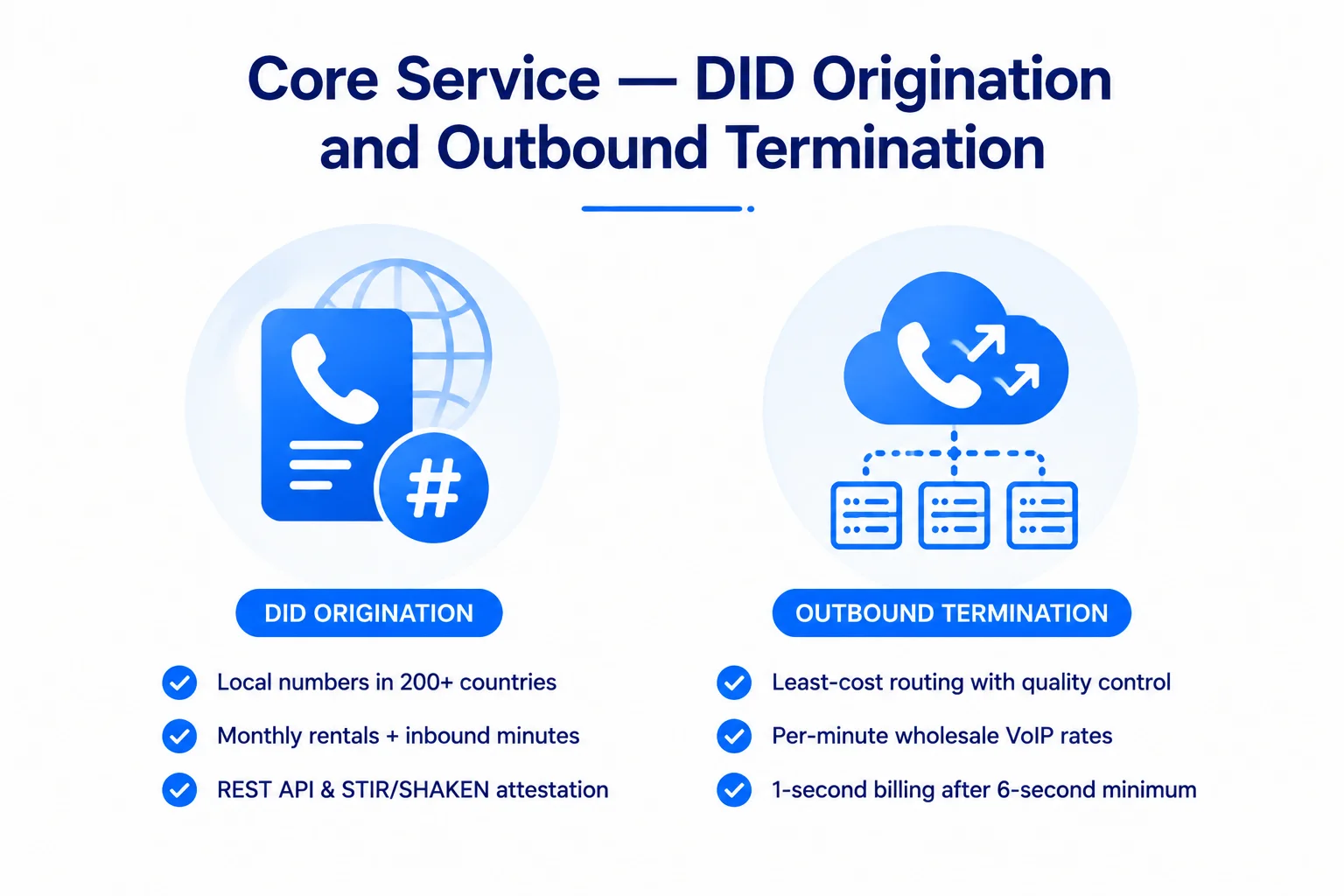
DID origination is the second core wholesale VoIP provider service — phone numbers in each country the buyer's customers need. It's billed at per-number monthly rentals plus per-minute inbound termination.
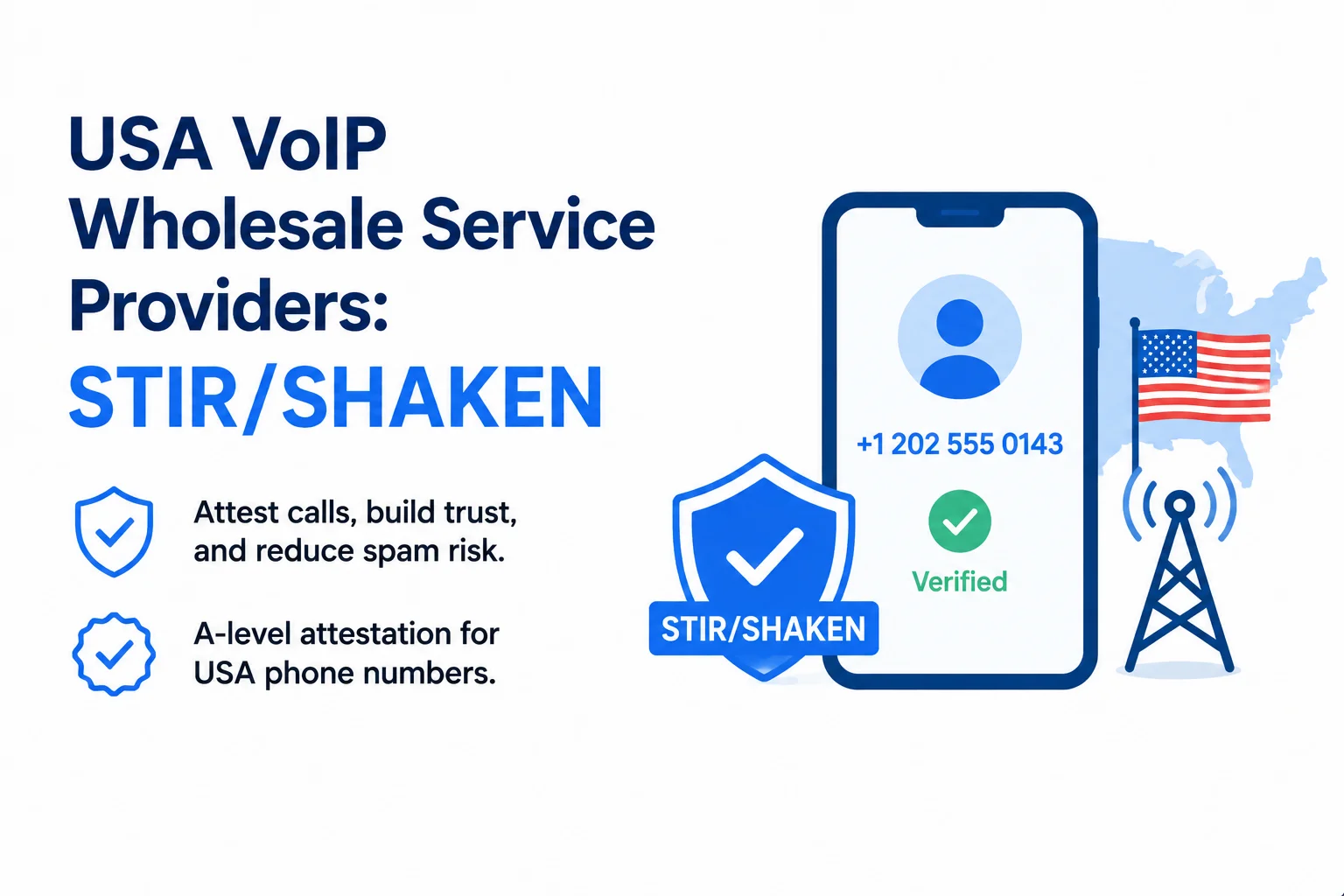
Country coverage depth, REST API provisioning, and A-level STIR/SHAKEN attestation on outbound caller ID using hosted DIDs are the differentiators.
Outbound termination routes customer-originated calls across the provider's interconnect base. It uses least-cost routing layered with quality-aware demotion.
It's billed at per-minute wholesale VoIP rates, typically with 1-second increments after a 6-second minimum on modern decks.
Evaluating a Wholesale VoIP Provider
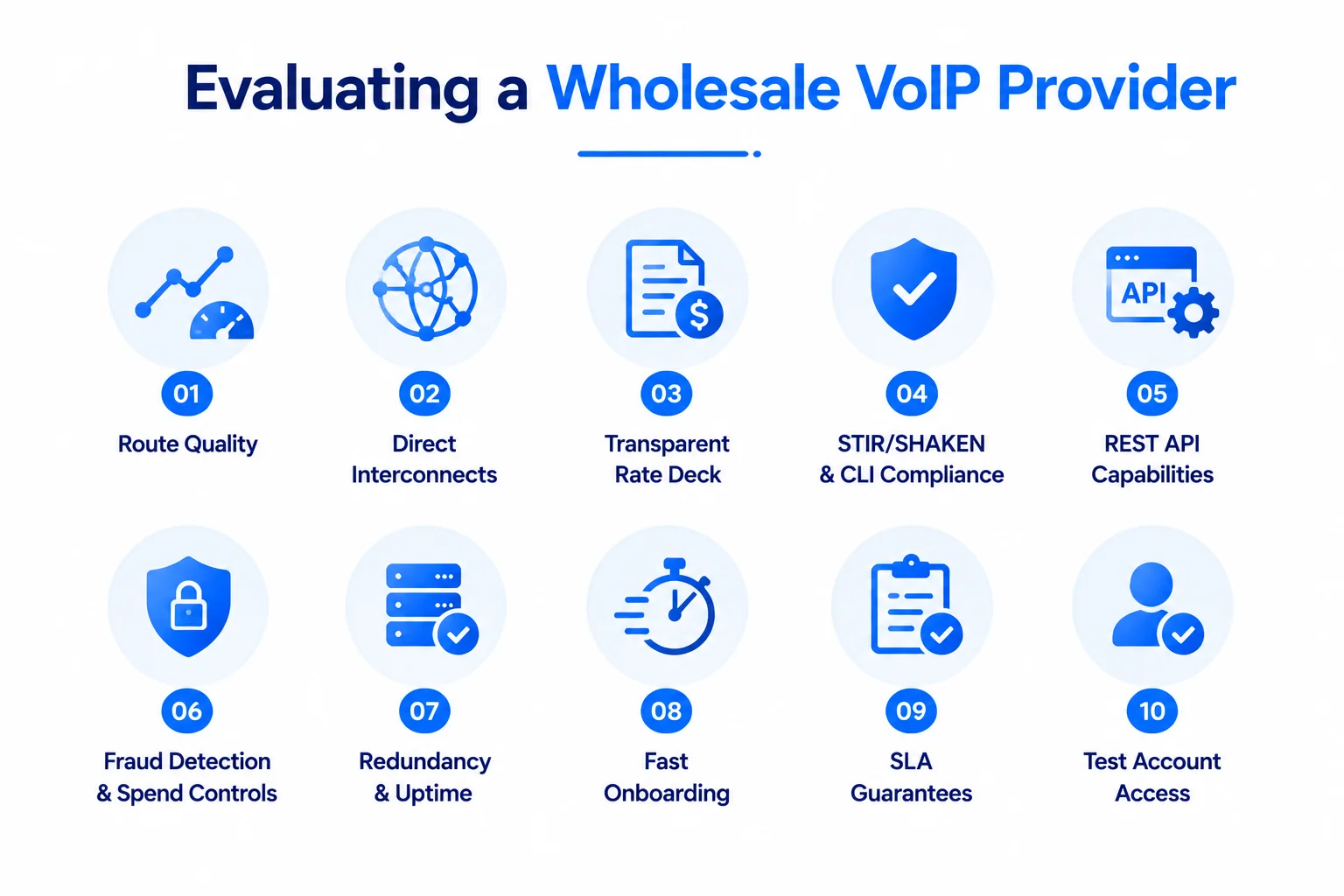
- 01Route quality with real-time per-destination ASR, PDD, MOS dashboards refreshed every 60 seconds and auto-demotion on degrading routes
- 02Owned direct interconnects in your top destinations versus reseller routing through intermediaries
- 03Per-destination rate deck published with billing increments, currency, effective dates, and notice periods
- 04A-level STIR/SHAKEN attestation inline on US-bound outbound calls and CLI compliance on UK/EU outbound
- 05REST API surface covering SIP-trunk configuration, DID provisioning, rate-deck queries, CDR retrieval, and webhook delivery
- 06IRSF fraud detection with hard spend caps, default-deny premium-rate posture, and anomaly alerting
- 07Redundancy architecture — multi-region active-active failover, carrier diversity, documented uptime history
- 08Onboarding speed — 48-hour KYC for standard business customers, same-day SIP trunk provisioning
- 09SLA terms — 99.99% uptime, 15-minute critical-incident response, named escalation contacts, financial credits
- 10Test-account access — live traffic testing before commercial commitment
Migration Pattern — Moving Traffic Between Wholesale VoIP Providers
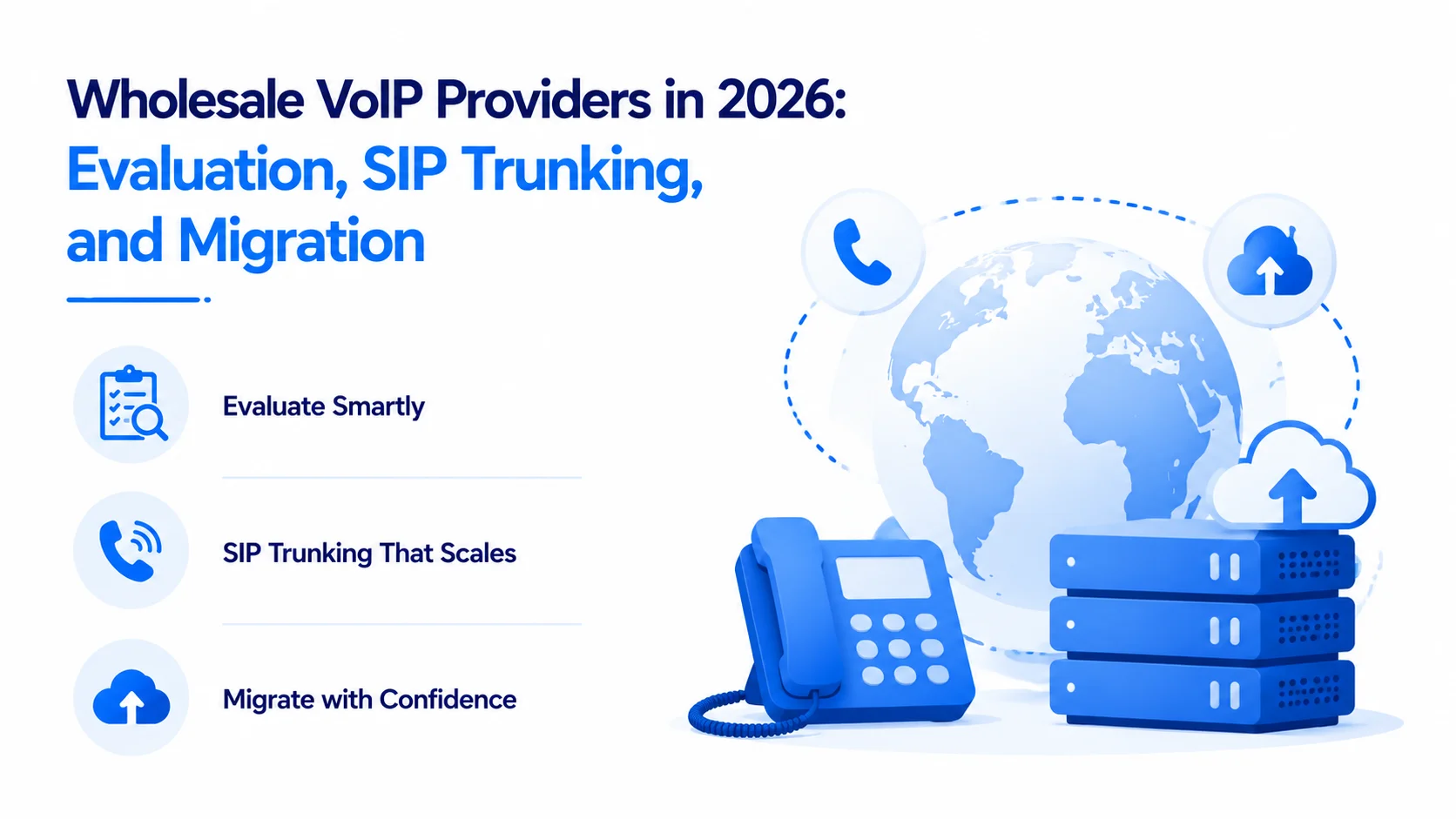
The safe pattern for migrating outbound traffic between wholesale VoIP providers is incremental, not big-bang. Configure the new wholesale VoIP provider as a secondary route on the customer side.
Send 10–20% of test traffic across the new provider for 1–2 weeks while measuring per-destination ASR, PDD, MOS against the incumbent. Compare destination by destination — averaging hides route-specific problems.
If the test traffic holds quality, gradually shift the share — 30%, 50%, 70%, 100% — over 4–6 weeks.
Keep the incumbent provider active for 30 days post-migration as failback while the new provider's quality stabilises under full load.
DID porting is a separate workflow with regulatory timelines that vary by market.
- 5–10 business days for US local numbers.
- 3–5 days for US toll-free.
- 1–5 days for many EU markets.
- 30+ days in some emerging markets.
Port numbers in batches rather than all at once, and keep the losing carrier active until each port confirms complete.
Twiching's wholesale VoIP provider migration workflow includes test-account access for live traffic testing before commercial commitment, and stage-by-stage porting status with named contacts.
Twiching as a Wholesale VoIP Provider
Twiching operates as a technology-led wholesale VoIP provider with direct SIP interconnects across 200+ countries and a cloud-native Class 4 softswitch running multi-region active-active failover.
The platform also runs multi-tier LCR routing per destination with auto-demotion on degrading routes, plus real-time CDR streaming via webhook or Kafka.
The platform also adds several other layers.
- A-level STIR/SHAKEN attestation on US-bound outbound.
- IRSF protection by default with customer-configurable spend caps.
- REST APIs for SIP-trunk configuration and DID provisioning.
- A 24/7 NOC with a 15-minute critical-incident SLA.
Per-destination wholesale VoIP rates publish with billing increments and effective dates visible on every row. KYC for standard business customers completes in under 48 hours; SIP trunks provision the same day; first production traffic the same week.
Test accounts are available for live traffic testing across destinations before any commercial commitment. White-label partners launch a branded wholesale VoIP provider business on the same routing and operations infrastructure Twiching uses internally.
Migrating between wholesale VoIP providers is disruptive but sometimes necessary. The safest approach is parallel running.
Route a small share of traffic to the new provider and monitor quality metrics. Then gradually increase the share.
Document your current quality baseline (ASR, MOS, PDD per destination) before migration so you have objective comparison data.
Allow 2–4 weeks for parallel running before full cutover. Maintain emergency rollback capability throughout the migration.
Long-term relationship management with wholesale VoIP providers creates value beyond rate negotiation. Providers invest more in customers who give them predictable volume, pay reliably, and communicate transparently about traffic changes.
Share quarterly traffic forecasts with your primary providers. Introduce your technical team to theirs so network engineers can communicate directly during incidents.
These relationship investments pay dividends in faster incident resolution, advance notice of network changes, and preferential treatment during capacity constraints. Providers who treat you as a strategic partner rather than a transaction will prioritise your traffic during capacity constraints.
Conclusion
Wholesale VoIP providers compete on route quality, coverage depth, billing transparency, redundancy architecture, attestation behaviour, API surface, and SLA terms — not on brand recognition or headline pricing alone. Buyers split traffic across Tier 1 owners-of-infrastructure, Tier 2 regional aggregators, technology-led platforms like Twiching, and niche specialists, choosing per-destination based on quality and economics rather than treating a single provider as the answer for every route. Migration between wholesale VoIP providers is safe when done incrementally — secondary route, 10–20% test traffic, gradual share shift over 4–6 weeks, 30-day failback overlap. Twiching operates as a technology-led wholesale VoIP provider with direct interconnects across 200+ countries, real-time CDR streaming, A-level STIR/SHAKEN, programmable APIs, and a 24/7 NOC. Run a test-account quality comparison against your current providers to benchmark whether your wholesale VoIP provider mix is still the right one.