Introduction
The published per-minute number on a wholesale VoIP termination rate deck is rarely what the invoice ends up showing. Hidden fees — USF contributions, E911 surcharges, FCC regulatory fees, FX exposure, and pass-through line items — quietly add 8 to 15 percent on top of the headline rate. This guide itemises every common hidden cost and gives the line-item language to demand from any carrier before signing.
What Is VoIP Termination and Why Does It Cost Money?
VoIP termination is the process of routing a call from an IP network to its final destination on the Public Switched Telephone Network (PSTN). Every call you place over VoIP — whether to a mobile, a landline, or a toll-free number — must eventually reach a physical telephone switch.
The carrier who owns that switch charges an interconnection fee to accept the call. Your wholesale provider pays that fee and passes it on to you, plus their margin.
Termination cost varies by destination because interconnection fees vary by country, number type, and carrier. US domestic landline termination is inexpensive because the PSTN is mature, competitive, and regulated.
Mobile termination in developing markets is expensive because mobile network operators charge high interconnect fees that the terminating carrier cannot negotiate around. Toll-free and premium numbers add surcharges because the called party — not the calling party — pays the termination cost.
How Wholesale VoIP Termination Rates Are Structured
Further reading: Wholesale Voice Pricing
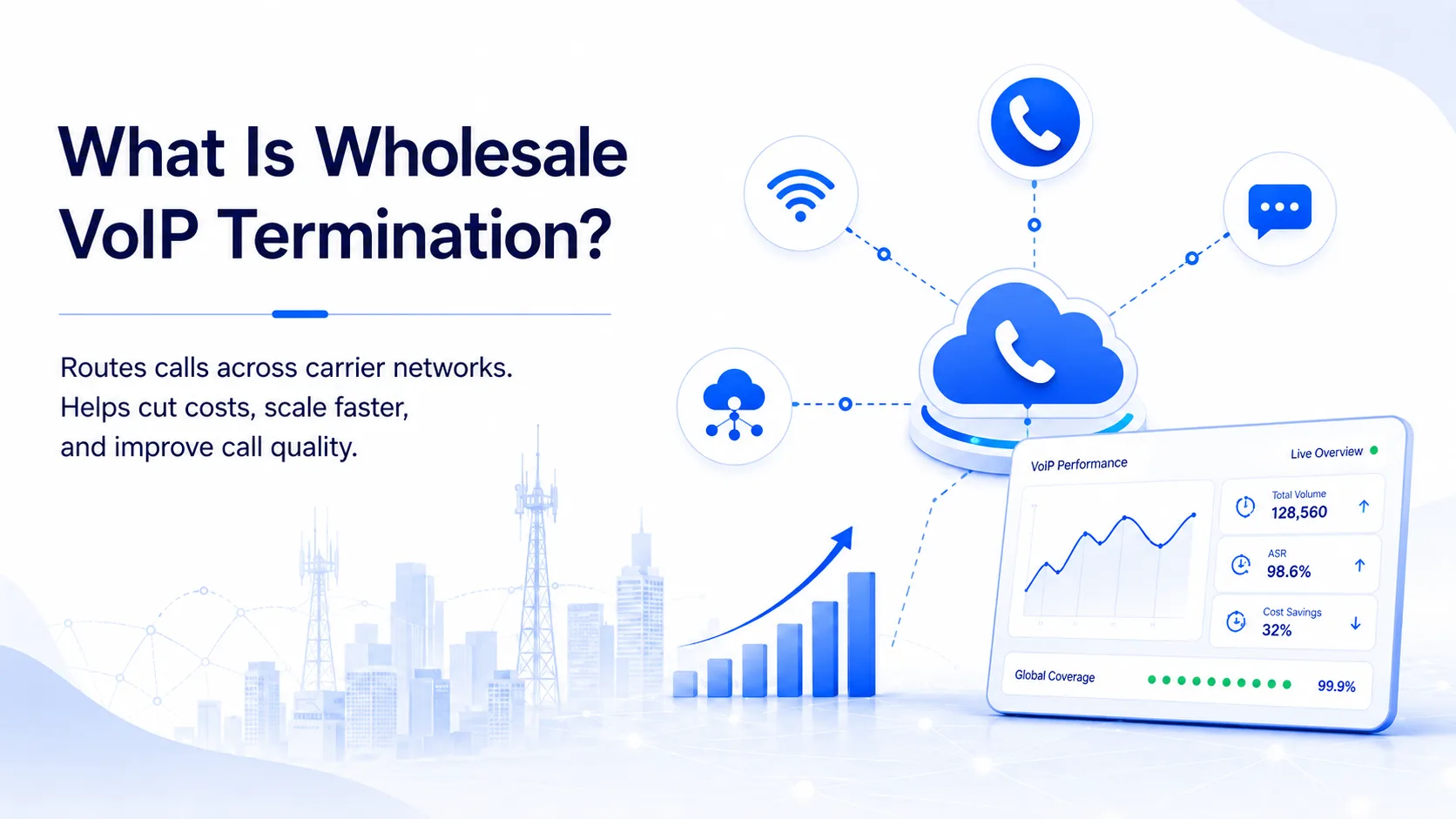
Wholesale termination rates are delivered in a rate deck: a structured file listing every destination prefix (country code + number prefix). Each row carries an associated per-minute rate, effective date, and billing increment. Rate decks can contain thousands of rows because mobile and landline termination rates differ within the same country, and carrier-specific prefixes may carry different rates.
Billing increments matter significantly at high volume. A 6/6 billing increment means calls are billed in 6-second increments — a 7-second call is billed as 12 seconds. A 60/60 increment means a 1-second call is billed as 60 seconds.
For contact centers with large volumes of short-duration calls (robocall screening, IVR front-ends, brief outreach), billing increments can add 15–30% to the effective per-minute cost. Always negotiate for 6/6 or smaller increments on high-volume outbound.
What Drives Rate Differences Between Providers?
Route quality tier is the primary driver of rate variance. A Tier 1 direct route to Germany costs more than an aggregated route through multiple resellers. That's because the Tier 1 route uses a direct interconnect with Deutsche Telekom or Vodafone Germany, producing 95%+ ASR and sub-2 second PDD.
The aggregated route costs 30–50% less but may route through 3–4 carrier hops, producing 78% ASR and 4+ second PDD. The per-minute price is lower; the cost per successfully connected call is higher.
Geographic footprint affects rates on international destinations. Providers with direct in-country termination agreements consistently beat providers who route internationally to a regional hub and use a local carrier for last-mile delivery. Ask specifically whether your provider has direct local carrier agreements for your top international destinations or whether they use a regional hub model.
Regulatory costs are baked into rates whether providers disclose them or not. In the US, STIR/SHAKEN infrastructure, Robocall Mitigation Database registration, and interstate access charges are all real costs.
Providers offering rates 40–60% below market for US domestic traffic are almost certainly absorbing regulatory costs by routing gray. They will eventually either raise rates or get delisted from downstream carriers.
Rate Deck Analysis: What to Look For
Further reading: Wholesale Call Termination Rates
- Destination coverage: Does the deck include rates for every country and number type in your traffic profile, including mobile prefixes?
- Rate update frequency: How often does the provider update the deck? Monthly updates miss significant rate movements in volatile markets.
- Effective date granularity: Are rates time-stamped so you can audit what rate applied to each historical call?
- Surcharge transparency: Are regulatory surcharges, number porting fees, and setup charges included in the per-minute rate or billed separately?
- Billing increment by destination: Many providers apply different billing increments by destination class — confirm 6/6 is available for your high-volume routes.
Negotiating Wholesale VoIP Termination Rates
Volume is your primary negotiating lever. Wholesale providers discount per-minute rates in exchange for committed monthly minute volumes. A commitment of 500,000 monthly minutes on US domestic routes typically produces rate reductions of 15–30% versus spot pricing.
Structure commitments around your actual traffic — overcommitting to earn a discount creates a budget liability if call volumes fall short.
Destination bundling creates additional negotiating opportunity. If you route significant traffic to five or six high-cost international destinations, negotiate those as a bundle rather than accepting the standard rate deck price. Providers will often discount a high-cost destination to retain a customer who commits volume across multiple routes simultaneously.
Rate guarantee periods protect you from mid-contract increases. Negotiate 6–12 month rate locks on your highest-volume destinations, with defined adjustment mechanisms tied to published indices rather than unilateral provider decisions.
Providers who refuse rate locks on Tier 1 routes are signaling something. They expect those routes to become more expensive — information worth factoring into your decision.
Common Billing Errors and How to Catch Them
Further reading: ITU International Numbering Plan
Billing errors in wholesale VoIP are more common than most buyers realize, and they almost always favor the provider. The most frequent error is duration rounding — calls billed at a higher increment than contracted.
A contract specifying 6/6 billing that actually bills at 60/60 will overcharge by 200–500% on short-duration calls. Compare CDR duration data against invoice data on a statistically significant call sample every month.
Destination miscoding occurs when calls to landline prefixes are billed at the more expensive mobile rate for the same country. This is particularly common on destinations where mobile and landline number ranges overlap in the provider's routing database.
Request CDRs with applied rate codes, not just the destination and duration. That way you can verify which rate row was applied to each call.
How Real-Time Rate Monitoring Reduces Costs
Sophisticated buyers do not react to invoices — they monitor rates in real time. Connect your wholesale provider's rate API to your routing engine so that rate changes propagate automatically to your least-cost routing logic.
When a rate increases on a destination, your system should immediately re-rank available routes. It should then shift traffic to the next most cost-effective path without manual intervention.
Beyond the published rate card, wholesale VoIP termination costs include several line items that appear only on the invoice. USF contributions in the US add 0–5% depending on carrier classification. E911 fees apply to numbers with emergency service capability.
FX surcharges on non-USD-denominated routes fluctuate monthly. Some carriers pass through national interconnect fee increases as 'regulatory adjustment' line items without prior notice.
Request a sample invoice from your prospective carrier before signing. Ask them to itemise all surcharges that may appear in addition to the base per-minute rate.
Proactively request an itemised surcharge schedule from your carrier before signing any agreement. Negotiate caps on regulatory pass-through increases to protect your margins from unexpected cost escalations throughout the contract term.
Conclusion
Wholesale VoIP termination rates are not a fixed cost — they are a managed variable that rewards the businesses who understand how they are built and how to negotiate them. The gap between an unmanaged rate deck and a carefully optimized one can represent 20–40% of your total voice costs at scale. Focus on cost per connected minute rather than cost per attempted minute, negotiate billing increments alongside per-minute rates, and build monitoring into your stack so rate changes trigger automatic routing adjustments rather than month-end invoice surprises.